
Mixing Alcohol and Marijuana: Interactions, Accident Risk, and Legal Status in Poland
Alcohol raises THC blood concentration, and driving after both substances simultaneously carries a higher accident risk than each alone. Data from studies and Polish law.
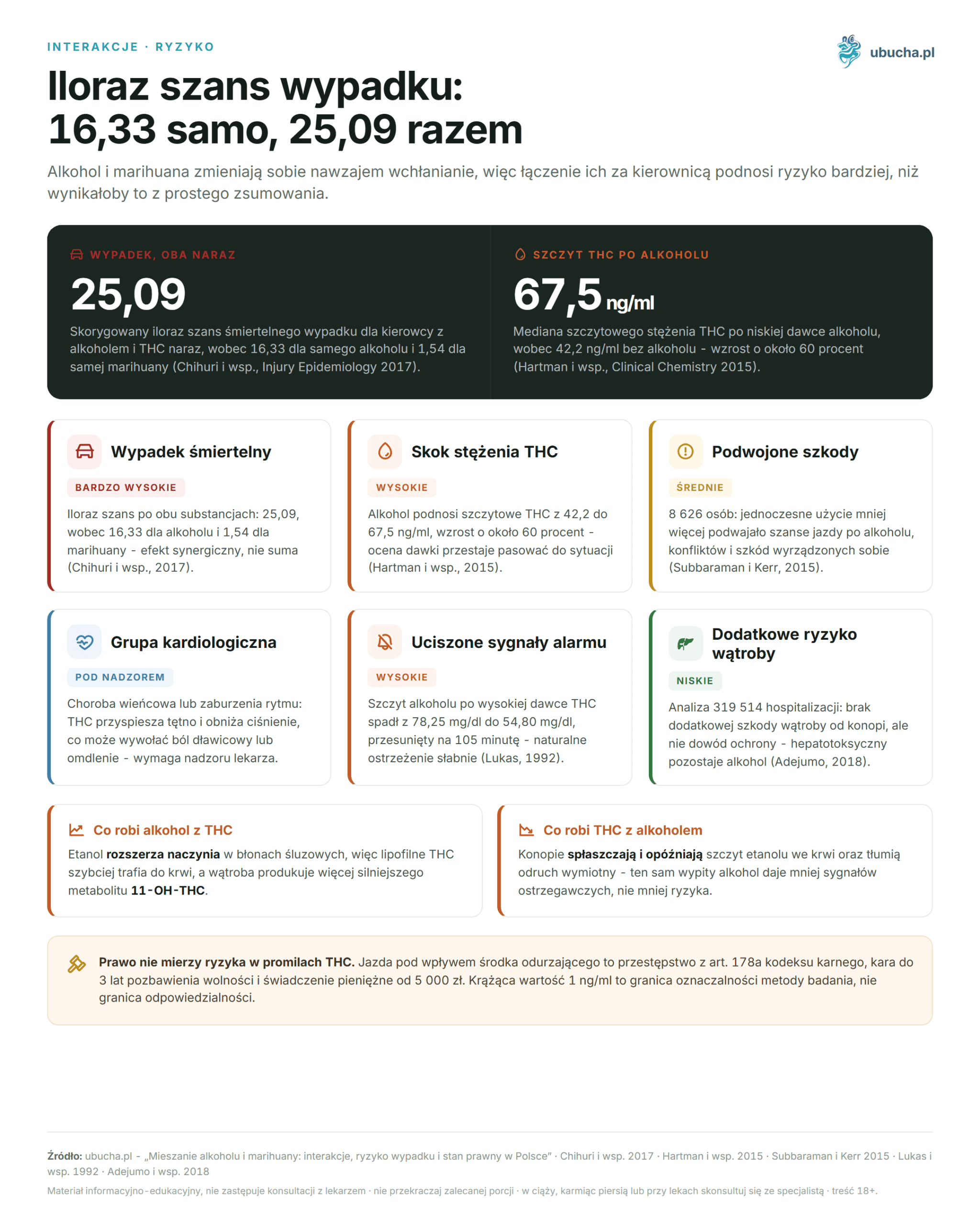
Alcohol raises the peak THC concentration from marijuana from 42.2 to 67.5 ng/ml, and when driving after both substances simultaneously, the odds ratio for a fatal accident reaches 25.09. These are the two most commonly combined psychoactive substances, and people who use both usually do so in the same session, not separately. The problem is that the body does not treat them as two independent stimuli. Alcohol increases THC blood concentration, THC alters ethanol absorption rate and suppresses the vomiting reflex, and behind the wheel, both deficits multiply rather than add. In an American study of drivers who died in accidents, the odds of a fatal event after both substances together exceeded what would be expected from summing their separate contributions. This text compiles what actually results from controlled studies and accident data, separates it from repeated online myths, and shows how Polish law treats drivers after one and both substances simultaneously.
KEY INFORMATION
- Alcohol raises peak THC blood concentration from 42.2 to 67.5 ng/ml at a higher cannabis dose (Hartman et al., Clinical Chemistry 2015).
- Odds ratio for fatal accident: 1.54 after marijuana alone, 16.33 after alcohol alone, 25.09 after both simultaneously (Chihuri et al., 2017).
- Driving under the influence of an intoxicating substance is a crime under Article 178a of the Penal Code, punishable by up to 3 years.
- Simultaneous use doubles the odds of drunk driving and personal harm compared to drinking alcohol alone.
What is crossfading and why is it not just simple addition?
Crossfading is the simultaneous or closely timed use of alcohol and THC in one session. The name comes from audio mixing, where one track smoothly transitions into another. Pharmacologically, it means something else: the two substances alter each other’s absorption and metabolism, so the effect is not the sum of two separate states.
Ethanol acts on the GABA system and inhibits glutamatergic transmission. It causes disinhibition at low concentrations and sedation at higher ones. THC binds to CB1 receptors and modulates dopamine, glutamate, and GABA release in the cortex and nucleus accumbens. Both substances have biphasic effects, meaning small doses act differently than large ones, and both impair the ability to assess one’s own state. This last point is important because a person in such a state judges their fitness using the very tool that is impaired.
The literature distinguishes two patterns that colloquially merge into one. Simultaneous use means both substances in the same session with overlapping effects. Separate use means using both in the same period but on different occasions. The difference is not academic because only the first pattern triggers the pharmacokinetic interactions described below.
The scale of the phenomenon is not marginal. An analysis of two waves of the American National Alcohol Survey on 8,626 people showed that simultaneous use prevalence was nearly twice that of separate use, meaning people who use both usually do so at once (Subbaraman and Kerr, 2015). The same study showed that simultaneous use was associated with more frequent drinking and higher alcohol consumption. The causal direction is unresolved, but the direction matters: people who combine drink more, not less.
Does alcohol really increase THC blood concentration?
Yes, and this is one of the best-documented phenomena on the topic. After drinking alcohol, the same cannabis dose yields higher plasma THC concentration and faster onset. This was measured under controlled, randomized, placebo conditions, not just user reports.
The first strong data were published by Lukas and Orozco. Volunteers smoked a joint after placebo or ethanol doses of 0.35 or 0.7 g/kg body weight. In many dose combinations, though not all, after alcohol subjects detected cannabis effects faster, reported more euphoria episodes, and had higher plasma THC concentrations than after placebo. The authors cautiously attributed this to increased THC absorption (Lukas and Orozco, Drug and Alcohol Dependence 2001).
Fourteen years later, Hartman’s team repeated the measurement for vaporization and provided specific numbers. Thirty-two cannabis users drank placebo or a low alcohol dose targeting about 0.065 percent peak breath concentration, then ten minutes later inhaled 500 mg placebo or cannabis with 2.9 or 6.7 percent THC. All six combinations were completed by nineteen participants, on whom the medians below are based.
| Condition | Median peak THC | Median peak 11-OH-THC |
|---|---|---|
| Cannabis 2.9%, no alcohol | 32.7 ng/ml | 2.8 ng/ml |
| Cannabis 2.9%, with alcohol | 35.3 ng/ml | 3.7 ng/ml |
| Cannabis 6.7%, no alcohol | 42.2 ng/ml | 5.0 ng/ml |
| Cannabis 6.7%, with alcohol | 67.5 ng/ml | 6.0 ng/ml |
The differences were statistically significant, and the authors considered them a probable explanation for the stronger impairment observed after the combination (Hartman et al., Clinical Chemistry 2015). The median increase from 42.2 to 67.5 ng/ml after a low alcohol dose is about 60 percent.
Why is THC concentration higher after alcohol?
The increase is mainly due to faster absorption, not slower elimination. Ethanol dilates blood vessels in mucous membranes and increases blood flow in airways and the gastrointestinal tract. Lipophilic THC then passes into the blood more efficiently and reaches its peak faster.
The second part concerns the liver. THC is metabolized there by cytochrome P450 isoenzymes to 11-hydroxy-THC, a psychoactive metabolite stronger than the parent compound. In Hartman’s study, 11-OH-THC concentrations were higher in every alcohol variant, as shown in the table above. This is especially relevant for oral products, where 11-OH-THC naturally contributes more than after inhalation.
It is worth noting the effect was uneven. With weaker cannabis, the median peak rose only from 32.7 to 35.3 ng/ml; with stronger cannabis, from 42.2 to 67.5 ng/ml. Individual variability was huge: in the stronger cannabis plus alcohol variant, single measurements ranged from 18.1 up to 210 ng/ml. In other words, the stronger the material, the greater the alcohol addition, and the less predictable the result for a given person.
The practical consequence is simple and unpleasant. A person who knows their usual dose gets a clearly higher peak from the same portion after alcohol, and faster. The subjective sense of control is based on experience from sessions without alcohol, so it no longer fits the situation. The variability in Hartman’s results also shows that even the same dose in two people yields concentrations differing by an order of magnitude, so transferring someone else’s experience to oneself fails even more easily.
What does THC do to alcohol concentration and the vomiting reflex?
The direction is opposite to intuition. Cannabis does not raise blood alcohol concentration but lowers it and delays its peak. This does not mean less risk because the amount consumed remains the same, and the body receives misleading feedback.
The measurement comes from Lukas et al. 1992. Fifteen healthy men were randomly assigned to one of three cannabis groups: placebo, low dose, or high dose. Each drank ethanol in three different doses on separate days and smoked a cigarette half an hour after starting drinking. After 0.7 g/kg ethanol, plasma concentration rose steeply, peaking at 78.25 mg/dl after 50 minutes. In the group smoking high-THC cannabis after alcohol, the peak was only 54.80 mg/dl and shifted to 105 minutes (Lukas et al., Neuropsychopharmacology 1992). Alcohol absorbed more slowly but did not disappear.
The second mechanism concerns vomiting. Cannabinoids’ antiemetic effects have been studied for a long time, but conclusions are more cautious than popular images suggest. A 2015 Cochrane review covered 23 randomized studies and summarized that cannabis-based preparations “may be useful” for refractory nausea and vomiting after chemotherapy, noting low evidence quality for most outcomes. All included studies were from 1975-1991, and none compared cannabinoids with newer antiemetics like ondansetron (Smith et al., Cochrane Database 2015). Vomiting from alcohol excess is a defense mechanism limiting further absorption. Suppressing this reflex while ethanol concentration rises more slowly creates a system where two natural warning signals weaken simultaneously. This is mechanistic reasoning, not a clinical poisoning study result, and should be treated as such.
Does the order of consumption change the risk?
The order changes which mechanism acts first but does not provide a safe variant. Alcohol before cannabis raises THC peak and accelerates onset. Cannabis before or during alcohol flattens and delays the ethanol curve and suppresses the vomiting reflex.
The popular online claim that reversing the order is safer has no data support. None of the studies above directly compared acute poisoning incidence in both orders. What can be said from data concerns simultaneity, not sequence: in the National Alcohol Survey, simultaneous use roughly doubled the odds of drunk driving, social harms, and self-inflicted harms compared to alcohol alone (Subbaraman and Kerr, 2015).
While editing this text, we noticed something easy to miss when skimming abstracts. In Lukas’s 1992 protocol, volunteers drank first and smoked 30 minutes later; in Hartman’s, alcohol was given 10 minutes before inhalation. Abstracts do not describe the reverse order, cannabis before drinking. All comparative knowledge about order is thus based on one of two possible scenarios, and the other is known mainly from user reports.
Advice about “proper order” circulating on Polish forums thus stems from folklore, not measurement. None of the original studies tested sequence as an independent variable. Such advice should be read as folklore, not protocol.
How much does accident risk increase after alcohol and marijuana together?
Very clearly, and it is not a matter of individual tolerance. A U.S. case-control study compared 1,944 drivers who died in accidents with 7,719 roadside survey drivers. The adjusted odds ratio for fatal accident was 25.09 for those positive for both substances, versus 16.33 for alcohol alone and 1.54 for marijuana alone.
| Driver test result | Adjusted odds ratio | 95% confidence interval |
|---|---|---|
| Marijuana positive, alcohol negative | 1.54 | 1.16 to 2.03 |
| Alcohol positive, marijuana negative | 16.33 | 14.23 to 18.75 |
| Both substances positive | 25.09 | 17.97 to 35.03 |
This is also visible in raw percentages before modeling. Among drivers who died, both substances were detected in 8.9 percent, and among roadside-tested drivers in 0.8 percent. For marijuana alone, the ratio was 12.2 versus 5.9 percent; for alcohol alone, 57.8 versus 7.7 percent. The combination is thus rare in traffic but overrepresented among victims.
The authors described this as a positive synergistic effect on an additive scale, meaning risk after both substances exceeds what would be expected from summing their separate contributions (Chihuri et al., Injury Epidemiology 2017). A similar conclusion was reached earlier by Ramaekers et al.: combined THC and alcohol use caused severe cognitive and psychomotor impairment in experimental studies and sharply increased accident risk in epidemiological analyses (Ramaekers et al., 2004). A separate European case-control study comparing 337 drivers after accidents with 2,726 population drivers identified alcohol and combinations of alcohol with drugs or medications as the most frequently detected substances posing the greatest traffic risk, both in risk magnitude and prevalence (Kuypers et al., PLoS One 2012). The highest single risk in that set was for stimulant and depressant combinations, not alcohol-cannabis mixtures.
Do experience and tolerance protect against impaired driving?
Not to a degree you can rely on. Sewell et al.’s review describes an interesting mechanism: people after cannabis alone are more aware of impairment and compensate effectively with various driving strategies. Alcohol removes this ability. The review also notes the opposite pattern of impairment for the two substances: cannabis more strongly disrupts automated functions, alcohol those requiring conscious control.
The authors state that combining marijuana with alcohol causes impairment at doses that alone would be insignificant, and the risk of driving under the influence of both exceeds the risk of each alone (Sewell et al., American Journal on Addictions 2009). Alcohol removes awareness of impairment, which was the basis for compensation. THC tolerance built over years by regular users affects perceived effects, not driving ability, and does not cover alcohol’s influence.
It is worth being honest about simulator data. In Hartman’s study on the University of Iowa National Driving Simulator, completed by eighteen participants, blood THC concentrations of 8.2 and 13.1 ng/ml increased lane weaving similarly to blood alcohol concentrations of 0.05 and 0.08 g/210 l. Effects of both substances were additive, not synergistic: 5 ng/ml THC with 0.05 g/210 l alcohol produced lane variability similar to 0.08 g/210 l alcohol alone (Hartman et al., Drug and Alcohol Dependence 2015). Comparing these two evidence lines, we noticed a discrepancy worth naming: a single driving simulator parameter sums linearly, while real fatal accident odds, where divided attention, situation assessment, and reaction time matter, increase supra-additively.
What penalty does one face in Poland for driving after alcohol and marijuana?
Driving under the influence of an intoxicating substance is a crime in Poland, not an offense. The basis is Article 178a paragraph 1 of the Penal Code, which for driving a motor vehicle while intoxicated or under the influence of an intoxicating substance provides for imprisonment up to 3 years (Penal Code, consolidated text Dz.U. 2025 item 383). The court also imposes a driving ban and a financial penalty of at least 5,000 PLN, pursuant to Article 43a paragraph 2 of the same code.
| Situation | Qualification | Legal basis |
|---|---|---|
| Alcohol 0.2 to 0.5 per mille | State after use, offense | Article 87 Code of Offenses |
| Alcohol above 0.5 per mille | Intoxicated state, crime | Article 178a paragraph 1 Penal Code |
| Under influence of intoxicating substance | Crime, up to 3 years imprisonment | Article 178a paragraph 1 Penal Code |
| Possession of cannabis herb other than fiber hemp | Crime, up to 3 years imprisonment | Article 62 paragraph 1 of the Act on Counteracting Drug Addiction |
For THC, the legislator has not set a numeric threshold analogous to per mille. The commonly cited 1 ng/ml value online is not a responsibility threshold but the detection limit of the method from the Minister of Health’s regulation of July 16, 2014; there is no saliva threshold in the regulation. The distinction between state after use and under influence is based on expert opinion, which assesses concentration together with symptoms and circumstances. A driver detected with both alcohol and THC is liable for one act, but the court considers both factors in sentencing. Possession is a separate matter. Cannabis herb other than fiber hemp is the aboveground part of plants where the sum of delta-9-THC and tetrahydrocannabinolic acid exceeds 0.3 percent dry weight; the threshold applies to the plant, not the finished product. Possession of such material is a crime under Article 62 paragraph 1 of the Act on Counteracting Drug Addiction, punishable by up to 3 years, and for significant amounts Article 62 paragraph 2 provides 1 to 10 years. For small amounts for personal use, Article 62a allows discontinuation of proceedings. We described this more in the guide on cannabis and CBD legality in Poland and the EU.
The same framework but with cannabidiol instead of THC is discussed in the text on CBD and alcohol, and the anxiety reaction after overdose in the text on bad trip. Legal hemp flower is collected in the flower category.
How to recognize greening out and how it differs from alcohol poisoning?
Greening out is an acute episode of malaise after THC, usually sudden with dominant autonomic reaction. It typically starts within minutes and resolves within half an hour to two hours. Alcohol poisoning develops more slowly and causes more uniform sedation.
| Feature | Greening out | Alcohol poisoning |
|---|---|---|
| Onset speed | Minutes | Gradual, over hours |
| Skin | Pale, cold, sweaty | Often flushed, warm |
| Pulse | Accelerated | Slowed or normal |
| Consciousness | Preserved, with strong anxiety | Progressive clouding |
| Duration | 30 to 120 minutes | Several to many hours |
After combining both substances, both pictures overlap and bedside differentiation loses meaning. The most common symptoms are sudden paleness, cold sweats, drooling, nausea and vomiting, dizziness worsening on standing, room spinning sensation, heart palpitations, anxiety or panic attack, slurred speech, and balance problems. In extreme cases, brief fainting occurs. The greatest danger is not fainting itself but vomiting in a person lying on their back.
There is another difference worth remembering when assessing the situation. Acute ethanol poisoning can be fatal and is common, so with the mixture, alcohol sets the real life threat boundary, even if symptoms frightening observers mainly come from cannabis. A separate risk group includes people with coronary disease or arrhythmias, where THC-induced heart rate acceleration and blood pressure drop may cause angina or fainting by a mechanism other than usual greening out.
When do symptoms require calling emergency services?
Number 112 is the right decision whenever breathing, consciousness, or repeated vomiting are involved. None of these situations resolve on their own and none can be assessed by appearance. Calling for help for a person after alcohol and cannabis does not expose them to liability for being under influence.
Call immediately if the person loses consciousness for more than a minute or two, cannot be awakened, has seizures, breathes fewer than eight times per minute or shallowly and irregularly, has bluish lips or fingers, vomits repeatedly, complains of chest pain, or has obvious heart rhythm disturbances.
Before help arrives, place the person on their side to prevent aspiration of vomit, ensure fresh air, give water in small sips only if conscious, and stay with them. Do not give coffee or energy drinks as they mask sedation without reducing poisoning. Do not give more alcohol, painkillers, or sleeping pills. Do not induce vomiting in someone with impaired consciousness and do not leave anyone sleeping on their back unattended.
Tell the dispatcher exactly what was taken, how much, and when. This is not a report but information that changes the team’s approach on site. Paramedics treat suspected ethanol poisoning differently than someone who also took a psychoactive substance or medications. Also provide chronic diseases and regular medications if known. Monitor breathing every few minutes and never leave the injured person alone even briefly.
Does regular mixing of alcohol and marijuana harm the liver?
The claim that the combination alone adds liver damage beyond alcohol lacks good support from human studies. The largest available analysis points in the opposite direction, though its design does not prove protection. Alcohol remains the established hepatotoxic factor.
Adejumo’s team analyzed 319,514 hospitalization records of adults with past or current alcohol abuse from the U.S. Nationwide Inpatient Sample. Among them, cannabis users had lower adjusted odds of alcoholic fatty liver, alcoholic hepatitis, cirrhosis, and hepatocellular carcinoma, with odds ratios of 0.55, 0.57, 0.45, and 0.62 respectively (Adejumo et al., Liver International 2018). These are cross-sectional hospital discharge data, so they do not resolve causality and are not an encouragement.
Mechanistically, there is a study where cannabidiol protected mice liver from steatosis caused by a single large alcohol dose by reducing oxidative stress and enhancing autophagy (Yang et al., Free Radical Biology and Medicine 2014). This is an animal model with single exposure. There is no controlled human study equivalent and no basis to conclude it protects the liver of a drinking person.
An earlier version of this article cited an alleged cohort showing higher liver damage rates in people combining both substances. We checked the identifier: it led to a study in a completely different field, and no such results were found in Europe PMC or Crossref. The claim was removed and the section rewritten based on actual data. The reasonable conclusion is cautious: the combination has no proven additional hepatotoxic effect, but that does not mean it is protective, and the amount of alcohol consumed remains the variable that really determines liver condition.
How does mixing affect mental health and daily functioning?
The best-documented harms concern behavior, not brain biochemistry. Simultaneous use roughly doubled the odds of drunk driving, conflicts, work problems, and self-inflicted harm compared to alcohol alone in a U.S. general population sample (Subbaraman and Kerr, 2015).
A diary analysis of 341 students using both substances separated their roles. Most acute consequences - injuries, memory lapses, aggressive behavior - were linked to alcohol amount, not cannabis addition. However, the probability of driving under influence was higher on days with both substances than alcohol alone (Drohan et al., Journal of Studies on Alcohol and Drugs 2023). In other words, cannabis does not add new harms but raises the chance of the one that ends in court or worse.
People predisposed to psychotic disorders, where high THC doses worsen symptoms, and those taking central nervous system drugs are treated separately. Mixing alcohol and cannabis with benzodiazepines, opioids, or sleeping pills risks deeper respiratory depression than any factor alone. The current state of knowledge on cannabis and mental health is collected in a separate research review.
What should patients treated with medical cannabis know?
For a patient with a prescription, alcohol is not a neutral therapy addition but a factor changing the effective dose. Since ethanol raises peak THC concentration, the dose agreed with the doctor no longer corresponds to what reaches receptors. The therapeutic effect becomes unpredictable in both directions.
There is also the context of other medications. Oncology and neurology patients usually take drugs metabolized in the liver by the same pathway competed for by THC and ethanol. This group includes antiepileptics and anticoagulants. Some cytostatics and antidepressants behave similarly. Adding alcohol increases concentration variability unpredictably.
There is also a purely practical reason. Medical cannabis is legal on prescription in Poland, but driving under THC influence remains a crime regardless of source. The prescription is not a defense. A patient who drinks loses the simplest control tool: their own assessment of when the drug’s effect has worn off.
If alcohol consumption occurred, it is worth informing the treating physician, especially if new symptoms like nausea, dizziness, or sleep worsening appear. The doctor may adjust the dose, order liver parameter tests, or shift dosing time. Self-adjusting dose after a failed evening usually worsens the situation.
Does CBD change the risk profile with alcohol?
Not enough to rely on. Cannabidiol does not strongly stimulate CB1 receptors and does not cause intoxication comparable to THC, but that does not make it a safeguard when drinking. It does not lower blood alcohol concentration, shorten metabolism time, or change legal assessment of drivers.
Human data are sparse. The above-cited Yang study concerned mice and single alcohol exposure, not regular drinkers. Some studies on cannabidiol in alcohol use disorders examined reducing alcohol craving in patients in treatment, a very different situation than an evening with drinks. None justify using cannabidiol while drinking.
There is also the issue of interactions. Cannabidiol is metabolized in the liver and can inhibit breakdown of other drugs; a documented example is clobazam, and separately cannabis effects overlapping with central nervous system depressants are described (Lucas et al., British Journal of Clinical Pharmacology 2018). Some fiber hemp products also contain trace THC amounts, which at sufficiently high doses may appear in blood tests. We return to this in the text on CBD and alcohol. None of the products in our store are intended for use with alcohol.
What does this mean in practice?
Three things can be said from data without reservations. Alcohol raises peak THC concentration and accelerates onset. Cannabis flattens and delays the alcohol curve and suppresses the vomiting reflex. Behind the wheel, both deficits produce risk higher than the sum of separate risks, visible in the odds ratio 25.09 versus 16.33 and 1.54.
From the same data set, what not to do is clear. You cannot choose a “safe order” because sequence was not tested as an independent variable. You cannot rely on your own sobriety feeling because alcohol removes the self-awareness that allowed compensation after cannabis alone. You also cannot simply wait it out until morning by a simple rule because THC blood concentration persists in some people many hours after subjective effects subside, as discussed in the text on THC persistence in the body.
If mixing substances becomes routine or affects work, relationships, and health, help is available without referral. It is provided by centers such as MONAR, the Anonymous Alcoholics community, and addiction treatment clinics within the NFZ.
Frequently Asked Questions
Does alcohol really increase THC blood concentration?
Yes. In the 2015 study by Hartman et al., the median peak THC concentration after a higher dose of vaporized cannabis was 42.2 ng/ml without alcohol and 67.5 ng/ml after a low dose of alcohol. Lukas and Orozco described the same effect after smoking a joint as early as 2001.
How much does the risk of an accident increase after using alcohol and marijuana together?
In a 2017 American case-control study, the adjusted odds ratio for a fatal accident was 1.54 for marijuana alone, 16.33 for alcohol alone, and 25.09 for both substances simultaneously. The authors described this as a synergistic effect on an additive scale.
What penalty does one face in Poland for driving under the influence of marijuana?
Driving a motor vehicle under the influence of an intoxicating substance is a crime under Article 178a paragraph 1 of the Penal Code, punishable by up to 3 years imprisonment. The court also imposes a driving ban and a financial penalty. A milder state after use is an offense under Article 87 of the Code of Offenses.
Do tolerance and experience protect against impaired driving?
Not to a reliable extent. The 2009 review by Sewell et al. describes that people after cannabis alone often compensate for impairment by driving more cautiously, but adding alcohol negates these strategies. Impairment then appears at doses that alone would be insignificant.
How to recognize greening out and what to do then?
Typical symptoms include sudden paleness, cold sweats, nausea, dizziness, heart palpitations, and anxiety, usually within minutes. Provide fresh air, place the person on their side, give water in small sips, and stay with them. Call 112 if there is loss of consciousness, seizures, or shallow breathing.
Does mixing alcohol and marijuana damage the liver?
Evidence for additional liver damage from the combination alone is weak. An analysis of 319,514 hospitalizations of alcohol abusers showed even lower odds of alcoholic cirrhosis in cannabis users. These are cross-sectional data and do not prove protection. Alcohol remains hepatotoxic.
Does CBD make drinking alcohol safer?
No. Protective effects of cannabidiol on the liver were shown in mice in an acute alcohol poisoning model, not in humans. CBD does not lower blood alcohol concentration, shorten its metabolism time, or change legal responsibility for drunk driving.
Are THC edibles safer than smoking when combined with alcohol?
No. After ingestion, effects build up more slowly than inhalation, making it easy to take another dose before the first peak. In Hartman’s study, alcohol simultaneously increased 11-hydroxy-THC, a stronger metabolite formed in the liver. The combination is harder to control than smoking alone, increasing the risk of acute poisoning.
Looking for an evening ritual without alcohol? Check out the hemp teas category in our store.
This article is informational and educational and does not constitute medical or legal advice. Mixing alcohol and cannabis increases health and legal risks. In Poland, possession of cannabis herb other than fiber hemp is a crime under the Act of July 29, 2005 on Counteracting Drug Addiction, and driving under the influence of an intoxicating substance is a crime under Article 178a of the Penal Code. Do not combine alcohol or cannabinoids with antidepressants, benzodiazepines, opioids, or other liver-metabolized drugs. In case of acute poisoning, call 112. Addiction help: MONAR, Anonymous Alcoholics, Alcohol Problem Helpline 801 033 242.
Author: Michał Waluk · Published: 2026-05-11 · Updated: 2026-08-24