
CBD and Alcohol: Can They Be Combined and What Happens to the Body
Can CBD be combined with alcohol? We check two trials in humans from 1979, data on the liver and drowsiness, and claims without support in publications.
A glass of wine with dinner, and next to it, daily drops of CBD oil. The question of the safety of such a combination often arises, and the answers online can be surprisingly confident: sometimes CBD is said to enhance alcohol, sometimes to protect the liver from it, and sometimes to cure hangovers. We checked each of these claims in source publications. Most are based on studies in mice or on works that say something different than what is attributed to them. There are two trials in which people received CBD along with alcohol, both from 1979, and the result of one of them is sometimes cited in the opposite way to what was actually measured. Below, we separate what has been verified from what sounds credible but has not been studied.
KEY INFORMATION
• In both trials where people received CBD along with alcohol, the combination did not impair performance more than alcohol alone (Consroe et al., 1979, ten people; Belgrave et al., 1979, fifteen people).
• Alcohol is primarily metabolized by alcohol dehydrogenase, not cytochrome P450, so the effect of CBD on CYP enzymes does not affect ethanol metabolism.
• Liver protection from alcohol is a result from mice. In humans, CBD alone at high doses raised aminotransferase activity.
• Neither in the literature nor in the clinical trial registry is there a study on CBD and hangovers.
• In two randomized trials in people with addiction, CBD was not more effective than placebo.
Is it permissible to combine CBD and alcohol?
There is no regulation or warning prohibiting this, but there are also no studies allowing this combination to be called verified. All direct knowledge about CBD and alcohol in humans is contained in two works from over forty years ago, conducted on ten and fifteen people. The rest is inference from mechanisms.
This distinction has practical significance. Warnings against combining CBD with alcohol repeated in guides do not stem from measurement, but from a reasonable assumption that two substances that depress the central nervous system may sum up. The assumption is sensible and argues for caution, but it should not be presented as a fact confirmed by studies, because it is not. The opposite is also true: the lack of evidence for the summation of effects is not evidence of safety.
However, there are situations where this combination is a bad idea regardless of the state of research:
- Driving, operating machinery, and any activity requiring reflexes. You should never drive after alcohol, and drowsiness after CBD adds risk to an already existing one.
- Taking medications that depress the central nervous system: benzodiazepines, sleeping pills, opioid painkillers, some antihistamines.
- Liver diseases and abnormal liver test results, as both substances burden the same organ.
- Pregnancy and breastfeeding, where neither of these substances has an established safety profile.
- Alcohol addiction treated pharmacologically, where any addition is decided by the attending physician.
To this list, there is a boundary set by the regulator. In a position from 2026, EFSA stated that the safety of cannabidiol cannot be established today in people under 25 years of age, in pregnant and breastfeeding women, and in those taking medications regularly. Alcohol does not facilitate anything in this assessment.
What have studies shown about CBD and alcohol in humans?
They have shown less than is attributed to them, and there are two. In the first, a randomized crossover trial, ten healthy volunteers, six men and four women, received in four sessions separated by a week placebo, CBD alone, alcohol alone, and alcohol with CBD. Adding CBD to alcohol changed little in the impairment picture.
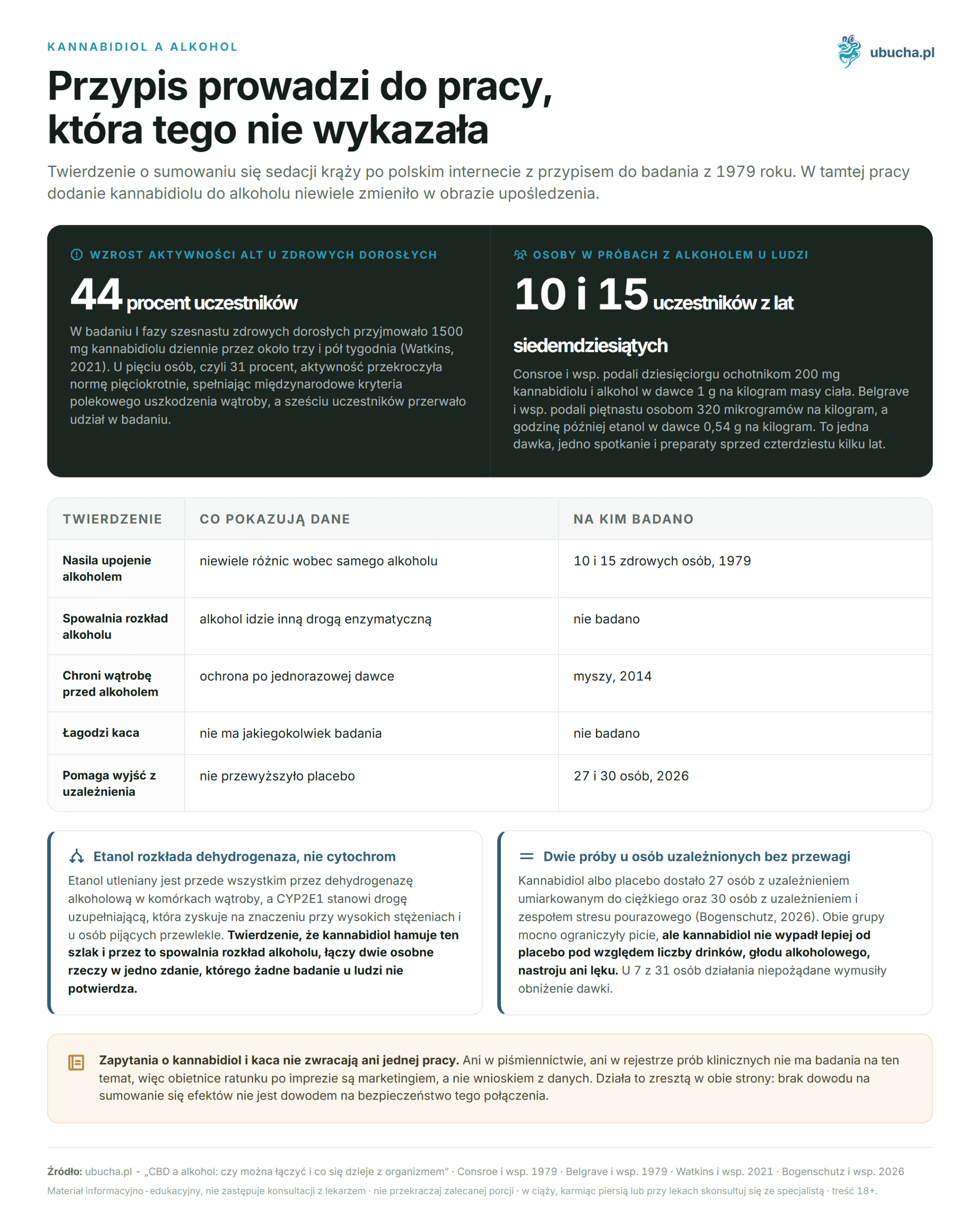
Details are important because they can be misrepresented. In the work Consroe et al. (Psychopharmacology, 1979), participants received 200 mg of CBD in a capsule and alcohol at a dose of 1 g per kilogram of body weight. They measured finger tapping speed, attention tests, differentiation ability, minute passage assessment, subjective feelings, and blood alcohol concentration with a breathalyzer. Compared to placebo, alcohol and alcohol with CBD impaired motor and psychomotor performance. CBD alone did not impair it at all.
Two results of this work are regularly reversed. First, between both sessions with alcohol, there were few differences, meaning CBD did not exacerbate the impairments caused by alcohol. Second, after alcohol with CBD, the blood alcohol concentration was significantly lower than after alcohol alone. The authors concluded that the lack of effect of CBD on performance extends to its interaction with alcohol.
The second work from the same year had similar results and is omitted in Polish guides. In the study Belgrave et al. (Psychopharmacology, 1979), fifteen volunteers received orally CBD at a dose of 320 micrograms per kilogram of body weight or placebo, and an hour later a drink with ethanol at a dose of 0.54 g per kilogram or placebo. Alcohol worsened the result of the factor linking psychomotor coordination with cognitive functions. CBD had no tangible effect either alone or in combination with alcohol.
The limitations are serious and do not allow for a green light. Ten and fifteen people, one dose, one meeting, preparations from the seventies, and no data on daily use. More importantly, the reduction in alcohol concentration is not visible in the second work: Belgrave administered CBD at a dose several times lower, and it did not change blood ethanol levels. One result against another, at different doses, is not a basis for anything.
Do CBD and alcohol sum up drowsiness?
Mechanically it is probable, but no one has measured it. Alcohol enhances the inhibitory effect of GABA and weakens the excitatory glutamate, thus directly depressing the central nervous system. Drowsiness is also among the documented side effects of CBD in clinical studies. The summation of these effects is therefore a real theoretical risk.
Data on drowsiness from CBD alone come from studies on epilepsy. In the trial Devinsky et al. (New England Journal of Medicine, 2017), 120 children and young adults with Dravet syndrome received CBD at a dose of 20 mg per kilogram of body weight daily or placebo. Drowsiness, fatigue, diarrhea, and abnormal liver test results occurred in the CBD group more often than in the placebo group. The doses used in supplements are many times lower than those in research, which does not eliminate individual differences.
On the side of the combination itself, the data are scant. The review Turna et al. (Alcoholism: Clinical and Experimental Research, 2019) sifted through 303 publications and qualified twelve, of which only three concerned healthy volunteers. It summarized them as follows: CBD was well tolerated and did not modify the subjective effects of alcohol. This agrees with the observations of Consroe and Belgrave, although all three are based on trials with a dozen participants.
We noticed while checking sources for this entry that the claim of additive sedation circulates in Polish internet with a reference to the work of Consroe, which did not demonstrate this. Caution remains justified, but the reference is false.
Does CBD slow down the breakdown of alcohol by cytochrome P450?
There is no basis to claim that. Ethanol is primarily oxidized by alcohol dehydrogenase in liver cells, not by cytochrome P450 enzymes. Inhibition of CYP by CBD concerns medications, not alcohol, and it is the medications that are the real problem in this system.
The pathways of alcohol metabolism are overviewed in a review by Cederbaum (Clinics in Liver Disease, 2012). The primary pathway is alcohol dehydrogenase. CYP2E1 constitutes a supplementary pathway that gains significance at high alcohol concentrations and in chronic drinkers, as it becomes induced then. The claim that CBD inhibits CYP2E1 and thus slows down alcohol breakdown combines two separate things into one sentence, which no study in humans confirms.
Documented interactions of CBD look different. The review Na and Lee (Biomolecules, 2025) lists the increase in the concentration of the active metabolite of clobazam due to the effect on CYP2C19 and the increase in aminotransferase activity with concomitant use of valproate. The risk therefore concerns a person who takes a medication metabolized this way, adds CBD to it, and then also alcohol. The third element here is the medication, not ethanol itself.
If you are taking medications regularly, talking to your doctor or pharmacist before reaching for CBD is standard caution. You can find more about these interactions in the entry CBD for seniors and interactions with medications.
Does CBD protect the liver from alcohol?
In humans, there is no evidence for this, and available data go in the opposite direction. A protective effect was described in mice after a single alcohol poisoning. In humans, CBD alone at research doses raised aminotransferase activity, thus burdening the liver instead of relieving it.
The work that references this thread is Yang et al. (Free Radical Biology and Medicine, 2014). CBD prevented acute fatty liver in mice after a large dose of alcohol by reducing oxidative stress, blocking the activation of the JNK MAPK pathway, and increasing autophagy. This is a result from rodents, after a single exposure, with no equivalent in humans.
On the human side, the picture is the opposite. In a phase I study Watkins et al. (Clinical Pharmacology and Therapeutics, 2021), sixteen healthy adults took 1500 mg of CBD daily for about three and a half weeks. In seven people, or 44 percent, ALT activity exceeded the upper limit of normal. In five people, or 31 percent, it exceeded it fivefold, meeting international criteria for drug-induced liver injury. Increases began in the second to fourth week, and six participants discontinued participation in the study.
The conclusion is simple. Treating CBD as a liver shield while drinking adds a second burden to the same organ. The only way to protect the liver from alcohol remains drinking smaller amounts or abstaining.
Does CBD help with alcohol addiction?
Not yet. The mechanistic premises are sensible, and the results in rodents are encouraging, but two randomized trials in people with addiction did not show an advantage of CBD over placebo. This is the best-studied direction in this entire topic, and it has ended with a negative result.
The starting point is the role of the endocannabinoid system in drinking. The review Pava and Woodward (Alcohol, 2012) gathered data showing that the CB1 receptor co-creates the motivational and rewarding properties of ethanol, and chronic drinking alters endocannabinoid levels and CB1 expression in structures related to addiction. The work concerns the entire system, not just CBD.
The systematic review by Turna et al. from 2019 found twelve studies meeting the criteria: eight on rodents, three on healthy volunteers, and one on cell culture. In rodents, CBD limited self-administration of alcohol, seeking it after exposure to cues, and withdrawal seizures. The authors directly pointed out the lack of studies in humans as the main limitation.
This lack has begun to be supplemented. In two parallel trials Bogenschutz et al. (Alcohol, Clinical and Experimental Research, 2026), CBD or placebo was given to 27 people with moderate to severe addiction (600 mg daily for four weeks, then 1200 mg for another four) and 30 people with addiction and post-traumatic stress disorder (600 mg daily for six weeks). Both groups significantly reduced drinking, but CBD did not perform better than placebo in terms of the number of drinks, alcohol cravings, mood, or anxiety. In 7 out of 31 people, or 22.6 percent, adverse effects forced a dose reduction.
The two experiments from 1979, on which most of what is known stands, are broken down in a separate text about CBD and alcohol, along with a conversion of the ethanol doses given there to drinks.
Which claims about CBD and alcohol are unfounded?
Four are most often repeated. The table below compares them with the works they refer to and the species on which the study was conducted. The difference between mouse and human and between a review and a clinical trial determines whether a statement can even be made.
| Claim | What the data show | On whom it was studied |
|---|---|---|
| CBD enhances alcohol intoxication | Little difference compared to alcohol alone in both trials | 10 and 15 healthy people, 1979 |
| CBD slows down alcohol breakdown | No studies, alcohol goes a different enzymatic route | not studied |
| CBD protects the liver from alcohol | Protection from fatty liver after a single dose | mice, 2014 |
| CBD alleviates hangovers | No studies whatsoever | not studied |
A separate issue is replacing evening alcohol with CBD oil. The idea is sometimes marketed as a cost-free exchange, but we found no comparisons of both options in the literature, and the safety profile of CBD with long-term use is not empty. A defensible statement is more cautious: it is unknown whether such a substitution offers any benefits.
A pattern repeats here. A result from mice or cell culture travels to the advisory text without mentioning the species, loses the conditions of the experiment along the way, and begins to sound like advice. Checking who was studied and how many people were in the trial is enough to sift out most of these claims. If you are looking for answers on how much and when to take, we have gathered it in the entry CBD dosing step by step.
Frequently Asked Questions
Can you drink alcohol while taking CBD oil?
There is no prohibition, but there is also no data that would allow this combination to be called tested. Two trials in humans from 1979 (Consroe et al., ten people; Belgrave et al., fifteen people) did not show that CBD exacerbated impairment after alcohol. If you are taking medications regularly, ask your doctor instead of guessing.
Does CBD raise blood alcohol levels?
In the study by Consroe et al. from 1979, it was the opposite: after alcohol given together with CBD, the level measured by a breathalyzer was significantly lower than after alcohol alone. The second trial from the same year, Belgrave et al., at a dose several times lower, found no effect on ethanol levels.
Does CBD protect the liver from alcohol?
Not in humans. Protection against fatty liver was described in mice after a single alcohol poisoning (Yang et al., 2014). In a phase I study of sixteen healthy adults, CBD alone raised ALT activity above normal in seven people (Watkins et al., 2021).
Does CBD help with hangovers?
There are no studies that have tested this. Queries about cannabidiol and hangovers return not a single paper in Europe PMC, nor a single registered study in the clinical trial registry. Promises of relief after a party are therefore marketing, not conclusions from data. Hydration, sleep, and time help with hangovers.
Does CBD treat alcohol addiction?
No. The review by Turna et al. from 2019 found twelve studies, eight on rodents, and only three on humans. In two randomized trials in people with addiction, CBD was tolerated but did not outperform placebo in reducing drinking, alcohol cravings, or anxiety (Bogenschutz et al., 2026).
Can you drive after taking CBD and alcohol?
You should never drive after alcohol, regardless of CBD. Drowsiness is a documented side effect of CBD in clinical studies (Devinsky et al., 2017), and alcohol depresses the central nervous system. There is no study in the clinical trial registry that measured the combination of CBD with alcohol in drivers.
If you are looking for products in this category, check out the section hemp oils.
This article is for informational and educational purposes only and does not constitute medical advice. Before starting to use cannabis or CBD for therapeutic purposes, consult your doctor, especially if you are taking other medications, are pregnant, or breastfeeding.
Author: Michał Waluk · Published: 2026-06-22 · Updated: 2026-08-24