
How long does marijuana stay in the body? Pharmacokinetics of THC and drug tests
We check how long THC remains in the blood, urine, saliva, and hair, what thresholds tests use, and what the consequences of a positive result are in Poland.
The question of how long marijuana stays in the body is one of the most frequently asked by patients, drivers, and those preparing for a drug test. The answer is never simply “X days” because THC has a unique pharmacokinetics: the active substance disappears from the blood within a maximum of one day, while its inactive metabolite can linger in urine for weeks. In this step-by-step guide, we show how the body absorbs, metabolizes, and eliminates THC, and what thresholds are used in urine, blood, saliva, and hair tests. We have verified each cited study against its actual content, so some numbers differ from those circulating in other online sources. We also explain why popular detox methods lack clinical data support and what Polish law really says about a positive test.
KEY INFORMATION
• THC is a highly lipophilic substance with a distribution volume of about 10 l/kg and a protein binding of 95-99%, which explains its storage in fat tissue (Grotenhermen, Clinical Pharmacokinetics, 2003)
• A urine test detects the inactive metabolite THC-COOH, not THC itself, which is why it can be positive long after any effect has subsided
• A blood test measures active THC and best reflects the current influence of the substance, but in chronic users, trace concentrations can persist for weeks
• No supplement or detox drink scientifically accelerates the documented removal of THC from the body; only time and abstinence work
What is THC and why does it stay in the body so long?
Delta-9-tetrahydrocannabinol (THC) is the main psychoactive cannabinoid in cannabis, and its exceptionally high lipophilicity determines how long the body retains it. The molecule (C21H30O2, mass 314.47 g/mol) has a terpenophenolic structure with a long pentyl chain, is practically insoluble in water (2.8 mg/l), and is very well soluble in fats. In plasma, THC binds 95-99% to lipoproteins and albumin, and its distribution volume reaches about 10 l/kg body weight (Grotenhermen, Clinical Pharmacokinetics, 2003). This fundamentally distinguishes THC from alcohol, which distributes evenly in body water and does not store in fat.
Fat tissue acts as a reservoir: THC accumulates in it and is released back into the blood slowly and irregularly, especially during lipolysis induced by fasting, intense exercise, or weight loss. In regular cannabis users, this delayed release explains why metabolites can be detected in urine for many weeks after the last use, even though the active THC itself disappears from the blood much faster. In a classic study by Ellis et al. on 86 chronic users at a threshold of 20 ng/ml, the average time to a permanently negative urine result was 27 days, with positive results persisting for up to 46 additional days from the time of observation, and in some individuals, the process extended to 77 days (Ellis, Clinical Pharmacology & Therapeutics, 1985). From a practical point of view, this means that two people smoking the same amount of cannabis on the same day may have completely different test results a week later if they differ in body fat percentage.
How is THC absorbed? Inhalation vs oral intake
The bioavailability of THC primarily depends on the route of administration. When smoking or vaporizing, THC crosses the alveolar-capillary barrier within seconds, and plasma concentration peaks (usually 50-200 ng/ml) within 3-10 minutes. Classic pharmacokinetic reviews of cannabinoids report a very wide range of bioavailability for the inhalation route, depending on the study and smoking technique, from a few to over fifty percent, with more frequently cited estimates around 8-24% (Huestis, Chemistry & Biodiversity, 2007).
After oral ingestion, THC passes through the intestinal wall and enters the portal vein to the liver, where intense first-pass metabolism occurs. This delays the peak concentration to 1-4 hours, and bioavailability drops to about 4-20% (Huestis, Chemistry & Biodiversity, 2007). At the same time, more of the highly psychoactive metabolite 11-OH-THC is produced, which explains why the same dose ingested works more intensely and lasts longer than when smoked. From the perspective of a drug test, this has practical significance: in a person tested shortly after consuming a THC product, the concentration in the blood is still rising, so the result may differ from what will appear a few hours later. The same mechanism applies to CBD oil taken orally: swallowing oil wastes most of the dose for the same reason that eating THC works more strongly than smoking.
Sublingual formulations, such as Sativex used in spasticity therapy in multiple sclerosis, partially bypass the first-pass effect, with peak concentration occurring after 45-120 minutes. This is an intermediate route between rapid inhalation absorption and slow but more predictable oral absorption.
How does the body metabolize THC? The role of CYP2C9 and CYP3A4
THC is primarily metabolized in the liver by cytochrome P450 isoenzymes. Studies on human liver microsomes show that CYP2C9 is primarily responsible for hydroxylation to 11-hydroxy-THC (11-OH-THC), while CYP3A4 catalyzes the remaining oxidation pathways of the molecule (Watanabe, Life Sciences, 2007). 11-OH-THC is psychoactive and can be as potent as the parent compound, and a higher proportion of it relative to THC in plasma often indicates the oral route of administration, which is significant in forensic expertise reconstructing the circumstances of use. This same hydroxylation step explains why edible forms of CBD act differently than smoking: we write more about this in the article on the 11-hydroxy metabolite and the potency of edible cannabis forms.
In the next stage, 11-OH-THC is oxidized to 11-nor-9-carboxy-THC (THC-COOH), which is pharmacologically inactive but crucial in laboratory diagnostics, as this is the metabolite detected by most immunochemical urine tests. THC-COOH is further conjugated with glucuronic acid, forming a water-soluble glucuronide excreted in urine.
The rate of this process is strongly dependent on genetics. A study by Sachse-Seeboth et al. on 43 healthy volunteers after oral administration of THC showed that in homozygotes CYP2C9*3/*3, the area under the concentration curve (AUC) of THC was about three times higher, and the AUC of the THC-COOH metabolite was 70% lower than in individuals with the typical CYP2C9*1/*1 variant (Sachse-Seeboth, Clinical Pharmacology & Therapeutics, 2009). In other words, two individuals of identical weight and frequency of use may have distinctly different exposures to THC and different elimination times solely due to genetic variant.
How long is THC eliminated from the body?
The elimination of THC and its metabolites occurs mainly through feces, over 65% of the dose, and urine, about 20% (Huestis, Chemistry & Biodiversity, 2007). A significant portion of the metabolites first enters the bile and small intestine, where gut bacteria partially deglucuronidate them, allowing for reabsorption and prolonging the presence of the substance in the body. This circulation also partially explains why the concentration of THC-COOH in urine can temporarily increase instead of systematically decreasing, despite the absence of new use. The same work indicates a biphasic elimination of THC from plasma: a short distribution phase measured in minutes and a slower terminal phase, which depending on the frequency of use lasts from about a day to several days.
In urine, THC appears almost exclusively as the inactive glucuronide THC-COOH, and free THC is negligible. Therefore, classic urine tests do not measure the current influence of the substance: a positive result indicates past use, not current impairment of psychomotor functions.
Other routes of elimination have a marginal quantitative share but practical diagnostic significance. Sweat contains trace amounts of THC itself, without THC-COOH, and is sometimes used in continuous clinical monitoring via patches. Hair accumulates THC and its metabolites from the bloodstream during the growth of the hair follicle, allowing for retrospective analysis of exposure from weeks or months ago. Saliva mainly contains THC from direct contact with the oral cavity during inhalation, not from blood filtration, which is why its detection window is shorter than in urine.
How long is marijuana detectable in urine?
The urine test is the most common method for detecting cannabis in Poland and worldwide, and the length of the detection window primarily depends on the frequency of use and the laboratory cutoff threshold. SAMHSA (Substance Abuse and Mental Health Services Administration) defines the standard cutoff threshold for a screening test at 50 ng/ml THC-COOH, and for a confirmatory test using GC-MS or LC-MS/MS at 15 ng/ml; Polish laboratories usually apply the same reference values (SAMHSA Mandatory Guidelines, 2017). The choice of threshold has practical significance: an employer using a screening threshold of 50 ng/ml will see a negative result faster than a forensic laboratory using a lower confirmatory threshold, even though both institutions are testing a comparable sample from the same person.
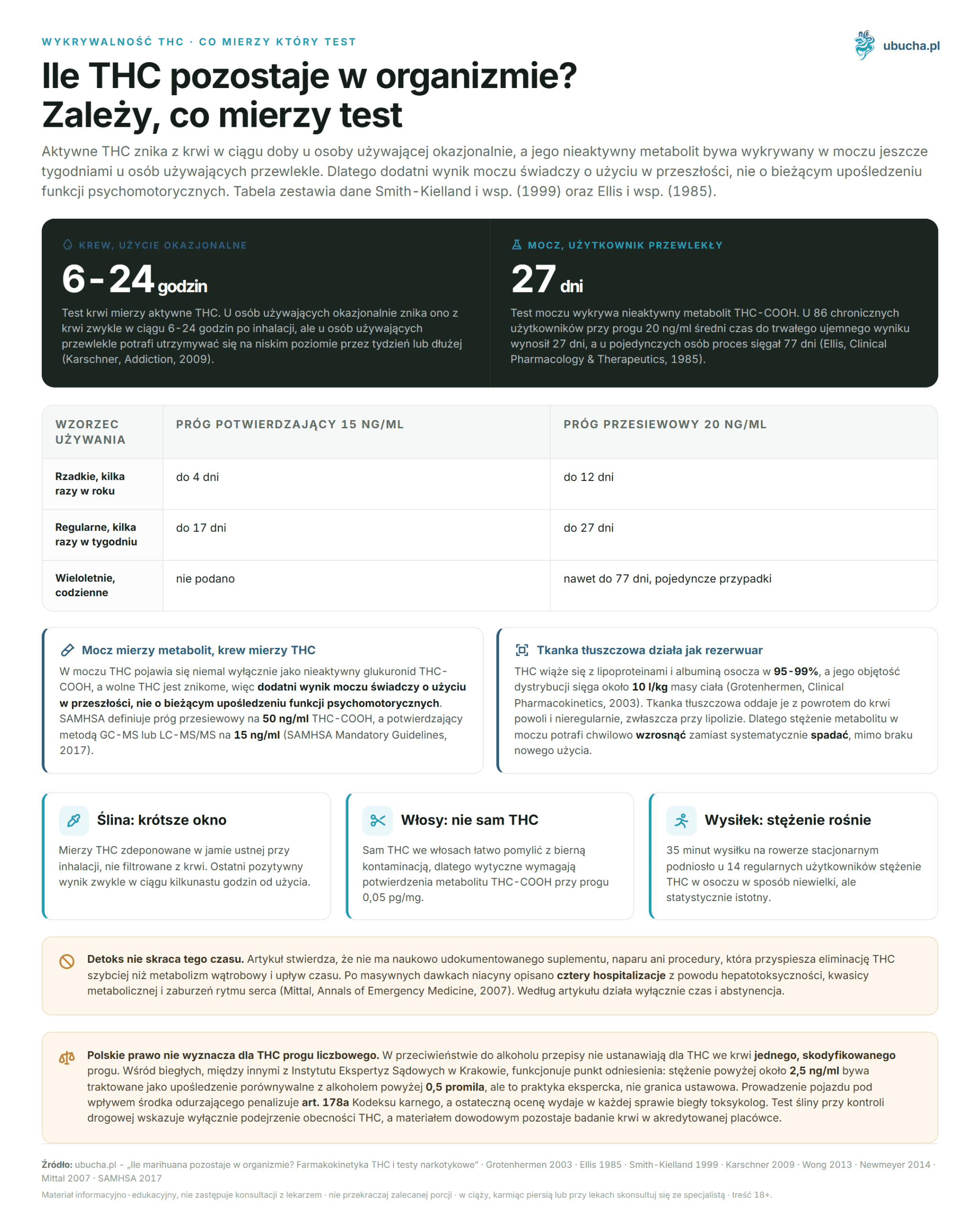
The study by Smith-Kielland et al. on individuals monitored during abstinence showed how strongly the result depends on the adopted threshold and history of use. The table below compares the last recorded positive urine result according to the pattern of use and cutoff threshold.
| Pattern of use | Confirmatory threshold 15 ng/ml | Screening threshold 20 ng/ml |
|---|---|---|
| Rare (a few times a year) | up to 4 days | up to 12 days |
| Regular (a few times a week or more) | up to 17 days | up to 27 days |
| Long-term, daily | even up to 77 days in individual cases (Ellis, 1985) | |
The immunochemical test (EMIT, CEDIA, test strips) is cheap and quick but prone to cross-reactivity, so a positive result always requires confirmation by chromatographic-mass spectrometry, which identifies the specific THC-COOH molecule, not just a class of compounds.
How long is marijuana detectable in blood?
The blood test measures active THC, not metabolites, and therefore best reflects the current influence of the substance on the body. In occasional users, THC usually disappears from the blood within 6-24 hours after inhalation. In chronic users, it can remain at low levels for a week or longer due to slow release from fat tissue (Karschner, Addiction, 2009).
After inhalation, the concentration of THC in plasma rises sharply and then decreases biphasically: the short distribution phase lasts about half an hour, and the slower elimination phase, depending on the frequency of use, lasts from several hours to several days. The study by Karschner et al. monitored 25 chronic users for 7 days of strict, controlled abstinence: in 9 individuals (36%), no THC was detected at any time during observation, but in 6 individuals (24%), active THC was still present on the seventh day, and 5 individuals had a positive result every day. The authors emphasize that the study lasted only a week, so it does not allow conclusions about the result after a month of abstinence, although such conclusions are often repeated in other publications.
Polish saliva tests (for example, Drager DrugTest) indicate only suspicion of the presence of THC. A positive result is the basis for stopping and taking blood for testing in an accredited laboratory, as it is the concentration in the blood, not in saliva, that has evidential significance in Polish proceedings. The regulations on driving under the influence refer specifically to blood, not urine, as only blood reflects the state of the body close to the time of testing.
How long does marijuana stay in saliva?
The saliva test detects THC for a shorter time than the urine test because it measures the substance deposited directly in the oral cavity during inhalation, not filtered from the blood. A controlled smoking study in occasional and regular users showed that under combined criteria, the last positive result usually appeared within several hours of use, and under broader thresholds based solely on THC, the window could be longer (Newmeyer, Drug Testing and Analysis, 2014). Proposed SAMHSA thresholds for saliva are 4 ng/ml THC in the screening test and 2 ng/ml in the confirmatory test.
In contrast to urine, THC-COOH is present in negligible amounts in saliva because salivary glands have a limited ability to filter lipophilic substances from the blood. After oral ingestion, the detection time in saliva is even shorter than after inhalation because THC does not go directly into the oral cavity.
Saliva tests are now the standard for roadside checks in Europe, including Poland. A positive result is the basis for stopping the driver, while the evidential material in the proceedings remains the blood test in an accredited laboratory (NIDA DrugFacts, 2023).
How long is marijuana detectable in hair?
The hair test theoretically allows for assessing cannabis use from months ago, as head hair grows on average about 1 cm per month, and a standard 3 cm segment corresponds to approximately three months of growth. In practice, however, hair testing has a distinctly lower sensitivity for cannabinoids than for other substances: THC and its main metabolite incorporate into hair to a very small extent, and THC itself does not bind to melanin as strongly as other drugs (Musshoff, Therapeutic Drug Monitoring, 2006). Therefore, a test result for the presence of THC in hair can easily be confused with passive contamination, i.e., being in a room with cannabis smoke.
The Society of Hair Testing guidelines therefore require confirmation of the presence of the metabolite THC-COOH at a threshold of around 0.05 pg/mg, as this metabolite is produced exclusively in the body and cannot come from external contamination. The structure of hair varies between individuals, which can be an additional source of error in interpreting the result.
The hair test is mainly used in civil cases, such as custody disputes, assessments of abstinence for drivers recovering their driving licenses, and in criminal toxicology. It is rarely used in routine employee testing, mainly due to the higher cost and complicated interpretation of the result. The price of such a test in a private laboratory can be significantly higher than that of a standard urine test, which further limits its popularity outside of court cases.
What personal factors influence the detection time of marijuana?
The detection time of THC varies between individuals by several times, and the most important single factor is the frequency and duration of use: daily users store multiple times more THC in fat tissue than occasional users, creating a reservoir that releases the substance for weeks. Other factors modify this effect but rarely exceed it.
| Factor | Impact on detection window |
|---|---|
| BMI and body fat percentage | higher body fat percentage extends detection in urine |
| Gender | women generally have a higher body fat percentage, which may slightly extend the window |
| Age | individual differences within one age group usually exceed differences between groups |
| Liver function | liver diseases reduce CYP2C9 activity and may prolong elimination |
| Hydration | dilutes urine and may lower THC-COOH concentration below the threshold, but laboratories detect dilution by creatinine |
These factors accumulate: a person with high BMI who has been using cannabis daily for years may have a detection window several times longer than a young, slim person after a one-time use, even if both go to the same laboratory on the same day.
Particularly counterintuitive is the effect of physical exertion: paradoxically, it may short-term raise, not lower, the concentration of THC in the blood. A study by Wong et al. on 14 regular cannabis users showed that 35 minutes of exercise on a stationary bike caused a small but statistically significant increase in plasma THC concentration, correlated with BMI and lipolysis markers: free fatty acids and glycerol (Wong, Drug and Alcohol Dependence, 2013). Long-term regular physical activity reduces fat tissue and speeds up elimination, but short-term may temporarily release stored THC back into the blood.
Do “detox” and niacin really remove THC from the body?
There is no scientifically documented supplement, brew, or procedure that accelerates the elimination of THC faster than natural liver metabolism and the passage of time. The elimination mechanism, described earlier, depends on the activity of enzymes CYP2C9 and CYP3A4 and the rate of THC release from fat tissue, and no nutrient accelerates any of these processes.
Products marketed as detox drinks usually contain caffeine and B vitamins. Some also add creatinine and diuretic herbs to raise creatinine levels in the diluted urine sample. Modern laboratories detect such manipulation by comparing creatinine levels with other parameters of the sample.
A separate myth is high doses of niacin, or vitamin B3, supposedly releasing THC from fat tissue. There is no pharmacological mechanism for this, but a series of clinical cases described four hospitalizations due to hepatotoxicity, metabolic acidosis, and heart rhythm disturbances after massive doses of niacin taken for this purpose (Mittal, Annals of Emergency Medicine, 2007). Sauna and intense training just before the test do not help for similar reasons: sweat contains trace amounts of THC, and short-term exertion is more likely to release stored substance than to remove it. The only method that really works is time: for occasional users, this is usually a few days, for regular users a few weeks, and for long-term users even longer.
What are the legal consequences of a positive THC test in Poland?
In Poland, mere possession of marijuana remains a crime under Article 62 of the Act of July 29, 2005, on Counteracting Drug Addiction (consolidated text Journal of Laws 2023, item 1939), punishable by up to 3 years of imprisonment. Driving under the influence of a narcotic is penalized by Article 178a of the Penal Code, and a milder state of “after use” of a substance, without signs of impairment, falls under Article 87 of the Misdemeanor Code.
Unlike alcohol, for which the regulations explicitly define thresholds in promille, Polish law does not establish a single, codified threshold for THC in the blood separating both states. In judicial practice and among experts, including those from the Institute of Forensic Expertise in Krakow, a reference point functions: a concentration above about 2.5 ng/ml THC in the blood is treated as corresponding to impairment comparable to alcohol above 0.5 promille, but this is expert practice, not a strict statutory boundary. The final assessment of whether a state of “under the influence” has occurred is made in each case by a toxicology expert based on complete documentation, not just a numerical result.
The saliva test during a roadside check indicates only suspicion of the presence of THC. The evidential material in the proceedings is a blood test performed in an accredited facility. The legal use of medical marijuana, permitted by the Act of July 7, 2017, does not exempt from liability under Article 178a of the Penal Code: a patient who drives a vehicle with a THC concentration assessed by an expert as indicating impairment may formally bear criminal responsibility regardless of the legality of the source of the substance. If you want to check what documents a police patrol may require from a medical marijuana patient, read a separate guide on police control and patient documents.
In the event of a positive test or legal dispute, it is advisable to consult a lawyer or legal advisor specializing in criminal law immediately. We do not provide advice on how to circumvent drug tests or falsify test results.
What cannabis products do not give a positive THC test result?
Products containing cannabidiol (CBD) and cannabigerol (CBG) derived from industrial hemp may contain up to 0.3% THC, counting the sum of delta-9-THC and tetrahydrocannabinolic acid (THCA), according to Article 4 point 5 of the Act on Counteracting Drug Addiction as amended by the Act of March 24, 2022 (Journal of Laws 2022, item 763). At standard dosing, such an amount of THC usually does not lead to a positive drug test, but “usually” does not mean “never”.
Broad spectrum oils contain cannabinoids with THC removed, which practically eliminates the risk of a positive result. Full spectrum oils retain trace amounts of THC up to the mentioned limit of 0.3%, and the risk increases with the dose: an analysis of 413 cannabis products from the German market showed that 12% of them contained THC above the lowest level causing side effects, mainly due to contamination of the raw material with full spectrum cannabinoids, not intentional declaration on the label (Lachenmeier, F1000Research, 2019). For individuals undergoing regular testing, such as professional drivers and machine operators, a safer choice is broad spectrum products or CBD isolates with zero THC content. If you are wondering whether your specific CBD oil may cause a positive result, we expand on this topic in the guide on whether CBD shows up on drug tests. Before purchasing, it is worth checking the certificate of analysis (COA) for a given batch if the seller provides it, as the declaration on the label and the actual THC content may differ, as shown by the aforementioned study of the German market.
Frequently asked questions
Do coffee or vitamin C speed up the elimination of THC from the body?
No. THC leaves the body at a rate determined by liver metabolism (enzymes CYP2C9 and CYP3A4) and slow release from fat tissue, and no commonly available substance speeds up these processes. Caffeine acts as a diuretic but does not affect THC clearance, and vitamin C does not interfere with the CYP2C9 pathway. The only effective method remains abstinence and time.
How much THC in the blood poses criminal liability for driving in Poland?
Polish law does not establish a strict numerical threshold for THC, as it does for alcohol in promille. Court experts, including those from the Institute of Forensic Expertise in Krakow, consider a concentration above about 2.5 ng/ml as indicating impairment comparable to alcohol above 0.5 promille, but the final assessment in each case is made by a toxicology expert.
Can CBD give a positive result on a marijuana test?
Rarely, but it is possible. An analysis of 413 cannabis products from the German market showed that 12% of them contained THC above the threshold causing side effects, mainly due to contamination of the raw material, not intentional declaration on the label (Lachenmeier, F1000Research, 2019). The risk increases with full spectrum oils and high doses. Broad spectrum oils and isolates practically eliminate this risk.
Why might a chronic user have a positive urine test after a week of abstinence?
Due to the accumulation of THC in fat tissue. A study by Karschner et al. on 25 chronic users showed that 6 individuals (24%) still had detectable THC in their blood on the seventh day of strict abstinence, and 5 individuals were positive every day of observation. THC is released from fat depots gradually, especially during lipolysis induced by exercise or caloric deficit.
Will a saliva test detect marijuana smoked yesterday?
Usually not as long as popular guides suggest. A study of controlled smoking showed that under combined criteria, the last positive result in saliva usually appeared within several hours of use (Newmeyer, Drug Testing and Analysis, 2014). If a saliva test during a roadside check is positive, a blood test is always performed for confirmation.
Will intense training before the test help or harm?
It is likely to harm in the short term. Wong et al. showed that 35 minutes of exercise on a stationary bike in regular cannabis users slightly but statistically significantly increased THC concentration in plasma, correlated with BMI (Wong, Drug and Alcohol Dependence, 2013). Long-term regular activity reduces fat tissue and speeds up elimination, but the effect takes weeks, not hours.
Can medication give a false positive result on a marijuana test?
Yes, in immunochemical tests. Some non-steroidal anti-inflammatory drugs, the protease inhibitor efavirenz, pantoprazole, and rifampicin have been reported as sources of cross-reactivity in screening tests for cannabinoids. A confirmatory test using GC-MS or LC-MS/MS specifically identifies the THC-COOH molecule and eliminates such false positive results.
How long does it take to return to a negative test after one joint?
For a person who rarely uses cannabis, typically a few days. The study by Smith-Kielland et al. showed the last positive result after 4 days at a confirmatory threshold of 15 ng/ml and up to 12 days at a broader screening threshold of 20 ng/ml (Smith-Kielland, Journal of Analytical Toxicology, 1999). In regular users, the same thresholds give 17 and 27 days, respectively.
What is really worth remembering about the detection time of THC?
The time marijuana stays in the body depends on the route of administration, pattern of use, individual biology, and type of test. Active THC disappears from the blood within a day for occasional users, but its inactive metabolite THC-COOH can be detected in urine for weeks in chronic users. No detox, drink, or niacin shortens this process in a clinically confirmed way: only time and abstinence work. In Poland, the law does not set a strict numerical threshold for THC in the blood like for alcohol, so criminal liability for driving is practically determined by the opinion of a toxicology expert, not one value recorded in the law.
A comparison of CBD and CBG oils available in the oils at Bucha category allows you to compare concentrations and spectrum type before purchase.
This article is for informational and educational purposes and does not constitute legal advice. The legal status described in the article is valid as of the date of publication: regulations regarding cannabis may change. Before making a decision, consult a lawyer or current legal acts.
Author: Michał Waluk · Published: 2026-05-06 · Updated: 2026-08-10