
Carnosine: an antioxidant for aging and the brain (table)
Carnosine and glycation, the brain, vision, and effort: which studies have checked this, on whom, for how long, and what popular numbers from labels do not confirm.
Carnosine, or beta-alanylhistidine, was discovered in 1900 by Russian chemist Vladimir Gulevich and remained on the margins of interest for a hundred years. It returned to attention when it was found that its concentration in muscles decreases with age, and the molecule itself does something that ordinary antioxidants do not: it binds reactive carbonyl groups before they damage proteins. However, many numbers have accumulated around this property that have no basis in the cited works. Below you will find each study outlined separately: who conducted it, on whom, for how long, and what exactly was measured. You will also find information about which popular claims about carnosine do not arise from any of these works, although they appear in almost every commercial description.
KEY INFORMATION
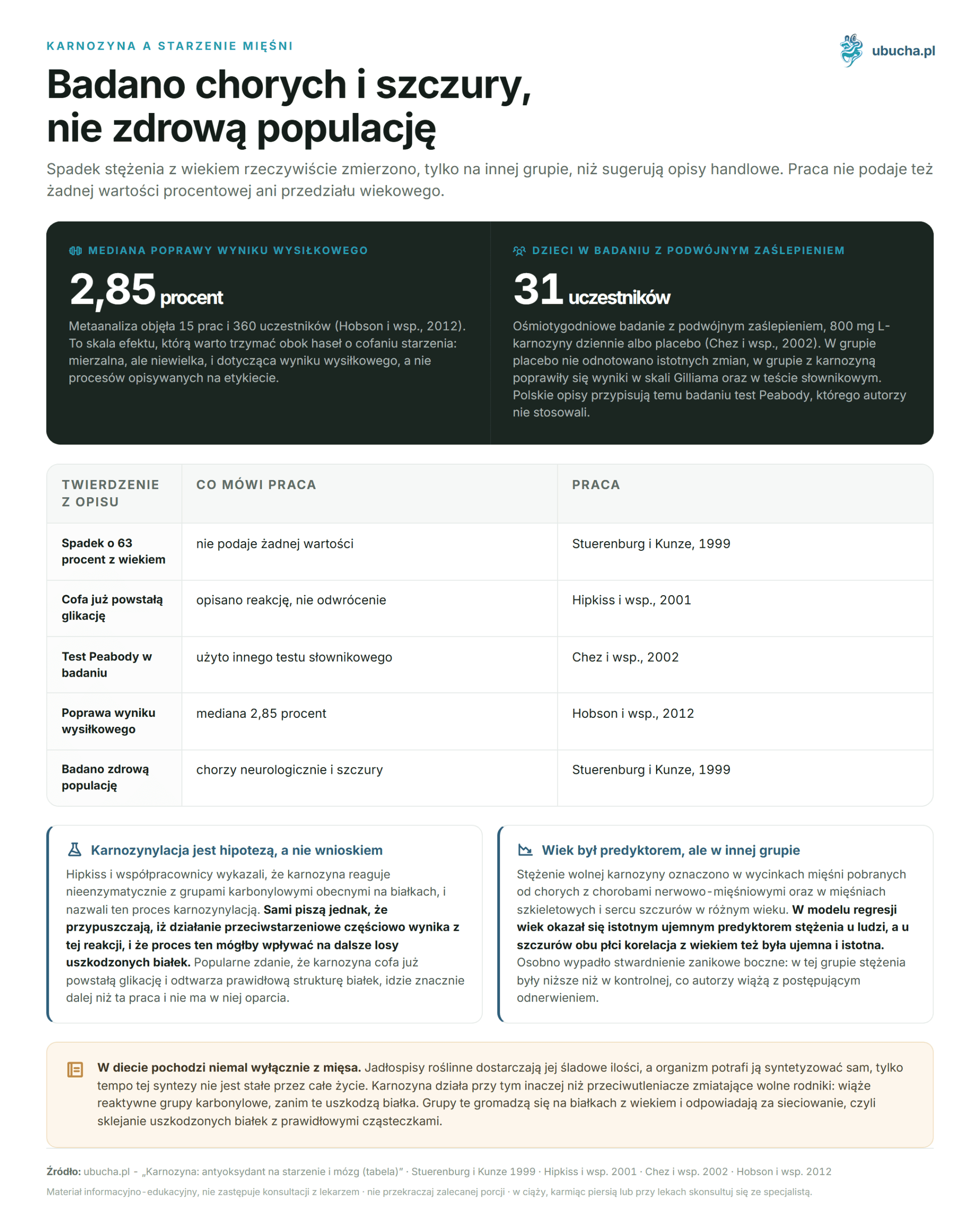
• Stuerenburg and Kunze (Archives of Gerontology and Geriatrics, 1999) showed that age is a significant negative predictor of free carnosine concentration in muscle; they studied neurologically ill patients and rats, not a healthy population.
• The repeated number “a decrease of 63 percent between the ages of 10 and 70” does not appear in this work.
• Hipkiss et al. (2001) described the reaction of carnosine with carbonyl groups of proteins and presented it as a hypothesis, not as a clinical fact.
• The meta-analysis by Hobson et al. (Amino Acids, 2012) included 15 studies and 360 participants; the median improvement in exercise performance was 2.85 percent.
What is carnosine and why does it decrease with age?
Carnosine is a dipeptide composed of beta-alanine and L-histidine, primarily present in skeletal muscles, and in smaller amounts in the brain, heart, and kidneys. In the diet, it comes almost exclusively from meat, so plant-based diets provide it in trace amounts. The body can synthesize it on its own, but the rate of this synthesis is not constant throughout life.
The decrease with age was measured by Stuerenburg and Kunze (Archives of Gerontology and Geriatrics, 1999). They marked the concentration of free carnosine in muscle samples taken from patients with neuromuscular diseases and in the skeletal muscles and hearts of rats of different ages. In the regression model, age turned out to be a significant negative predictor of carnosine concentration in humans, and in rats of both sexes, the correlation with age was also negative and significant. The group with amyotrophic lateral sclerosis had lower concentrations than the control group.
However, the work does not provide any percentage value or age range. The number “a decrease of 63 percent between the ages of 10 and 70,” which is repeated in most descriptions of carnosine, does not come from this study. The authors link the loss of carnosine to the age-related decrease in muscle mass and strength, and in the case of patients with amyotrophic lateral sclerosis, to progressive denervation.
How does carnosine block protein glycation?
Glycation is the non-enzymatic attachment of sugars to proteins, leading to the formation of advanced glycation end products, in short AGE. They damage collagen in the skin, the endothelium of blood vessels, and the lens of the eye, and their accumulation increases with age. Carnosine acts here differently than antioxidants that scavenge free radicals.
Hipkiss et al. (Mechanisms of Ageing and Development, 2001) showed that carnosine reacts non-enzymatically with carbonyl groups present on proteins, and named this process carnosinylation. Carbonyl groups accumulate on proteins with age, and they are responsible for cross-linking, or sticking damaged proteins to normal molecules. By binding to them, carnosine inhibits this cross-linking. The authors added a preliminary animal experiment: in rats fed fructose, carnosine prevented the diabetes-related increase in blood pressure.
However, it is necessary to read how the authors themselves formulate the conclusion. They write that they hypothesize that the anti-aging effect of carnosine partially results from this reaction, and that carnosinylation could influence the further fate of damaged proteins. This is a hypothesis formulated based on laboratory data. The popular statement that carnosine “reverses already formed glycation and restores the normal structure of proteins” goes much further than this work and has no basis in it.
What is known about carnosine and the brain?
The brain consumes disproportionately large amounts of oxygen relative to its mass and is rich in lipids prone to peroxidation, so the hypothesis about the protective role of carnosine makes sense there. However, there is little data in humans, and it comes from one small trial.
Chez et al. (Journal of Child Neurology, 2002) conducted an eight-week double-blind study involving 31 children with autism spectrum disorders, administering 800 mg of L-carnosine daily or a placebo. No significant changes were noted in the placebo group. In the group receiving carnosine, scores improved on the Gilliam scale, including in the subscales of behavior, socialization, and communication, as well as in the Receptive One-Word Picture Vocabulary test. It is worth noting the name of this test, as Polish descriptions attribute the Peabody test to this study, which the authors did not use.
The authors themselves state that the mechanism of action of carnosine is not well understood. The trial involved 31 children and lasted 8 weeks, and the result was not replicated in a larger study. This is not an accepted treatment method, and the decision to give anything to a child with developmental disorders should be made with a neurologist or child psychiatrist, not based on an article.
Does carnosine improve physical performance?
In muscle, carnosine buffers hydrogen ions produced during intense exercise, thus delaying acidosis. This mechanism has been mainly tested through beta-alanine supplementation, which is a substrate for carnosine synthesis and raises its concentration in muscle more effectively than administering the dipeptide itself.
The meta-analysis by Hobson et al. (Amino Acids, 2012) gathered 15 published works, encompassing 57 measurements in 23 exercise tests and 360 participants. Beta-alanine significantly improved performance compared to placebo, with the improvement concerning endurance, not athletic achievement. Efforts lasting from 60 to 240 seconds performed better, efforts longer than 240 seconds also did, while no difference was noted for efforts shorter than 60 seconds. The median improvement was 2.85 percent.
This is a number worth remembering when reading advertisements. Just under three percent at a median total intake of 179 grams of beta-alanine is a real but modest effect, measurable more in the laboratory than in the feeling of the exercising person. The meta-analysis did not evaluate L-carnosine administered orally, only its precursor.
| Study | Who and how many | Time and dose in the study | What was measured and with what result |
|---|---|---|---|
| Chez et al., 2002 | 31 children with autism spectrum disorders | 8 weeks, 800 mg of L-carnosine daily | improvement on the Gilliam scale and in the Receptive One-Word Picture Vocabulary test; no changes in the placebo group |
| Hobson et al., 2012 | meta-analysis of 15 studies, 360 participants | median total intake of 179 g of beta-alanine | median improvement in exercise performance of 2.85 percent; no effect for efforts shorter than 60 seconds |
| Babizhajev et al., 2002 | 49 people with age-related cataracts, 76 eyes | 6 and 24 months, drops with 1 percent N-acetylcarnosine twice daily | after 6 months, improvement in best-corrected visual acuity in 90 percent of treated eyes |
| Stuerenburg and Kunze, 1999 | muscle samples from neurologically ill patients and rats of different ages | cross-sectional study, no supplementation | age as a significant negative predictor of free carnosine concentration in muscle |
Does carnosine protect vision?
The lens of the eye is one of the tissues where glycation and oxidative stress are best documented, as its proteins practically do not undergo replacement throughout life. However, the ophthalmological study concerned not oral carnosine, but its derivative administered topically.
Babizhajev et al. (Drugs in R&D, 2002) included 49 people with age-related cataracts in a randomized study, totaling 76 eyes, with an average age of 65 years. Twenty-six patients, or 41 eyes, received drops with one percent N-acetylcarnosine twice daily; the control group consisted of patients with placebo drops and patients not receiving drops. After six months, improvement in best-corrected visual acuity was noted in 90 percent of treated eyes, and improvement in glare sensitivity in nearly 89 percent. In lens image analysis, improvement concerned 41.5 percent of eyes. The effect persisted after two years, and the tolerance of the drops was good.
Two caveats must be made immediately. The number 90 percent refers to eyes, not patients, and pertains to visual acuity, not lens clarity, for which the result was clearly lower. Moreover, N-acetylcarnosine in drops is a different preparation than oral L-carnosine. This study does not imply anything about the effect of capsules on the lens.
What is the difference between carnosine and beta-alanine and for whom does it make sense?
Beta-alanine is a component of carnosine, so its administration increases the pool of substrate for dipeptide synthesis directly in the tissue. Oral L-carnosine, on the other hand, is rapidly broken down in the blood by carnosinase, an enzyme that cleaves it back into beta-alanine and histidine. This is why sports studies almost invariably use the precursor, not the ready dipeptide.
Our observations from comparing these works are as follows: the literature on carnosine and the literature on beta-alanine practically address two different questions. Works on beta-alanine measure exercise performance in healthy individuals. Works on carnosine measure clinical endpoints in small groups, and one of them, the ophthalmological study, does not concern oral administration at all. Commercial descriptions usually mix one with the other.
So for whom does carnosine make sense? The honest answer is: there is no study that resolves this for a healthy adult. People with kidney diseases should discuss use with a doctor, as the kidney is involved in carnosine metabolism. In a similar context, ergothioneine and glutathione are described, and a separate topic is coenzyme Q10, whose concentration also decreases with age. You can find such preparations in the supplements category.
Frequently Asked Questions
Does carnosine really drop by 63 percent with age?
This number does not come from the work it is usually attributed to. Stuerenburg and Kunze (1999) showed that age is a significant negative predictor of free carnosine concentration in muscle, but they did not provide either a percentage value or an age range from 10 to 70 years.
What is the difference between carnosine and beta-alanine?
Beta-alanine is a component of carnosine and a substrate for its synthesis in tissue. Oral L-carnosine is rapidly broken down in the blood by carnosinase. The meta-analysis by Hobson et al. (2012), cited by manufacturers, evaluated beta-alanine, not the ready dipeptide administered orally.
Does carnosine reverse protein glycation?
Not in the sense that commercial descriptions claim. Hipkiss et al. (2001) showed that carnosine binds to carbonyl groups of proteins and inhibits their cross-linking with normal molecules. The authors themselves present the conclusion about the anti-aging effect as a hypothesis requiring confirmation.
Does carnosine help children with autism?
One double-blind study involving 31 children showed improvement on the Gilliam scale and in the vocabulary test after 8 weeks with 800 mg of L-carnosine daily (Chez et al., 2002). The result was not replicated in a larger sample. This is not an accepted treatment method and requires a doctor’s decision.
Do carnosine drops treat cataracts?
The study by Babizhajev et al. (2002) involved 49 people with age-related cataracts. After 6 months, improvement in visual acuity was noted in 90 percent of treated eyes, but improvement in lens image analysis was only 41.5 percent. This concerns drops with N-acetylcarnosine, not oral capsules.
Is carnosine safe?
The cited studies did not report serious adverse effects, but involved a total of several dozen people and lasted from 8 weeks to 2 years. This is too little to comment on long-term safety. People with kidney diseases and those taking medications regularly should consult supplementation with a doctor.
This article is for informational and educational purposes only and does not constitute medical advice. Before starting supplementation, consult with a doctor, especially if you are taking medications regularly, are pregnant or breastfeeding, or have chronic illnesses.
Author: Michał Waluk · Published: 2026-08-05 · Updated: 2026-08-11