
Nociceptive Pain vs Neuropathic Pain: Why Cannabinoids Work Differently for Each Type
Nociceptive and neuropathic pain are two different mechanisms. Check what clinical studies say about cannabinoids for each and where the evidence ends.
Pain is not a single mechanism. Nociceptive pain arises when tissue is damaged, while neuropathic pain occurs when the nervous system itself is damaged. This distinction determines the choice of medications, as products effective for one type may be useless for the other, and the patient then hears that the medication “did not work.” Cannabinoids are increasingly appearing in this conversation, usually with the promise that they work on both types of pain simultaneously. A systematic review published in JAMA included 79 studies involving 6462 participants and deemed the evidence for their effect on chronic pain to be of moderate quality. This article explains how the two types of pain differ, what studies on cannabinoids say about humans, and where popular explanations diverge from the literature.
KEY INFORMATION
• A review of 79 studies involving 6462 people found moderate quality evidence for the effects of cannabinoids in chronic pain and spasticity (Whiting et al., JAMA 2015).
• A meta-analysis of 24 randomized studies indicates neuropathic pain as the indication where the effect is most evident, but the authors themselves call its clinical significance uncertain.
• The popular division into CB receptors for neuropathic pain and TRPV1 for inflammatory pain is an oversimplification: in Xiong’s work, the strength of the analgesic effect did not correlate with affinity for CB1 or CB2.
• Evidence for topical CBD in arthritis comes from animal models, not from human studies.
• EFSA in 2026 stated that the safety of CBD cannot be established in individuals taking medications, which is a typical reader of a post about chronic pain.
What is nociceptive pain?
Nociceptive pain is a warning signal triggered by actual tissue damage. Nociceptors, which are specialized nerve endings scattered in the skin, muscles, joints, and internal organs, respond to mechanical, thermal, and chemical stimuli. Damage releases inflammatory mediators: prostaglandins, bradykinin, substance P. They stimulate nociceptors, and the signal travels through A-delta and C fibers to the spinal cord, and from there upward.
This type of pain has a clear localization. It intensifies with touch or movement at the injury site and usually subsides as healing occurs. This is how a fracture, sprain, surgical wound, burn, and inflammatory joint diseases, including rheumatoid arthritis and osteoarthritis, feel. Non-steroidal anti-inflammatory drugs work well here because they directly target the inflammatory mediators that drive this pain.
It is worth noting one distinction within the category itself. Nociceptive pain can be inflammatory, as in arthritis, or post-traumatic and short-lived, as after a procedure. All the literature on cannabinoids referenced in this article pertains to chronic pain. Studies on acute postoperative pain are few and do not allow for conclusions in either direction, so extending results from chronic pain to acute injury is an overreach.
What is neuropathic pain?
Neuropathic pain arises when the nervous system itself, either peripheral or central, is damaged or functioning abnormally. There is no active tissue injury here that a nociceptor could report. Instead, damaged neurons generate spontaneous pain signals. Described mechanisms include neuronal hyperexcitability, central sensitization, demyelination of fibers, and pathological functioning of ion channels.
The description of the complaint is also clear. Patients report burning, stabbing, and a sensation of electric shock. Allodynia, which is pain triggered by a stimulus that normally does not cause pain, and hyperalgesia, which is an excessive reaction to a painful stimulus, occur. The pain persists despite the absence of active injury and is most often chronic. Typical causes include diabetic neuropathy, postherpetic neuralgia, phantom pain, chemotherapy-induced neuropathy, and multiple sclerosis.
Classic painkillers perform worse here than with nociceptive pain because they do not reach the pathological activity of neurons. In clinical practice, stabilizing medications such as gabapentin, pregabalin, or duloxetine are used. This distinction is also significant for assessing cannabinoids, as it is precisely in neuropathic pain that meta-analyses see the most promise.
How do CBD and inflammatory pain interact?
The most concrete data regarding topical application comes from animal models. Hammell and colleagues induced unilateral knee joint inflammation in rats and then applied CBD gel for four days (European Journal of Pain, 2016). The joint circumference, immune cell infiltration, and synovial membrane thickness decreased depending on the dose, and the exploratory behavior of the animals remained unchanged, which the authors interpreted as a lack of impact on higher brain functions.
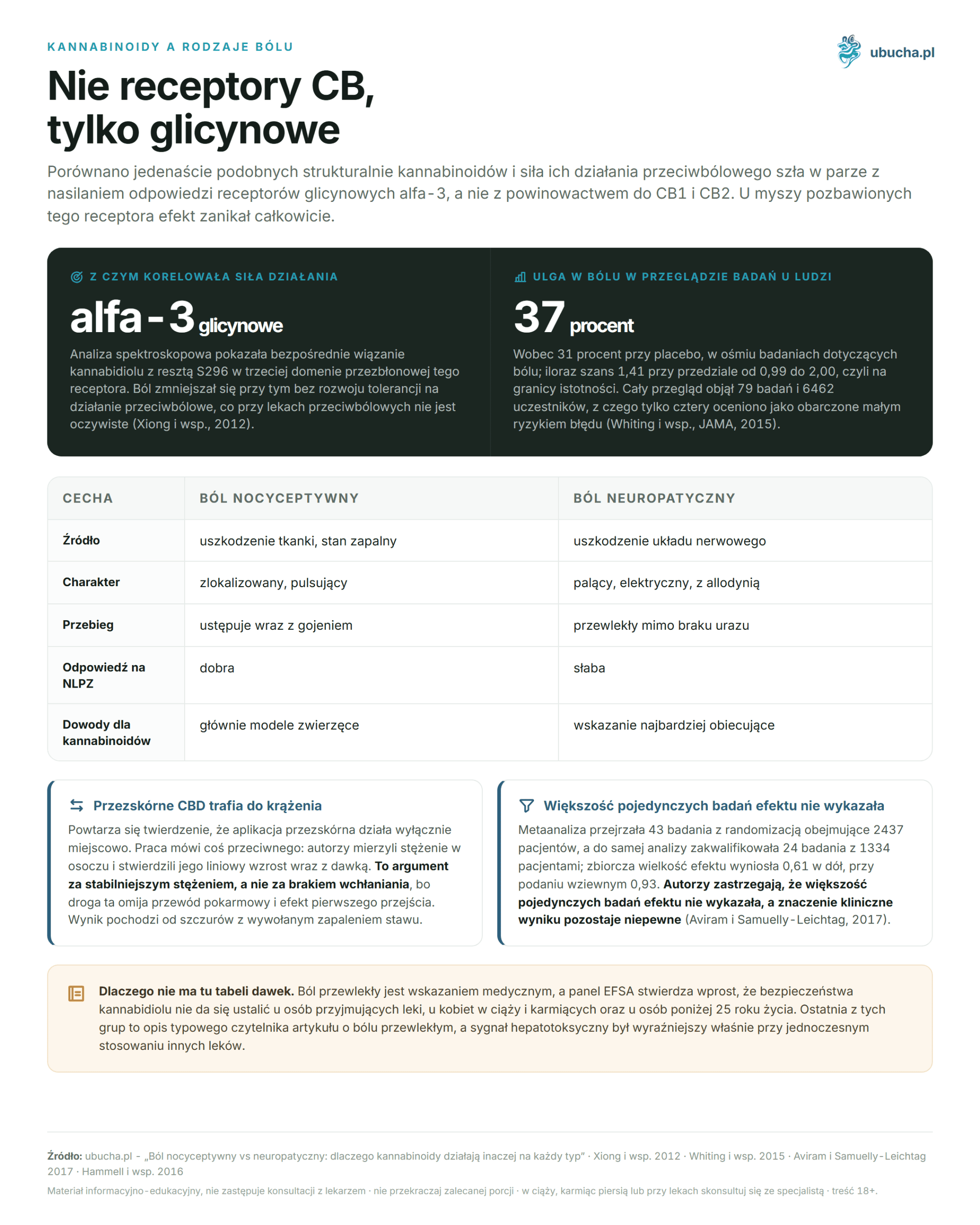
One aspect of this work is often reversed in consumer texts. It is repeated that transdermal application works exclusively locally and does not enter the bloodstream. The study states the opposite: the authors measured CBD concentration in plasma and found a linear increase with the dose in the lower range of tested gels. Therefore, transdermal CBD does enter circulation, just bypassing the digestive tract and first-pass effect. This is an argument for a more stable concentration, not for a lack of absorption.
The limitation of this study is obvious and must be stated directly. These are rodents, four days of observation, and artificially induced joint inflammation. The result justifies further research on topical preparations, not the transfer of numbers to humans with knee osteoarthritis. We discuss the boundary between evidence and promise more broadly in the text about CBD for chronic pain.
What do we know about CBD for neuropathic pain?
The most frequently cited preclinical work in this area is also the one that most strongly undermines the popular explanation. Xiong and colleagues administered CBD and its derivatives to rodents with chronic inflammatory and neuropathic pain (The Journal of Experimental Medicine, 2012). The pain clearly decreased, and this occurred without the development of tolerance to the analgesic effect, which is not obvious with pain medications.
However, the mechanism turned out to be different from the commonly held version. The authors compared eleven structurally similar cannabinoids and found that the strength of their analgesic effect was associated with the enhancement of alpha-3 glycine receptor responses, not with affinity for CB1 and CB2 receptors. In mice lacking the alpha-3 glycine receptor, the analgesic effect completely disappeared. NMR spectroscopic analysis showed direct binding of CBD to residue S296 in the third transmembrane domain of this receptor.
For the reader, this means one thing. Sentences like “in neuropathic pain, CB1 and CB2 work, while in inflammatory pain, TRPV1 and COX-2 do” sound precise but have no basis in this literature. The TRPV1 receptor is indeed a target of CBD, and we describe it separately in connection with the capsaicin receptor, but deriving from this a division into two types of pain is adding a conclusion that the studies did not establish.
What do clinical studies on humans show?
The systematic review by Whiting and colleagues published in JAMA included 79 randomized studies and 6462 participants, of which only four studies were rated as having a low risk of systematic error (JAMA, 2015). In eight studies concerning pain, the percentage of individuals with relief was 37 percent with cannabinoids compared to 31 percent with placebo, with an odds ratio of 1.41 and a confidence interval from 0.99 to 2.00. This interval touches one, so the result is on the border of significance. The authors’ conclusion was: moderate quality evidence for chronic pain and spasticity.
The meta-analysis by Aviram and Samuelly-Leichtag reviewed 43 randomized studies involving 2437 patients, and 24 studies with 1334 patients qualified for the meta-analysis (Pain Physician, 2017). The overall effect size compared to placebo was -0.61 with a confidence interval from -0.78 to -0.43, and with inhalation -0.93. The authors call this evidence limited. However, the authors caution that most individual studies did not show an effect, and the clinical significance of the result remains uncertain. Their conclusion points to neuropathic pain as the indication with the best, though still limited, basis.
A separate issue is the registration status. Nabiximols, a preparation combining THC and CBD, are allowed for sale in Poland under the mutual recognition procedure, indicated for spasticity in multiple sclerosis. This is not a central registration with the European Medicines Agency nor registration for neuropathic pain, although both formulations circulate in consumer texts. More about the neurological indication is discussed in connection with trigeminal neuralgia.
What is mixed pain?
Pure forms of both types are practically rarer than their mixture. Diabetic neuropathy combines nerve damage with vascular and inflammatory changes. Rheumatoid arthritis starts as inflammatory pain but adds secondary central sensitization, i.e., a neuropathic component, after years. Back pain is often described as mixed precisely because both mechanisms overlap. Similarly, cancer pain, where the tumor’s pressure on tissues coexists with nerve damage from the disease or treatment.
This has practical consequences when reading studies. Works on cannabinoids usually recruit patients with chronic pain described by diagnosis, not mechanism, so study groups can be mixed. This is one reason why aggregate results are heterogeneous, and meta-analysis authors write about significant heterogeneity in studies. The effect visible in one trial may therefore come from a subgroup with a predominance of one mechanism, which a single study usually does not resolve. A cautious conclusion is thus: the distinction of mechanisms is real and clinically useful, but data on cannabinoids are not yet precise enough to assign each type a separate efficacy profile.
Why won’t you find a dosage table here?
Chronic pain is a medical indication, and for a medical indication, we do not provide milligram numbers that the reader could measure out. The reason is not formal. The EFSA panel in the 2026 update derived a provisional safe dose of CBD at 0.0275 mg per kilogram of body weight per day, or about 2 mg for a person weighing 70 kg, and noted that it applies only to supplements with at least 98 percent purity of CBD, without nanoparticles (EFSA Journal, 2026).
In the same document, the panel states directly that the safety of CBD cannot be established in individuals under 25 years of age, in pregnant and breastfeeding women, and in individuals taking medications. The last group describes a typical reader of an article on chronic pain. The hepatotoxic signal in human studies was, in the panel’s assessment, more pronounced precisely when other medications were taken simultaneously.
Additionally, there are interactions. Brown and Winterstein reviewed the characteristics of registered CBD products and described the impact of substances on CYP3A4 and CYP2C19 and on P-glycoprotein, which affects the metabolism and excretion pathways of many commonly used medications (Journal of Clinical Medicine, 2019). Nearly half of CBD users reported adverse effects, including increased aminotransferase activity and drowsiness. This is a conversation to have with the attending physician, not to be resolved by a table on the internet.
Frequently Asked Questions
What is the difference between nociceptive pain and neuropathic pain?
Nociceptive pain is a response to actual tissue damage and usually subsides with healing. Neuropathic pain results from damage to the nervous system itself, persists chronically, and has a burning or electric character. The difference concerns the mechanism, so medications effective for one type may be ineffective for the other.
Does CBD help with neuropathic pain?
A meta-analysis of 24 randomized studies involving 1334 patients indicates neuropathic pain as the indication with the best evidence among pain syndromes, but the authors themselves call the clinical significance of this result uncertain and note that most individual studies did not show an effect. This is too little to speak of efficacy, and enough to continue researching.
Does CBD work for inflammatory joint pain?
Data primarily comes from animal models. In rats with induced knee joint inflammation, four days of using CBD gel reduced joint swelling and inflammatory infiltration depending on the dose. Randomized studies on topical CBD in degenerative disease in humans are still lacking, so the result justifies research, not recommendation.
Why is there no dosage table in this article?
Because chronic pain is a medical indication. EFSA in 2026 stated that the safety of CBD cannot be established in individuals taking medications, in pregnant and breastfeeding women, and in individuals under 25 years of age. Dose selection in such situations is a decision for the attending physician, who knows the other medications being taken.
Can cannabinoids be combined with painkillers?
This requires consultation. CBD interacts with the enzymes CYP3A4 and CYP2C19 and with P-glycoprotein, which affects the metabolism and excretion pathways of many medications. In the review by Brown and Winterstein, nearly half of users reported adverse effects, and the signal of liver damage was more pronounced when taking other medications simultaneously.
In summary: the distinction between nociceptive and neuropathic pain is real and significant for treatment, but the evidence for cannabinoids is not yet precise enough to assign each type a separate mechanism and separate efficacy. The results we have pertain to chronic pain, are of moderate quality, and most strongly indicate neuropathic pain.
If you are looking for products for oral or sublingual use, you will find them in the oils category.
This article is for informational and educational purposes only and does not constitute medical advice. Before starting to use cannabis or CBD for therapeutic purposes, consult your doctor, especially if you are taking other medications, are pregnant, or breastfeeding.
Author: Michał Waluk · Published: 2026-08-05 · Updated: 2026-08-16