
The Impact of Marijuana on Mental Health - Current Research 2025-2026
CBD and THC and anxiety, depression, PTSD, and psychosis: what clinical studies confirm, where evidence ends, and what the Polish legal status looks like in 2026.
More and more Poles are asking whether cannabis can help with anxiety, depression, or PTSD. The question arises in psychiatrists’ offices, pharmacies, and social media. The answer is not simple. According to EMCDDA data (European Drug Report), about 27.2% of adult Europeans aged 15-64 have used cannabis at least once in their lives, and Poland is among the countries with a lower than average European annual consumption rate, estimated at about 7.8% in the 15-34 age group. In this article, we conduct an honest, research-based review: what cannabis can realistically offer to mental health, where evidence ends and risk begins, and what the Polish clinical and legal reality looks like in 2026.
KEY INFORMATION
• CBD shows promising anxiolytic effects in social anxiety and panic attacks, confirmed by RCTs by Crippa et al. (2011), Bergamaschi et al. (2011), and Linares et al. (2018).
• THC carries documented risk of psychosis in predisposed individuals: a meta-analysis by Marconi et al. (2016, Schizophrenia Bulletin) indicates an OR of about 3.9 for daily use of high-THC cannabis.
• In depression, there is a lack of strong evidence for monotherapy with CBD or THC; a meta-analysis by Gobbi et al. (2019, JAMA Psychiatry) indicates an increased risk of depression and suicide attempts in youth using cannabis.
• In insomnia, CBD may indirectly improve sleep, but long-term THC disrupts REM sleep (Babson et al. 2017, Current Psychiatry Reports).
• This is not medical advice. In cases of mental disorders, consultation with a psychiatrist is essential; do not discontinue SSRIs or benzodiazepines on your own. In a crisis, call: 116 123 or 800 70 22 22.
Short answer: what does science say about cannabis and mental health?
According to current meta-analyses (Marconi 2016, Gobbi 2019, McGuire 2018), CBD shows moderately strong anxiolytic effects in social anxiety and may support sleep quality. THC, with regular high consumption, increases the risk of psychosis in predisposed individuals. Results in depression remain mixed and require individual psychiatric assessment.
In simple terms: cannabidiol (CBD) has the most reliable evidence in anxiety, less in PTSD, even less in insomnia, and trace evidence in depression. Tetrahydrocannabinol (THC) acts in the opposite direction of risk. The higher the concentration and more frequent consumption, the greater the likelihood of psychotic symptoms, anxiety, and cognitive decline, especially in the group of teenagers and young adults. This is not demonization; these are data from large cohorts.
It is also worth stating clearly: most positive studies on CBD are small RCTs, short, on healthy volunteers or small patient groups. We do not yet have large, long-term efficacy confirmed in truly severe disorders. This does not mean that CBD does not work. It only means that the evidence is promising but incomplete.
What do the latest studies say about cannabinoids in psychiatry?
According to a review by Black et al. published in The Lancet Psychiatry (2019), covering 83 studies (including 40 randomized controlled trials, with a total of 3067 participants), the evidence for the effectiveness of medical cannabinoids in psychiatry is limited, and the quality of studies is often low. The number of publications indexed in PubMed under the phrase “cannabidiol anxiety” has increased from about 40 per year in 2015 to over 280 per year in 2024, showing the scale of interest, although this interest does not yet translate into strong evidence in clinical guidelines.
The latest studies focus on three areas:
- CBD as an adjunct therapy in anxiety and PTSD in adults, with increasingly better research methodology.
- CBD in patients with treatment-resistant epilepsy and with psychotic symptoms in schizophrenia.
- Medical marijuana with THC in patients with chronic pain and secondary mood disorders, a more controversial and less studied area.
Studies on THC in psychiatry are rarely of good quality and often rely on observations of medical marijuana patients rather than blind trials. This introduces a systematic asymmetry of evidence that is worth understanding before reading headlines.
Does CBD really help with anxiety and panic?
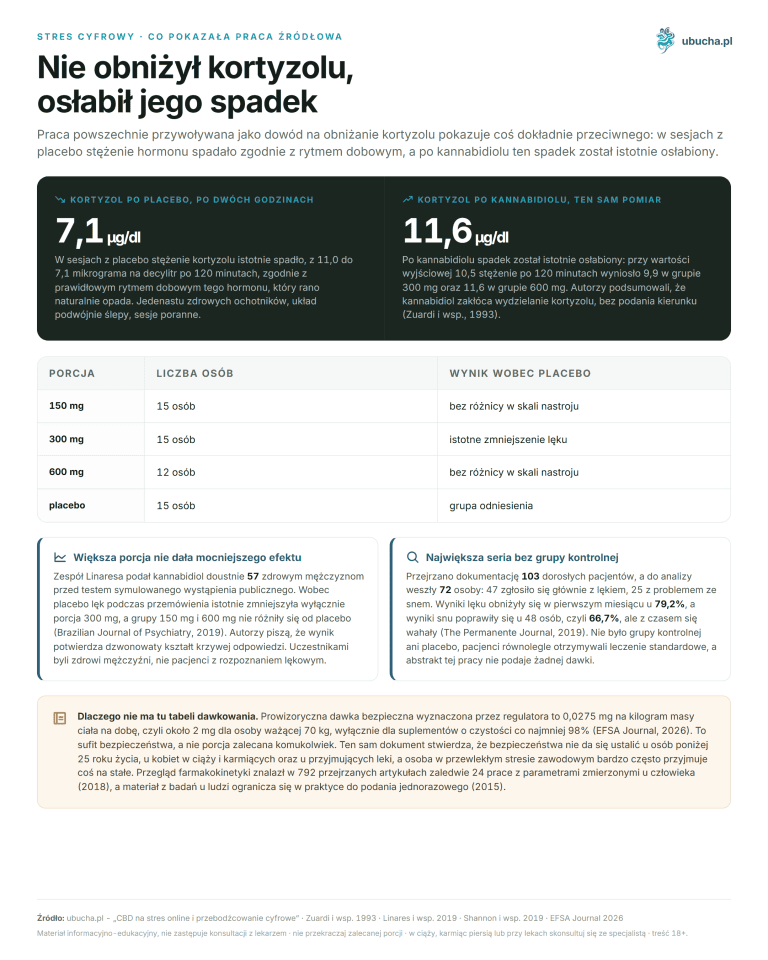
According to a double-blind RCT by Bergamaschi et al. published in Neuropsychopharmacology (2011), a single dose of 600 mg of CBD significantly reduced anxiety, cognitive discomfort, and the severity of vegetative symptoms during a simulated public speaking test in patients with generalized social anxiety disorder (SAD), compared to placebo (Bergamaschi et al., 2011).
Three publications recur in almost every review. Crippa et al. (2011) used functional neuroimaging and showed that 400 mg of CBD reduces blood flow in brain areas associated with anxiety, including the hippocampus and temporal lobe. Bergamaschi et al. (2011) demonstrated clinical efficacy in the public speaking test (SPST). Linares et al. (2018) compared three doses of CBD (150, 300, 600 mg) and found that 300 mg was the most effective, while 600 mg paradoxically worked worse, suggesting a U-shaped dose-effect relationship (Linares et al., 2018).
The same plant material can reduce or exacerbate anxiety, depending on the cannabinoid profile. High doses of THC, above 7.5 mg at once in non-addicted individuals, often induce anxiety, panic, and derealization. Low doses, below 5 mg, may have a calming effect. This is a biphasic effect phenomenon, known since the 1970s and confirmed in contemporary RCTs. It happens that a person with anxiety reaches for high-THC cannabis, expecting calmness, and the effect can be the opposite: tachycardia intensifies, leading directly to a panic attack. Education about the CBD:THC profile determines which way the effect will go.
Do cannabis help with PTSD in veterans and trauma victims?
According to the first pilot double-blind RCT by Bonn-Miller et al. published in PLOS ONE (2021), comparing three inhaled marijuana preparations (high THC, high CBD, mixed) with placebo in 80 veterans with PTSD, no statistically significant difference was found between groups in the severity of PTSD symptoms after 3 weeks (Bonn-Miller et al., 2021). All groups, including placebo, experienced improvement.
The Bonn-Miller result is sometimes cited as evidence of the ineffectiveness of cannabis in PTSD, which is an overinterpretation. The study had a small sample, a short duration, and the placebo showed significant improvement. It rather showed that there is no quick, simple answer like “marijuana cures PTSD,” and designing well-blinded studies on a psychoactive substance is methodologically challenging.
A more promising direction is CBD as an adjunct to standard therapies: SSRIs and exposure therapy (PE, prolonged exposure). The neurobiological hypothesis suggests that CBD facilitates the extinction of conditioned responses, which theoretically supports the mechanism of cognitive-behavioral therapy in PTSD. The first small RCTs on groups of 30-50 people indicate an effect, but large phase III studies are lacking. Do not discontinue SSRIs or other medications prescribed for PTSD without consultation: adding CBD without the doctor’s knowledge may affect the metabolism of medications through cytochrome P450.
Do cannabis treat depression, or do they harm it?
According to a meta-analysis by Gobbi et al. published in JAMA Psychiatry (2019), covering 11 cohort studies and over 23,000 people, cannabis use during adolescence was associated with a significantly increased risk of depression in young adulthood (OR 1.37; 95% CI 1.16-1.62) and suicide attempts (OR 3.46) (Gobbi et al., 2019).
There is currently no reliable, large RCT that clearly shows that CBD or THC treat major depressive disorder (MDD). Most positive observations come from animal studies, where CBD shows effects similar to antidepressants in behavioral tests. This does not directly translate to humans.
The brain develops until about the age of 25. Regular high doses of THC during this period may disrupt the maturation of the prefrontal cortex, which potentially explains the observed association with depression and suicide risk. The Gobbi (2019) meta-analysis is based on prospective data and controls for numerous confounding variables, so it is not evidence of a causal relationship, but a strong epidemiological hint. In countries with legal medical marijuana, some patients treated for chronic pain report secondary mood improvement, although it is difficult to separate whether depression as such improves or pain relief reduces secondary depressive symptoms.
Does CBD help with insomnia?
According to a retrospective case series by Shannon et al. published in The Permanente Journal (2019), in a group of 72 adult psychiatric patients with anxiety (47 individuals) or sleep problems (25 individuals), monthly supplementation with CBD (averaging 25 mg daily) was associated with a reduction in anxiety severity in 79% of patients and improvement in sleep in 66.7% in the first month (Shannon et al., 2019).
The Shannon data (2019) are interesting, but this is not an RCT, just a retrospective case series without a control group and blind trial. The data suggest that CBD may help with sleep indirectly by reducing arousal and anxiety preceding sleep. This is an anxiolytic mechanism, not a sedative in the classical sense.
According to a review by Babson et al. published in Current Psychiatry Reports (2017), THC short-term reduces sleep latency, but studies on its long-term impact on sleep architecture, including REM phase, yield mixed results and require further controlled studies. After discontinuing regular THC, some individuals experience a rebound effect, manifesting as intense dreams and insomnia for 2-4 weeks. Surveys among customers of CBD product stores indicate that sleep problems and anxiety are among the most frequently mentioned reasons for interest in CBD in Poland, showing that for many consumers, CBD functions as a natural aid rather than a lifestyle product. If you are looking for specific products for evening supplementation, you can find a review in our article on CBD and sleep disorders.
Why can THC be dangerous in psychosis and schizophrenia?
According to a meta-analysis by Marconi et al. published in Schizophrenia Bulletin (2016), covering 10 studies and over 66,000 people, daily cannabis use was associated with nearly four times higher risk of psychotic symptoms compared to non-users (OR 3.90; 95% CI 2.84-5.34), with a clear dose-response relationship (Marconi et al., 2016).
Psychosis does not appear randomly, but in individuals with genetic and biological susceptibility. An important candidate is the COMT gene polymorphism (Val158Met), which encodes the enzyme that breaks down dopamine: studies by Caspi et al. (2005) suggested that carriers of the Val/Val variant have a higher risk of psychosis after exposure to THC, although later attempts at replication yielded mixed results. There has been a decades-long debate about whether cannabis induces psychosis or whether individuals with prodromal psychosis seek self-medication in cannabis. The latest data from large cohorts suggest a causal effect, although they do not exclude a partial self-medication effect. Clinically, the difference is small: if there are cases of schizophrenia in the family, it is not worth the risk. More about the mechanism of this phenomenon is discussed in a separate article on self-medication with cannabis and paranoia.
According to a double-blind RCT by McGuire et al. published in American Journal of Psychiatry (2018), 88 patients with schizophrenia received 1000 mg of CBD daily or placebo as an adjunct to standard antipsychotic treatment for 6 weeks. The CBD group showed greater reduction in positive symptoms on the PANSS scale and better overall clinical improvement according to CGI-I (McGuire et al., 2018). This is one of the most important RCTs in cannabinoid psychiatry: it shows that CBD may act against what THC potentially induces. However, doses of 600-1000 mg daily are not achievable through commercially available CBD oils without significant costs.
Can cannabis help with ADHD?
According to a report by the American Academy of Pediatrics (2017) and Cochrane reviews, there is a lack of solid RCT evidence supporting the use of cannabis in the treatment of ADHD in children or adults. Most observations come from self-reported surveys of medical marijuana patients in the USA, which constitutes a low level of evidence.
Some adults with ADHD claim that low doses of THC help them focus. The neurobiological hypothesis speaks of suboptimal dopaminergic activity, which cannabinoids may short-term balance, but the mechanism is speculative, and long-term risks in young adults with ADHD, such as impulsivity and addiction risk, are well documented. Standard treatment with methylphenidate or atomoxetine remains unmatched in guidelines. Observational studies also indicate that young adults with ADHD who use cannabis are more likely to develop problematic use patterns than peers without ADHD, further complicating the balance of benefits and risks. In children with ADHD, the answer is clear: there is no justification for administering THC. CBD without THC is a somewhat more open area, but without RCT studies in children with ADHD, it remains experimental therapy, not clinical.
Does CBD help children on the autism spectrum?
According to a small retrospective study by Aran et al. published in Journal of Autism and Developmental Disorders (2019), on 60 children with autism spectrum disorder and severe behavioral problems, treatment with a CBD-rich extract (CBD:THC ratio 20:1) for 7-13 months improved behavioral disorders in 61% of children according to parent reports. The results are promising, but the study lacked a control group or independent assessment. The same study also reported side effects: sleep disturbances in 14% of children, irritability in 9%, and decreased appetite in 9%. One girl using a preparation with a higher THC content experienced a transient psychotic episode requiring treatment with an antipsychotic, showing that even low doses of THC in children require special caution.
Here, three tensions meet: the suffering of parents seeking help for children with severe autism, incomplete scientific data, and the lack of registration of preparations. In Israel and some states in the USA, CBD is prescribed for children on the spectrum with severe behavioral disorders. In Poland, such practice remains an area requiring caution and specialist decision-making.
Do cannabis help with behavioral addictions?
Reviews of available literature do not indicate valuable RCTs assessing the role of cannabis in behavioral addictions, such as gambling, pornography, or compulsive shopping. Few observations concern harm reduction in opioid addiction: an early ecological analysis by Bachhuber et al. (2014) linked states with legal medical marijuana to lower opioid overdose rates from 1999-2010, but later, longer analyses of the same type of data showed that the trend reversed after 2010. This is a good example of why a single ecological study should not be the basis for clinical claims.
The risk of addiction to cannabis itself is real and often downplayed in public discussion: about 9% of cannabis users develop cannabis use disorder (CUD), and the rate rises to 17% among those starting before age 18 and to 25-50% among daily smokers. The risk increases with frequency of use, early age of initiation, and high potency of the product, which aligns with patterns known from addictions to other substances. If you notice a loss of control over the frequency of use, it is worth talking to your family doctor or addiction treatment center before the problem deepens.
How does the endocannabinoid system work in neuropsychiatry?
According to the classic work by Mechoulam and Parker in Annual Review of Psychology (2013), the endocannabinoid system includes at least two receptors and two main endogenous ligands. It is one of the most widely distributed neuromodulatory systems in the brain, and its three elements explain most of the effects described above.
| System Element | Where It Acts | Clinical Significance |
|---|---|---|
| CB1 Receptor | Prefrontal cortex, hippocampus, amygdala, striatum | Modulates the release of glutamate and GABA. Activation by THC disrupts memory, concentration, and mood |
| CB2 Receptor | Microglia, immune system | Role in neuroinflammation, one of the proposed mechanisms of depression and schizophrenia. CBD may act anti-inflammatory here |
| Anandamide (AEA) | Endogenous ligand for CB1 receptors, broken down by the FAAH enzyme | Elevated levels are associated with anxiolytic and antidepressant effects. CBD indirectly raises its level |
The name anandamide comes from the Sanskrit word “ananda,” meaning bliss. Studies on FAAH inhibitors show that raising anandamide levels may have anxiolytic and antidepressant effects, which is one of the proposed mechanisms of CBD action. More about this mechanism and its relationship with serotonin receptors is described in a separate article on CBD as an antipsychotic compound.
How do Polish psychiatrists approach cannabis in 2026?
Interest in the Rpw prescription for medical marijuana in Poland has been steadily increasing since the amendment came into effect in 2017, which allowed its issuance. According to industry reports in 2023, approximately 313,000 prescriptions for medical marijuana were filled in Polish pharmacies, and sales exceeded two tons of dried cannabis annually, with further growth in the first months of 2024.
Most prescriptions concern chronic pain, especially neuropathic pain, and some forms of treatment-resistant epilepsy. Polish psychiatrists remain much more cautious than neurologists or pain specialists for three reasons: the lack of registration of THC for psychiatric indications, limited data from RCTs, and the real risk of exacerbating psychotic symptoms in some patients. The first Polish cohort observations of patients treated with medical marijuana with secondary anxiety and depressive symptoms are emerging, and standards are still lacking, meaning that decisions are highly individualized. The first psychiatric conferences in Poland are beginning to introduce sessions dedicated to cannabinoids, signaling growing interest in the topic among the community, despite the lack of formalized guidelines from national scientific societies.
What is the Polish legal status regarding medical marijuana and CBD?
According to Article 4 point 5 of the Act of July 29, 2005 on Counteracting Drug Addiction (Journal of Laws 2023, item 1939), as amended by the Act of March 24, 2022 (Journal of Laws 2022, item 763), cannabis other than fiber is defined as plants in which the total content of delta-9-THC and tetrahydrocannabinolic acid (THCA) exceeds 0.3% when calculated on a dry mass basis. This distinction has practical significance: the laboratory counts the sum of both compounds, rounded to one decimal place, not just delta-9-THC. Possession and trade in cannabis above this threshold remain illegal, except for the fulfillment of an Rpw prescription in a pharmacy. CBD products with a total THC content of up to 0.3% are legal as cosmetics or dietary supplements.
An Rpw prescription for medical marijuana can be issued by any doctor with the right to practice after individual patient assessment. There is no formal list of indications, although in practice, chronic pain unresponsive to other treatments, treatment-resistant epilepsy, spasticity in multiple sclerosis, nausea after chemotherapy, and selected cases of PTSD and oncological pain dominate. Oils, dried cannabis, and CBD cosmetics with a total THC content of up to 0.3% are available in cannabis shops and increasingly in pharmacies, but manufacturers cannot declare therapeutic properties because the products are not registered as medicines. The consumer must assess the quality and cannabinoid content confirmed by HPLC studies.
What to do if you have a mental health problem?
According to a 2024 report by the NFZ, about 1.6 million people in Poland use psychiatric help each year, and estimates of undiagnosed and untreated needs are significantly higher, likely reaching several million. This gap is partially filled by helplines, crisis hotlines, and an increasing number of private practices. CBD is not a substitute for professional help. Numbers worth noting:
- Crisis helpline for adults: 116 123 (available daily 14:00-22:00, free).
- Support Center for People in Mental Crisis: 800 70 22 22 (available 24/7, free).
- Helpline for children and youth: 116 111 (available 24/7).
- Emergency number in life-threatening situations: 112.
What not to do: do not discontinue SSRIs, SNRIs, benzodiazepines, antipsychotics, or mood stabilizers on your own. Sudden discontinuation can trigger withdrawal symptoms, relapse of illness, or increase the risk of suicide, and any changes should occur under the supervision of a psychiatrist. CBD and medical cannabis preparations may interact pharmacokinetically with many medications through cytochrome P450. What you can do yourself: sleep hygiene, regular physical activity, limiting alcohol, social contact, a diet rich in omega-3 fatty acids, and exposure to daylight are interventions with the best evidence profile in mild and moderate mood disorders. More about the long-term effects of regular cannabis use, including outside the mental health context, can be found in a separate article on the long-term effects of marijuana. CBD can be an addition, not the basis of treatment.
Frequently Asked Questions
Does CBD help with anxiety?
Double-blind RCTs (Crippa 2011, Bergamaschi 2011, Linares 2018) show the anxiolytic effect of CBD in social and situational anxiety at doses of 300-600 mg at once. There is a lack of long-term studies and data for generalized anxiety disorders in clinical settings. CBD may help, but it does not replace psychiatric treatment or cognitive-behavioral therapy.
Does marijuana cause schizophrenia?
A meta-analysis by Marconi et al. (2016, Schizophrenia Bulletin) shows that daily use of high-THC cannabis increases the risk of psychosis nearly fourfold (OR 3.90), especially in individuals with a genetic predisposition. Cannabis does not cause schizophrenia in a deterministic sense, but it is one of the significant risk factors, particularly in youth and those with a family history.
Does CBD help with PTSD?
A pilot RCT by Bonn-Miller et al. (2021, PLOS ONE) on 80 veterans did not show a significant advantage of smoked marijuana over placebo in PTSD. Neurobiological hypotheses indicate the potential of CBD as support for exposure therapy, but large RCTs are lacking. PTSD requires specialized treatment: SSRIs, cognitive-behavioral therapy with exposure elements, or EMDR.
Can CBD help with insomnia?
A retrospective case series by Shannon et al. (2019, The Permanente Journal) on 72 adults showed improvement in sleep in 66.7% of patients after one month of supplementation with 25 mg of CBD daily. The mechanism is likely indirect, through the reduction of anxiety preceding sleep. There is a lack of large RCTs on primary insomnia. Sleep hygiene and CBT-I therapy remain the first-line treatment.
Can I combine CBD with antidepressants?
CBD is metabolized by cytochrome P450 enzymes (CYP3A4, CYP2C19), the same ones that break down many SSRIs and other psychiatric medications. This may change the concentration of medications in the blood. Consultation with a psychiatrist or clinical pharmacist before combining is necessary. Do not discontinue medications without consulting a doctor.
Is THC legal in Poland in 2026?
According to Article 4 point 5 of the Act of July 29, 2005 on Counteracting Drug Addiction, possession and trade in cannabis other than fiber, i.e., with a total delta-9-THC and THCA content above 0.3%, remain illegal, with a penalty of up to 3 years in prison. An exception is the fulfillment of a prescription Rpw for medical marijuana issued by a doctor. CBD products with a total THC content of up to 0.3% are legal.
Is CBD addictive?
Clinical data do not indicate an addictive potential of CBD in healthy volunteers, and the provisional safe dose set by EFSA in 2026 is only 0.0275 mg per kilogram of body weight per day, or about 2 mg for a 70 kg person; safety cannot be established in individuals under 25 years of age, pregnant and breastfeeding women, and those taking medications. This distinguishes CBD from THC, which has a documented addictive potential: cannabis use disorder develops in about 9% of users.
What dose of CBD should I start with?
The recommended approach is to start low, go slow: begin with 10-25 mg of CBD daily, increasing by 5-10 mg every 5-7 days, observing reactions and side effects, mainly drowsiness, dry mouth, and fatigue. Doses studied in RCTs for anxiety were 300-600 mg at once, significantly more than typical supplemental doses.
Summary: a balanced approach to cannabis and mental health
Cannabis is neither a miracle cure nor a clear poison for the psyche. CBD has the best-documented anxiolytic effect (Bergamaschi 2011, Linares 2018) and supportive effects in schizophrenia (McGuire 2018), although research doses are high. THC carries a real risk of psychosis in predisposed individuals (Marconi 2016) and depression in youth (Gobbi 2019). In insomnia and PTSD, the data are promising but incomplete.
The Polish legal context remains strict, although since 2017, medical marijuana on Rpw prescription has been available. CBD with a total THC content of up to 0.3% is legal, but the quality of products on the market is varied. The most important rules: consultation with a psychiatrist in cases of mental health disorders, low initial dose, no self-discontinuation of medications, quality control of the product.
If you are struggling with anxiety, depression, or suicidal thoughts, do not try to solve this on your own. Call 116 123 or 800 70 22 22. Professional help exists, is free, and available.
Products with CBD oil mentioned in the text can be found in the category CBD oils at Bucha.
Disclaimer: This article is for informational and educational purposes only. It does not constitute medical advice, diagnosis, or treatment recommendations. In cases of mental health disorders, consultation with a psychiatrist is necessary. Do not discontinue psychiatric medications (SSRIs, benzodiazepines, antipsychotics, mood stabilizers) on your own. In Poland, possession and trade in cannabis with a total delta-9-THC and THCA content above 0.3% are illegal (Article 4 point 5 of the Act of July 29, 2005 on Counteracting Drug Addiction), except for Rpw prescriptions. CBD products with a total THC content of up to 0.3% are legal. In a mental crisis, call: 116 123 (helpline for adults) or 800 70 22 22 (Support Center 24/7). The author and publisher are not responsible for decisions made based on this text.
Author: Michał Waluk · Published: 2026-05-11 · Updated: 2026-08-10