
How to Use ABV Herb? The Second Life of Vaporized Material
Some cannabinoids remain in the chamber after a session. Learn how to recognize good ABV herb, how to store it, convert it into butter or capsules, and what the law says.
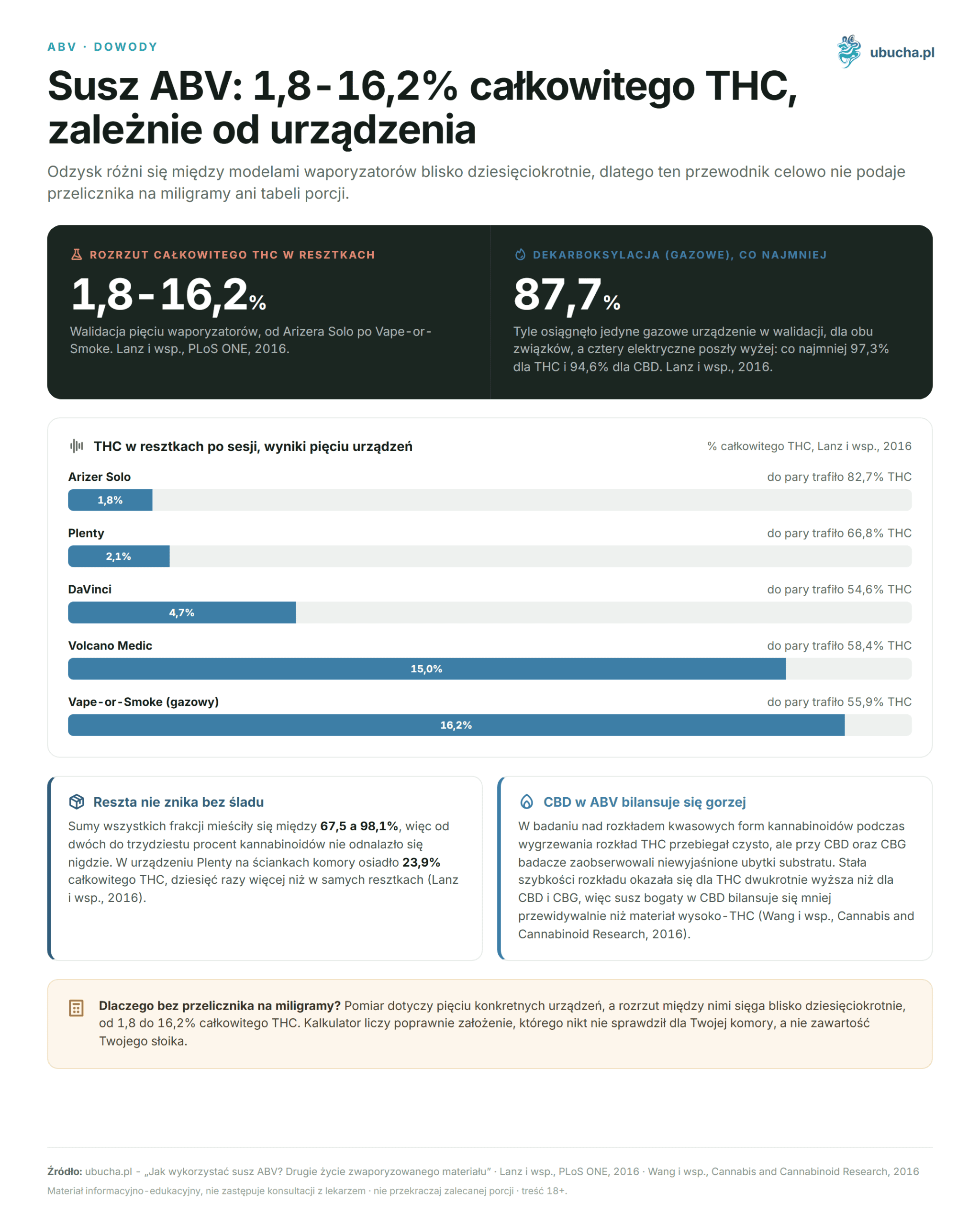
ABV herb, from English already been vaped, is the brown material left in the vaporizer chamber after a session that most users throw away. Validation of five devices published in PLoS ONE measured each fraction separately and showed that residues in the chamber carry from 1.8 to 16.2% of total THC, depending on the model. This is much less than guides promise but still not zero. The same measurement showed something else: in four electric devices, decarboxylation efficiency was at least 97.3% for THC and 94.6% for CBD, meaning the material leaves the chamber chemically ready to eat, without baking in the oven. This guide will tell you how much really remains after a session, how to recognize well-vaped herb, how to store it, and how to convert it into butter, capsules, or drink without spoiling the whole recipe’s taste.
KEY INFORMATION
• Residues in the chamber contain 1.8-16.2% total THC, depending on the device (Lanz et al., PLoS ONE 2016).
• The more efficient the vaporizer, the leaner the collection: Arizer Solo leaves 1.8%, Volcano Medic 15.0%.
• In electric devices, decarboxylation reaches at least 97.3% for THC and 94.6% for CBD, so the oven step is unnecessary.
• A fatty meal quadrupled CBD exposure in eight patients with drug-resistant epilepsy (Birnbaum et al., Epilepsia 2019).
What is ABV herb and how many cannabinoids remain in it?
ABV stands for Already Been Vaporized, i.e., herb left in the chamber after a session. Validation of five vaporizers weighed four fractions separately: vapor, chamber residues, device parts, and tubing. Residues contained from 1.8 to 16.2% total THC and from 1.1 to 14.7% total CBD, depending on the model (Lanz et al., PLoS ONE 2016).
The spread between models is greater than intuition suggests and follows a rule opposite to common assumptions. Arizer Solo delivered the most vapor, 82.7% total THC, and left the least in the chamber, 1.8%. Volcano Medic delivered 58.4% and left 15.0%. The more efficient the vaporizer, the poorer the secondary material, so collection from a good device is by definition leaner.
| Vaporizer | THC in vapor | THC in residues | CBD in residues | Deposited in device | Input per 1 g THC from residues |
|---|---|---|---|---|---|
| Arizer Solo | 82.7% | 1.8% | 1.6% | 13.6% | about 56 g |
| Plenty | 66.8% | 2.1% | 1.1% | 23.9% | about 48 g |
| Volcano Medic | 58.4% | 15.0% | 11.3% | 1.6% | about 7 g |
| Vape-or-Smoke (gas) | 55.9% | 16.2% | 14.7% | 12.4% | about 6 g |
| DaVinci | 54.6% | 4.7% | 3.3% | 7.4% | about 21 g |
The columns do not sum to one hundred percent and this is a separate piece of information, not a table error. The sums of all fractions ranged between 67.5 and 98.1% in the study, so from two to thirty percent of cannabinoids were not found anywhere: they decomposed in heat or were lost during analysis. The popular saying that “everything not inhaled ends up in the chamber” is therefore false by an order of magnitude.
You can also see where the rest really goes. In Plenty, 23.9% of total THC deposited in device parts, ten times more than in residues alone, and in Arizer 13.6%. These cannabinoids remain on chamber walls and mouthpiece, not in the powder you dump into a jar. Regular device cleaning recovers more than the entire ABV collection, but in a form unsuitable for cooking.
How much material do you realistically collect? The chamber leaves slightly less powder after a session than the input because mainly water and volatile fraction are lost. Several grams of ABV result from dozens of sessions, practically a few weeks of use. The collected material comes from an unknown device, and the range from 1.8 to 16.2% shows how much this changes the result.
The last column is a conversion of the adjacent column’s share, not a separate measurement: the study states what portion of THC remains in residues, not how much the residues weigh. It thus indicates how much herb must be run through a given device to have THC in collected ABV equivalent to one gram of fresh material. The difference between Volcano Medic and Arizer Solo is eightfold and determines whether collecting ABV makes sense at all.
Why is material after vaporization already decarboxylated?
Because the vaporizer does exactly the same as an oven during decarboxylation, only faster and with full temperature control. In the same validation, decarboxylation efficiency of four electric devices was at least 97.3% for THC and 94.6% for CBD; the gas device performed worse, at least 87.7% for both cannabinoids (Lanz et al., PLoS ONE 2016).
The chemistry behind this number is well described. Wang’s team studied the breakdown of acidic cannabinoid forms at 80, 95, 110, 130, and 145 degrees Celsius, obtaining an exponential dependence typical for first-order reactions (Wang et al., Cannabis and Cannabinoid Research 2016). The rate constant for THCA-A was twice as high as for cannabidiol and cannabigerol acid counterparts. Practical conclusion: THC activates fastest, CBD and CBG need longer heating.
A vaporization session usually occurs between 170-220 degrees, well above the threshold where the reaction starts. Therefore, you do not do with ABV what you do with fresh flower before baking. If you are interested in the fresh material heating procedure, we described it separately in the article on step-by-step cannabis decarboxylation. With ABV, you simply skip this step, saving an hour and avoiding losses caused by extra heating.
The same study noted something rarely mentioned. THCA-A breakdown proceeded cleanly, without side reactions or byproducts, whereas cannabidiol and cannabigerol acid showed unexplained substrate or product losses. For someone collecting ABV from CBD-rich herb, the conclusion is inconvenient: the balance is less predictable than with high-THC material. This does not mean cannabidiol disappears. It only means home conversions have an even larger margin of error with CBD than with THC.
Why shouldn’t ABV be thrown away?
Because you throw away material you already paid for, just less valuable than legend says. With a device like Volcano Medic, residues contain 15.0% total THC and 11.3% total CBD; with Vape-or-Smoke, 16.2 and 14.7% respectively (Lanz et al., PLoS ONE 2016). With Arizer or Plenty, we talk about single-digit percentages.
There is also an argument few think about during the first session. The ABV profile is not a miniature of fresh flower profile but material shifted towards degradation products. Cannabinol forms from THC degradation under heat and time, and analysts treat its content directly as an indicator of cannabis sample age and condition (Mandrioli et al., J Pharm Biomed Anal 2024). ABV undergoes an accelerated version of this process in the chamber.
This explains a common user observation: ABV products are more often described as heavy and evening than stimulating. This is not a placebo effect but a consequence of material composition. If you want to understand cannabinol itself, we analyze its properties in a separate post on CBN and its effects. The third reason is banal but true: cultivation, drying, and transport of herb cost water and energy, and dumping residues prematurely closes this chain.
The calculation becomes interesting only on a yearly scale. Someone emptying two 0.2 g chambers daily collects well over one hundred grams of secondary material per year that otherwise would not exist. Even at a few percent content, this yields a noticeable amount, and with a device from the top of the table, clearly less. The cost of collection is zero: just one jar kept in a drawer next to the vaporizer and the habit of emptying the chamber into it instead of the trash. The habit builds in two weeks, and material accumulates by itself.
How to store ABV to preserve potency?
Just like fresh herb, only with even more attention to moisture. Vaporized material is overdried and absorbs water from air faster than flower. The longer it sits, the more the profile shifts towards cannabinol, which in analytics serves as an age indicator (Mandrioli et al., 2024).
The first choice container is a small dark glass jar with a seal. Plastic is out: it absorbs aromas, electrifies, and with prolonged contact with oily powder can release its own additives. The interior must be dry before adding material, and a moisture absorber sachet at the bottom reduces mold risk. Keep the jar in a drawer or fridge, never on a windowsill.
What shortens ABV shelf life fastest:
- exposure to sun, halogen, or other heat sources near the container,
- frequent opening of the jar letting in moist air,
- handling herb with greasy fingers instead of a clean spoon,
- storing in bathroom, near oven, or in a car,
- thin ziplock bags that let oxygen through and crush material.
From our talks with vaporizer users, the best system is three jars: current week, last month, and batch ready for processing. This way you don’t mix material of different ages, and each batch retains roughly uniform character. Broader rules are collected in our post on proper cannabis storage.
Freezing is sometimes recommended but has a catch. A removed jar gets covered with condensed water, and moisture is the shortest path to mold in material that absorbs water by itself. If you freeze, remove the container an hour before opening and let it reach room temperature with the lid closed. For batches processed within weeks, the fridge suffices, and for material waiting longer than a quarter, freezing in small single-use portions makes sense.
What ABV recipes are in this text?
Three groups, ordered from most labor-intensive. Cannabis butter requires melting and straining but gives a carrier you can use in any baked good. Capsules and tincture require no cooking and keep longest. Drinks and quick snacks - banana smoothie, golden milk, and firecracker crackers - take from a few to twenty minutes and are best to start with.
All three share one thing: the material is already decarboxylated, so you don’t reheat it in the oven. Just fat and time suffice, as cannabinoids transfer to fat, not water.
How to make cannabis butter from ABV step by step?
Butter is the simplest processing method because cannabinoids transfer well to fat, and the finished product fits any recipe. The ABV version differs by skipping the heating step since the material left the chamber decarboxylated at at least 94.6% for CBD and 97.3% for THC, if the vaporizer was electric (Lanz et al., 2016).
You need 10-15 g ground ABV, 250 g unsalted high-fat butter, a glass of water to prevent burning, and cheesecloth or a very fine sieve. A kitchen thermometer is essential because the whole difference lies in temperature.
- Melt butter with water in a heavy-bottomed saucepan on the lowest heat.
- Add ground herb and bring mixture to 70 degrees, monitoring with thermometer.
- Maintain this temperature for one hour, stirring every ten minutes.
- Strain through cheesecloth into a clean container, squeezing liquid from the sediment.
- Chill in the fridge at least three hours until fat solidifies above water.
- Remove solid block, dry it, and store in the fridge up to eight weeks.
The classic fresh herb recipe calls for 90-100 degrees for two hours to allow decarboxylation. Here, such temperature would only destroy what survived the session along with terpene residues. The full procedure for fresh material is in our cannabis butter recipe.
The taste of the finished product depends more on filtering than extraction time. Fold cheesecloth into at least four layers and do not squeeze sediment completely, as the last drops carry the most bitter fractions into the butter. Divide the solid block into portions immediately and wrap each separately. Then taking a piece does not require thawing the whole, and the rest can be kept in the freezer for up to six months without noticeable taste loss.
How to prepare capsules and tincture from ABV?
Capsules provide repeatable volume and eliminate taste; tincture allows dosing by single drops. Both forms rely on the same principle as butter: cannabinoids are lipophilic and need a carrier. A study with eight adults with drug-resistant epilepsy showed the cannabidiol concentration area under the curve was four times higher after a fatty meal than fasting (Birnbaum et al., Epilepsia 2019).
Make capsules with 10 g ground ABV and 100 ml refined coconut or MCT oil. Heat oil in a water bath to 70 degrees, add herb, and maintain temperature for one hour. Filter hot liquid through cheesecloth into a dark glass bottle, cool to about 40 degrees, then fill empty size 00 capsules with a syringe. Store finished capsules in the fridge up to three months.
Tincture requires patience. Cover 20 g ground ABV with vodka or diluted spirit so the liquid covers herb by two centimeters, label the date, and place the jar in a dark cabinet for six weeks, shaking daily. After that, filter through a coffee filter into a dropper bottle and keep in the fridge.
Forum conversions promise you can calculate solution strength in milligrams per milliliter after such extraction. The calculation assumes cannabinoid content in secondary material, but measured values vary nearly tenfold between devices, from 1.8 to 16.2% total THC. The calculator thus correctly computes an assumption no one verified for your chamber, not your jar’s content.
Describing containers sounds excessive until you have three similar bottles in the fridge. Label with soaking date, herb weight, and solvent volume. Dark glass is not a whim: light breaks down cannabinoids in solution faster than in dry material, and a clear bottle on the fridge door gets a dose each time opened. Store tincture kept long in a box.
What drinks and quick snacks come from ABV?
The best are those carrying lots of fat and having a strong own flavor. The first condition is supported by measurement: a fatty meal quadrupled cannabidiol concentration area under the curve and increased maximum concentration fourteenfold (Birnbaum et al., 2019). The second is common kitchen experience: without a strong flavor base, the bitterness of vaporized herb breaks through everything.
| Recipe | Fat carrier | What masks bitterness | Preparation time |
|---|---|---|---|
| Banana smoothie | coconut milk, peanut butter | sweetness of banana and nut paste | 3 minutes |
| Golden milk with turmeric | full-fat coconut milk | turmeric, cinnamon, ginger | 20 minutes |
| Firecracker crackers | natural peanut butter | salt and fat from paste | 10 minutes |
Blend the smoothie for at least a minute at high speed, as the finer the powder, the less gritty it feels. Heat golden milk to 70 degrees with turmeric, cinnamon, and a pinch of pepper, adding herb in the last fifteen minutes on low heat. Add honey after removing from heat to preserve aroma.
Firecracker is fastest. Spread two crackers thickly with peanut butter, sprinkle herb on one, press lightly, fold into a sandwich, wrap in foil, and heat for thirty seconds at 600 W. Without a microwave, wrap in foil and bake for twenty minutes at 120 degrees. Higher temperature is unnecessary since activation is not needed.
Warm drinks have another advantage important for evening ritual. Slow drinking over fifteen minutes spreads absorption over time and softens onset, unlike eating everything in two minutes. If you prefer an infusion without fat base, a ready cannabis tea is a better choice, as ABV herb brewed in plain water releases little. Cannabinoids practically do not dissolve in water, so without fat or alcohol they remain in the dregs.
What is ABV good for outside the kitchen?
For baths and topical preparations, where systemic effect is unwanted. The WHO expert committee in a 2018 review noted that use of pure cannabidiol has not been associated with any public health problems (WHO ECDD, 2018). Vaporizer chamber powder is not a pure preparation and this assessment does not apply.
The simplest recipe is three grams of ground ABV mixed with 50 ml melted coconut oil, left for an hour, then combined with a cup of Epsom salt and a dozen drops of essential oil. Put all into a muslin bag or cotton sock, tie, and drop into a bath with water at 38-40 degrees. The bag traps sediment no one wants to fish from the drain.
Soaking for twenty minutes suffices. Magnesium from salt relaxes muscles, coconut oil limits skin drying from hot water, and after the bath it’s better to towel dry than rinse in the shower. The same ABV oil poured into a jar serves as a balm base. Ready skin products are in our cannabis cosmetics category.
One rule applies to external use that no one likes: test on a small forearm patch a day before. Homemade ABV oil undergoes no microbiological control, and material stored for months in a jar may be contaminated with mold invisible to the naked eye. Do not apply such preparations on damaged skin or inflammatory lesions. If you want repeatable composition, ready cosmetics are always safer than a jar from the kitchen drawer.
Why can’t ABV herb potency be reliably calculated?
Because the measurement that exists does not concern your case. Validation of five vaporizers gave residue content to a tenth of a percent, but the range between devices was from 1.8 to 16.2% total THC, and for one device the standard deviation exceeded the mean (Lanz et al., PLoS ONE 2016). If your model is not on this list, you have no starting point.
There is also uncertainty on absorption. A systematic review covered 24 human studies and found that none measured absolute oral bioavailability of cannabidiol, though smoking was measured at 31% (Millar et al., Frontiers in Pharmacology 2018). Internet ranges for oral route come from one source: a statement in the introduction citing Mechoulam’s 2002 work, mainly based on animal studies. This is literature background, not the review’s own measurement.
| What affects ABV potency | What can be determined | What cannot be determined |
|---|---|---|
| Starting material | content from batch test if seller provides | whether value includes acid forms |
| Vaporizer model | residue content for five devices from Lanz’s study | how much remains in models outside this five |
| Temperature and session length | device settings if recorded | how far degradation proceeded at those settings |
| Age of collection | date on jar | how profile shifted towards cannabinol |
| Extraction into fat | recipe proportions and temperature | what fraction of cannabinoids actually transferred to butter |
Therefore, this text does not include portion tables or milligram conversions. This is not excessive caution. EFSA in an updated 2026 assessment derived a temporary safe cannabidiol dose of 0.0275 mg per kilogram body weight per day, about 2 mg daily for a 70 kg person, and specified it applies only to supplements with at least 98% purity (EFSA NDA Panel, 2026). The same opinion states safety of cannabidiol cannot be established for people under 25, pregnant or breastfeeding, or taking medications.
What to do in practice? Treat each new batch as unknown, note device and session settings, and do not mix material from different periods.
How fast does ABV act and how long does it last?
Slower than vaporizer experience suggests. A study comparing three cannabis administration routes with 6.9% THC content (~54 mg per dose) showed heart rate rose above baseline half an hour after inhalation but only after 1.5 hours orally, lasting beyond three hours (Newmeyer et al., Drug and Alcohol Dependence 2017).
The same study observed something important for ABV product users. Subjective effects increased significantly after each route in occasional users, but in frequent users oral effects did not differ from placebo. In other words, tolerance built on vaporization translates more strongly to oral products than most expect. Cannabidiol pharmacokinetics review gives time to maximum concentration between zero and four hours (Millar et al., 2018).
The practical conclusion is dull: after eating anything with ABV, wait at least one and a half hours before deciding nothing happens. Beginners often err by taking a second dose after thirty minutes when the first is not absorbed yet. Effects overlap after an hour, resulting in an unplanned evening. Fat in the meal, fine grinding, and warm drink speed onset; a full stomach slows it.
Duration is another matter with practical consequences. Oral cannabis products act noticeably longer than inhalation, and residual impairment can last even when you subjectively feel normal. Plan ABV products for an evening without obligations, not an hour before going out. Do not drive the same day regardless of how little you ate or how legal the starting material was.
How to deal with ABV’s bitter taste?
With three parallel moves: fine grinding, fatty base, and strong flavor addition. You cannot improve the material itself because bitterness comes from thermal degradation products formed in the chamber, and their share relative to cannabinoids depends on session temperature (Pomahacova et al., Inhalation Toxicology 2009).
This study actually shows a result opposite to intuition. The cannabinoid to byproduct ratio in Volcano vapor was significantly better at 200 and 230 degrees than in cannabis cigarette smoke, and worst at 170 degrees. Low session temperature does not guarantee cleaner secondary material.
What really masks bitterness in recipes:
- honey, maple syrup, or date syrup added after removing from heat,
- cocoa and dark chocolate above 70%, which share a note with herb,
- peanut butter, cashew butter, and tahini,
- cinnamon or vanilla in warm drinks,
- turmeric with ginger if you prefer a savory profile.
Grinding does more than any additive. An electric spice grinder turns herb into powder like finely ground coffee, which stops crunching between teeth. Use short pulses instead of continuous blade run, as a heated grinder warms material that does not need activation.
There is also a workaround for those especially sensitive to bitterness. Instead of masking taste in a recipe, move herb into a form that does not touch the tongue at all, i.e., capsules. You lose eating pleasure but gain peace of mind. In baked goods, the problem almost disappears because cocoa and fat in the dough work in the same direction.
The devices that started this whole story are collected in the vaporizers category, and their operating principle is explained in the guide on how a vaporizer works.
Is ABV herb legal in Poland?
Origin of material decides, not form. ABV from hemp is legal just like the original herb, and ABV from material exceeding the legal threshold is subject to the July 29, 2005 anti-narcotics law on the same terms as the raw material it came from (consolidated text Dz.U. 2023 item 1939).
The threshold is often described inaccurately, so it’s worth quoting the legal wording. Article 4 point 5 of this law, as amended by the March 24, 2022 act (Dz.U. 2022 item 763, effective May 7, 2022), defines hemp as Cannabis sativa L. plants in which the sum of delta-9-THC and tetrahydrocannabinolic acid in flower or fruiting tops with unremoved resin does not exceed 0.3% dry weight, rounded to one decimal place. Two things in this sentence change test results: the sum with acid form counts, not just delta-9-THC, and the plant is measured, not the finished product.
Material above the threshold is listed. Cannabis other than hemp appears under position 113 in annex 2 to the Ministry of Health regulation on psychotropic substances and narcotics, in group I-N narcotics (consolidated text Dz.U. 2024 item 1139). Lists are annexes to the regulation, not the law, and the legal path goes through article 33a of the law: herb as pharmaceutical raw material for pharmacy-compounded medicines on prescription. Vaporization changes nothing here.
Two situations require special attention. First is transport: an unlabelled jar with brown powder looks suspicious, so carry original packaging with batch test alongside the collection. Second is tests for alcohol-like substances that may detect THC metabolites even from material within the threshold. The legal threshold itself does not protect against a positive result.
Home practice requires several fixed habits:
- label jars and finished products with date and content,
- keep them out of reach of children and animals,
- never share without clear information about the portion,
- do not drive after consuming any cannabis product,
- do not combine products with alcohol or sedatives,
- consult use with a doctor for chronic diseases and regular medications.
Frequently Asked Questions
Does ABV herb have psychoactive effects?
It depends solely on the starting material. ABV from legal hemp herb comes from a plant within the 0.3% threshold of total delta-9-THC and THCA, so it does not intoxicate. The WHO expert committee in a 2018 review stated that pure cannabidiol in humans shows no effects indicating potential for abuse or dependence (WHO ECDD, 2018).
Can you eat ABV straight from the vaporizer chamber?
Chemically nothing prevents it, as in electric devices decarboxylation reached at least 94.6% for CBD and 97.3% for THC (Lanz et al., 2016). Practically, it’s a bad idea: the taste is very bitter, and without fat absorption remains low.
How long can ABV be stored?
In an airtight dark glass jar, kept cool and away from light, the material lasts longest, but with each month the profile shifts towards cannabinol, which researchers treat directly as an indicator of the age and condition of the cannabis sample (Mandrioli et al., 2024). A moisture absorber sachet reduces mold risk.
Can ABV be vaporized a second time?
It can, but the yield is negligible. Residues after the first session contained from 1.8 to 16.2% of total THC, and what remains is released only at temperatures where the material starts to burn (Lanz et al., 2016). Extraction into fat or alcohol recovers more.
How much ABV is needed for one batch of cannabis butter?
The ratio used in home recipes is 10-15 g of ground ABV per 250 g of butter. How many cannabinoids end up in the finished block depends mainly on the device: residues from five tested vaporizers contained from 1.8 to 16.2% total THC. With such a range, we do not provide a conversion per spoon or serving.
What acts faster: tincture or butter from ABV?
A tincture held briefly under the tongue starts working earlier because part of the dose bypasses the first pass through the liver. Via the digestive route, physiological effects appeared only after 1.5 hours and lasted beyond three (Newmeyer et al., 2017). Both forms require waiting before assessing the effect.
How to distinguish good ABV from overheated?
Good material ranges from light brown to amber, crumbles in the fingers, and smells of roasted nuts. Black, hard, and smoking herb is a sign of a session conducted at the upper limit of the scale. It is still suitable for baths but gives a very weak effect in culinary recipes.
Is possession of ABV legal in Poland?
Yes, as long as it comes from hemp herb, i.e., a plant within the 0.3% threshold of total delta-9-THC and THCA. ABV from material above this threshold is subject to the anti-narcotics law on the same terms as the original herb (consolidated text Dz.U. 2023 item 1939). Origin decides, not form.
The second life of herb begins with the quality of the first. The higher the initial cannabinoid content and the better the terpene profile preserved, the more remains in the chamber after a session, so check the batch lab test before purchase. Legal hemp flowers are in the hemp herb category, and containers protecting collection from light and moisture in the storage category.
This article is informational and educational and does not constitute medical advice. Before starting cannabis or CBD for therapeutic purposes, consult a doctor, especially if you take other medications, are pregnant, or breastfeeding.
Author: Michał Waluk · Published: 2026-05-11 · Updated: 2026-08-24