
Transdermal CBD Patches: How They Work and When to Use Them (FAQ)
Does CBD from the patch enter the bloodstream? We check what has been measured in humans, what only in animals, and where EFSA has set the safety limit.
A patch with cannabidiol promises what neither a capsule nor a cream provides: a steady level of the substance for many hours, without passing through the stomach. Pharmacologically, this promise makes sense. However, there is significantly less evidence than product descriptions suggest. A systematic review of CBD pharmacokinetics in humans states that the absolute bioavailability of cannabidiol was determined in humans only after smoking and was 31 percent, and no study has attempted to measure it for the transdermal route (Millar et al., Frontiers in Pharmacology, 2018). This text shows what is really known about CBD patches, which results come from animals, which from humans, and why you won’t find a dosing scheme here.
KEY INFORMATION
• The absolute bioavailability of CBD has been measured in humans only after smoking and was 31 percent; no study has done this for the transdermal route (Millar et al., 2018).
• Transdermal CBD gel provides a plasma concentration that increases linearly with the dose, but this has been shown in rats, not in humans (Hammell et al., 2016).
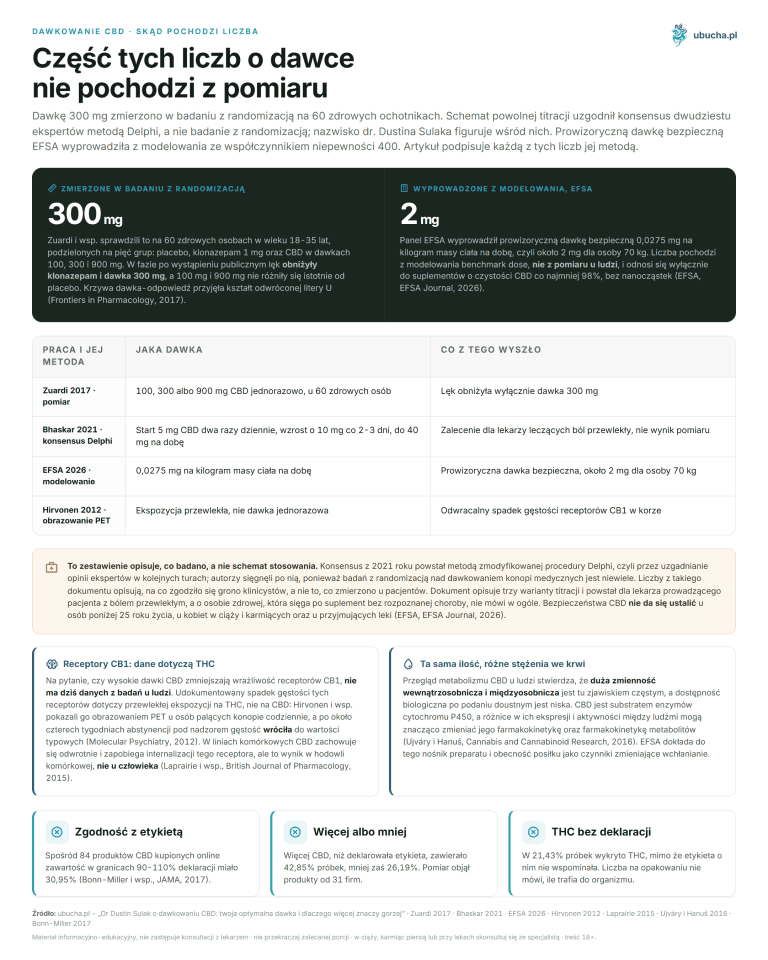
• EFSA established a temporary safe dose in 2026 of 0.0275 mg per kilogram of body weight per day, which is about 2 mg daily for a person weighing 70 kg.
• The safety of CBD cannot be established in individuals under 25 years of age, in pregnant and breastfeeding women, and in individuals taking medications (EFSA, 2026).
• The store ubucha.pl does not carry patches with cannabidiol; catalog status as of August 16, 2026.
Does CBD from the patch actually enter the bloodstream?
Yes, although the strongest evidence comes from animals. In a knee joint inflammation model in rats, transdermal CBD gel provided a plasma concentration that increased linearly with the dose, ranging from 0.6 to 6.2 mg per day, while also reducing joint swelling and immune cell infiltration (Hammell et al., European Journal of Pain, 2016).
The route itself is physiologically possible. Cannabidiol is well soluble in fats, so it overcomes the lipid-rich stratum corneum of the epidermis. From the dermis, densely supplied with vessels, the substance passes into the systemic circulation, bypassing the intestine and liver, thus avoiding first-pass metabolism, which reduces exposure after ingestion.
The second set of measurements comes from guinea pigs. After applying CBD gel, the plasma concentration stabilized at 6.3 ng/ml and was reached after about 15.5 hours, and adding a permeation-enhancing substance raised this level 3.7 times (Paudel et al., Drug Development and Industrial Pharmacy, 2010). This explains why manufacturers add permeation enhancers to the matrix: without them, the flow through the skin is too small to change anything.
None of these studies are human studies, and none provide the percentage of the absorbed dose.
How much CBD from the patch is absorbed in humans?
It is unknown, and this is not an oversight of this text. A review of 24 studies with pharmacokinetic measurements in humans showed that the absolute bioavailability of cannabidiol was determined only after smoking, at 31 percent, and no one has attempted such a trial for any other route of administration (Millar et al., Frontiers in Pharmacology, 2018).
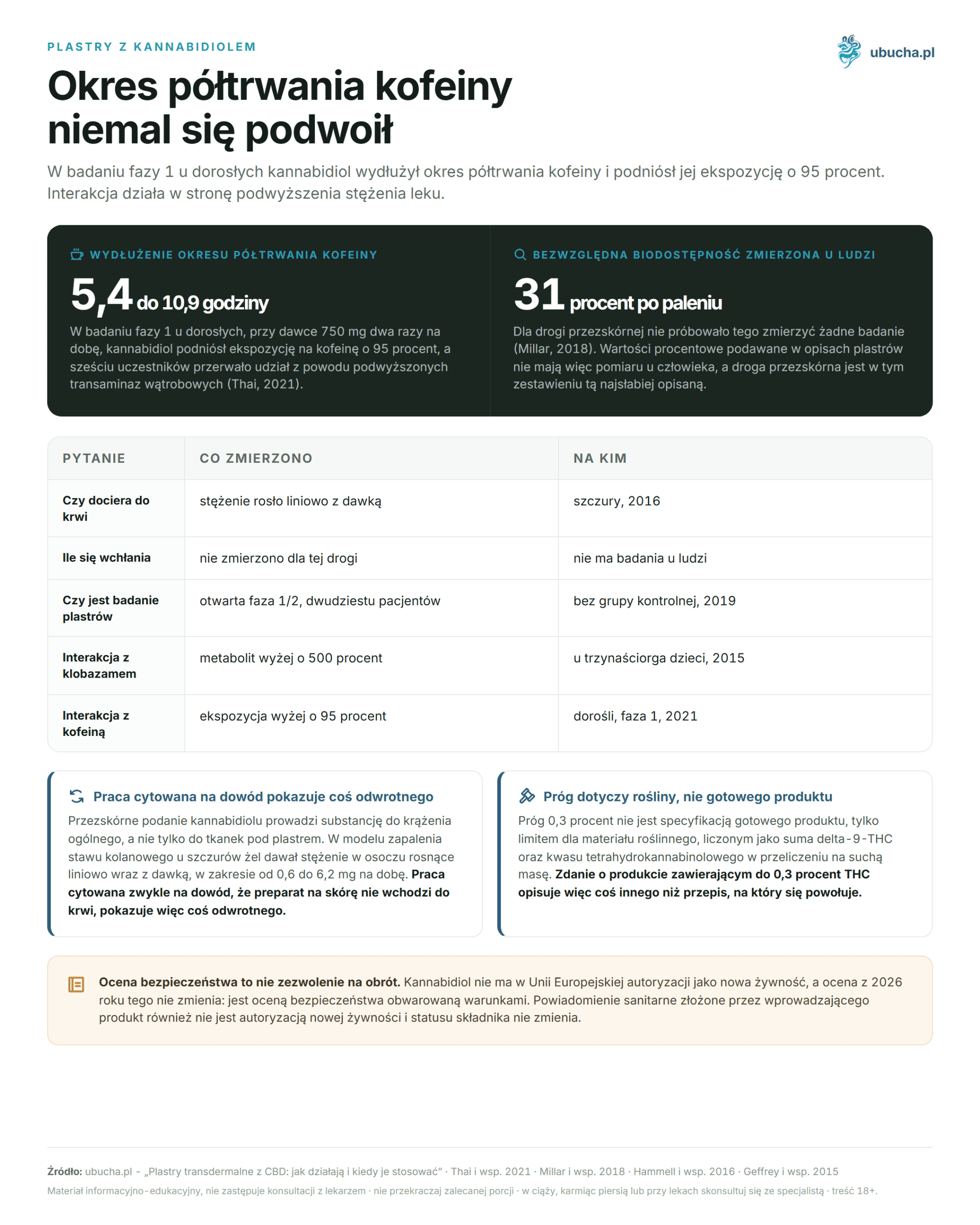
Therefore, the percentage values circulating in patch descriptions have no measurement behind them. This also applies to tables comparing the bioavailability of the patch with the bioavailability of oil: the columns appear to be the result of a study, but in reality, they are copied from one text to another. The following table shows what has really been measured and on whom.
| Study | Who was studied | What was measured | Result |
|---|---|---|---|
| Millar et al. 2018 | humans, review of 24 studies | absolute bioavailability | determined only after smoking: 31 percent |
| Hammell et al. 2016 | rats | plasma concentration after gel | linear in the range of 0.6-6.2 mg per day |
| Paudel et al. 2010 | guinea pigs | steady concentration after gel | 6.3 ng/ml after about 15.5 hours |
| Heussler et al. 2019 | 20 people aged 6-17 years | symptoms and safety | improvement in symptom scales, no control group |
However, there is an open phase 1/2 study of the transdermal gel ZYN002 in twenty children and adolescents aged 6 to 17 years with fragile X syndrome. The gel was used twice daily for 12 weeks, increasing the daily dose from 50 to a maximum of 250 mg. Researchers noted improvements in anxiety and mood scales and adverse events in 85 percent of participants, mostly mild (Heussler et al., Journal of Neurodevelopmental Disorders, 2019). The study had no control group or blinding, and it measured symptoms, not absorption.
How does a patch differ from CBD cream and gel?
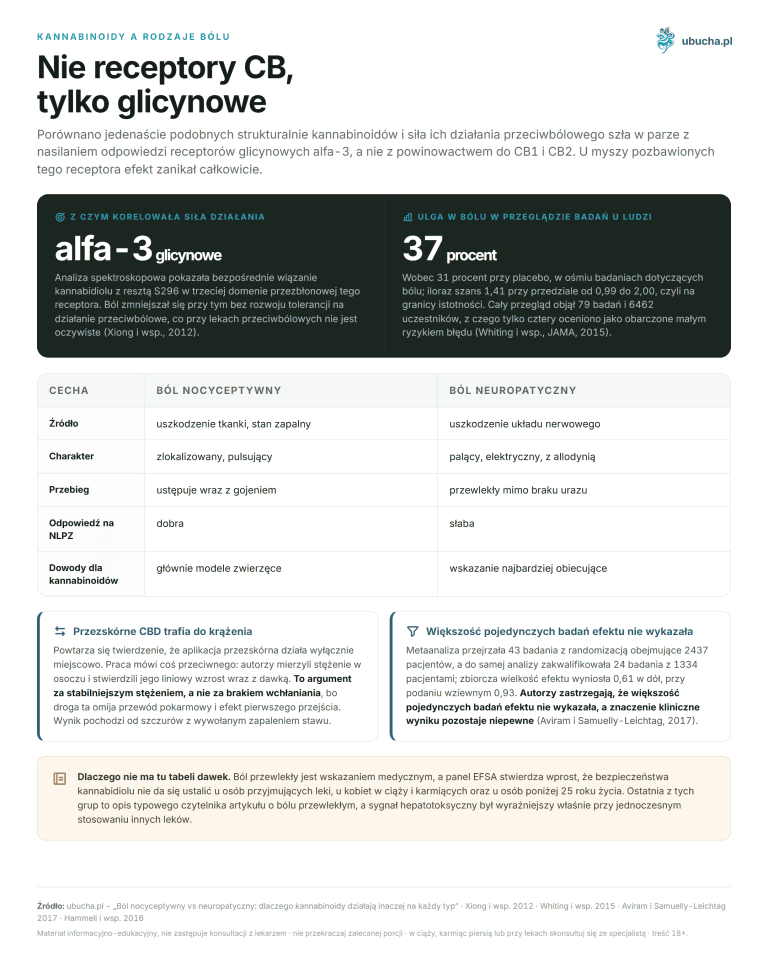
Less than is usually written. The statement that a preparation applied to the skin works exclusively locally and does not enter the blood is sometimes supported by Hammell’s work, but this shows the opposite: the concentration of cannabidiol in plasma increased linearly with the dose of the gel. The work concerns rats, but says exactly the opposite of what it is cited for.
The boundary is rather drawn by the structure of the preparation than by its trade name. The patch has a matrix designed to release the substance slowly over the planned wearing time. A cream or gel releases it all at once, and how much reaches the circulation depends on the carrier, the presence of permeators, and the application site.
The practical conclusion is more cautious than the marketing one. Do not assume that a preparation applied to the skin stays in one place, nor that a patch applied over a painful joint targets that joint. The difference between a topical and a transdermal preparation is developed in a separate text about transdermal patches and regular ointments, and a broader overview of routes of administration can be found in the post about methods of consuming cannabis and CBD.
How much CBD is safe and what happens with medications?
The only number given in this text as a limit comes from the EFSA assessment. The panel on nutrition and new food established in 2026 using the benchmark dose method, with an uncertainty factor of 400, a temporary safe dose of 0.0275 mg per kilogram of body weight per day, which is about 2 mg daily for a person weighing 70 kg (EFSA, EFSA Journal, 2026).
This is a ceiling, not a recommendation, and is subject to caveats. It applies only to supplements with a purity of cannabidiol of at least 98 percent and without nanoparticles. The panel also states explicitly that the safety of CBD cannot be established in individuals under 25 years of age, in pregnant and breastfeeding women, and in individuals taking medications simultaneously.
The last group has practical significance here, as interactions have been demonstrated in humans. In thirteen children taking clobazam and cannabidiol simultaneously, the concentration of the active metabolite of clobazam increased by an average of 500 percent, and adverse effects occurred in ten of them (Geffrey et al., Epilepsia, 2015). In a phase 1 study in adults, at a dose of 750 mg twice daily, CBD prolonged the half-life of caffeine from 5.4 to 10.9 hours and increased its exposure by 95 percent, and six participants discontinued participation due to elevated liver transaminases (Thai et al., Clinical Pharmacology in Drug Development, 2021). The interaction works towards increasing the concentration of the drug, so the risk is overdose, not loss of effect.
Therefore, there is no dosing scheme or wearing time for the patch here. The dose and method of using the cannabidiol preparation should be determined with a doctor.
Are CBD patches legal and can you buy them in Poland?
Cannabidiol does not have authorization as a novel food in the European Union, and the EFSA assessment from 2026 does not change this: it is a safety assessment with conditions, not a permission for marketing. The sanitary notification submitted by the product introducer is also not authorization for novel food and does not change the status of the ingredient.
Separately, it is worth correcting the number that recurs in patch descriptions. The 0.3 percent threshold is not a specification of the finished product, but a limit for plant material. The Act on Counteracting Drug Addiction, as amended on May 7, 2022, counts it as the sum of delta-9-THC and tetrahydrocannabinolic acid calculated on a dry mass basis. The statement about a product containing up to 0.3 percent THC describes something different than the regulation it refers to.
As for purchasing: in the catalog of the store ubucha.pl, as of August 16, 2026, there is not a single patch with cannabidiol. However, there are topical preparations, such as hemp massage gels, as well as cosmetics, which we dedicated a separate text to about hemp creams and balms. This is a different category of product and a different purpose than a transdermal patch, so do not treat them as a substitute.
Frequently Asked Questions
Does the CBD patch work locally or systemically?
Transdermal administration of cannabidiol leads the substance to the systemic circulation, not just to the tissues under the patch. In a rat model, plasma concentration increased linearly with the dose of the gel (Hammell et al., 2016). However, in humans, it has not been measured what portion of the dose from the patch reaches the blood.
How much CBD is absorbed from the patch?
This has not been established in humans. A review of CBD pharmacokinetics showed that absolute bioavailability was determined only after smoking and was 31 percent, and no study has measured it for the transdermal route (Millar et al., 2018). The percentage values given in patch descriptions have no measurement in humans.
Is there a study of CBD patches in humans?
There is an open phase 1/2 study of the transdermal gel ZYN002 in twenty children and adolescents aged 6 to 17 years with fragile X syndrome, conducted over 12 weeks (Heussler et al., 2019). It did not have a control group, so it does not determine the efficacy of the preparation.
How does a patch differ from CBD cream?
By structure, not by the fact that one works systemically and the other only locally. The patch has a matrix that releases the substance slowly over the planned wearing time, while the cream releases it all at once. The work usually cited as evidence that topical preparations do not enter the blood shows the opposite.
How much CBD is safe to take daily?
EFSA established a temporary safe dose in 2026 of 0.0275 mg per kilogram of body weight per day, which is about 2 mg for a person weighing 70 kg. This applies only to preparations with a purity of at least 98 percent and without nanoparticles. This is a limit, not a recommendation.
Can CBD from the patch interact with medications?
Yes. In children taking clobazam along with cannabidiol, the concentration of the active metabolite of the drug increased by an average of 500 percent (Geffrey et al., 2015), and in a study in adults, CBD nearly doubled exposure to caffeine (Thai et al., 2021). EFSA does not establish the safety of CBD in people taking medications.
This article is for informational and educational purposes and does not constitute medical advice. Before starting to use cannabis or CBD for therapeutic purposes, consult a doctor, especially if you are taking other medications, are pregnant, or breastfeeding.
Author: Michał Waluk · Published: 2026-08-09 · Updated: 2026-08-16