
Herbs for Sleep: Lemon Balm, Lavender, Hops, and CBD (Comparison)
Lemon balm, lavender, hops, and CBD for sleep compared according to what the HMPC monographs and studies really say, not according to promises on the packaging.
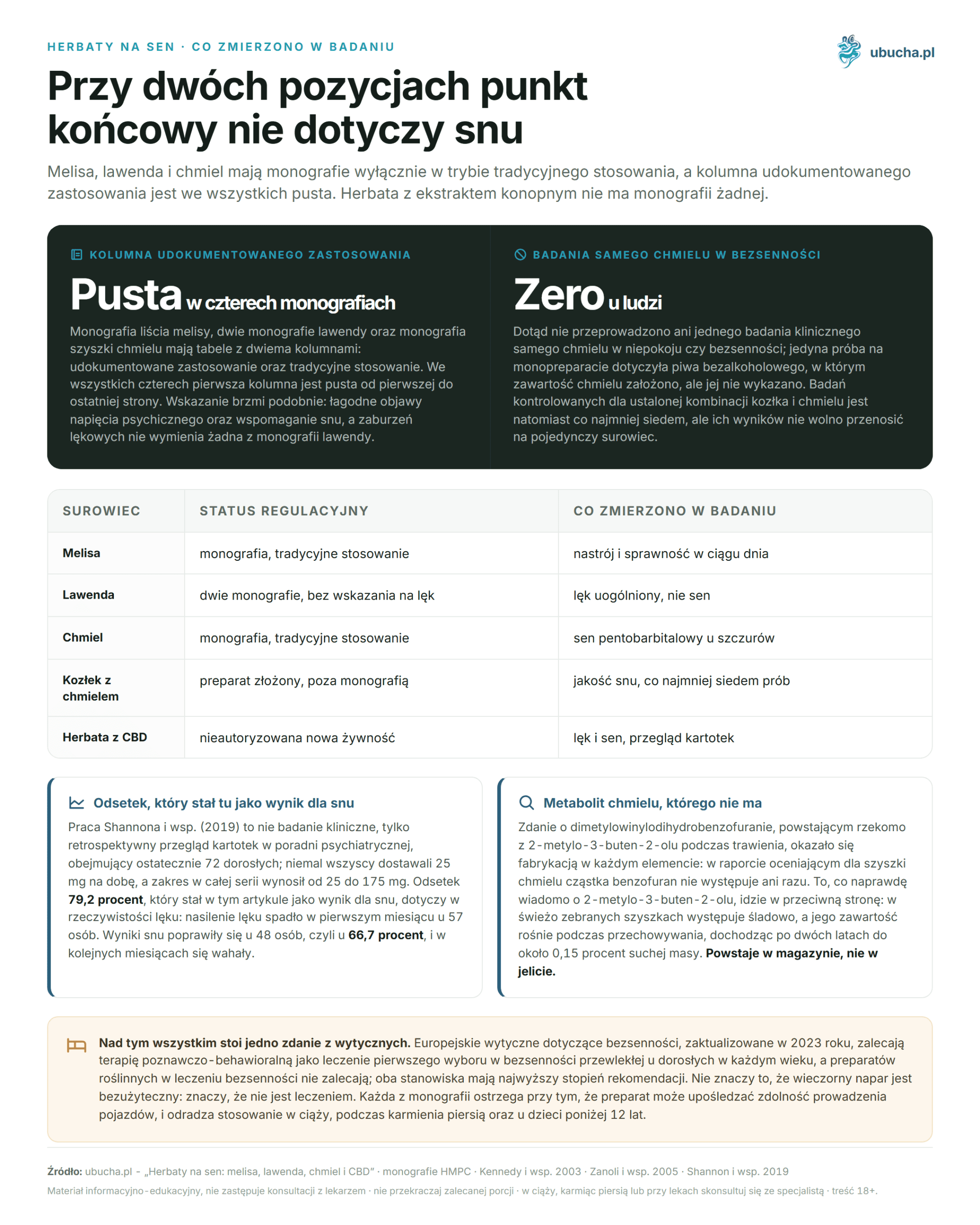
Lemon balm, lavender, and hops have monographs from the European Union’s Committee on Herbal Medicinal Products, while tea with hemp extract has none. This is the first difference worth knowing before choosing an evening infusion, and it is also the axis of this comparison. We checked each of these raw materials in the monograph read at the source and in the studies cited by popular literature. The result is less impressive than the previous version of this article, but it can be defended sentence by sentence. We start with regulatory documents, as they set the boundary between what can be written about herbal infusions and what cannot. Then we move on to studies, one for each raw material, and check what each of them actually measured.
KEY INFORMATION
• Lemon balm, lavender, and hops have HMPC monographs solely under traditional use. The documented use column is empty in all three.
• The indication in each of them sounds similar: mild symptoms of mental tension and support for sleep. Anxiety is not mentioned in any of the lavender monographs.
• Each of the three monographs advises against use during pregnancy and breastfeeding and in children under 12 years of age, and warns that the preparation may impair the ability to drive vehicles.
• Clinical studies exist mainly for mixtures, not for individual herbs. For hops alone, there is not a single study on insomnia.
• CBD extract remains unauthorized new food in the EU, and EFSA in 2026 stated that safety cannot be established for several consumer groups.
What do HMPC monographs say about lemon balm, lavender, and hops?
The monograph for lemon balm leaves is designated EMA/HMPC/196745/2012, the lavender monographs are marked EMA/HMPC/143181/2010 for the oil and EMA/HMPC/734125/2010 for the flower, and the hop cone has EMA/HMPC/682384/2013. In each of these documents, the tables have two columns: documented use and traditional use. In all four, the first column is empty from the first to the last page. The previous version of this entry referred to lemon balm as a product with documented use, which elevated it a whole level higher than it actually stands.
The indications are almost identical. Lemon balm: alleviation of mild symptoms of mental tension and support for sleep, and separately symptomatic treatment of mild gastrointestinal discomfort. Lavender in both forms: alleviation of mild symptoms of mental tension and exhaustion, and support for sleep. Hops: the same as lemon balm, without the gastrointestinal point. Lemon balm and hops have a two-week term written in, after which one should see a doctor; the lavender monograph does not provide a term at all, so any number of weeks for lavender is added from the outside.
The safety records are almost identical, with one exception at the end. Use in children under 12 years of age is not recommended due to lack of data. Safety during pregnancy and breastfeeding has not been established, so use is also not recommended. The point about interactions reads in the lemon balm monograph: no available data, and in the lavender and hops monographs: no reported interactions. These are two different records and do not mean the same thing. Each of these four documents warns that the preparation may impair the ability to drive vehicles. In the previous version of this article, there was neither a record about pregnancy for lemon balm and lavender nor any about driving vehicles.
What did the study on lemon balm, which everyone refers to, really show?
The work by Kennedy et al. from 2003 in Neuropsychopharmacology is real and it stood behind the statement about the dose of 600 mg. However, the study looks different than it was described. It involved 20 healthy young individuals in a crossover design with placebo. Single doses of dried leaf were administered in capsules: 600, 1000, and 1600 mg. It was not an extract, but powdered raw material, and the difference between these two forms is fundamental in herbs.
The result was also different. The most favorable profile, i.e., improvement in memory and increased sense of calm in all measurements after administration, concerned the highest dose, 1600 mg. Decreases in speed in memory tasks and in the information processing test increased as the dose decreased, so 600 mg performed the worst of the three. The study measured mood and cognitive performance during the day, not sleep or anxiety severity. The statement about reducing anxiety and shortening sleep onset has no basis in this work and has been removed.
The conversion factor, according to which an infusion from 2 grams of leaf was supposed to yield 150-200 mg of rosmarinic acid, has also disappeared. The European Pharmacopoeia requires a minimum of 1 percent rosmarinic acid in dried lemon balm leaves, and reviews report a content of up to 6 percent. From 2 grams of raw material, this gives 20 to 120 mg even before brewing, and extraction is never complete. The statement about MAO-A inhibition by rosmarinic acid was also removed: in the over fifty thousand character EMA assessment report for lemon balm leaves, the abbreviation MAO does not appear even once. The documented mechanisms there are different and all come from studies on cell models or animals.
Does lavender work for anxiety and does the monograph confirm this?
The previous version of this entry claimed that the HMPC monograph from 2012 classified the oral preparation of lavender called Silexan at a dose of 80 mg as a traditional herbal product supporting the alleviation of anxiety states. None of the three elements of this statement withstands verification. The trade name does not appear in the monograph even once. The number 80 mg is the upper end of the allowed daily dose range for the oil, which is 20-80 mg, and not the potency of a specific preparation. Most importantly: the indication in the monograph speaks of mild symptoms of mental tension and exhaustion and support for sleep. Anxiety disorders are not mentioned there at all.
The study of Silexan in generalized anxiety disorder exists and is discussed in the EMA assessment report: 77 patients, six weeks, comparison with lorazepam, a decrease in the Hamilton scale similar in both arms. This is a real work, but HMPC did not translate it into an indication and the documented use column remained empty. The difference between the study described in the report and the indication entered in the monograph is the boundary at which it is easiest to elevate a raw material by one level.
A separate matter is the form. The monograph that this entry referred to concerns the essential oil for oral use and bathing, not the infusion from the flowers. For the lavender flower, there is a separate document with the same indication. The statement about linalool binding to NMDA and AMPA receptors was also removed: in the assessment report covering both forms of lavender, close to one hundred sixteen thousand characters, neither of these two abbreviations appears. More about the raw material itself can be found in the entry about lavender for sleep and stress.
Where did the story about the sedative metabolite of hops come from?
The statement about dimethylvinyl-dihydrobenzofuran, supposedly formed from 2-methyl-3-buten-2-ol during digestion, was the most impressive in this article and turned out to be a fabrication in every element. The identifier placed next to the name Zanoli leads to a work on the anti-proliferative properties of the glandular hop, which is confirmed independently by two databases. Zanoli’s work from 2005 exists, but it was published in Journal of Ethnopharmacology in 2005 and is a study on rats: hop extract prolonged pentobarbital sleep, and the alpha-acid fraction was responsible for this effect. The authors did not find any anxiolytic action.
The name of the compound does not appear anywhere. In the EMA assessment report for hop cones, which is over one hundred thirty thousand characters long, the benzofuran fragment does not appear even once, and a title query in the literature database returns no work on such a compound in the context of hops.
What is really known about 2-methyl-3-buten-2-ol is more interesting and goes in the opposite direction. In freshly harvested cones, it occurs in trace amounts, and its content increases during storage, reaching about 0.15 percent of dry mass after two years, due to the breakdown of humulones and lupulones. It is therefore produced in storage, not in the intestine. The hypothesis that it could be formed in the body from alpha-acids is dismissed by the assessment report with the statement that it has not been demonstrated so far. The warning about depression was also removed: contraindications in the hops monograph include only hypersensitivity, and the cited work by Zanoli describes antidepressant action in rats, not the reverse. More broadly about this raw material is discussed in the entry about hop cones for sleep and nervousness.
Do mixtures have better evidence than individual herbs?
The table in the previous version of this article answered: no, because there is a lack of randomized studies for mixtures. Two sections above, the same text referred to a meta-analysis confirming the effectiveness of the combination of valerian with hops. Both answers could not be true at the same time, and the true one turned out to be none of them.
The meta-analysis by Bent et al. from 2006 in the American Journal of Medicine exists and the identifier is correct, only it concerns valerian alone: 16 studies, 1093 patients. The authors’ conclusion is cautiously that valerian could improve sleep quality, with most studies having serious methodological flaws, and a collective measure detected signs of publication bias. There is not a single word about hops there.
The answer to the question in the header is given by the EMA assessment report for hops and is exactly the opposite of the table. So far, not a single clinical study of hops alone in anxiety or insomnia has been conducted; the only trial on a monopreparation concerned non-alcoholic beer, in which the content of hops was assumed but not demonstrated. There are at least seven controlled studies with placebo or a comparative drug for the established combination of valerian and hops. The regulator adds a caveat that must be read together with that number: the results of trials on composite preparations cannot be transferred to a single raw material, and they are primarily used to assess safety.
Above all this stands a statement that was not in the previous version of this article. European guidelines on insomnia, updated in 2023 in the Journal of Sleep Research, recommend cognitive-behavioral therapy as the first-line treatment for chronic insomnia in adults of all ages, and herbal products are not recommended for treating insomnia. Both positions in these guidelines have the highest level of recommendation. This does not mean that an evening infusion is useless: it means that it is not a treatment and that in chronic insomnia, the choice between it and therapy is not a choice between two equivalent paths.
What is known about CBD tea and what is its status?
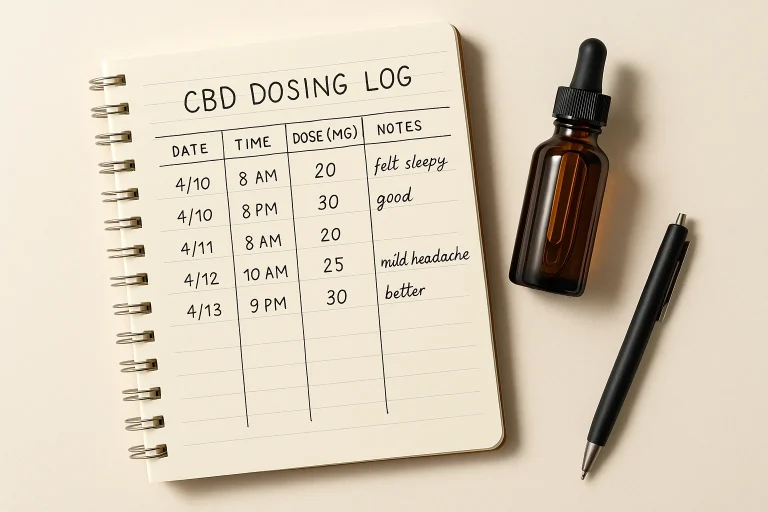
The work by Shannon et al. from 2019 in The Permanente Journal has been cited in this article from the beginning and its identifier is correct. However, the description has changed. This is not a clinical study, but a retrospective review of records in a psychiatric clinic, ultimately involving 72 adults. Almost all received 25 mg per day in capsules, and the range in the entire series was from 25 to 175 mg. The percentage of 79.2 percent, which stood here as a result for sleep, actually concerns anxiety: anxiety severity decreased in the first month in 57 individuals. Sleep results improved in 48 individuals, or 66.7 percent, and the authors note that they fluctuated in subsequent months.
The legal status requires separating two things that the previous version glued into one sentence. Cannabidiol does not appear in Polish lists of controlled substances and is not a controlled substance. However, this does not make tea with extract a food product approved for circulation: in the EU, CBD extracts are subject to the new food procedure and have not received authorization. The EFSA panel in the 2026 position update upheld that the data gaps from 2022 have not been closed, derived a temporary safe dose of 0.0275 mg per kilogram of body weight per day, or about 2 mg for a person weighing 70 kg, and stipulated that it applies only to supplements with a purity of cannabidiol of at least 98 percent. The panel also stated directly that safety cannot be established for individuals under 25 years of age, for pregnant and breastfeeding women, and for individuals taking medications simultaneously. Separately about the raw material itself is discussed in the entry about CBD flower for tea.
How do these four raw materials look in one comparison?
The previous version of this article ended with a table of ratings on a five-point scale. The ratings have disappeared because they had neither method nor source, and one of them contradicted the content two sections above. Instead, the following comparison shows three verifiable things at the source: what regulatory status the raw material has, which study this text refers to, and what was actually measured in that study. The last column is the most important here, as it is in it that the promise on the packaging often diverges from the result of the scientific work. Note that for two items, the endpoint does not concern sleep at all.
| Raw Material | Regulatory Status | Study Referenced in This Entry | What Was Measured |
|---|---|---|---|
| Lemon Balm | HMPC Monograph, Traditional Use | Kennedy et al. 2003, 20 healthy individuals, single doses of dried leaf | Mood and cognitive performance during the day; best profile at 1600 mg. Sleep was not measured |
| Lavender | Two HMPC Monographs, Traditional Use; no indication for anxiety | Silexan vs. lorazepam, 77 patients with generalized anxiety, 6 weeks | Decrease in Hamilton scale similar in both arms; HMPC did not make this an indication |
| Hops | HMPC Monograph, Traditional Use | Zanoli et al. 2005, rats, supercritical extract and alpha-acid fraction | Prolongation of pentobarbital sleep; no anxiolytic action found. No human studies on hops alone |
| Valerian with Hops | Composite preparation, outside the monograph of a single raw material | At least 7 placebo-controlled trials or comparative drug | Sleep quality; results cannot be transferred to a single herb |
| CBD Tea | Unauthorized New Food in the EU | Shannon et al. 2019, 72 adults, record review, mainly 25 mg per day | Anxiety decreased in 79.2 percent, sleep improved in 66.7 percent and fluctuated over time |
Frequently Asked Questions
Which sleep tea has the strongest evidence?
None of the four has sufficient evidence for registration under documented use. Lemon balm, lavender, and hops have monographs based solely on a long history of use. The most controlled studies concern the established combination of valerian with hops, not individual herbs.
Does the lavender monograph mention anxiety?
No. Both lavender monographs, for the oil and for the flower, provide the same indication: alleviation of mild symptoms of mental tension and exhaustion, and support for sleep. The study of Silexan in generalized anxiety discusses an assessment report, but HMPC did not make it an indication.
Can children drink lemon balm or lavender tea?
The monographs advise against use in children under 12 years of age due to lack of data. This wording is stronger than referring to a pediatrician, which was stated here earlier. The same note is repeated in the hops monograph and in the passionflower monograph.
Are these herbs safe during pregnancy?
The monographs for lemon balm, lavender, and hops contain identical wording: safety during pregnancy and breastfeeding has not been established, so use is not recommended. In the previous version of this article, this sentence was not present for any of the three raw materials.
Is CBD tea legal in Poland?
Cannabidiol is not a controlled substance in Poland, but that is not the same as approval for food circulation. CBD extracts are subject to the new food procedure in the EU and have not received authorization, and EFSA in 2026 upheld significant data gaps regarding safety.
Can lemon balm and lavender impair concentration?
Each of the four verified monographs contains the same point: the preparation may impair the ability to drive vehicles and operate machinery, and individuals experiencing this should not drive. The earlier version of this entry did not mention this at all.
In the tea category, the store at Bucha primarily has hemp teas and one herbal mixture for sleep. There is no lemon balm or lavender for brewing in the catalog, while hops cones and valerian extract are listed in the herbs category (catalog status as of August 8, 2026).
This article is for informational and educational purposes and does not constitute medical advice. Before starting supplementation, consult a doctor, especially if you are taking medications regularly, are pregnant or breastfeeding, or have a chronic illness.
Author: Michał Waluk · Published: 2026-08-09 · Updated: 2026-08-16