
Hemp in the Kitchen: A Complete Guide to Cooking with Seeds, Oil, Flour, and CBD
Hemp in the kitchen: what seeds contain, why hemp oil should not be heated, how to store it without going rancid, and what the law says about home processing.
Shelled hemp seeds provide about 31.6 g of protein per 100 g, which is more than most nuts and seeds used in Polish cuisine. Alongside them is oil with a rare fatty acid profile, flour for gluten-free baking, hemp protein for smoothies, and CBD oils, whose absorption changes multiple times depending on whether you take them with a fatty meal. This guide shows what each of these ingredients brings, how to handle them to avoid wasting their properties, and where the legal boundary lies between legal hemp food and home processing, which is a crime. You will also find data on the composition of seeds, results of a study on oil storage, and a summary of culinary applications for each of the four ingredients.
KEY INFORMATION
• Shelled hemp seeds contain about 31.6 g of protein, 48.8 g of fat, and 8.67 g of carbohydrates per 100 g (USDA FoodData Central, record 170148).
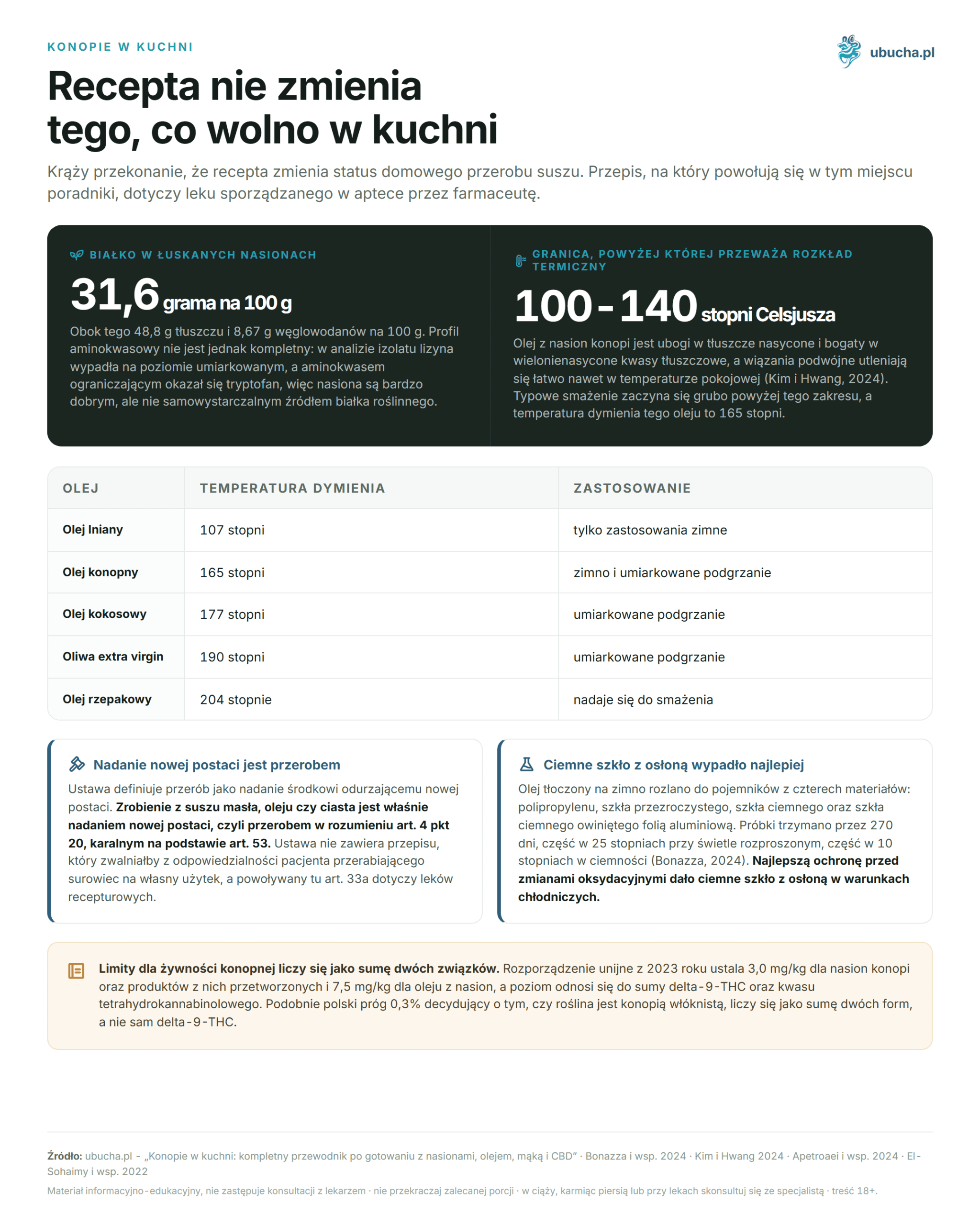
• Hemp oil should not be heated. Above approximately 100-140 degrees Celsius, the thermal degradation of fatty acids begins to outweigh oxidation (Kim and Hwang, Journal of Food Science, 2024).
• The best protection for the oil was provided by storage in dark glass with an aluminum foil cover under refrigeration, tested over 270 days (Bonazza et al., Molecules, 2024).
• CBD taken after a fatty meal gave eleven volunteers 9.7 times higher total exposure than fasting (Saals et al., Scientific Reports, 2025).
• Seeds, oil, flour, and hemp protein are legal food. Home processing of hemp flower into butter or baked goods is a completely different matter and is prohibited.
Are hemp products in the kitchen legal and safe?
Hemp seeds, seed oil, hemp flour, and hemp protein are legal food in Poland and the European Union, while CBD oils function as supplements. They do not produce a psychoactive effect because they come from industrial hemp and contain only trace amounts of THC.
The permissible levels of these trace amounts are set by Commission Regulation (EU) 2023/915 regarding the maximum permissible levels of certain contaminants in food, effective from May 25, 2023. In section 2.6 of Annex I, it establishes 3.0 mg/kg for hemp seeds and for ground seeds and other processed products, as well as 7.5 mg/kg for hemp seed oil. The level refers to the sum of delta-9-THC and tetrahydrocannabinolic acid, expressed as delta-9-THC. The same limits were previously introduced by Regulation (EU) 2022/1393, which was repealed along with the act that amended it.
A separate issue is the THC content threshold that determines whether a plant is industrial hemp. In Poland, it is 0.3% based on dry mass and, what is often overlooked, it is calculated as the sum of delta-9-THC and THCA, rounded to one decimal place. The basis is Article 4 point 5 of the Act of July 29, 2005 on Counteracting Drug Addiction as amended by the act of March 24, 2022 (Journal of Laws 2022, item 763), effective from May 7, 2022. The national threshold corresponds to the EU threshold set by Regulation (EU) 2021/2115, but it is a separate regulation, not a consequence of it.
Is it allowed to make butter or cookies from hemp flower at home?
No, and this is the most important distinction in this whole topic. Everything this guide talks about concerns legal hemp food: seeds, seed oil, flour, protein, and CBD supplements. Home processing of hemp flower, even that issued on prescription, is subject to completely different regulations.
The Act on Counteracting Drug Addiction defines processing as giving a narcotic a new form. Making butter, oil, or dough from flower is precisely giving it a new form, which is processing under Article 4 point 20, punishable under Article 53. The law does not contain a provision that would exempt a patient from liability for processing the raw material for personal use.
There is a belief that a prescription changes this. It does not. The provision that authors of guides usually refer to, namely Article 33a, concerns the flower as a raw material for prescription drugs, which are prepared in pharmacies by pharmacists, not in a home kitchen. Having a valid prescription legalizes possession of the raw material in the prescribed form, not its processing on one’s own. If you are interested in culinary use of hemp, the entire legal area is described in the rest of this text, and it is indeed very broad.
What exactly do hemp seeds contain?
Shelled hemp seeds provide about 31.6 g of protein, 48.8 g of fat, and 8.67 g of carbohydrates per 100 g according to the USDA FoodData Central database (record 170148 for shelled seeds). The protein is primarily made up of edestin and albumin. These two proteins are indicated in a review dedicated to hemp seeds as a functional food ingredient as sources of their nutritional value, alongside linoleic and alpha-linolenic acids and vitamins E, D, and A (Tănase Apetroaei et al., Molecules, 2024).
Besides macronutrients, the seeds are mineral-rich. One hundred grams provide about 700 mg of magnesium, 1650 mg of phosphorus, nearly 8 mg of iron, 9.9 mg of zinc, and 1.6 mg of copper according to the same record. It is worth noting, however, that the amino acid profile is not ideal: in the analysis of hemp protein isolate, lysine was found to be at a moderate level, and tryptophan was the limiting amino acid (El-Sohaimy et al., Plants, 2022). Therefore, hemp seeds are a very good but not self-sufficient source of plant protein. More about the seeds themselves can be found in the text on nutritional properties of hemp seeds.
Why should hemp oil not be heated?
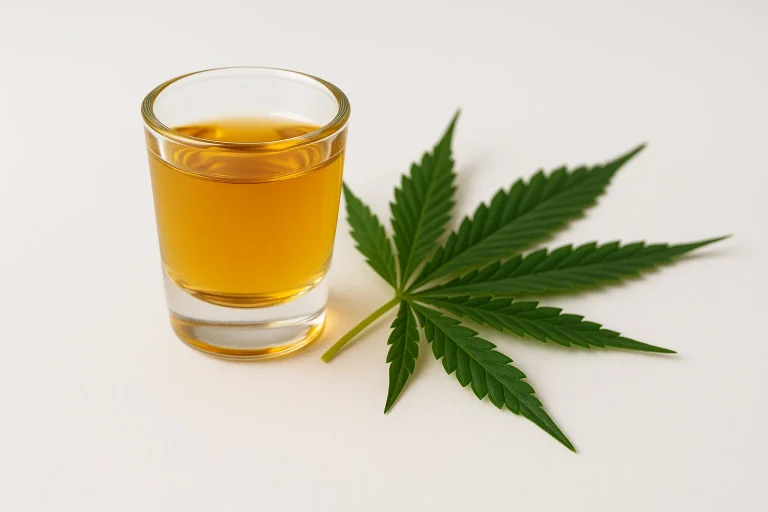
Because it is composed almost entirely of what degrades the fastest when heated. Hemp seed oil is low in saturated fats and high in polyunsaturated fatty acids omega-6 and omega-3, and the double bonds in these molecules oxidize easily even at room temperature. A study on its stability showed that above approximately 100-140 degrees Celsius, the thermal degradation of fatty acids begins to outweigh oxidation (Kim and Hwang, Journal of Food Science, 2024). Typical frying starts well above this range.
So what does hemp oil pair well with? With everything that does not require fire: dressings, cold sauces, hummus, guacamole, pesto, smoothies, and drizzling over soups and risottos after removing them from the heat. The green-gold color and nutty flavor with a hint of grass pair well with leafy vegetables. It also works well with citrus and fresh herbs. If you want a ready addition to warm dishes, prepare a cold infusion with thyme, rosemary, or garlic and keep it in the refrigerator.
It is important to ensure that you do not confuse two different products. Hemp seed oil is a food fat pressed from seeds and does not contain significant amounts of cannabinoids. CBD oil is a preparation in which the cannabinoid is dissolved in a carrier and is used in completely different amounts. The differences between them are detailed in a text about how hemp oil and CBD oil differ.
How to store hemp oil to prevent it from going rancid?
Best in dark glass, in cool conditions, and without light exposure. This is not advice from tradition, but the result of a study in which cold-pressed oil from the Futura 75 variety was poured into containers made of four different materials: polypropylene, clear glass, dark glass, and dark glass wrapped in aluminum foil. The samples were kept for 270 days, some at 25 degrees Celsius under diffused light, and some at 10 degrees in darkness, monitoring peroxides and conjugated dienes and trienes.
The best protection against oxidative changes was provided by the combination of dark glass with an aluminum foil cover under refrigeration (Bonazza et al., Molecules, 2024). The practical conclusion for the home kitchen is therefore: a bottle of dark glass, a refrigerator or cool pantry, and a tight closure after each use. A clear container sitting on a windowsill is the worst possible option.
For the same reason, it is worth buying hemp oil in small bottles, even if larger ones are cheaper per milliliter. An open bottle begins to oxidize every time you let air in, so a capacity matched to the actual consumption rate protects the contents better than any storage method. In Bonazza’s study, polypropylene and clear glass were also compared, which performed worse than dark glass with a cover.
You will recognize rancidity by smell before you can taste it. Fresh hemp oil has a nutty and grassy smell; oxidized oil has a sharp smell reminiscent of old nuts or oil paint. Such oil is only suitable for disposal, as oxidized fats do not only lose nutritional value.
How to bake with hemp flour and how to use hemp protein?
Hemp flour is naturally gluten-free, has a dark brown color, and a distinct, slightly earthy taste, which colors and changes the character of baked goods. For this reason, it works well in whole grain breads, brownies, chocolate muffins, oatmeal cookies, and whole grain pancakes, but less so in light sponge cakes. Its use in gluten-free cakes was the subject of a separate study (Hayit et al., Journal of Culinary Science and Technology, 2024).
In practical baking, hemp flour is not used on its own, but as an additive to base flour, because the lack of gluten and high fiber content change the structure of the dough. The additive also absorbs more water than wheat flour, so the dough can be denser and may require additional liquid. It is wise to start with a small proportion in your favorite recipe, bake a small batch, and then increase the ratio.
Hemp protein, on the other hand, is a product that results from defatting the seeds. It retains natural fiber and some fats, making it less concentrated than whey isolates but closer to a complete nutritional ingredient. It easily incorporates into smoothies, overnight oats, energy balls, and pancakes. People who have previously consumed little fiber should introduce it gradually, as a sudden large portion can be burdensome for the digestive tract. More applications are gathered in the text on how to use hemp protein in the kitchen.
Does CBD in food work differently than under the tongue?
It works differently, and the difference is significant, as measured. In a pharmacokinetic study, eleven healthy volunteers, five men and six women, took a single dose of an extract corresponding to 70 mg of CBD, in an alternating pattern: once fasting, once after a standardized fatty meal. After the meal, total CBD exposure was 9.7 times higher, and peak concentration was 17.4 times higher than fasting. The authors also noted a double peak concentration after eating, linking it to lymphatic transport and enterohepatic circulation (Saals et al., Scientific Reports, 2025).
The mechanism is simple: CBD is lipophilic, meaning it dissolves in fats, not in water. When taken with oil, avocado, peanut butter, or fatty yogurt, it reaches lipid micelles in the small intestine and is absorbed much more efficiently. Adding it to a water-based infusion without any fat is, in this light, a waste of the preparation.
From a culinary perspective, this results in two things. First, the oil is added to the dish after heat treatment or just before serving, not in the pan. Second, the same amount taken fasting and after a fatty meal is practically two different events, so if you observe effects, it is worth noting the meal as well. Ways to combine CBD with dishes are discussed in a separate text on how to add CBD to dishes.
What to cook with hemp products?
The easiest way to start is with shelled seeds, as they are neutral in flavor, do not require changes to recipes, and are hard to spoil. The table below collects proven uses for each of the four ingredients, organized by time of day and type of dish.
| Ingredient | Breakfast and Snacks | Main Dishes and Sides |
|---|---|---|
| Shelled Seeds | Oatmeal, yogurt with honey, smoothie bowl, granola, muesli, energy balls, date bars | Sprinkle for salads and cream soups, pesto, sandwich spreads, lentil patties, falafel, baked fish |
| Seed Oil | Drizzle over oatmeal, add to smoothies, dip for bread | Dressings, vinaigrette, guacamole, hummus, cold soup, gazpacho, finishing risotto and soups |
| Hemp Flour | Whole grain pancakes, banana fritters, waffles, oatmeal cookies | Whole grain bread, brownies, chocolate muffins, breading for plant-based cutlets, tart bases |
| Hemp Protein | Smoothies, overnight oats, energy balls, yogurt with fruit | Protein pancakes, post-workout shake, thickening yogurt sauces |
Seasonally, seeds and oil fit well into autumn and winter dishes: pumpkin and carrot soups, grain dishes with root vegetables, warming oatmeal. In spring and summer, they work better in light salads, cold soups, and fruit smoothies. It is also worth remembering that hemp cuisine is not a novelty in Poland: hemp oil was a common fat in rural kitchens as late as the turn of the nineteenth and twentieth centuries, and hemp seeds were added to grains, soups, and bread before cheaper vegetable oils replaced them.
Frequently Asked Questions
Is cooking with hemp oil safe?
It is safe as long as you do not heat the oil. Hemp seed oil mainly contains polyunsaturated fatty acids, and studies on its stability have shown that above about 100-140 degrees Celsius, thermal degradation begins to outweigh oxidation. Use it for dressings, cold sauces, and drizzling over finished dishes.
How much protein do hemp seeds have?
Shelled hemp seeds contain about 31.6 g of protein per 100 g according to the USDA FoodData Central database (record 170148), along with 48.8 g of fat and 8.67 g of carbohydrates. The protein is primarily made up of edestin and albumin. However, the amino acid profile is not complete, as tryptophan was found to be the limiting amino acid.
Is hemp protein sufficient as the sole source of protein?
It is not the best idea. In the analysis of hemp protein isolate, lysine was found to be at a moderate level, and tryptophan was the limiting amino acid. Hemp protein works well as part of a plant-based diet combined with other sources, such as legumes and grains, rather than as its sole foundation.
How to use hemp flour in baking?
It is used as an additive to the base flour, not on its own, because it is gluten-free and high in fiber, which changes the structure of the dough. It also absorbs more water than wheat flour, so the dough may require additional liquid. Start with a small proportion and a small batch of baking, then increase the ratio.
Does CBD in food work the same as under the tongue?
Not the same. In a study with eleven healthy volunteers, a fatty meal increased total CBD exposure by 9.7 times, and peak concentration by 17.4 times compared to fasting. A double peak concentration was also noted after eating. The oil is added to the dish after heat treatment, never in the pan.
How to store hemp oil?
In dark glass, tightly closed, in the refrigerator or a cool, dark place. In a study conducted over 270 days, the best protection against oxidation was provided by dark glass with an aluminum foil cover under refrigeration. A sharp, old nut-like smell indicates that the oil has already oxidized.
Are hemp products in the kitchen legal in Poland?
Seeds, seed oil, flour, and hemp protein are legal food in Poland and the European Union. Regulation (EU) 2023/915 establishes permissible THC levels: 3.0 mg/kg for seeds and processed products and 7.5 mg/kg for seed oil, counting the sum of delta-9-THC and THCA.
Can I make butter from hemp flower at home with a prescription?
No. Giving a narcotic a new form is considered processing under Article 4 point 20 of the Act on Counteracting Drug Addiction and is punishable under Article 53. The referenced Article 33a in this context concerns the flower as a raw material for prescription drugs prepared in pharmacies, not for preparing anything in a home kitchen.
You can find hemp food in the food category.
This article is for informational and educational purposes and does not replace consultation with a doctor. If you are pregnant, breastfeeding, taking medications, or have chronic conditions, consult the use of supplements or herbs with a specialist.
Author: Michał Waluk · Published: 2026-05-04 · Updated: 2026-08-16