
How Many Grams of Dried Herb from One Plant? Yields 2026
How much dried herb does one cannabis plant yield: 30-150 g autoflower, 100-250 g in ScrOG tent, 80-400 g in Polish soil. Yields, drying, and law in Poland.
One cannabis plant usually yields from 30 to 150 g of dried herb for an autoflower strain, from 100 to 250 g in a ScrOG tent, and from 80 to 400 g in Polish soil. Upper values around 1500 g concern a full season in a warm climate, not the Polish summer. The result simultaneously depends on genetics, cultivation system, lighting, nutrition, and harvest timing, not a single dominant factor. In this guide, we break down the entire process into basic elements: the plant’s growth cycle, key agrotechnical parameters, differences between indoor, outdoor, and greenhouse cultivation, fresh mass to dried herb ratio, and the drying and curing process, which determines the quality of the final raw material more than its weight. We also show how these principles translate into practical results, from windowsill to commercial grow room, and what yield is realistic and legal in Poland, where only fiber varieties registered in KOWR with guaranteed low THC content are allowed.
KEY INFORMATION
• Genotype is the strongest single yield factor, alongside planting density, light, and flowering duration (Backer et al., 2019, Frontiers in Plant Science).
• Professional indoor achieves 400-600 g/m² in SOG; best hydroponic LED systems reach up to 2 kg/m².
• Outdoor in temperate climate yields 80-400 g per plant, up to 1500 g in warmer climates.
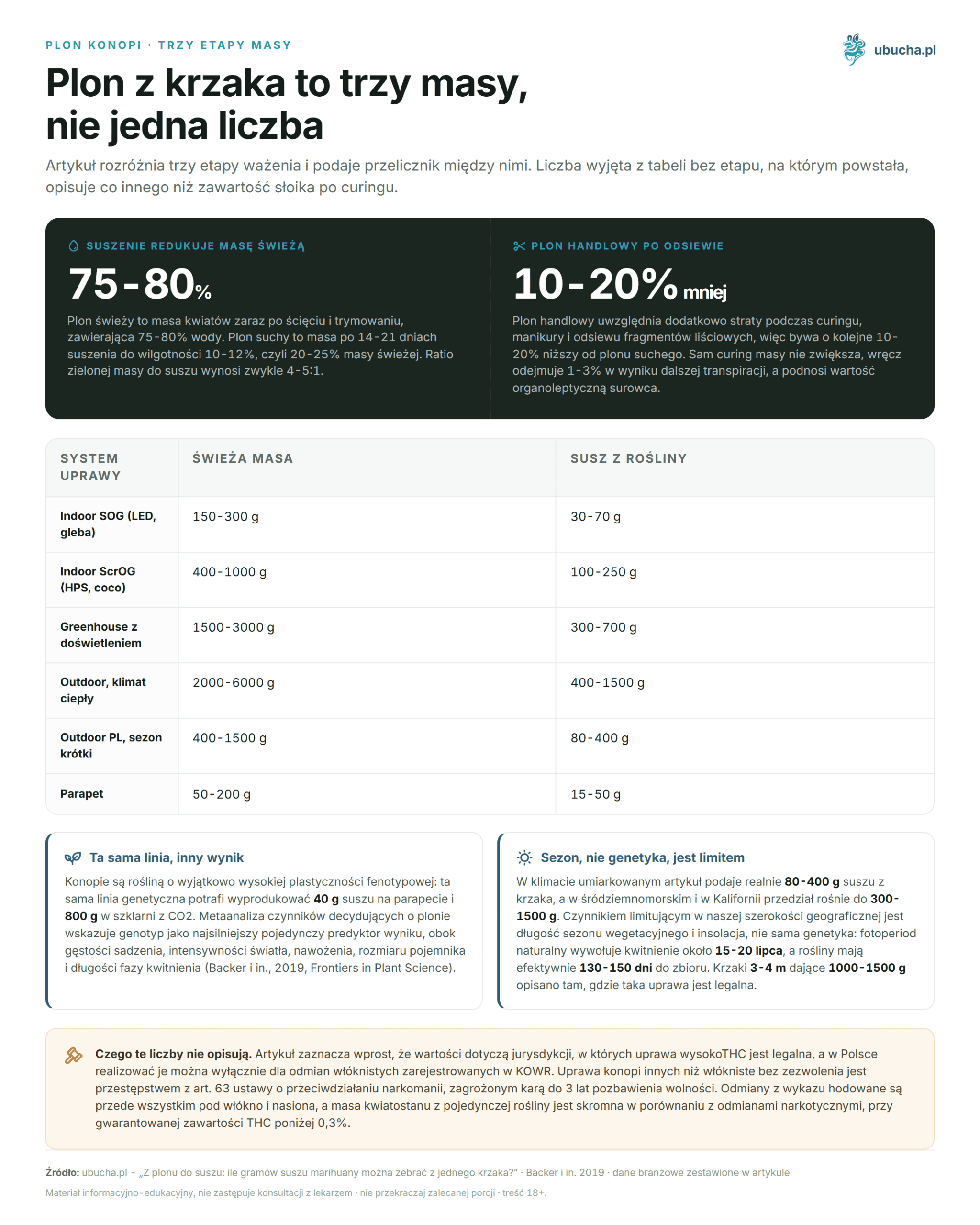
• Drying reduces fresh mass by 75-80%; fresh mass to dried herb ratio is usually 4-5:1.
• Growing high-THC marijuana without a permit is a crime in Poland (Art. 63 of the Act); only CBD products remain legal.
What exactly is cannabis yield and how to measure it correctly?
Before we get to numbers, one distinction, as these two questions are often confused. “How many grams does a plant yield” is a question about agrotechnics and we answer it below. “How many grams are allowed to possess” is a legal question and the answer differs from intuition: Polish law does not set any threshold for personal use, and cultivation of cannabis other than fiber is a separate crime, independent of yield. We explain this in the article about marijuana possession in Poland.
Cannabis yield is the dry mass of female flower clusters after drying and curing, expressed in grams per plant or per square meter. Distinguishing three weight stages changes how we interpret numbers from the internet or fellow growers. Standardizing measurement is key: gross biomass mass is not equal to commercial yield.
Fresh yield (fresh weight) is the mass of flowers immediately after cutting and trimming, containing 75-80% water. Dry yield is the mass after 14-21 days of drying to 10-12% moisture. Commercial yield also accounts for losses during curing, manicuring, and leaf fragment removal, so it is often 10-20% lower than dry yield.
Cannabis is a plant with exceptionally high phenotypic plasticity: the same genetic line can produce 40 g of dried herb on a windowsill and 800 g in a CO2 greenhouse. The final result is the product of a dozen variables, so in practice the best results come from optimizing limiting factors, not maximizing all parameters at once - which often ends in nutrient burn or light stress.
What is the cannabis plant growth cycle and what happens at each stage?
The cannabis growth cycle under photoperiod conditions lasts from 12 to 32 weeks and is divided into four distinct phases. Knowing the physiology of each allows conscious intervention at critical points instead of reacting only to visible problems. The table below organizes the key parameters of each phase.
| Phase | Duration | What Happens |
|---|---|---|
| Germination | 3-10 days | Temperature 22-25°C, humidity 70-90%; certified seeds germinate at 90-95% (ISTA standard). |
| Vegetation | 3-8 weeks | Root, stem, and leaf development under 18/6 photoperiod; biomass growth 5-15% daily under optimal conditions. |
| Flowering | 6-12 weeks | After switching to 12/12, plant stretches 50-100%, buds form, trichome production peaks weeks 6-9. |
| Maturation and Harvest | 1-2 weeks | Optimal harvest when milky trichomes predominate over amber; too early reduces mass by 15-25%, too late favors THC degradation to CBN. |
This ends the cultivation phase in tent or field and begins post-production: drying and curing described in detail later.
Which yield factors are most important: genetics, light, or environment?
A meta-analysis of cannabis yield factors published by a team from McGill University identifies genotype as the strongest single predictor alongside planting density, light intensity, fertilization, pot size, and flowering duration (Backer et al., 2019, Frontiers in Plant Science). Choosing the strain is thus the highest leverage decision before even starting the tent. More about why genotypes differ in potency is in the article about what determines marijuana potency. The table below organizes six main yield levers.
| Factor | Effect on Yield |
|---|---|
| Strain Genetics | Sativa yields 300-700 g/plant with 10-14 weeks flowering, indica 150-500 g with 7-9 weeks, autoflowers flower independently of photoperiod in 70-100 days. |
| Cultivation Type | Indoor yields 2-6 cycles/year and 400-600 g/m² in SOG, outdoor one cycle but up to 1500 g/plant in warm climates, greenhouse combines both. |
| Lighting | HPS 600-1000 W is a proven standard, new generation LED can be more energy efficient, CMH offers broader spectrum favoring terpenes. |
| Photoperiod, CO2, and VPD | CO2 raised to 1200-1500 ppm with higher temperature and VPD maintained at 0.8-1.5 kPa stabilizes transpiration and nutrient uptake. |
| Fertilization | High nitrogen demand in vegetation, phosphorus and potassium in flowering; magnesium is the most common micronutrient deficiency. |
| Plant Training | SCROG, topping, LST, and mainlining distribute plant energy to more buds instead of one dominant apex. |
What yields does indoor cultivation give and what determines efficiency per square meter?
Professional indoor grow rooms produce on average 400-600 g dried herb per square meter in a 10-week cycle. The best commercial operations with LED and hydroponics report up to 2 kg/m² in a single cycle, though this is achievable only with full climate control, dense planting, and experienced staff. The result mainly depends on planting density, light architecture, and climate control.
| Method | Plants/m² | Yield/plant |
|---|---|---|
| SOG (Sea of Green) | 9-16, vegetation 10-14 days | about 40 g |
| ScrOG (Screen of Green) | 1-4, vegetation 4-6 weeks | 100-250 g |
| Single large plant | 1, 25 l pot, 600 W | 400-700 g in 14 weeks |
Hydroponic systems (DWC, NFT, RDWC) provide the fastest nutrient access and yield 15-25% more than soil under identical lighting. Coco coir is a compromise between soil’s water buffer and hydroponic control, while soil forgives more mistakes and gives a richer terpene profile at the cost of slightly lower mass yield. A windowsill plant receives 15-30 mol/m²/day of light in summer and below 5 mol in winter, while cannabis prefers 35-65 mol daily - hence yields of 20-90 g per plant and increased risk of hermaphroditism due to light stress.
How much dried herb does outdoor cultivation yield and what limits plant size?
Outdoor in a temperate climate zone, i.e., Poland and Central Europe, realistically yields 80-400 g dried herb per plant, while in Mediterranean and California climates this range grows to 300-1500 g, with record plants exceeding 2 kg. The limiting factor in our latitude is the length of the growing season and insolation, not genetics alone.
Plants planted in the ground after May 15 effectively have 130-150 days until harvest, i.e., until the end of September, when night temperatures drop to 5°C. Natural photoperiod triggers flowering around July 15-20, giving 9-10 weeks for bud development before autumn rains. The main limits besides light are root system size and susceptibility to pathogens, especially gray mold (Botrytis cinerea), which attacks buds at humidity above 75%. In experimental conditions in jurisdictions where such cultivation is legal, single plants in soil reached 3-4 m height and yielded 1000-1500 g dried herb after trimming - in the Polish climate such height is practically unattainable with natural photoperiod and shorter season.
Is a greenhouse a sensible compromise between indoor and outdoor?
A greenhouse with heating and LED supplementation extends the season by 6-10 weeks compared to pure outdoor and allows 2-3 cycles per year instead of one. Yields reach 150-600 g per plant, and energy costs are 40-60% lower than indoor because the sun does part of the work for free. It is a system combining indoor predictability with outdoor lower costs, at the expense of somewhat less microclimate control.
Organic certifications occur more often with greenhouses than artificial light cultivation because the natural day-night cycle is easier to reconcile with organic farming requirements. If you are interested in how cannabis fits into the broader model of organic and sustainable agriculture, we develop this topic separately. Choosing between indoor, outdoor, and greenhouse is practically a choice between control, cost, and seasonality - no system wins in all three categories simultaneously. For a farmer just starting, greenhouse is often the safest starting point: less risk of losing the entire crop due to a single frost night than pure outdoor, and lower entry cost than full indoor.
How do autoflower strains differ and what yields do they give?
Autoflowering strains are crosses with ruderalis that flower independently of photoperiod 3-4 weeks after germination. Yields typically range from 30-150 g dried herb per indoor plant and up to 200 g outdoor, in 70-90 days from seed to harvest. They are a choice for discretion, sequential cycles in the season, and locations with short summers.
The biggest advantage is no need to change photoperiod and the possibility of 20/4 light throughout the cycle, which shortens total cultivation time and increases stress resistance. Limitations include no cloning possibility (clone inherits the biological age counter of the mother plant), weaker response to training (topping delays development by 1-2 weeks), and lower yield ceiling than photoperiod strains. Autoflower works best with several cycles per year in a small indoor, as a second plant of the season outdoor (June sowing, September harvest), and for those just testing equipment - modern F4-F6 lines today match much of the yield of good photoperiods under equivalent conditions, though they still require precise nutrition from week one - early mistakes cannot be compensated by extending vegetation, as it is practically absent.
What is the cannabis drying and curing process?
Drying and curing are two post-production stages that primarily determine raw material quality, not dry mass. Proper drying lasts 10-21 days at 18-22°C and 55-60% humidity. Curing extends over 2-8 weeks in sealed jars, stabilizing aroma and smoke smoothness.
| Stage | Duration | Conditions and Effect |
|---|---|---|
| Drying | 10-21 days | 18-22°C, 55-60% humidity, darkness and low air circulation; moisture drops from 75-80% to 10-12%, dry mass is 20-25% of fresh mass. |
| Early Curing | first 2 weeks | Jars opened (burping) 1-2 times daily for 10 minutes; humidity stabilizes at 58-62% RH. |
| Long Curing | up to 8 weeks | Enzymatic chlorophyll degradation, acid esterification, terpene maturation; mass loss limited to 1-3%. |
The seemingly insignificant weight loss during curing is in practice an investment in aroma density per mass unit: well-cured herb delivers intensity hard to achieve from freshly dried, poorly aged material. That is why the premium market pays more for aged raw material, not just weight.
What mistakes most often reduce yield and how to avoid them?
Among growers seeking help with yield problems, five mistakes repeat: overfertilization, wrong pH, light stress, poor ventilation, or wrong harvest timing. Each is detectable long before harvest and fully reversible if you react early instead of waiting for irreversible symptoms.
| Mistake | Symptom | How to React |
|---|---|---|
| Overfertilization | Brown, curled leaf tips, yellowing between veins at EC above 2.2-2.6 | Flush with clean water (3x pot volume) and return to 50% dose strength |
| Wrong pH | Interveinal chlorosis outside 5.8-6.2 (hydroponics) or 6.0-6.8 (soil) | Regular pH meter measurement and solution correction to target range |
| Light Stress | Light leak during flowering, risk of revegetation or hermaphroditism | Absolute darkness during 12/12 night phase, seal the tent |
| Wrong Harvest Time | Harvest with predominance of clear trichomes or excess amber ones | Microscope observation 60-100x every 2-3 days in last two weeks |
| Poor Ventilation | Humidity above 65% during flowering, risk of gray mold | Exchange tent volume 40-60 times per hour |
How much CBD-positive raw material can legally be obtained from fiber hemp in Poland?
Fiber hemp registered in KOWR, e.g., Beniko, Białobrzeskie, Tygra, or Rajan, is grown mainly for fiber and seeds, and the floral mass from a single plant is modest compared to narcotic varieties. This is the real, legal ceiling in Poland: a small amount of raw material with guaranteed THC content below 0.3%, calculated as the sum of delta-9-THC and THCA.
The application for KOWR registration must be submitted before cultivation and planned sowing to the appropriate regional office, in writing or electronically. Required data include field location, EU-listed variety, and cultivation area. Phytosanitary control and THC sampling occur later in the season - this is when so-called hot crops appear, i.e., plants exceeding the 0.3% threshold despite registered, legal variety. We wrote more about this phenomenon and its consequences for farmers in the article about why hot crops are destroyed despite legal registration.
Fiber varieties have lower floral mass per plant but higher stem fiber and seed mass. The whole plant is associated with a multifunctional product: fiber for industry, seeds for oil pressing, flower clusters as raw material for further processing into CBD products.
How does the CBD market and consumer products arise from legal biomass?
The CBD oil and consumer product market in Poland is valued by Grand View Research at about 63 million USD in 2024, with a projected average annual growth of 43.1% until 2030 (Grand View Research, 2024). It is one of the fastest-growing wellness market segments in the country, driven mainly by broad spectrum oils, CBD dried herbs from fiber hemp, and CBG concentrates.
Legal biomass from registered crops goes to processors who separate the flower fraction from fiber and seeds, then extract it or sell it as dried herb ready for brewing or vaporizing. The entire chain, from KOWR-registered field to store shelf, is subject to the same THC limits as cultivation itself - no processing stage, extraction, or product standardization raises the legal 0.3% threshold. For consumers, this means that a product bought in a legal store has documented history from a registered field, unlike raw material of unknown, unconfirmed origin and unknown THC content.
How to read the comparative table of typical yields?
The table below lists approximate medians and ranges for eight common cultivation systems, based on scientific and industry literature cited in previous sections of this guide. Treat these numbers as reference points, not guarantees - your real result depends more on genetics, experience, and climate control discipline than on the cultivation system itself. Values concern jurisdictions where high-THC cultivation is legal; in Poland, they apply only to fiber varieties registered in KOWR.
| Cultivation System | Plant Height | Fresh Mass (g) | Dried Herb (g/plant) | Yield g/m² | Cycle (weeks) |
|---|---|---|---|---|---|
| Indoor SOG (LED, soil) | 40-70 cm | 150-300 | 30-70 | 400-550 | 10-12 |
| Indoor ScrOG (HPS, coco) | 80-120 cm | 400-1000 | 100-250 | 500-700 | 14-18 |
| Indoor hydro premium (LED, DWC) | 90-130 cm | 600-1500 | 150-400 | 700-2000 | 12-16 |
| Greenhouse with supplementation | 150-250 cm | 1500-3000 | 300-700 | 500-800 | 14-20 |
| Outdoor in soil (warm climate) | 200-400 cm | 2000-6000 | 400-1500 | n/a | 20-24 |
| Outdoor PL (short season) | 100-200 cm | 400-1500 | 80-400 | n/a | 18-22 |
| Outdoor PL, typical value | 150 cm | 800 | 200 | n/a | 20 |
| Autoflower indoor | 40-90 cm | 100-400 | 30-150 | 250-450 | 9-12 |
| Windowsill (ornamental/fiber plant) | 30-80 cm | 50-200 | 15-50 | n/a | 16-22 |
What modern technologies are changing cannabis cultivation?
Artificial intelligence, IoT sensors, and bioengineering are changing the cannabis industry faster than five years ago, though for most home growers they remain a curiosity, not a daily tool. Large licensed operations are increasingly implementing them because at the scale of hundreds of plants even small improvements in repeatability translate into real money. Parallel work continues on biotechnological cannabinoid production in yeast, which in the longer term may reduce the entire market’s dependence on plant cultivation - at least in the segment of pure, single cannabinoids intended for pharmaceutical and research purposes.
| Technology | How It Works |
|---|---|
| AI-supported climate control | Systems read data from temperature, humidity, CO2, and VPD sensors, then regulate air conditioning and humidification in real time. |
| Image analysis and phenotyping | Hyperspectral cameras detect nutrient deficiencies earlier than symptoms become visible to the naked eye. |
| Biotechnology and precision fermentation | Saccharomyces cerevisiae yeast modified to produce cannabinoids without the plant (Luo et al., 2019, Nature). |
Frequently Asked Questions
How many grams of dried herb does an average marijuana plant yield?
An average plant under indoor conditions yields 80-200 g of dried herb, outdoor 200-500 g, and autoflower strain 30-100 g. These are broad ranges because the result depends simultaneously on genetics, lighting, and grower experience, not a single factor. Real values in amateur grows are usually 30-50% lower than results obtained under experimental conditions.
How much fresh biomass yields 100 g of hemp dried herb?
Fresh flowers lose on average 75-80% of their mass during drying, so 100 g of dried herb comes from 400-500 g of fresh floral biomass after trimming. The 4-5:1 ratio is a commonly accepted standard in cultivation, although it can be lower (3.5:1) with dense buds and higher (5.5:1) with fluffy strains.
Is growing marijuana in a pot on a balcony legal in Poland?
No. Cultivation of cannabis other than fiber (containing THC above 0.3%) without a permit is a crime in Poland under Article 63 of the Anti-Narcotics Act, punishable by up to 3 years imprisonment. Only cultivation of fiber varieties from the EU list after registration in KOWR is legal, which concerns agricultural land reported before sowing, not a balcony. We described the rules of this registration in more detail in the article about whether it is legal to grow fiber hemp in Poland.
How long does the full cycle from seed to jar with curing take?
Photoperiod strains: 16-26 weeks (vegetation 4-8, flowering 8-12, drying 2-3, curing 2-3). Autoflower: 12-16 weeks total, as flowering starts automatically 3-4 weeks after germination. Greenhouse and outdoor in Poland: 20-28 weeks, with an upper limit of the growing season.
Does LED really give a higher yield than HPS?
Modern LED diodes are generally considered more energy-efficient than traditional HPS lamps, but the exact advantage depends on the specific model, cooling, and fixture layout, not just the lighting technology itself. The investment cost in LED is often higher than in HPS, and the payback period in commercial cultivation is usually counted in several grow cycles.
How to check exactly when to harvest the plant?
The optimal harvest time is determined using a 60-100x microscope or 30x loupe by observing trichomes: a predominance of milky (milky-white) trichomes over amber ones signals peak THC, and a growing share of amber indicates a shift towards more sedative effects. Pistils (hairs) should be mostly orange-brown.
Does curing actually increase yield or only quality?
Curing does not increase mass; it actually reduces it by 1-3% due to further transpiration but radically improves the organoleptic value of the raw material. Uncured herb tastes grassy-hay and has harsh smoke. Well-cured material has intense terpenes and smooth smoke, which is why the premium market pays more for aged material.
What is the real yield ceiling for legal fiber hemp cultivation in Poland?
Fiber varieties registered in KOWR (e.g., Beniko, Białobrzeskie, Tygra) are grown mainly for fiber and seeds, and the floral mass from a single plant is modest compared to narcotic varieties. This is the real, legal ceiling in Poland: a small amount of raw material with guaranteed THC content below 0.3%, not a substitute for high-yield cultivation in jurisdictions where it is legal.
Summary: from seed to jar
There is no single answer to “how many grams of dried herb per plant,” but there is math connecting genetics, light, agrotechnics, and post-production. Professional indoor yields 400-600 g dried herb per square meter, hydroponics with LED in the best variant reaches 2 kg/m², outdoor in warmer climates produces 200-1500 g per plant. Fresh mass to dried herb ratio is 4-5:1. Proper drying and curing primarily determine raw material quality, not mass.
Understanding plant physiology in each of the four phases allows intervention at critical points and avoiding five most common mistakes: overfertilization, wrong pH, light stress, poor ventilation, and wrong harvest timing. In Poland, grow legally, i.e., only fiber hemp registered in KOWR. The consumer market provides legal CBD and CBG products of repeatable quality that cover the practical needs of most users.
Legal CBD dried herbs and oils from fiber hemp mentioned in this guide can be found in the CBD dried herb category at u Bucha store.
This article is informational and educational and does not constitute legal advice. The legal status described is valid as of publication date: cannabis regulations may change. Consult a lawyer or current legal acts before making decisions.
Author: Michał Waluk · Published: 2026-05-06 · Updated: 2026-08-24