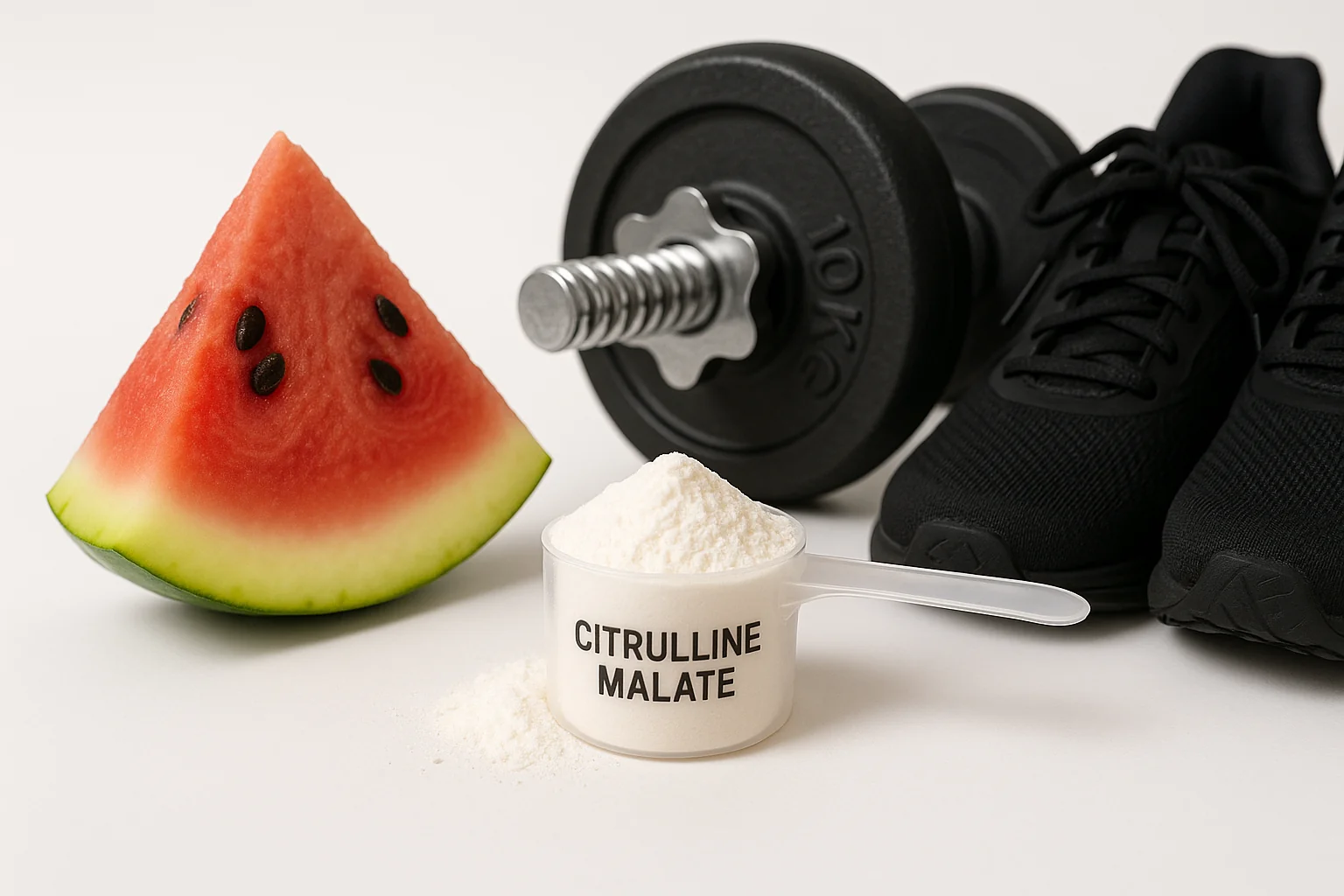

Citrulline (malate): pre-workout dosage (table)
Citrulline malate pre-workout: what did Pérez-Guisado's study measure, why malate is not the same as citrulline, and what did Schwedhelm NOT improve.
Citrulline malate made its way into pre-workouts based on a handful of studies, and into guides in the form of dosage tables that look more solid than the material beneath them. This article goes the other way: it shows what exactly was measured, on whom, for how long, and which result was not achieved at all. Along the way, we separate two things that blend into one number in supplement descriptions: grams of citrulline malate and grams of citrulline itself. These are not interchangeable values, and the difference determines what the dosage stated on the package actually means. The dosage table that this post previously had has completely disappeared: there was no study behind it, and its rows mixed portions of the compound with portions of the amino acid itself. What remains is a description of the studies, which is what can be relied upon.
KEY INFORMATION
• The study by Pérez-Guisado and Jakeman involved 41 men and a single dose of 8 g of citrulline malate in a crossover design with double blinding.
• It measured bench press: the number of repetitions increased from the third assessed set, in the last by 52.92 percent, and muscle soreness after 24 and 48 hours decreased by 40 percent.
• Gastrointestinal discomfort was reported by 14.63 percent of participants in this study.
• In the Schwedhelm study, citrulline raised arginine levels in plasma more effectively than arginine itself, but vasodilation did not improve after any of the treatments.
• This study was funded by the manufacturer of L-citrulline tablets, and its medical director is one of the co-authors.
• The store u Bucha does not offer citrulline or arginine (as of August 16, 2026).
What was measured in the study on which the whole topic stands?
The work cited in this topic most often studied one thing and studied it thoroughly. Forty-one men performed two consecutive chest training protocols after sixteen sets, in a crossover design with randomization and double blinding. In one session, they received 8 g of citrulline malate, in the other placebo. Endurance was measured by a test of repetitions to fatigue at 80 percent of previously established maximum weight, in eight sets of bench press (Pérez-Guisado and Jakeman, Journal of Strength and Conditioning Research, 2010).
The results are specific and worth knowing in their original form. The number of repetitions increased compared to placebo from the third assessed set, and the advantage grew with each subsequent set, reaching 52.92 percent more repetitions in the last with a hundred percent response from the subjects. Muscle soreness after 24 and 48 hours from the session decreased by 40 percent, with a response rate above 90 percent. The only reported adverse effect was gastrointestinal discomfort in 14.63 percent of participants.
However, the scope of this finding is narrow and easily stretched too far. Anaerobic effort with short breaks was measured in the same men, after one dose, in one exercise. The authors explicitly write about high-intensity anaerobic efforts with short rest. The conclusion about aerobic endurance, about women, or about daily use does not arise from this work.
Is citrulline malate the same as citrulline?
No, and this difference is the source of the most common misunderstanding in supplement descriptions. Citrulline malate is a combination of citrulline with malic acid, so one gram of the preparation contains less than one gram of the amino acid itself. The portion given in grams of malate and the portion given in grams of L-citrulline are two different numbers, even if both are called the same on the label.
This has a direct impact on reading studies. The work of Pérez-Guisado states its portion as 8 g of citrulline malate, not as 8 g of citrulline. The ingredient ratio in the preparation used cannot be read from the available abstract, so converting this portion to grams of citrulline itself would require data that is not available here. The previous version of this post provided such a conversion, additionally in a dosage table, and attributed to it an accuracy that it did not have.
The practical conclusion for the reader is simple: when comparing two preparations or matching a label with a study, check whether the number refers to the salt or the amino acid itself, and whether the ratio is provided. This is the same trap as with iron, where the mass of the salt and the mass of the element are two different values, and in comparisons of L-arginine with its derivatives, which we describe in the text about L-arginine and citrulline in the context of erection and pressure.
How does citrulline raise arginine levels in plasma?
Oral arginine loses a significant part of the dose along the way. It is removed even before entering the general circulation, among other things by intestinal bacteria and arginases in the intestinal wall and liver. Citrulline does not go through this pathway: it is converted to argininosuccinate and then to arginine, with the authors generally linking this conversion to the kidney and other tissues, including the vessel itself, without determining the ratios (Schwedhelm et al., British Journal of Clinical Pharmacology, 2008).
The study involved twenty healthy volunteers in a crossover design, with randomization, double blinding, and placebo. Participants received six different dosing regimens, and pharmacokinetic parameters were calculated after a week of taking the preparation. Citrulline raised the area under the curve and the maximum concentration of arginine in plasma in a dose-dependent manner and more effectively than arginine itself. The highest dose, 3 g twice a day, also raised the ratio of arginine to its endogenous inhibitor and the excretion of nitrates and cyclic GMP in urine.
Two things need to be said about this work right away. First, the time to peak arginine concentration ranged in the table from 1.4 to 2.3 hours, depending on the dose, and was measured after a week of dosing twice a day, not after a single dose before training. The previous version of this post stated 60-90 minutes here. Second, the study was funded by Angiogenix, the manufacturer of L-citrulline tablets, its then medical director is a co-author, and one of the researchers declares funding from it for research and consulting fees.
Were vasodilation and pump actually measured?
They were measured, and here lies the most important correction of the entire article. Endothelial-dependent vasodilation, measured by the flow-mediated vasodilation method, the authors treated as the third question of their work. The answer is: after a week of administration, none of the regimens improved this parameter compared to baseline values. The authors call this disappointing and note that it was a secondary aim of the study. They also add one caveat in favor of the hypothesis: in the pooled analysis of all vasodilation results, there is a correlation between the increase in the ratio of arginine to its inhibitor and the improvement of this parameter.
The positive result concerned something else: arginine levels in plasma, the ratio of arginine to its inhibitor, and markers of nitric oxide production in urine. These are intermediate points. The statement about vasodilation and the perceptible muscle pump requires an endpoint that this study did not achieve, and the Pérez-Guisado study measured the number of repetitions and soreness, not the diameter of the vessels.
The distinction of endpoints is the whole content here. An increase in the concentration of the precursor is not the same as an increase in nitric oxide production, which in turn is not the same as vessel dilation, and vessel dilation is not the same as a better training outcome. The previous version of this post smoothly transitioned between these four levels in one paragraph and without reservations. The same ladder of intermediate points returns with other pre-workout supplements, which we discuss in the texts about beta-alanine and caffeine pre-workout.
How much citrulline is really in watermelon?
Less than this article stated, and the measurement concerned something different than the sentence suggested. The work referenced had a title about determining citrulline in watermelon rind and compares the content between varieties, types, flesh colors, and tissues (Rimando and Perkins-Veazie, Journal of Chromatography A, 2005).
The values were mainly given on a dry mass basis and ranged from 3.9 to 28.5 mg per gram. Watermelons with red flesh had slightly less citrulline than those with yellow or orange flesh. When calculated on a fresh mass basis, which is what is actually eaten, the rind contained 1.3 mg per gram, and the flesh 1.9 mg per gram. The previous version of the post stated about 3.5 g for the flesh per kilogram of fresh mass, or 3.5 mg per gram, and calculated from this that the portion from the study corresponds to less than two kilograms of fruit.
With the value from the work, this calculation looks different, and the author’s conclusion also sounds different: the researchers point to watermelon rind as an underutilized agricultural waste that is a source of natural citrulline, not the flesh as a practical alternative to the supplement. The number given in the previous version next to this sentence actually led to a work on seizure synchronization in the rat cortex.
Frequently Asked Questions
What exactly did the study by Pérez-Guisado and Jakeman show?
Forty-one men performed two chest training protocols after 8 g of citrulline malate or placebo. The number of repetitions to fatigue in the bench press increased from the third set, in the last by 52.92 percent, and muscle soreness after 24 and 48 hours decreased by 40 percent.
Is citrulline malate and L-citrulline the same dose?
No. Citrulline malate is a combination of the amino acid with malic acid, so one gram of the preparation contains less than one gram of citrulline. The portion given in grams of malate does not directly translate to grams of citrulline without knowing the ingredient ratios in a specific preparation.
Does citrulline dilate blood vessels?
In the Schwedhelm study, citrulline raised arginine levels in plasma and markers of nitric oxide production, but endothelial-dependent vasodilation did not improve after any of the regimens after a week of administration. The authors call this result disappointing.
Does citrulline work better than arginine?
In terms of raising arginine levels in plasma, yes: oral arginine is largely removed by intestinal and liver arginases before it enters circulation, while citrulline does not go through this pathway. However, the advantage concerns the parameter in the blood, not the training outcome.
How much citrulline is in watermelon?
According to the work of Rimando and Perkins-Veazie, fresh weight pulp contains 1.9 mg per gram, and the rind 1.3 mg per gram. When calculated on a dry mass basis, the range is from 3.9 to 28.5 mg per gram, depending on the variety and tissue studied.
We do not sell citrulline, citrulline malate, arginine, beta-alanine, or creatine. None of our categories currently contain these ingredients, so this article does not direct to any of them (as of August 16, 2026). If you are looking for something for training in our store, we have separately described research on CBD in athletes.
This article is for informational and educational purposes and does not constitute medical advice. Before starting supplementation, consult with a doctor, especially if you are taking medications regularly, are pregnant or breastfeeding, or have chronic illnesses.
Author: Michał Waluk · Published: 2026-08-09 · Updated: 2026-08-16