
The Problem of Hot Crops: Why Farmers Destroy Legal Hemp Over a Fraction of a Percent
Hot hemp crops without myths: what really increases THC in the field, what the KOWR register requires, and why the industry fights for a threshold higher than 0.3 percent.
The farmer sows a variety from the EU catalog, completes the formalities, waits the entire season, and the pre-harvest inspection shows 0.35% instead of the permissible 0.3%. The crop is destroyed. This phenomenon has its own name in the industry, “hot crops,” and carries a whole list of explanations, most of which do not withstand the collision with field studies. The most popular of them says that heat and drought cause the plant to produce more THC. Controlled experiments show something different, sometimes even the opposite. In this text, we separate three layers: what biology says, what Polish law requires, and what the buyer of the herb learns from all this. Each is supported separately, as in popular studies they merge into one story about a helpless farmer and a capricious regulation, while the actual mechanism is less dramatic and more predictable.
KEY INFORMATION
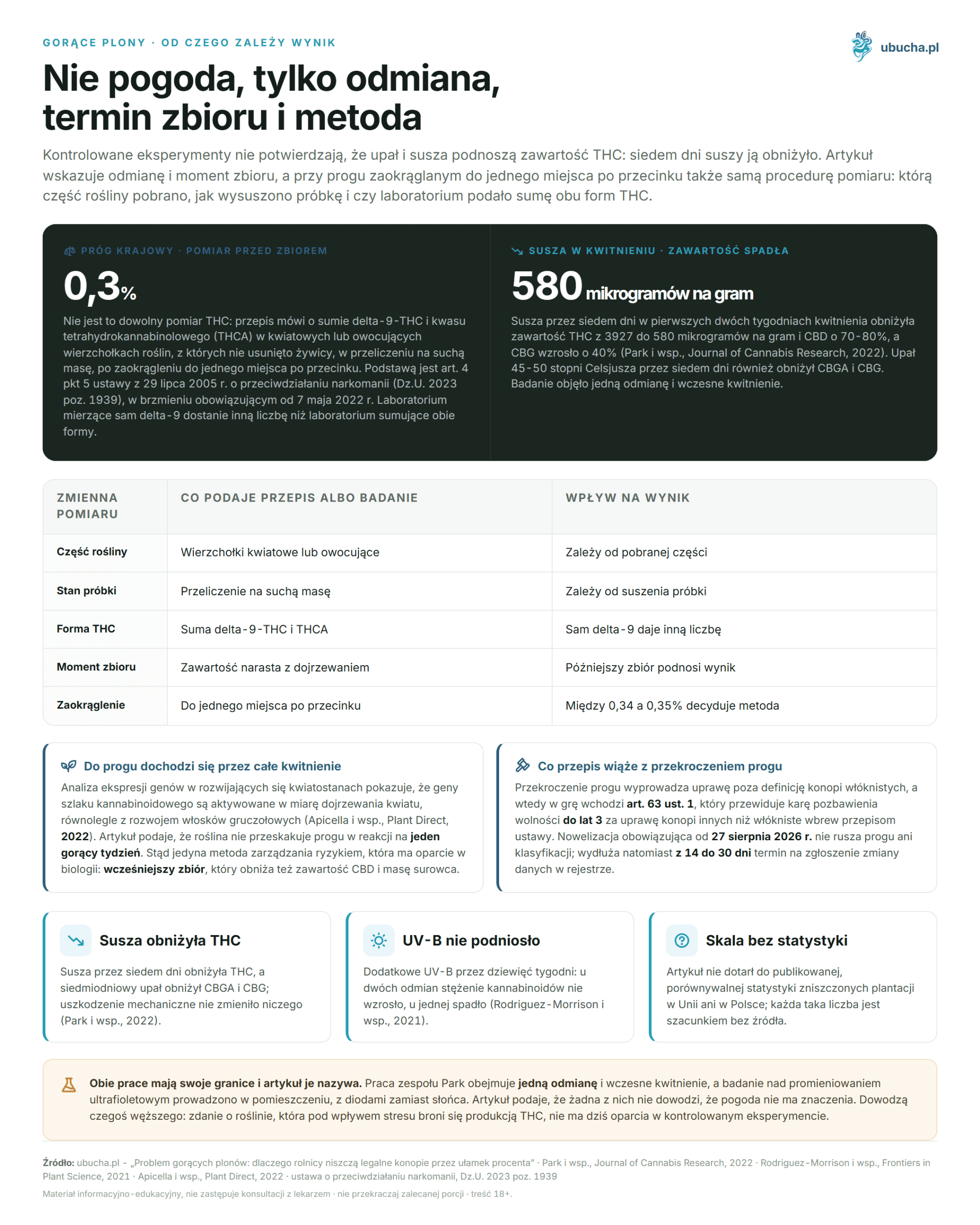
• Seven days of drought reduced THC content in hemp from 3927 to 580 micrograms per gram and increased CBG by 40% (Park et al., Journal of Cannabis Research, 2022).
• Additional UV-B radiation did not increase cannabinoid concentrations, and in one of the two strains, it decreased them along with the yield.
• The Polish threshold is 0.3% of the sum of delta-9-THC and THCA in the flowering tops, rounded to one decimal place.
• The register of hemp producers is maintained by the director of the regional branch of KOWR, not the marshal of the province.
What are hot crops?
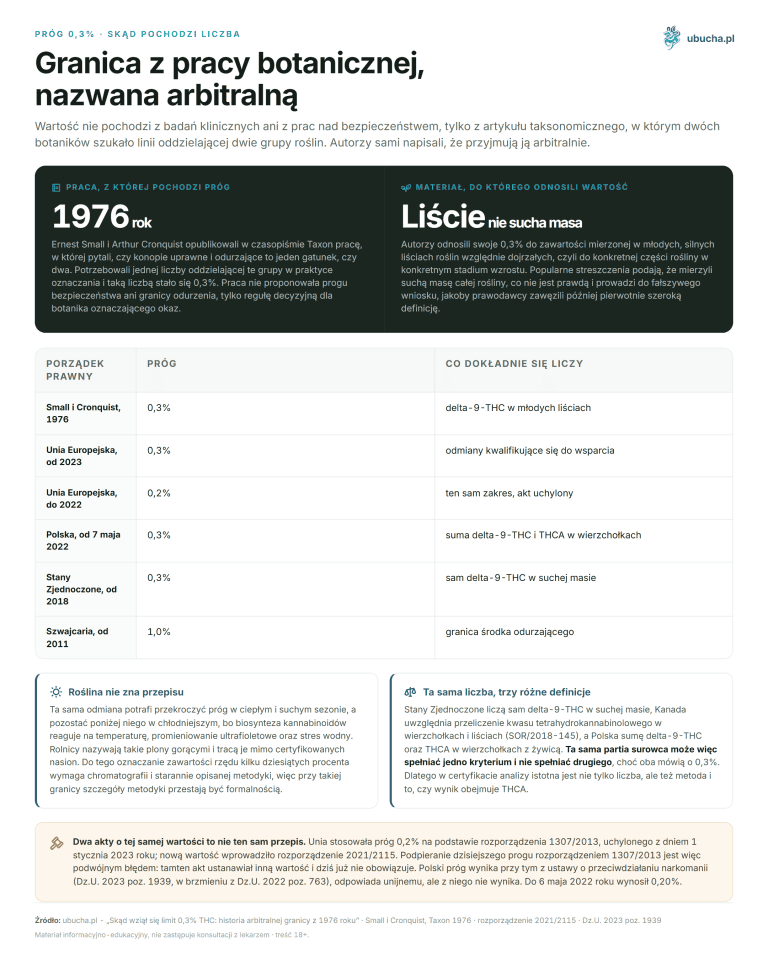
A hot crop is a cultivation that exceeded the legal THC content threshold in an official pre-harvest test. In Poland and the European Union, this threshold is 0.3%, but it is calculated differently than most guides repeat. The law refers to the sum of delta-9-THC and tetrahydrocannabinolic acid (THCA) in the flowering or fruiting tops of the plants, from which the resin has not been removed, calculated on a dry weight basis, with the sum subject to rounding to one decimal place.
This distinction determines the laboratory result. Fresh plant material mainly contains THCA, which is the acidic form that only converts to delta-9-THC upon heating. A laboratory measuring only delta-9-THC will get a different number than a laboratory summing both forms, and the regulation requires the latter value. The basis is Article 4 point 5 of the Act of July 29, 2005 on Counteracting Drug Addiction, consolidated text Journal of Laws 2023 item 1939, as amended by the Act of March 24, 2022 (Journal of Laws 2022 item 763), effective from May 7, 2022.
The EU threshold has the same numerical value but a separate source. From January 1, 2023, hemp varieties eligible for support under the Common Agricultural Policy can contain up to 0.3% THC based on Article 4 paragraph 4 of Regulation (EU) 2021/2115. Previously, a threshold of 0.2% from Regulation 1307/2013 was in effect, repealed on the same day. Therefore, the Polish threshold corresponds to the EU one, but it does not derive from it. We elaborated on where this value came from in our post about the history of the 0.3% THC limit.
Does environmental stress really increase THC?
Field and greenhouse studies do not confirm this, and some results indicate the opposite direction. The Park team subjected a variety of industrial hemp to four typical stresses in the first two weeks of flowering: mechanical damage, insect feeding, heat of 45-50 degrees Celsius for seven days, and drought for seven days. The greatest change was caused by drought, resulting in a decrease: THC dropped from 3927 to 580 micrograms per gram, CBD by 70-80%, and CBG increased by 40% (Journal of Cannabis Research, 2022). Heat also reduced the content of CBGA and CBG, while mechanical damage did not change anything.
Similarly, the hypothesis about ultraviolet radiation did not hold. In a study where two hemp varieties grew for nine weeks under additional UV-B with increasing intensity, increasing the dose intensified leaf damage and reduced photosynthesis, but did not increase cannabinoid concentrations. In one of the strains, the total concentrations of delta-9-THC and CBD even decreased, and terpene content decreased in both (Rodriguez-Morrison et al., Frontiers in Plant Science, 2021).
Both studies have their limitations, and it is important to know them. The Park team’s work involves one strain and early flowering, and the UV study was conducted indoors, with LEDs instead of sunlight. Neither proves that weather does not matter. However, they do demonstrate something narrower and sufficient: the popular saying “a plant under stress defends itself by producing more THC” has no support in controlled experiments today. The very idea of cannabinoids as a chemical defense of the plant is older and broader; we described it in our post about cannabinoids as natural pesticides.
What determines the outcome of inspections if not the weather?
Primarily the strain and the timing of the harvest. Gene expression analysis in developing inflorescences shows that the genes of the cannabinoid pathway are generally activated as the flower matures, alongside the development of glandular hairs and the increase in cannabinoid content (Apicella et al., Plant Direct, 2022). The plant does not exceed the threshold in response to one hot week; it happens gradually throughout the flowering period.
This leads to the only risk management method that has a basis in biology: harvesting early. The longer the inflorescence matures, the higher the cannabinoid content, including THC. The price is obvious, as early harvesting also reduces CBD content and raw material mass, so the farmer chooses between legal risk and yield.
The second variable is the measurement procedure itself. The result depends on which part of the plant was sampled, how the sample was dried, and whether the laboratory provided the sum of both forms of THC or just delta-9. With a threshold rounded to one decimal place, the difference between 0.34 and 0.35% ceases to be a botanical issue and becomes a methodological one. Farmers who monitor their fields with their own preliminary tests before inspection mainly buy themselves time to decide on early harvesting, not certainty of the result.
What does Polish law require from the grower?
Registration, certified seed material, and notification before sowing. The register of hemp cultivation is maintained by the director of the regional branch of the National Support Center for Agriculture responsible for the place of residence or seat of the applicant, not the marshal of the province or the mayor (Article 47b paragraph 1 of the Act, Journal of Laws 2023 item 1939, reading from the consolidated text, August 2026). The application is submitted before the planned sowing.
A copy of the invoice for the purchase of elite or qualified seed material and a copy of the label from the packaging must be attached to the application. The applicant also indicates the strain, planned area with parcel numbers, and the purpose of cultivation. A contract with the purchasing entity is only required if the cultivation is not for personal use and if the raw material will not be processed independently; for personal use, the law does not require it.
Exceeding the threshold removes the cultivation from the definition of fiber hemp, and then Article 63 paragraph 1 comes into play, which provides for a penalty of up to 3 years of imprisonment for cultivating hemp other than fiber hemp in violation of the provisions of the Act. The amendment effective from August 27, 2026, does not change the threshold or classification; however, it extends the deadline for reporting changes in the register from 14 to 30 days. This is a good illustration of what real change looks like in this area: minor, procedural, and unrelated to THC.
Why does the industry want a higher threshold?
The argument does not concern intoxication but the selection of strains. The European Industrial Hemp Association (EIHA) in its campaign for reform of the Common Agricultural Policy pointed out that with a threshold of 0.2%, European producers had a choice of several dozen strains, while with 0.3%, the number of available strains increases several times, along with access to genotypes with better disease resistance, stronger fiber, and shorter cultivation cycles. The organization also reminds that 0.3% was an international benchmark from 1976 to 1999.
This campaign was successful: the EU threshold returned to 0.3% with Regulation 2021/2115, effective from January 1, 2023. Part of the sector is now arguing for going further, to 1%, citing environmental variability and the risk of losses for farmers acting in good faith. This is an industry proposal, not a binding legal state, and should be read as such.
It is worth noting what is missing in this discussion. We have not been able to obtain published, comparable statistics on destroyed plantations on a European or Polish scale, so any number like “a few percent of crops annually” circulating in texts about hot crops is an estimate without a source. This is a significant gap, not a detail, when assessing the scale of the problem. We gathered broader context on hemp cultivation in our post about hemp in organic farming.
What do hot crops mean for the buyer of herb?
First of all, it means that the analysis certificate of the batch is not a formality. When a plantation exceeds the threshold and is destroyed, the entire contract disappears from the market, and a specific strain becomes unavailable overnight. The availability of a repeatable raw material therefore directly depends on how the supplier manages the harvest timing.
A good certificate provides not only the THC and CBD results but also the date of analysis and batch number, which allows linking the product to a specific harvest. Check whether the THC result is given as the sum of delta-9-THC and THCA, as this value corresponds to the legal definition. A certificate without a batch number is worth nothing.
| Stage | What happens | Effect |
|---|---|---|
| Entry in the KOWR register | Application before sowing, invoice, and seed material label | Condition for legal cultivation |
| Maturation of the inflorescence | Cannabinoid content increases with the development of glandular hairs | Risk of exceeding the threshold increases |
| Pre-harvest inspection | Measurement of the sum of delta-9-THC and THCA in the tops | Result rounded to one decimal place |
| Exceeding 0.3% | Cultivation falls outside the definition of fiber hemp | Destruction of the crop, Article 63 of the Act comes into play |
| Market effect | Contract does not come to fruition | Strain disappears from distributors’ offers |
Frequently Asked Questions
What are hot crops?
These are hemp crops that exceeded the legal THC threshold during pre-harvest inspection, which is 0.3% in Poland and the EU. Despite certified seeds and completed formalities, such a crop is subject to destruction, causing economic loss and legal risk for the farmer.
Does heat and drought increase THC content?
Controlled studies do not confirm this. Seven days of drought reduced THC content from 3927 to 580 micrograms per gram and increased CBG by 40%, while seven days of heat reduced CBGA and CBG (Park et al., 2022). The study involved one strain and early flowering.
How is the 0.3% THC threshold calculated?
As the sum of delta-9-THC and tetrahydrocannabinolic acid in the flowering or fruiting tops of the plants, from which the resin has not been removed, calculated on a dry weight basis, rounded to one decimal place. The basis is Article 4 point 5 of the Act on Counteracting Drug Addiction.
Who maintains the register of hemp cultivation in Poland?
The director of the regional branch of the National Support Center for Agriculture responsible for the place of residence or seat of the applicant (Article 47b paragraph 1 of the Act, Journal of Laws 2023 item 1939). The application is submitted before the planned sowing, along with the invoice and label of the certified seed material.
How can a farmer reduce the risk of hot crops?
Most effectively by harvesting early, as cannabinoid content increases with the maturation of the inflorescence (Apicella et al., 2022). Choosing a strain with a stable profile and personal field monitoring also helps. No method guarantees the result of an official analysis.
Legal hemp herb with an up-to-date analysis certificate can be found in the hemp herb category; when purchasing, compare the batch number with the date of analysis, not just the strain name.
This article is for informational and educational purposes and does not constitute legal advice. The legal state described in the article is valid as of the publication date: regulations regarding hemp may change. Consult a lawyer or current legal acts before making decisions.
Author: Michał Waluk · Published: 2026-08-09 · Updated: 2026-08-11