
How long does the phase after marijuana last? Hour by hour
The phase peaks at 15-30 minutes and fades in 2-3 hours, but driving ability returns after about 5. Three clocks of THC and detection time in tests.
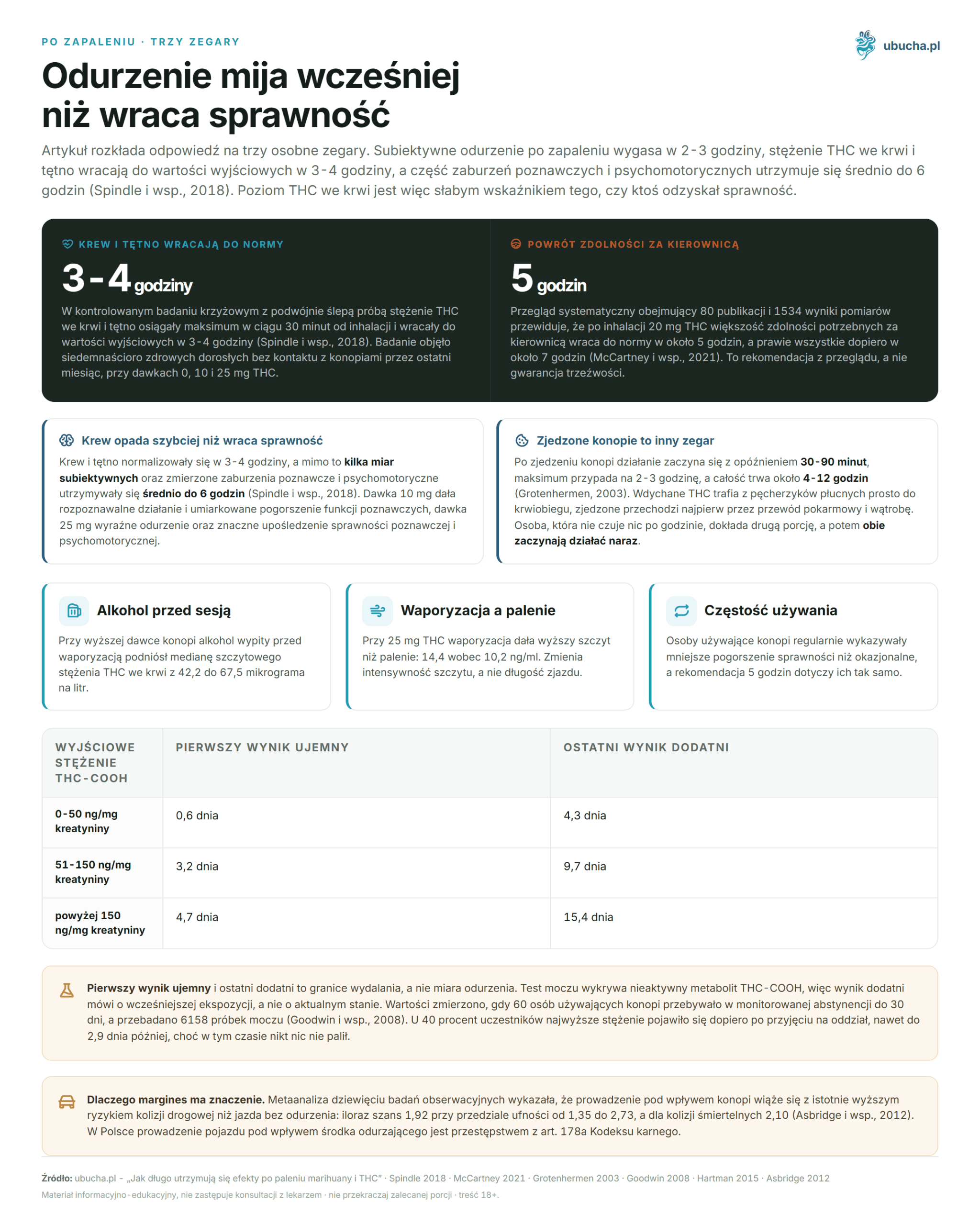
The phase after marijuana peaks at 15 to 30 minutes, subjective intoxication fades in 2 to 3 hours, and driving ability returns only after about 5 hours. The question is simple, but the answer breaks down into three separate clocks. Subjective intoxication after smoking wears off in a few hours, psychomotor performance returns later, and metabolites remain in the body even when you no longer remember smoking. In a controlled study involving cannabis users, THC concentration in the blood and heart rate rarely peaked within 30 minutes of inhalation and returned to baseline values in 3-4 hours, but some cognitive impairments persisted on average for up to 6 hours (Spindle et al., 2018). Below, we break down these clocks by the hour: what happens after smoking, how vaporization differs from eating, when it is safe to return to driving, and how long tests detect traces.
KEY INFORMATION
• THC concentration in the blood peaks at 30 minutes after inhalation and returns to baseline in 3-4 hours (Spindle et al., 2018).
• Cognitive and psychomotor impairments persist on average for up to 6 hours.
• After eating cannabis, effects begin after 30-90 minutes and last 4-12 hours (Grotenhermen, 2003).
• You can return to driving no sooner than 5 hours after inhalation (McCartney et al., 2021).
• In Poland, driving under the influence of an intoxicant is a crime under Article 178a of the Penal Code.
How quickly does THC work after smoking and how long does it last?
In colloquial Polish, this period is called the phase, and most questions sound like this: how long does the phase last after the green, how long does the phase hold, after what time does it fade. The phase is exactly the first of the three clocks, that is, subjective intoxication, and lasts 2 to 3 hours after inhalation. The other two clocks, psychomotor performance and the presence of metabolites, run much longer, and it is they, not the phase, that determine driving and the test results.
After inhalation, psychoactive effects begin within seconds to a few minutes, peaking at 15-30 minutes, and intoxication fades within 2-3 hours (Grotenhermen, 2003). Blood measurements confirm this rhythm: THC concentration and heart rate return to pre-administration values after 3-4 hours.
This rhythm was measured in a controlled crossover study with a double-blind design, in which seventeen healthy adults with no contact with cannabis for the last month received doses of 0, 10, and 25 mg THC (Spindle et al., 2018). A dose of 10 mg produced recognizable effects and moderate cognitive impairment. A dose of 25 mg caused clear intoxication, more side effects, and significant impairment of cognitive and psychomotor performance.
The most important observation from this study concerns the discrepancy between blood levels and a person’s state. Blood and heart rate normalized in 3-4 hours, yet several subjective measures and measured cognitive and psychomotor impairments persisted on average for up to 6 hours. Therefore, THC levels in the blood are a poor indicator of whether someone has regained their abilities.
| Time since inhalation | What happens | Equivalent after eating |
|---|---|---|
| seconds to a few minutes | Onset of psychoactive effects | 30-90 minutes |
| 15-30 minutes | Peak intoxication, peak THC concentration in blood and heart rate | 2-3 hours |
| 2-3 hours | Subjective intoxication fades | 4-12 hours |
| 3-4 hours | THC concentration in blood and heart rate return to baseline values | longer, without measured limits |
| up to 6 hours | Some cognitive and psychomotor impairments still present | longer, without measured limits |
How does vaporization differ from smoking in terms of duration of effects?
The time profile is almost identical, but the strength differs. At the same dose, vaporization produced a higher peak THC concentration in the blood than smoking: for 25 mg, it was 14.4 ng/ml after vaporization compared to 10.2 ng/ml after smoking, and the subjective effect was stronger for most measured indicators (Spindle et al., 2018).
The reason is simple. During smoking, some THC breaks down in the flame before reaching the lungs. A vaporizer heats the material below the combustion temperature, so a larger portion of the substance reaches the body from the same amount. The practical effect is that a portion that was tolerable with a joint can turn out to be too strong when vaporized. You can find more about temperature selection in the post vaporization of herbs and cannabis.
For the duration of effects, the conclusion is one: vaporization does not shorten or lengthen intoxication in a way that can be planned. It changes the intensity of the peak, not the length of the descent. Those hoping for a quicker return to performance by choosing a vaporizer over a joint are counting on something that measurement does not confirm.
Why do edibles take longer to kick in and last significantly longer?
After eating cannabis, psychoactive effects begin with a delay of 30-90 minutes, peak at 2-3 hours, and last about 4-12 hours, depending on the dose and which effect is measured (Grotenhermen, 2003). This is a completely different clock than with inhalation.
The difference arises from the route the substance takes. Inhaled THC goes from the alveoli directly into the bloodstream, so peak plasma concentration appears within minutes. Ingested THC must first pass through the digestive tract and liver, which stretches and flattens the entire process.
The practical risk arises directly from this delay. A person who feels nothing after an hour adds a second portion, and then both start to work at once. The most common acute side effects when exceeding the psychoactive threshold are anxiety and panic attacks, and from the body, increased heart rate and changes in blood pressure. With eating, they cannot be reversed by quickly stopping, as the dose is already in the body and will continue to release over the next hours.
How long do cognitive and psychomotor impairments last?
Longer than the feeling of intoxication itself. A systematic review covering 80 publications and 1534 measurement results predicts that after inhaling 20 mg THC, most cognitive abilities related to driving return to normal in about 5 hours, and almost all in about 7 hours (McCartney et al., 2021).
This same review showed that at the peak of THC effects, control of lane position, target tracking, and divided attention worsened. The magnitude of the impairment is not constant: it depends on the dose, the time elapsed since administration, and which ability is being measured. These three variables explain why user reports vary so widely.
Along the oral route, the return to performance takes longer than after inhalation, which is consistent with the extended absorption process. The authors of the review formulate one practical recommendation: before engaging in tasks requiring safety, one should wait at least 5 hours after inhaling cannabis. For eating, this time is longer, and the review does not provide a single number for it.
Are you still impaired the next day after smoking?
Data do not support the widespread belief in a hangover from cannabis. A systematic review of 20 studies involving 458 people and 345 performance measurements found that 209 of 345 tests showed no THC effects the next day (McCartney et al., 2023).
Results indicating impaired performance the next day came from 12 measurements in five publications. None of these five had a randomized double-blind design with a placebo control, and all were published over eighteen years ago, including four over thirty years ago. Another 121 measurements were marked as ambiguous due to a lack of data.
The authors’ conclusion is cautious and should be read as such: scientific evidence that cannabis use impairs performance the next day is limited. This is not the same as evidence of a lack of such an effect. Most studies, including some of higher methodological quality, simply did not find it. Separately, it is worth noting that the review concerned single doses with a median of 16 mg THC, not a pattern of daily use; we discuss the latter in the post about long-term effects of cannabis use.
When is it safe to drive after smoking?
No sooner than 5 hours after inhalation, and for doses higher than 20 mg THC and after eating cannabis, appropriately later (McCartney et al., 2021). This is a recommendation from the review, not a guarantee of sobriety: almost all tested abilities returned only around the seventh hour.
The reason to take this margin seriously is evident in accident data. A meta-analysis of nine observational studies found that driving under the influence of cannabis is associated with a significantly higher risk of a traffic collision compared to driving without intoxication, with an odds ratio of 1.92 with a confidence interval from 1.35 to 2.73 (Asbridge et al., 2012). The risk was more pronounced for fatal collisions, where the odds ratio was 2.10.
Subjective feelings of sobriety are a poor guide here, as THC levels in the blood drop faster than abilities return. In Poland, driving under the influence of an intoxicant is a crime under Article 178a of the Penal Code. Additionally, there is the test result: the same concentration can indicate a completely different state in a person who smokes daily and in one who uses cannabis once every few months.
How does alcohol change the effects of THC?
It raises THC levels in the blood and thus enhances intoxication. In a study where thirty-two adults consumed either a placebo or a small amount of alcohol ten minutes before vaporizing cannabis, peak THC concentrations after alcohol were significantly higher than without it (Hartman et al., 2015).
The scale of this difference depended on the dose of cannabis. At a higher dose, the median peak THC concentration in the blood increased from 42.2 to 67.5 micrograms per liter with the addition of alcohol, and the median concentration of the active metabolite 11-OH-THC increased from 5.0 to 6.0 micrograms per liter. The target blood alcohol concentration in this study was about 0.065 percent, which falls within a range that many people consider negligible.
The authors link this increase to the stronger impairment observed in other studies when combining cannabis with alcohol. For the duration of effects, this means that an evening with alcohol shifts the entire clock: the peak is higher, and the moment when one can speak of a return to performance is pushed further away. We expand on this topic in the post about mixing alcohol and marijuana.
How does tolerance change the strength of effects and how long does it take to reset?
Regular smoking weakens the brain’s response to THC, and recovery takes about four weeks. Positron emission tomography imaging showed reversible and selective regional decreases in CB1 receptor density in the brain cortex in daily cannabis users (Hirvonen et al., 2012).
Two observations from this study have practical significance. First, the intensity of the change correlated with the number of years of smoking, so it is not the effect of one intense month. Second, after about four weeks of monitored abstinence in a research center, CB1 receptor density returned to normal levels. A break effectively reverses the change, but it takes weeks, not days.
This same difference is evident in performance measurements. In a review of 80 publications, regular cannabis users showed less impairment than occasional users (McCartney et al., 2021). This does not mean they are safe behind the wheel. It only means that the same dose has a different effect on them, and the recommendation to wait at least 5 hours applies to them as well.
What happens after stopping THC?
A significant portion of regular cannabis users experiences withdrawal syndrome. A meta-analysis of 47 studies involving 23,518 participants estimated its overall prevalence at 47 percent, with a confidence interval from 41 to 52 percent (Bahji et al., 2020).
This single number, however, hides a vast range and is worth breaking down. In population trials, the prevalence was 17 percent, in outpatient trials 54 percent, and among hospitalized individuals 87 percent. The differences between these three groups were statistically significant, so the risk primarily depends on how intense the pattern of use was.
The analysis also identified factors associated with a higher prevalence of withdrawal syndrome: daily cannabis use and co-occurring dependence on tobacco or other substances. The authors formulate a practical conclusion for those limiting use: withdrawal symptoms are common enough that it is worth expecting them, rather than treating them as a signal that something has gone wrong.
This same picture emerges from a pharmacological review, which notes that regular cannabis use can lead to dependence and mild withdrawal syndrome (Grotenhermen, 2003). Comparing this data with the time for CB1 receptor recovery provides a practical hint for those planning a break: the period when symptoms are most severe ends earlier than the four-week return of receptors to normal. A break interrupted halfway costs discomfort without the benefit it was calculated for.
Does CBD alleviate too strong THC effects?
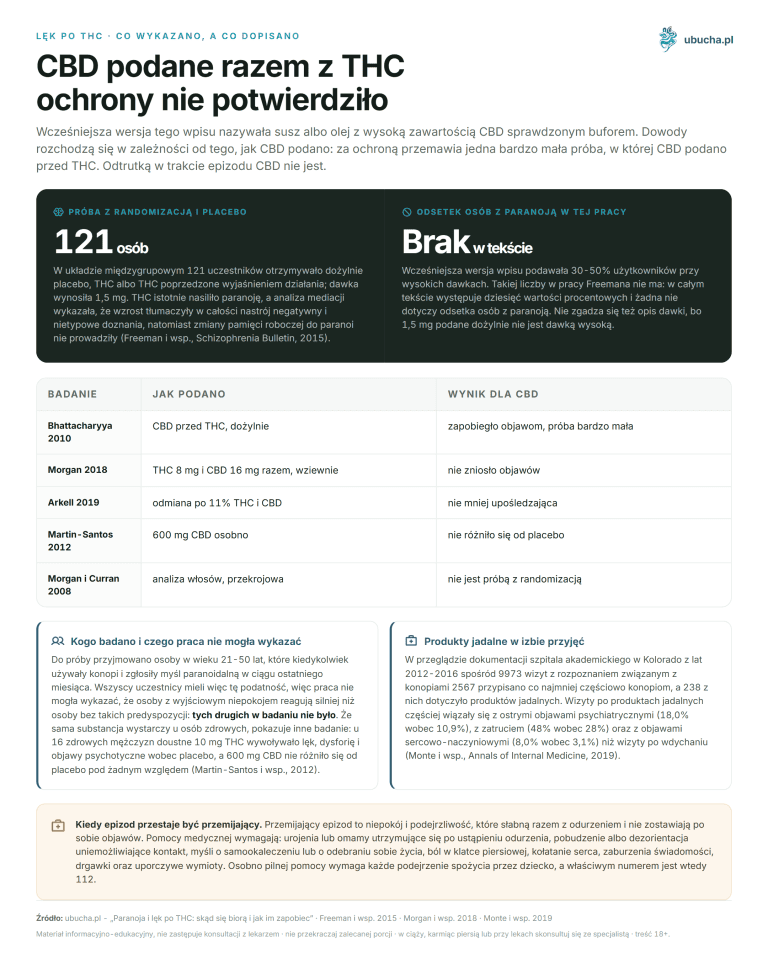
Partially and not for everyone. In a randomized placebo-controlled study, where twenty-six recreational cannabis users received vaporized cannabis in four variants, anxiety after the variant containing equal amounts of THC and CBD was significantly lower than after THC alone (Hutten et al., 2022).
What proved decisive was the level of anxiety someone started with. At low baseline anxiety, CBD completely alleviated anxiety caused by THC. At high baseline anxiety, it did not alleviate it at all. This means that those who would most need such protection receive it the least.
It is also worth noting what this study does not say. One scheme was tested, in which CBD and THC were given together, in doses of 13.75 mg each. It was not checked whether CBD taken afterward would shorten ongoing intoxication. Therefore, this result does not apply to the popular practice of rescuing oneself with oil drops in the midst of too strong an experience.
It also speaks against it the clock of cannabidiol itself. A review of 24 pharmacokinetic studies in humans states that peak CBD concentration in the blood appears within a range from zero to 4 hours after administration, with oral and sublingual routes taking longer than inhalation (Millar et al., 2018). Oil swallowed in the midst of too strong intoxication would therefore start to work roughly when the peak of THC is already declining. This same review notes that peak CBD concentration increases after a meal and in fat-based preparations, which further blurs the predictability of such an on-the-spot dose.
How long is THC detectable in tests?
Much longer than the intoxication lasts, and the longer, the higher the baseline concentration. In a study where 60 cannabis users stayed in a research unit under monitored abstinence for up to 30 days, 6158 urine samples were tested and participants were divided into three groups based on initial concentration (Goodwin et al., 2008).
| Initial THC-COOH concentration in urine | First negative result | Last positive result |
|---|---|---|
| 0-50 ng/mg creatinine | 0.6 days | 4.3 days |
| 51-150 ng/mg creatinine | 3.2 days | 9.7 days |
| above 150 ng/mg creatinine | 4.7 days | 15.4 days |
The urine test detects the inactive metabolite THC-COOH, so a positive result indicates prior exposure, not current intoxication. The authors present these values directly as a guideline for distinguishing fresh use from residual excretion. It is worth noting that in 40 percent of participants, the highest concentration appeared only after admission to the unit, even up to 2.9 days later, despite no one smoking during that time. A detailed breakdown of detection windows for individual materials is collected in the post about how long marijuana remains in the body.
What shifts this entire clock for a specific person?
Four variables explain most of the discrepancies between reports. A meta-regression involving 481 estimates for the inhalation route and 243 for the oral route showed that the severity of impairments after THC depends on the dose, the time elapsed since administration, and which ability is being measured (McCartney et al., 2021). The fourth variable is the frequency of use.
The dose dependency is most clearly seen in controlled data. At 10 mg THC, recognizable effects and moderate cognitive impairment occurred, while at 25 mg, clear intoxication and significant impairment of cognitive and psychomotor performance were observed (Spindle et al., 2018). The same portion spread over two doses gives a different course than taken all at once.
The route of administration does not determine strength but rather the shape of the curve: inhalation gives a quick peak and quick descent, while eating provides a flat course stretched over 4-12 hours (Grotenhermen, 2003). Frequency of use works in the opposite direction than intuition suggests to outsiders: at the same dose, regular cannabis users showed less impairment than occasional users. Alcohol consumed before the session, on the other hand, raises peak THC levels in the blood, thus shifting the entire course upward (Hartman et al., 2015).
How much trace remains after CBD alone, without THC, is broken down separately in the text about CBD detection time.
What is the legal status of THC and CBD in Poland?
Marijuana other than hemp remains a controlled substance in Poland, while cannabidiol does not. The boundary between the two is defined by a specific content threshold, calculated in a strictly defined manner, and it determines whether a given plant material is legal.
Hemp refers to plants of the species Cannabis sativa L., in which the total content of delta-9-THC and tetrahydrocannabinolic acid, or THCA, in the flowering or fruiting tops of the plants, from which the resin has not been removed, does not exceed 0.3 percent when calculated on a dry weight basis. The total is rounded to one decimal place. The basis is Article 4 point 5 of the Act of July 29, 2005 on Counteracting Drug Addiction, as amended by the Act of March 24, 2022, effective from May 7, 2022.
Two things in this provision are regularly misrepresented. First, the threshold concerns the sum of delta-9-THC and THCA, not just delta-9-THC, which changes the laboratory test result. Second, the national threshold corresponds to the EU threshold, but it does not derive from it: these are two separate regulations with the same numerical value. Plant material exceeding 0.3 percent is marijuana other than hemp, which is a controlled substance. Cannabidiol itself does not appear in any list of controlled substances.
Frequently asked questions
How quickly does marijuana start to work after smoking?
Psychoactive effects appear within seconds to a few minutes after inhalation, peaking at 15-30 minutes (Grotenhermen, 2003). THC concentration in the blood and heart rate peak within the first 30 minutes, then begin to decline (Spindle et al., 2018).
How many hours should you wait before driving?
At least 5 hours after inhalation, and longer after consuming cannabis (McCartney et al., 2021). At a dose of 20 mg THC, almost all driving-related abilities returned only around the seventh hour. Driving under the influence of an intoxicant is a crime in Poland under Article 178a of the Penal Code.
Why does the effect last longer after eating cannabis than after smoking?
Ingested THC passes through the digestive tract and liver, which extends the entire process. Effects begin after 30-90 minutes, peak at 2-3 hours, and last about 4-12 hours, depending on the dose and measured effect (Grotenhermen, 2003).
Do you still feel effects the next day after smoking?
Evidence for this is limited. In a review of 20 studies and 345 performance measurements, 209 tests showed no THC effects the next day, and all studies suggesting such effects had weaker methodology and were published over eighteen years ago (McCartney et al., 2023).
How long are THC metabolites detectable in urine?
From about 4 days at low baseline concentrations to about 15 days at high concentrations, counting to the last positive result (Goodwin et al., 2008). Urine tests detect the inactive metabolite THC-COOH, so a positive result indicates prior exposure, not current intoxication.
Does CBD interrupt too strong THC effects?
When taken together with THC, it reduces anxiety caused by it, but only in individuals with low baseline anxiety; it does not work at all in those with high anxiety (Hutten et al., 2022). The study did not check whether CBD taken during intoxication shortens or alleviates anything.
How long does THC tolerance reset take?
About four weeks. In daily smokers, reversible decreases in CB1 receptor density in the brain cortex were observed, which returned to normal levels after about four weeks of monitored abstinence (Hirvonen et al., 2012). The intensity of the change correlated with the number of years of smoking.
If you are looking for plant material available in legal trade, check the category hemp flower. Stock levels change continuously.
This article is for informational and educational purposes and does not constitute legal advice. The legal status described in the article is valid as of the date of publication: regulations regarding cannabis may change. Before making a decision, consult a lawyer or current legal acts.
Author: Michał Waluk · Published: 2026-05-06 · Updated: 2026-08-24