
Cannabis and hemp cannabinoids in oncology therapy - new guidelines from the American Society of Clinical Oncology (ASCO 2024)
What do the ASCO guidelines really say about cannabis in adults with cancer, what evidence they stand on, and which popular claims contradict them.
The American Society of Clinical Oncology issued its first guidelines in 2024 regarding the use of cannabis and cannabinoids in adults with cancer (Braun et al., Journal of Clinical Oncology, 2024). The document is more cautious than its summaries suggest online. The panel discourages the use of cannabis as a treatment directed against cancer outside of clinical trials, allows it as an adjunct for refractory nausea and vomiting after chemotherapy, and states that the benefit remains uncertain for other indications. The difference between this document and its popular summaries is significant and concerns aspects that patients consider when making decisions: the size of the evidence base, the strength of recommendations, and what cannabinoids were compared to. In this text, we separate what the guidelines actually state from claims that have been attributed to them secondarily, and we show what studies both positions are based on.
KEY INFORMATION
• ASCO recommends not to use cannabis or cannabinoids as a treatment directed against cancer outside of clinical trials (Braun et al., Journal of Clinical Oncology, 2024).
• Cannabinoids may improve control of refractory nausea and vomiting after chemotherapy, but only as an adjunct to the standard antiemetic regimen.
• For other symptoms, the guidelines use the phrase that the benefit remains uncertain; the certainty of evidence for most outcomes was rated as low or very low.
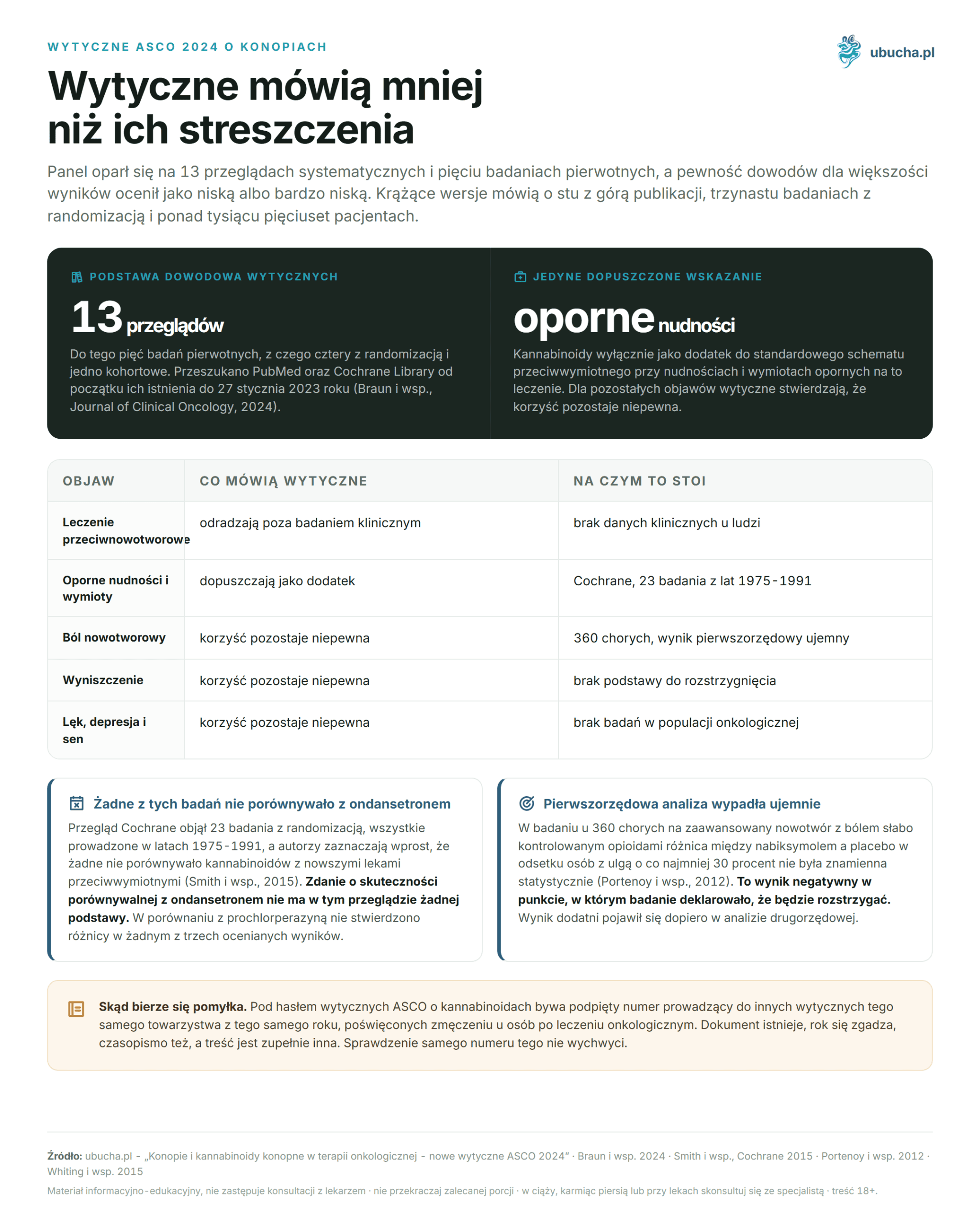
• The basis of the guidelines was 13 systematic reviews and five primary studies, not over a hundred publications as popular discussions state.
• The safety of cannabidiol cannot be established in individuals taking medications, and this is the situation for every cancer patient (EFSA Journal, 2026).
What exactly do the ASCO 2024 guidelines recommend?
The guidelines provide three determinations and one major caveat. They discourage cannabis as an anticancer treatment outside of clinical trials. They allow it as an adjunct for refractory nausea and vomiting after chemotherapy. For other symptoms, they state that the benefit remains uncertain (Braun et al., Journal of Clinical Oncology, 2024).
The fourth element of the document is often overlooked, and it is the most prominently highlighted. The panel opens the guidelines with the statement that the availability of cannabis and its use by adults with cancer has outpaced the science that would justify its use. A significant portion of the document describes not pharmacology, but how to conduct the conversation: how a doctor should ask about cannabis openly and without judgment.
This shift in emphasis has practical implications for the reader. The guidelines are not a list of indications for prescriptions but a tool to reveal what the patient is already using. Their authors assume that some patients turn to cannabis without the knowledge of their treatment team, and the greatest risk is not the product itself, but that no one knows about it when planning chemotherapy.
The document concludes with a call for research. The panel explicitly states the urgent need for further work on cannabis and cannabinoids in oncology. It is hard to send a clearer signal that we are dealing with an open area, not an established standard of care. We discuss the broader question of whether cannabis can support oncological treatment in our post about CBD and cancer.
What evidence underpins the ASCO guidelines?
The evidence base was smaller than summaries repeat. The panel relied on 13 systematic reviews and five additional primary studies, four of which were randomized studies and one was a cohort study. They searched the PubMed and Cochrane Library databases from their inception until January 27, 2023 (Braun et al., Journal of Clinical Oncology, 2024).
The quality assessment of this base is stated directly in the document: the certainty of evidence for most outcomes was low or very low. This term has a strict meaning in the methodology of guideline development. It means that further research will likely change the effect estimate, and the result that is visible today may turn out to be much smaller or may not confirm at all.
Popular discussions provide different numbers at this point. Versions circulate about a systematic review of over a hundred publications, thirteen randomized studies, and over fifteen hundred patients. None of these agree with what is written in the document itself. The discrepancy is so large that it cannot be explained by a different counting method.
Where does such a mistake come from? The most common source of error is the substitution of identifiers: under the heading of ASCO guidelines on cannabinoids, a number leading to other guidelines from the same society from the same year, dedicated to fatigue in individuals after cancer treatment, is sometimes attached. The document exists, the year matches, the journal does too, but the content is entirely different. Checking the number itself does not catch this.
Do cannabis treat cancer?
There is no evidence to support this, and the guidelines state this most strongly among all their recommendations. The panel advises doctors to discourage the use of cannabis and cannabinoids as a treatment directed against cancer, with one exception: participation in a clinical trial (Braun et al., Journal of Clinical Oncology, 2024).
The wording is deliberately strong because it concerns the most dangerous decision a patient can make based on information from the internet. Replacing chemotherapy, radiotherapy, or surgery with a cannabis product has no clinical data support in humans. Anticancer effects described in cell cultures and animals do not automatically translate to disease progression in humans, and the history of oncology is full of substances that stopped at this stage.
It is worth naming what distinguishes supportive therapy from causal treatment. A product that reduces nausea does not reduce a tumor. Improvement in well-being after using any agent may be perceived as evidence of action on the disease, but these are two entirely different things, and confusing them costs time that cannot be regained in oncology.
Therefore, treat any statement about the anticancer action of cannabis that you encounter without a reference to a specific study in humans as advertising content. If there is a reference, check whether the work pertains to humans or cells in a dish, and whether it measured survival or protein concentration in culture.
What is known about cannabinoids in nausea and vomiting after chemotherapy?
This is the only area where the guidelines allow cannabinoids, and even there conditionally: as an adjunct to the standard antiemetic regimen for refractory nausea and vomiting. The basis is a Cochrane review that included 23 randomized studies (Smith et al., Cochrane Database of Systematic Reviews, 2015).
A detail that changes the meaning of the entire thread concerns the age of these studies. All were conducted between 1975 and 1991, and the authors of the review explicitly state that none compared cannabinoids with newer antiemetic drugs such as ondansetron. The statement about effectiveness comparable to ondansetron that circulates in Polish internet has no basis in this review.
What the review actually showed. Compared to placebo, cannabinoids increased the chance of complete absence of vomiting and complete absence of nausea and vomiting, with evidence rated as low to moderate quality. No difference was found compared to prochlorperazine in any of the three assessed outcomes. Patients chose cannabinoids more often, but they also discontinued treatment more often due to adverse effects.
The authors’ caution is evident in their own conclusion. They write that cannabis-based products may be useful in refractory nausea and vomiting after chemotherapy, but the methodological limitations of the studies restrict this conclusion, and studies reflecting today’s chemotherapy regimens and newer antiemetic drugs will likely change it.
Do cannabis help with cancer pain?
Here the guidelines use the phrase of uncertain benefit, and the most frequently cited study in this indication did not achieve its primary goal. Portenoy and colleagues randomized 360 patients with advanced cancer and poorly controlled pain with opioids to placebo or one of three levels of nabiximols (The Journal of Pain, 2012).
The primary analysis compared the percentage of individuals whose pain decreased by at least 30%. The difference between nabiximols and placebo was not statistically significant. This is a negative result at the point where the study declared it would be decisive, and it must be described as such.
The secondary analysis turned out differently. When the continuous change in pain was assessed instead of the percentage threshold, the percentage of patients reporting relief was higher with nabiximols than with placebo, with the effect visible in the low and medium dose groups, but not in the high dose group. In the lowest dose group, improvement also concerned the most severe pain and sleep disturbances. Adverse effects depended on the dose, and only at the highest level did they fare worse than placebo.
A broader context is provided by Whiting’s review, which found moderate quality evidence for chronic pain as a whole (JAMA, 2015). This is an assessment for all types of chronic pain combined, not for cancer pain separately. Transferring it directly to oncology is a shortcut that the authors do not take.
What does ASCO say about cancer cachexia and appetite?
Cachexia is among those symptoms for which the guidelines state that the benefit of cannabis remains uncertain. There is neither a recommendation for nor a hard prohibition; there is a lack of basis to resolve it one way or the other (Braun et al., Journal of Clinical Oncology, 2024).
To understand why mere appetite stimulation is not enough, one must know what cancer cachexia actually is. An international consensus defines it as a multifactorial syndrome characterized by the loss of skeletal muscle mass, with or without loss of fat tissue, and which cannot be fully reversed by nutritional support alone (Fearon et al., The Lancet Oncology, 2011).
The definition also states where this resistance comes from. At its core is a negative protein-energy balance driven by both reduced food intake and abnormal metabolism. The second component does not disappear when the patient simply eats more. Therefore, a product that improves appetite may enhance comfort without affecting muscle mass or functionality.
The consensus also distinguishes stages: from a pre-cachexia state, through cachexia, to a treatment-resistant form. The diagnostic criterion is a weight loss exceeding five percent or exceeding two percent in already lean individuals. The assessment includes appetite, catabolic drive, muscle mass and strength, and functionality. This is the framework within which a doctor assesses the sense of any intervention, including cannabis.
Do cannabinoids help with anxiety, depression, and sleep in cancer?
The guidelines classify these symptoms as a group for which the benefit remains uncertain. There are no dedicated randomized studies in the oncology population that would allow for a recommendation, and data from other populations do not directly transfer to a person undergoing anticancer treatment.
The scale of the problem is often exaggerated. A meta-analysis by Mitchell and colleagues included 70 studies and over ten thousand individuals in oncology and hematology centers. Depression diagnosed according to diagnostic criteria occurred in 16.3% of patients, anxiety disorders in 10.3%, and any mood disorder in 38.2% (The Lancet Oncology, 2011).
The authors draw a conclusion opposite to the popular one. They state that depression and anxiety diagnosed in psychiatric interviews are less common in cancer patients than previously thought, although some form of mood disorder affects thirty to forty percent of patients in hospital settings. The popular statement about a forty percent prevalence of anxiety comes from confusing the percentage for all mood disorders with the percentage for anxiety alone.
For the patient, this means two things at once. Psychological suffering in cancer is real and requires treatment, but the first-line tools remain psychotherapy and pharmacotherapy with documented effectiveness, not a cannabis product. An undiagnosed mood disorder is a bigger problem than lack of access to cannabinoids.
What are the risks of combining cannabis with chemotherapy?
The main risk concerns drug metabolism. A systematic review by Stout and Cimino indicates that the metabolism of cannabidiol involves the isoenzymes CYP2C19 and CYP3A4, while the metabolism of tetrahydrocannabinol involves the isoenzymes CYP2C9 and CYP3A4 (Drug Metabolism Reviews, 2014). These same pathways handle many anticancer drugs.
The authors of the review are more cautious than is often presented. They assess that studies on the inhibition and induction of major isoenzymes by tetrahydrocannabinol, cannabidiol, and cannabinol indicate a low risk of clinically significant interactions in most applications, but they also note a lack of data in humans. An interaction confirmed by a pharmacokinetic study involved ketoconazole with the extract administered orally.
The second risk concerns the liver, and here the signal is stronger. The European Food Safety Authority summarized that studies in humans indicate the potential hepatotoxicity of cannabidiol, especially when used together with other medications (EFSA Journal, 2026). Animal studies have shown consistent liver toxicity, with organ mass and histopathological changes as sensitive endpoints.
The most important statement of this document directly concerns the situation of cancer patients. The safety of cannabidiol cannot be established in individuals taking medications, in pregnant and breastfeeding women, and in individuals under 25 years of age. A patient undergoing chemotherapy always falls into the first of these groups without exception, so any decision to add a product must be made by the oncologist and pharmacist, not the seller.
What is known about combining cannabis with immunotherapy?
There is one warning signal, and it comes from an observational study, not from randomization. Taha and colleagues reviewed the documentation of 140 patients treated with nivolumab for advanced melanoma, non-small cell lung cancer, or clear cell kidney cancer, of which 51 individuals used cannabis simultaneously (The Oncologist, 2019).
The result was clear in one point. The response rate to immunotherapy was 37.5% in individuals treated with nivolumab alone compared to 15.9% in those additionally using cannabis, and in the multivariate model, cannabis was the only factor lowering this rate. The content of tetrahydrocannabinol or cannabidiol in the used product did not affect the outcome in either group.
The rest of the results were neutral. The use of cannabis was not a significant factor for progression-free survival or overall survival. However, smoking and brain metastases influenced these two parameters, and additionally, low performance status affected overall survival.
The authors themselves point out limitations, and it is worth repeating them. This is a retrospective analysis from a single center, so it does not determine causation, only co-occurrence. Their conclusion for practice is, however, unequivocal: caution is needed when starting immunotherapy, and a person using cannabis should disclose this before treatment begins.
What adverse effects can be expected?
Cannabinoids increase the risk of short-term adverse effects, including severe ones. A review by Whiting and colleagues included 79 randomized studies and 6462 participants in various medical indications, and among the most common adverse effects, they list dizziness, dry mouth, nausea, fatigue, and drowsiness (JAMA, 2015).
The list is longer and includes symptoms that mean more to a person weakened by illness than to a healthy person: euphoria, vomiting, disorientation, drowsiness, confusion, loss of balance, and hallucinations. In a patient after chemotherapy, with anemia and electrolyte disturbances, loss of balance can lead to falls, and confusion may be mistaken for delirium from another cause.
The Cochrane review shows the same picture in a narrower indication. Compared to prochlorperazine, patients taking cannabinoids reported dizziness, dysphoria, euphoria, a sense of intoxication, and sedation more often, and they also discontinued treatment more often due to adverse effects (Smith et al., Cochrane Database of Systematic Reviews, 2015).
A note on numbers. In the Whiting study, precise percentages for individual symptoms and the odds ratio for the risk of adverse effects circulate online. They do not come from the summary of this work and could not be confirmed in it, so we do not repeat them here. However, the direction of the conclusion is unequivocal and does not require percentages.
Why can’t the results of these studies be transferred to cannabidiol oils?
Because they studied something else. The Cochrane review assessed cannabis-based medications based on tetrahydrocannabinol (Smith et al., Cochrane Database of Systematic Reviews, 2015), and Portenoy’s study involved nabiximols, a standardized extract administered orally (The Journal of Pain, 2012). Neither is an oil with a predominance of cannabidiol from the store.
This distinction often gets lost in popular discussions more than any other. The result obtained with a tetrahydrocannabinol product, available in Poland only by prescription, is attributed to an over-the-counter product that was not present in the study. For the reader, this sounds like confirmation, but it is a substitution of substances.
The situation is not simplified by the hypothesis of the entourage effect, which is the thesis about the interaction of cannabinoids and terpenes in the plant extract. Russo discussed it in a review where he compares data on individual components and proposes ways to test it (British Journal of Pharmacology, 2011). Synergy is conditionally formulated there as a hypothesis to be proven, not as an established mechanism.
One observation actually goes against the entire narrative. In the analysis of patients treated with nivolumab, the content of tetrahydrocannabinol or cannabidiol in the used product did not affect the response rate (The Oncologist, 2019). The composition that manufacturers differentiate their products with did not turn out to be a decisive factor for anything other than the mere fact of using cannabis.
When should cannabis not be used in cancer?
The first situation is unconditional: cannabis does not replace oncological treatment and should not be substituted for chemotherapy, radiotherapy, or surgical treatment. This is the only place where the guidelines formulate a negative recommendation directly (Braun et al., Journal of Clinical Oncology, 2024).
The second group of situations arises from the safety assessment of cannabidiol. The European regulator cannot determine the safety of this substance in pregnant and breastfeeding women, in individuals under 25 years of age, and in individuals taking medications. It also points out the passage of cannabidiol through the placenta and the observed developmental consequences in animal studies after prenatal exposure.
The third situation is ongoing immunotherapy. Retrospective data link simultaneous use of cannabis with a lower response rate to nivolumab, and in the absence of prospective studies, it is reasonable to discuss this issue with an oncologist before starting treatment, not during it.
The fourth group arises from the route of administration. Inhaling smoke or vapor introduces microbiological contaminants into the respiratory tract, which is a real, not theoretical risk for a person with neutropenia after chemotherapy. If a doctor deems a cannabinoid justified, the oral or sublingual route is safer, and the material should come from a pharmacy.
What is the access to medical marijuana like in Poland?
Non-fibrous cannabis flower has been available in Poland as a pharmaceutical raw material by prescription since November 1, 2017, based on the act of July 7, 2017 (Dz.U. 2017 poz. 1458). A prescription can be issued by any doctor with the right to practice, including an oncologist or a palliative care specialist.
Two procedural regulations are worth knowing before scheduling a visit. A prescription for non-fibrous cannabis requires a personal examination of the patient, so a teleconsultation is not an equivalent path to an office visit; exceptions to this rule are narrow. A prescription for a narcotic retains validity for a shorter time than a regular electronic prescription, so it cannot be postponed indefinitely.
Registered cannabinoid medications stand separately, meaning products approved for circulation with their own narrowly defined indication. This is not the same as pharmaceutical raw material issued by prescription and not the same as a product purchased over the counter. The current list of such medications and their indications is checked in the register of medicinal products, as it changes more frequently than the content of this article.
The third category is cannabidiol products available without a prescription. They are not medications, do not have registration indications, and cannot be recommended as part of oncological treatment. The practical side of the path to a prescription is described in our posts about medical marijuana in Poland and about how to become a medical marijuana patient.
How to talk to an oncologist about cannabis?
The guidelines dedicate a separate section to this and formulate it as a task for the doctor: to conduct an open, non-judgmental conversation with an adult patient about the use of cannabis and cannabinoids (Braun et al., Journal of Clinical Oncology, 2024). The reason is simple: undisclosed information cannot be included in the treatment plan.
From the patient’s side, the conversation is easier when you come with specifics instead of generalities. It is worth preparing a few pieces of information that the doctor will need to establish anyway.
- What products are you currently using and for how long.
- What is the route of administration: oral, sublingual, or inhalation.
- How often do you use the product during the day.
- What symptoms do you want to alleviate and do you see an effect.
- What adverse effects have you noticed, especially drowsiness and dizziness.
- Are you simultaneously using other supplements or herbal products.
The fear of moral judgment is the most common reason for silence, and this is precisely what the guidelines address directly. A doctor who hears about cannabis use should respond with a conversation about benefits and risks, not judgment. If the reaction is different, it is not a reason to stop talking about it altogether; it is a reason to mention it to the clinical pharmacist in the center as well.
What are the practical conclusions for Polish patients?
The first conclusion concerns expectations. The ASCO guidelines do not open the way to treating cancer with cannabis and explicitly warn against this. However, they do open a narrow door for refractory nausea and vomiting after chemotherapy, as an adjunct to the standard regimen, and leave the question open for other symptoms.
The second conclusion concerns numbers. A significant portion of claims attributed to these guidelines has no support in them: neither the size of the evidence base nor supposedly strong recommendations in pain, appetite, and sleep, nor the comparison of the effectiveness of cannabinoids with ondansetron. If a text attributes specific support to a scientific society, check whether the reference leads to this document and not to other guidelines from the same year.
The third conclusion concerns safety. A cancer patient is, by definition, taking medications, which means they belong to the group for which the European regulator cannot establish the safety of cannabidiol. This is not a formal disclaimer to be overlooked, but a real boundary of knowledge that translates into liver risk and unpredictable concentrations of anticancer drugs.
If after this reading you are to do one thing, let it be a conversation with your treating oncologist and clinical pharmacist before adding anything to your treatment. Never discontinue oncological therapy in favor of a cannabis product and do not make this decision based on information from the internet, including this one.
Finally, a note about reading sources, as it will be useful longer than this article. With every sentence citing a study, check three things: whether humans were studied, whether the substance was the same as the one the text refers to, and whether the result pertained to the primary goal of the study or a secondary analysis. The three most common mistakes in this topic boil down to these three questions, and none of them require medical knowledge.
Frequently Asked Questions
Do cannabis treat cancer according to ASCO guidelines?
No. The panel recommends discouraging the use of cannabis and cannabinoids as a treatment directed against cancer unless it is part of a clinical trial (Journal of Clinical Oncology, 2024). Cannabis may only be considered as symptomatic support, never as a substitute for oncological treatment.
In which symptom do the guidelines allow cannabinoids?
Only in refractory nausea and vomiting after chemotherapy and only as an adjunct to the standard antiemetic regimen. For other supportive care symptoms, the guidelines state that the benefit remains uncertain, and the certainty of evidence for most outcomes was rated as low or very low.
Do ASCO guidelines confirm the effectiveness of cannabis in cancer pain?
No. Pain is among the symptoms for which the benefit remains uncertain. The largest study in this indication involved 360 patients and did not show a significant difference compared to placebo in its primary analysis (The Journal of Pain, 2012). A positive result only appeared in the secondary analysis.
Do cannabinoids work the same as ondansetron?
This has not been tested. A Cochrane review including 23 randomized studies states that none of them compared cannabinoids with newer antiemetic drugs such as ondansetron, and all were conducted between 1975 and 1991 (Cochrane Database of Systematic Reviews, 2015).
Can cannabis be used during immunotherapy?
This requires a discussion with an oncologist before starting treatment. In a retrospective analysis of 140 patients treated with nivolumab, the response rate was 37.5% without cannabis compared to 15.9% with cannabis, although survival time did not differ significantly (The Oncologist, 2019).
Can a patient use cannabidiol products without the oncologist’s knowledge?
They should not. Cannabidiol and tetrahydrocannabinol are metabolized by the same isoenzymes as many anticancer drugs (Drug Metabolism Reviews, 2014), and the European regulator cannot determine the safety of cannabidiol in individuals taking medications.
Can one vaporize cannabis during chemotherapy?
The inhalation route carries the risk of introducing microbiological contaminants into the respiratory tract, which is a real threat in neutropenia after chemotherapy. The oral or sublingual route is safer, and the material should come from a pharmacy, never from an uncontrolled source.
This article is for informational and educational purposes only and does not constitute medical advice. Before starting to use cannabis or CBD for therapeutic purposes, consult with a doctor, especially if you are taking other medications, are pregnant, or breastfeeding.
Author: Michał Waluk · Published: 2026-05-06 · Updated: 2026-08-10