
Hemp in Organic Farming, the Future of Sustainable Development
How much industrial hemp is grown in Poland and the EU, how much CO2 does the crop sequester, and does it manage without herbicides. Verified data from KOWR, the European Commission, and research.
The statement “one hectare of hemp absorbs more carbon dioxide than a forest” has been circulating in industry circles since 2021 and comes from a press interview, not from a peer-reviewed study. Industrial hemp has much to defend in organic farming, but the real numbers look different from those in brochures. The National Support Center for Agriculture records 1,275 ha of hemp cultivation as of the end of September 2025 and 1,606 registered producers, which is almost four times more than three years earlier. However, a farmer considering entering this crop needs numbers, not slogans, as they determine the investment decision for several seasons. Below you will find verified data on carbon sequestration, water consumption, plant protection, and phytoremediation, along with a clear indication of which popular claims are not supported by literature and where they originated from.
KEY INFORMATION
• In Poland, 1,275 ha of industrial hemp was cultivated as of September 30, 2025, and there were 1,606 producers compared to 425 in 2022 (KOWR, 2025).
• The EU area increased from 20,540 ha in 2015 to 33,020 ha in 2022, with France accounting for over 60% of production (European Commission).
• One ton of produced hemp corresponds to a reduction of 1.83 tons of net CO2 (Kilic-Topuz and Ayan, Journal of Environmental Quality, 2026).
• The figures “8-15 tons of CO2 per hectare” and “one-third of cotton’s water” do not come from peer-reviewed works.
Why do industrial hemp plants fit into organic farming?
Industrial hemp fits into organic farming because it quickly closes the canopy and suppresses weeds without herbicides, sequesters more carbon than the cost of its cultivation, and leaves a lot of organic residues in the field. An analysis of 49 farms in the Turkish province of Samsun showed that the plantation absorbs about sixteen times more CO2 than its production emits (Kilic-Topuz and Ayan, Journal of Environmental Quality, 2026).
This same work provides a figure that is easier to transfer to Polish conditions: one ton of produced hemp corresponds to a reduction of 1.83 tons of CO2 in net balance, after subtracting fuel, fertilizers, and machine labor. Technically efficient farms had a balance 39% better than inefficient ones. Therefore, the environmental outcome is determined by the cultivation method, not just the presence of the plant in the field.
The second argument is agronomic. Hemp is sown densely, the plant grows quickly, and after a few weeks, it shades the inter-rows, so weeds lose access to light. A peer-reviewed review of weeding strategies confirms that rapid canopy closure and high density significantly reduce the need for herbicides (Kaur et al., Journal of Cannabis Research, 2025). This is not the same as cultivation entirely without chemicals, but in an organic farm, where herbicides cannot be used anyway, the advantage is tangible.
The third reason is practical. Poland has its own varieties, its own breeding, and experience spanning centuries. Therefore, the farmer is not entering an exotic crop but returning to a species that disappeared from the crop rotation for regulatory, not agronomic, reasons.
How much hemp is grown in Poland and how much in the European Union?
As of September 30, 2025, 1,275 ha of industrial hemp was cultivated in Poland, and there were 1,606 producers and 80 purchasing entities in the KOWR register (KOWR, 2025). The EU area was 33,020 ha in 2022 compared to 20,540 ha in 2015, an increase of 60% (European Commission).
| Date | Area in Poland | Producers in the register | Purchasing entities |
|---|---|---|---|
| 2022 | 843 ha | 425 | 31 |
| 2023 | 1,274 ha | 1,139 | 86 |
| 2024 | 1,371 ha | 1,327 | 87 |
| 30.09.2025 | 1,275 ha | 1,606 | 80 |
The comparison shows something that gets lost in public discourse: the number of producers is growing much faster than the area. Since 2022, their number has nearly quadrupled, while the area has increased by half. The average plantation has shrunk from nearly 2 ha to less than one hectare. This profile reflects farms testing cultivation on small plots, not the profile of commodity raw material production.
The European scale can also be inflated. The figure “over 50,000 ha in 2023” circulates, which is not confirmed by any official source. The European Commission’s statistics close at 33,020 ha and production of 179,020 tons in 2022. France accounts for over 60% of EU production, Germany for 17%, and the Netherlands for 5%. Poland, with an area of 1,275 ha, accounts for about four percent of the cultivation area in the Community.
We noticed when comparing KOWR annual reports that the area itself can be a misleading measure. The statistics at the end of December 2025 show 1,146.78 ha, which is less than in September. The reported area and the area maintained for harvest are two different numbers, and the register is updated throughout the year.
How do industrial hemp plants differ from psychoactive varieties?
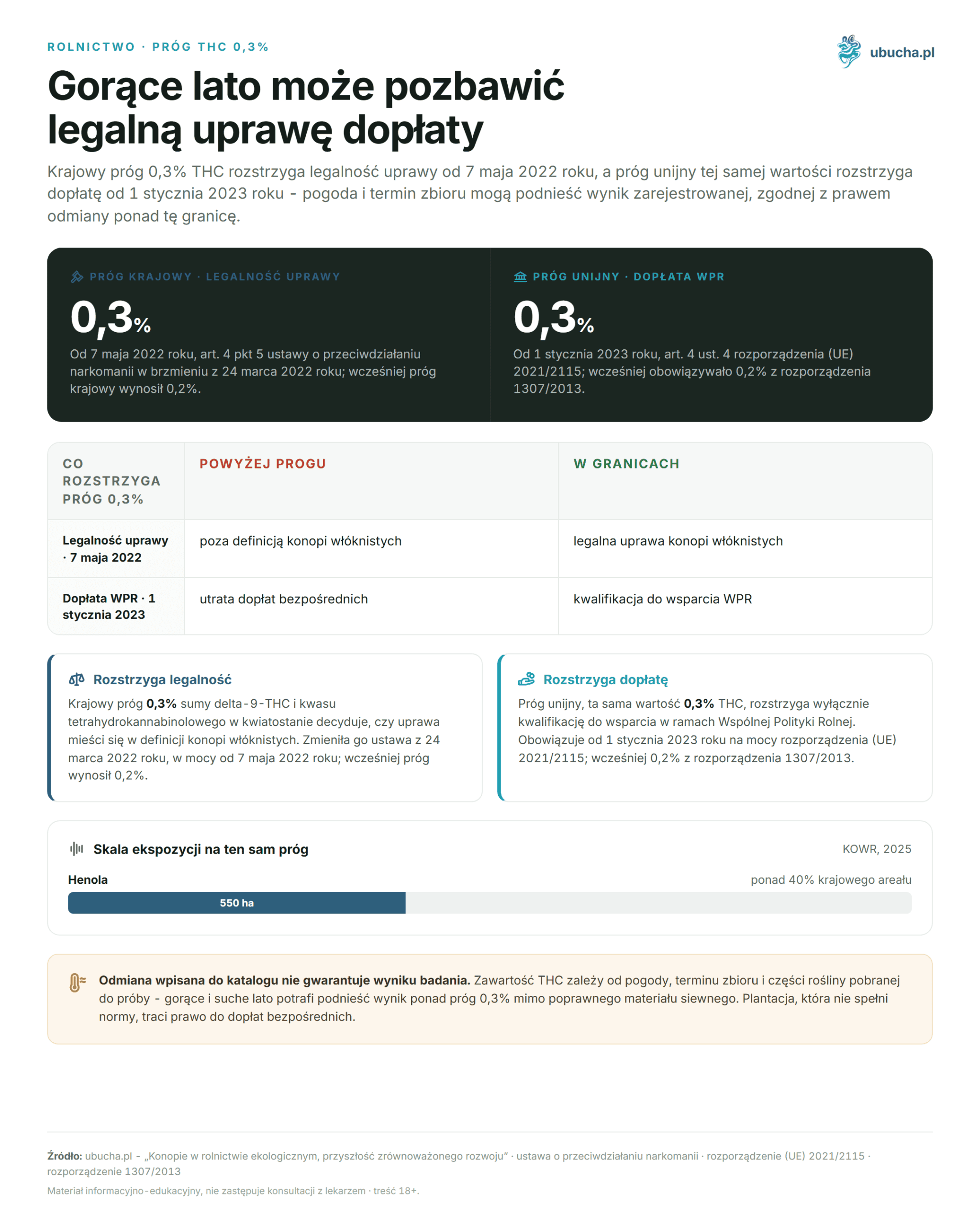
The difference is legal and breeding, not species. Industrial hemp is Cannabis sativa L. from varieties in which the sum of delta-9-THC and tetrahydrocannabinolic acid in the flowering or fruiting tops, from which the resin has not been removed, does not exceed 0.3% dry weight. The sum is rounded to one decimal place. The basis is Article 4 point 5 of the Act on Counteracting Drug Addiction, as amended by the Act of March 24, 2022, effective from May 7, 2022. Previously, the national threshold was 0.2%.
The EU threshold is a separate regulation with the same numerical value. From January 1, 2023, varieties eligible for support under the Common Agricultural Policy may contain up to 0.3% THC under Article 4 paragraph 4 of Regulation (EU) 2021/2115; previously, 0.2% from Regulation 1307/2013 was in effect, which was repealed on the same day. The Polish threshold corresponds to the EU one, but it does not derive from it and began to apply eight months earlier. For the grower, the distinction is practical: the subsidy is determined by the EU regulation, while the legality of the cultivation is determined by the national one.
Only varieties listed in the EU catalog of agricultural plant varieties or in the national register maintained by COBORU may be used for cultivation. In Poland, four varieties dominate: Henola, Finola, Białobrzeskie, and Futura 75. Henola alone occupies about 550 ha, which is over 40% of the national area.
Where does the risk for the grower come from? A variety listed in the catalog does not guarantee the test result. The THC content depends on the weather, harvest timing, and which part of the plant was sampled, so a hot and dry summer can raise the result above the threshold despite correct seed material. The financial consequences are borne by the farmer, as a plantation that does not meet the standards loses the right to direct payments. How this looks in practice is described in our post about destroying legal crops by a fraction of a percent.
Botanically, marijuana is not a separate species but a term for varieties selected for high THC content. The same plants diverged into two breeding directions only in the last century, after the introduction of international cultivation restrictions. The differences in chemotypes, terpene profiles, and purposes are described in detail in our post about varieties and properties of hemp.
How much CO2 does one hectare of hemp really absorb?
There is no single reliable number per hectare, and the most frequently repeated figure, 8-15 tons of CO2, comes from an interview that Darshil Shah from Cambridge gave in June 2021 to an architectural magazine, not from a peer-reviewed work. However, a reliable balance was calculated at 1.83 tons of net CO2 per ton of produced hemp (Kilic-Topuz and Ayan, 2026).
Where does the discrepancy come from? The amount of carbon sequestered in biomass depends on the yield, and hemp yield in Europe ranges from a few to several tons of dry mass per hectare, depending on the variety, sowing density, and weather conditions. Multiplying the yield range by the range of carbon content in the tissues results in such a wide range that a single number becomes meaningless.
The second issue is the durability of sequestration. Carbon stored in the stem returns to the atmosphere within months if the biomass is burned in a boiler, and remains for decades if it ends up in a building wall or in a composite. A life cycle analysis of composites with hemp fiber showed that the CO2 absorbed by the plant exceeded emissions from cultivation and processing by up to fifteen times, and partially replacing glass fiber with hemp reduced the carbon footprint of the product by 25% (Miranda et al., Polymers, 2025).
Comparing it to a forest is unreliable for a third reason. It compares the seasonal gross absorption by an annual crop with the annual net growth of a forest, which accumulates carbon over decades and is not cut every year. Hemp has real climate value, but it is calculated per product, not as a marketing slogan.
Which ecological promises of hemp are not supported by data?
Four claims repeated in Polish materials about hemp do not withstand confrontation with sources: absorption greater than a forest, zero demand for plant protection, one-third of cotton’s water, and cleaning soil of heavy metals on a seasonal scale. Each has a kernel of truth, and each has been exaggerated along the way.
| Popular Claim | What Sources Say |
|---|---|
| One hectare absorbs 8-15 tons of CO2, more than a forest | The number comes from a press interview in 2021. Peer-reviewed balance states 1.83 t CO2 net per ton of product |
| Cultivation requires no plant protection measures | Early weed competition reduces yield, and few herbicides are registered for hemp (Kaur et al., 2025) |
| Hemp uses one-third of cotton’s water | The source is a 2005 SEI report, counting liters per kilogram of fiber, not millimeters per season. Field measurements give 220-700 mm per season (Gokool et al., 2025) |
| The plant cleans the soil of heavy metals | The rate of cadmium, lead, and zinc removal is low, so we are talking about decades (Delemazure et al., 2026) |
Why clarify this when the plant performs well anyway? Because the farmer makes an investment decision, not an aesthetic one. If they enter cultivation with the assumption that hemp will manage weeds on its own with sparse sowing and late timing, they will lose yield in the first year. If they calculate the subsidy for sequestration based on the number from the brochure, they will miss the audit.
Can hemp cultivation be done without plant protection measures?
Not entirely. Hemp has low pest pressure in Europe and manages weeds well due to dense planting, but a review from 2025 shows that early weed competition can significantly reduce yield before the canopy closes (Kaur et al., Journal of Cannabis Research, 2025).
There is also a difference that marketing obscures. The small number of herbicides used in hemp is largely due to the fact that few are registered for this crop, not because the plant does not need them. The review mentions pendimethalin as a safe soil herbicide in many experiments, as well as chizalofop, clethodim, and fluazifop for controlling grasses, with varying responses depending on the variety.
Weed pressure is also regional. In studies, common lambsquarters and amaranth, species well known to Polish farmers, often emerge early and win the race for light if sowing occurs in a cool spring. In an organic farm, the response is denser sowing, properly chosen timing, and mechanical weeding until the canopy closes.
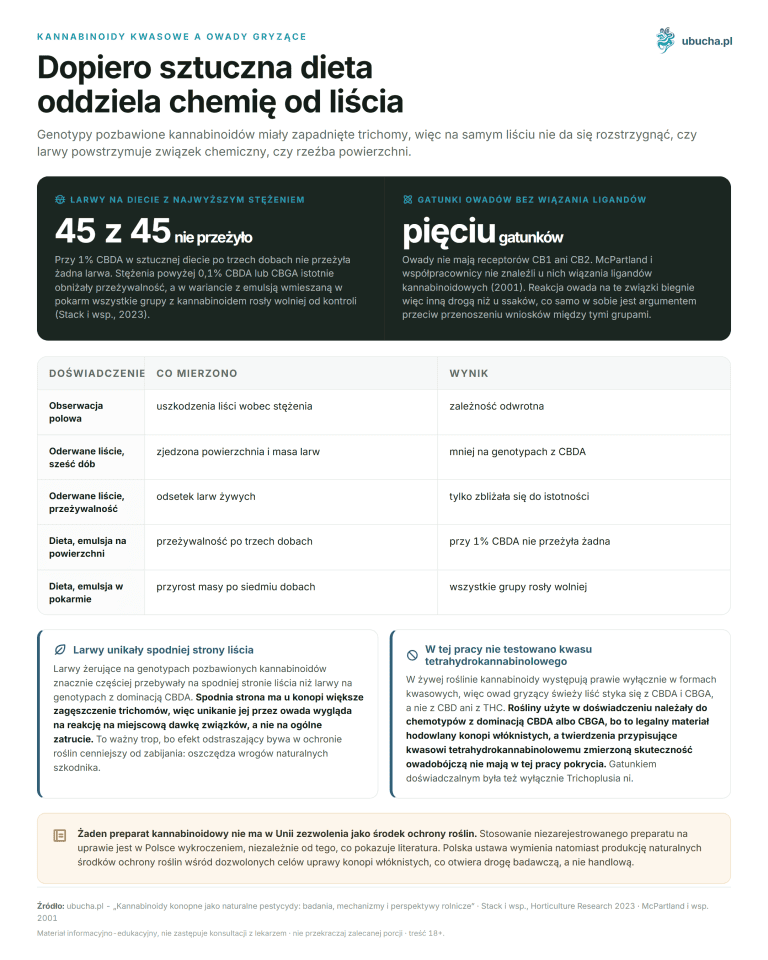
Both cannabinoids and terpenes are studied as plant-derived insecticides, which is a separate topic described in our post about cannabinoids as natural pesticides. From the perspective of field practice, however, what matters is that hemp reduces the need for chemicals but does not eliminate it.
How much water do hemp plants consume compared to cotton?
A literature review from 2025 indicates water consumption by hemp at 220-700 mm during the growing season, which is about 4-5 mm per day (Gokool et al., Journal of Cannabis Research, 2025). The popular statement about one-third of cotton’s water requirement comes from a 2005 report by the Stockholm Environment Institute, prepared for BioRegional and WWF Cymru. The report is true, but it counts something different: liters per kilogram of finished fiber, not millimeters of rainfall per season. Cotton and hemp cultivation occur in different climatic zones, so the difference largely describes the location, not the plant.
The range of 220-700 mm is not a measurement error but a reflection of real differences: climate, irrigation, density, and purpose of cultivation. The first measurements of evapotranspiration using the eddy covariance method conducted in South Africa yielded 377 mm in the season, with low water productivity resulting from a sparse density of 2,000 plants per hectare (Denton et al., 2025). The authors state directly that hemp is considered a water-intensive crop, and field data is still lacking.
What does this mean for Polish fields? With rainfall amounts during the growing season of around 250-350 mm, a fiber plantation usually fits within the balance without irrigation. A flower crop, conducted sparsely and irrigated, does not fit at all. Under one name, there are two different technologies with different water requirements.
Resistance to periodic drought is, however, real. The same review indicates a deep root system and efficient regulation of stomatal conductance and photosynthesis as mechanisms by which the plant withstands water stress and copes better with drought. The authors do not compare it with any other crop, so comparisons with cotton or grains must be taken from other sources. However, a comparison of the root architecture of 46 genotypes showed a difference in root length of up to 175% between extreme varieties (Morales et al., PLOS ONE, 2026), so resistance depends on the choice of variety.
What is phytoremediation with hemp and where is its limit?
Phytoremediation is the use of plants to clean contaminated soil. Hemp tolerates high concentrations of heavy metals and grows where grains no longer yield, as shown by a classic work from 2002 (Linger et al., Industrial Crops and Products, 2002). However, the limit is clear, as tolerance is not the same as removal.
A greenhouse experiment from 2026 on soil contaminated with cadmium, lead, and zinc showed low rates of removal of all three metals, indicating limited ability for phytoextraction (Delemazure et al., International Journal of Phytoremediation, 2026). Cleaning a field using this method would take decades. Hemp is more suitable for phytostabilization and productive use of land that cannot be designated for food.
The good news concerns the distribution of metals in the plant. Lead accumulates mainly in the roots, where 70-80% of the absorbed amount remains, and the concentration decreases in the order: stems, leaves, fiber, seeds (Xu et al., Toxics, 2025). In a 2026 study, flowers collected from contaminated soil contained 0.45 mg/kg of cadmium and 1.1 mg/kg of lead, below most commercial limits for herbal raw materials.
This does not mean that every raw material from such a plantation is safe. The testing of a specific batch determines safety, not the general property of the species. The result looks different for seeds pressed for oil, different for fiber, and even different for shives that go into a building wall.
What does a farmer sell from one hectare of hemp?
From one plant, several independent streams of raw material are produced: seeds, fiber, shives, flowers, and biomass for energy purposes. KOWR lists applications in food and textiles, in building insulation, in cosmetics, and in energy. Therefore, hemp is described as a crop fitting into a circular economy.
| Part of the Plant | What is Produced | Who Buys It |
|---|---|---|
| Seeds | Cold-pressed oil, hulled seeds, flour, protein | Presses and food companies |
| Long Fiber | Yarn, ropes, geotextiles, technical composites | Spinning mills and composite industry |
| Shives | Lime-hemp filling, mulch, horticultural substrates | Construction and horticulture |
| Flowers | Dried flowers, extracts, cosmetic raw material | Processors registered for purchase |
| Harvest Residues | Pellets, briquettes, substrate for biogas plants | Distributed energy |
Seeds are currently the easiest sales path in Poland, as presses and food companies operate in many regions, and oil and hulled seeds have stable retail demand.
Be cautious with revenue forecasts. We see in industry materials ranges of 6,000-12,000 PLN per hectare provided without indicating a source. KOWR does not publish such statistics. An economic analysis of three production models, from flower to fiber to seed, shows that profitability is primarily determined by the availability of processing, followed closely by price volatility, not yield itself (Quaicoe et al., 2025). The calculations were conducted for North Carolina, so the amounts do not directly transfer to Polish fields, but the conclusion about the bottleneck in processing is the same.
Does hempcrete work in Polish construction?
Yes, as a filling and insulating material. Polish studies on lime-hemp composites yielded thermal conductivity of 0.067-0.134 W/(m·K) and compressive strength of 0.05-1.50 MPa, depending on the density and degree of compaction of the mixture (Gołębiewski et al., Materials, 2025).
These values place hempcrete close to good insulation but not as a load-bearing structure. A wall made of shives and lime fills a wooden frame, takes on thermal tasks, and regulates moisture, while the structure bears the loads. The range of parameters is large, so the designer needs data for a specific recipe, not a general range from a catalog.
Surprisingly, the behavior in fire can be remarkable. Studies from the Opole University of Technology showed no flammability and self-extinguishing of samples subjected to direct flame from a burner, and the addition of metakaolin at 15% of the binder mass reduced mass loss during a fifteen-minute test at 500 degrees Celsius by about 58% (Janowska-Renkas et al., Materials, 2025). Fluid ash at 20% increased compressive strength by 26%.
The barriers are market-related, not material-related. There is a lack of contractors with experience, a lack of domestic supply of shives in consistent quality, and each project goes through an individual path of approvals. Therefore, the number of implementations is growing slowly, even though the technical parameters are known and published in peer-reviewed journals, including by Polish research centers.
How to register cultivation with KOWR and what hinders the Polish industry?
Before starting cultivation, one must obtain an entry in the register of industrial hemp, maintained by the director of the appropriate local KOWR branch. The application must include an invoice for the purchase of elite or qualified seed material, a copy of the label from the seed packaging, and proof of payment of the stamp duty of 30 PLN.
These tasks were entrusted to KOWR by the amendment to the Act on Counteracting Drug Addiction from 2022, which replaced the previous system of permits with a single national register (Act of March 24, 2022, consolidated text of the 2005 Act: Dz.U. 2023 poz. 1939). The entry is one-time, and the branch director makes it within 14 days of receiving a complete application. The purchasing entity registers separately, pays 125 PLN, and by the end of July provides information about the contracts made. Whether and under what conditions it is allowed to cultivate industrial hemp is broken down in a separate guide on legal cultivation.
What hinders development? Primarily processing. A farmer will not earn on fiber if there is no spinning mill within a reasonable distance, and on seeds if there is no press accepting batches of goods. The aforementioned analysis of three production models confirms that limited processing capacity and lack of a transparent pricing mechanism reduce the grower’s income regardless of yield quality. The authors described the American market, but this is a barrier that Polish growers will recognize without translation.
The second barrier is knowledge. Agricultural advisory centers are just building an offer for this crop, and a farmer entering hemp for the first time has no one to ask about sowing timing, density, and harvest timing in their area. We have noticed that the questions that repeat in conversations with growers concern these three decisions, not legal issues.
Frequently Asked Questions
How much industrial hemp is grown in Poland?
As of September 30, 2025, the area was 1,275 ha, and there were 1,606 registered producers and 80 purchasing entities. In comparison, in 2022 it was 843 ha and 425 producers. The largest crops are located in the Lublin, Masovian, and Warmian-Masurian Voivodeships.
Does one hectare of hemp absorb more CO2 than a forest?
No peer-reviewed work confirms such a comparison. The figure of 8-15 tons of CO2 per hectare comes from a press interview in 2021. A reliable balance was calculated at 1.83 tons of net CO2 per ton of hemp, according to an analysis of 49 farms published in the Journal of Environmental Quality in 2026.
Does the cultivation of industrial hemp require registration in Poland?
Yes. Before starting cultivation, one must obtain an entry in the register of industrial hemp maintained by the director of the local KOWR branch. The application requires an invoice for the purchase of elite or qualified seed material, a label from the seed packaging, and a stamp duty of 30 PLN.
Do hemp plants really grow without pesticides?
Pest pressure is low, and dense sowing suppresses weeds after the canopy closes, but a review from the Journal of Cannabis Research in 2025 shows that early weed competition reduces yield. The small number of herbicides used is also due to the fact that few are registered for hemp.
Are hemp plants from soil contaminated with metals suitable for use?
It depends on the part of the plant and the results of the batch testing. Lead accumulates mainly in the roots, where 70-80% of the absorbed amount remains, and the least goes to the fiber and seeds. In a greenhouse experiment from 2026, flowers from contaminated soil were below most commercial limits for herbal raw materials.
How much water do industrial hemp plants consume?
A literature review from 2025 indicates 220-700 mm during the growing season, which is about 4-5 mm per day. The popular statement about one-third of cotton’s water requirement comes from a 2005 report by the Stockholm Environment Institute, which counts liters per kilogram of fiber, not millimeters per season. These are two different measures and cannot be directly compared.
What hemp varieties dominate Polish crops?
According to KOWR, the most commonly sown varieties are Henola, Finola, Białobrzeskie, and Futura 75. Henola alone occupies about 550 ha, which is over 40% of the national area. Only varieties listed in the EU catalog of agricultural plant varieties or in the national COBORU register may be used for cultivation.
If you want to check what is produced from Polish industrial hemp, start with hemp food with seeds, oil, and protein or from hemp oils from certified varieties.
This article is for informational and educational purposes and does not constitute legal advice. The legal status described in the article is valid as of the date of publication, and regulations regarding hemp may change. Before making a decision, consult a lawyer or current legal acts.
Author: Michał Waluk · Published: 2026-05-11 · Updated: 2026-08-15