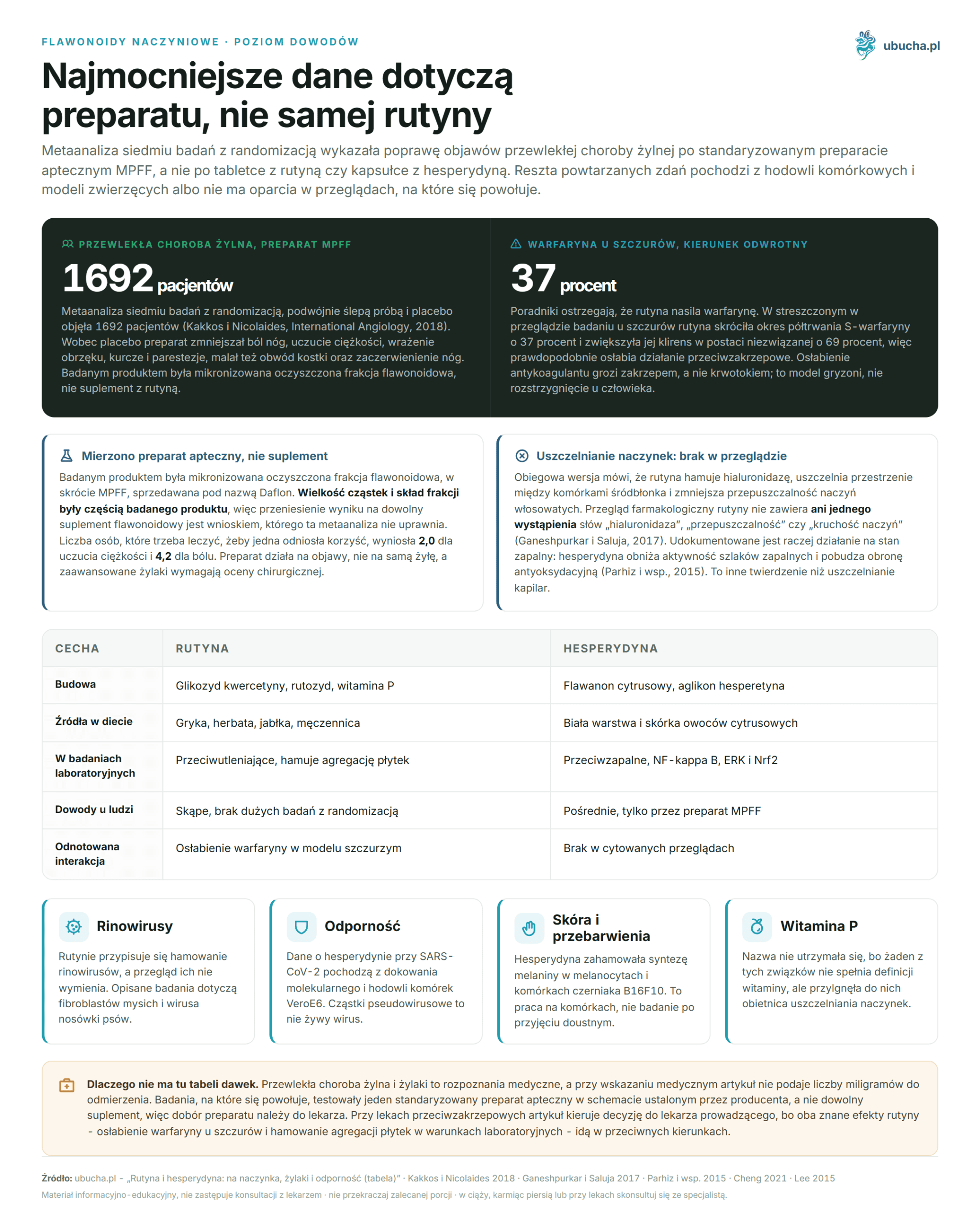

Rutin and Hesperidin: for Blood Vessels, Varicose Veins, and Immunity (Table)
Rutin and hesperidin for blood vessels, varicose veins, and immunity. Check which claims are supported by research and which are repeated stories about vitamin P.
Rutin and hesperidin are plant flavonoids that for decades were referred to as “vitamin P”. The name did not hold because neither of these compounds meets the definition of a vitamin, but they have been associated with a promise: they strengthen blood vessels and veins. Part of this promise is supported by randomized studies, while part has been repeated for years without it, and the difference lies in a place that supplement labels do not show. The strongest data concern a standardized flavonoid preparation studied in chronic venous disease, not tablets with just rutin bought at a drugstore. Several commonly repeated statements about both compounds have no support in the reviews they cite. This article separates one from the other and shows what is known about both flavonoids and what is not.
KEY INFORMATION
• A meta-analysis of seven randomized studies with a double-blind placebo-controlled design, involving 1692 patients, showed improvement in symptoms of chronic venous disease after the standardized flavonoid preparation MPFF (Kakkos and Nicolaides, International Angiology 2018).
• These studies concerned a specific pharmacy preparation, not supplements with rutin or hesperidin, and transferring the result to any tablet has no basis.
• The popular statement about the sealing of capillaries by rutin does not appear in the pharmacological review of this compound even once.
• Rutin interacts with warfarin in the opposite direction than most guides state: in a study on rats, it weakened its anticoagulant effect.
• Data on the effect of hesperidin on immunity come from cell models and simulations, not from human studies.
How do rutin and hesperidin affect blood vessels?
The answer must start with a disclaimer, as the common version is stronger than the literature. It is repeated that rutin inhibits hyaluronidase, seals the spaces between endothelial cells, and reduces capillary permeability. A pharmacological review of rutin published in the Saudi Pharmaceutical Journal does not contain a single occurrence of the words “hyaluronidase”, “permeability”, or “fragility of vessels” (Ganeshpurkar and Saluja, 2017). This does not mean that such works do not exist anywhere, but that the most frequently cited review of this compound does not record them.
What is documented relates more to inflammation and oxidative stress than to the mechanics of the vessel wall. Hesperidin and its aglycone hesperetin reduce the activity of inflammatory pathways, including NF-kappa B, inducible nitric oxide synthase, and cyclooxygenase type 2, and their antioxidant action is realized not only by scavenging free radicals but also by stimulating cellular antioxidant defense via the ERK and Nrf2 pathways (Parhiz et al., Phytotherapy Research, 2015). The vessel wall benefits from reduced inflammation, but that is a different claim than sealing capillaries.
Do flavonoids help with varicose veins and leg swelling?
Yes, and this is the best-documented part of the whole matter, but it concerns one specific preparation. Kakkos and Nicolaides collected seven randomized studies with a double-blind placebo-controlled design, involving a total of 1692 patients with chronic venous disease (International Angiology, 2018). The preparation tested was a micronized purified flavonoid fraction, abbreviated as MPFF, sold under the name Daflon.
The results are specific. Compared to placebo, MPFF reduced leg pain, heaviness, the sensation of swelling, cramps, and paresthesia. The number of people that need to be treated for one to benefit was 2.0 for the sensation of heaviness and 4.2 for pain. The improvement was not limited to sensations: the ankle circumference decreased, which is a measure of swelling independent of patient relations, as did the redness of the legs. The authors assessed the existing evidence in the GRADE system as mostly high quality, with minimal heterogeneity of studies.
A note that determines how to read this result. The studies checked a standardized, micronized pharmacy preparation produced by the drug manufacturer, not a tablet with rutin or a capsule with hesperidin. The particle size and composition of the fraction were part of the studied product, so transferring the result to any flavonoid supplement is a conclusion that this meta-analysis does not support. Advanced varicose veins still require surgical evaluation, and flavonoid preparations act on symptoms, not on the vein itself.
What are the differences between rutin and hesperidin?
Both compounds are often sold together and described in one sentence, but their documentation looks different. Rutin is a glycoside of quercetin, while hesperidin belongs to citrus flavanones. The table below compares what is known about each of them, indicating the type of studies from which the data come.
| Feature | Rutin | Hesperidin |
|---|---|---|
| Structure | Glycoside of quercetin, also known as rutoside and vitamin P | Citrus flavanone, aglycone is hesperetin |
| Dietary sources | Buckwheat, tea, apples, passionflower | White layer and skin of citrus fruits |
| Best-documented action | Antioxidant, inhibition of platelet aggregation in laboratory conditions | Anti-inflammatory and antioxidant, NF-kappa B and ERK and Nrf2 pathways |
| Evidence in humans | Sparse, lack of large randomized studies | Indirect, through the MPFF preparation in venous disease |
| Noted interaction | Weakening of warfarin’s effect in a rat model | No documented in cited reviews |
The row about evidence in humans is the most important and often omitted in marketing materials. Rutin has extensive laboratory pharmacology behind it and very sparse clinical documentation. Hesperidin enters human studies almost exclusively as a component of a ready-made preparation, making it difficult to separate its contribution from the rest of the flavonoid fraction. None of these situations means that the compound does not work, only that the question of effectiveness in humans has not yet been asked in the appropriate study.
Do citrus flavonoids support immunity?
Here we need to go down a few levels in the hierarchy of evidence. Rutin is often attributed with inhibiting rhinoviruses, the most common cause of colds. The pharmacological review of this compound does not mention rhinoviruses at all. The antiviral studies described in it concern the vesicular stomatitis virus on mouse fibroblasts and the canine distemper virus. These are distant models, and none of them speaks about colds in humans.
Hesperidin has newer data, also laboratory-based. The Cheng team first checked by molecular docking whether hesperidin and hesperetin bind to two host cell proteins needed by the SARS-CoV-2 virus to enter, namely TMPRSS2 and ACE2 (Nutrients, 2021). Then, in VeroE6 cell culture, both compounds limited infection by pseudovirus particles, blocking the spike protein’s contact with the ACE2 receptor and reducing the expression of both host proteins.
It is worth naming the limit of this result directly. Computer simulation and cell culture are not studies in humans, and pseudovirus particles are not a living virus. The result justifies further research and does not justify the statement that hesperidin protects against infection.
What do citrus flavonoids do to the skin?
The best-studied skin-related aspect is the effect of hesperidin on melanin production. The Lee team measured melanin content in normal human melanocytes and in melanoma cells of the B16F10 line (International Journal of Molecular Sciences, 2015). Hesperidin clearly inhibited melanin synthesis and tyrosinase activity, lowering the levels of tyrosinase and TRP-1 and TRP-2 proteins.
The mechanism turned out to be indirect. Hesperidin enhanced the phosphorylation of Erk1 and Erk2 kinases, leading to the degradation of the transcription factor MITF that controls the entire melanogenesis program. Blocking Erk1 and Erk2 or the proteasome abolished this effect, confirming the pathway. The authors note that the anti-melanogenic effect of hesperidin had not been previously described, even though the compound itself has long been known as an antioxidant.
This is a cell-based study, so it says nothing about lightening discolorations after oral intake of hesperidin. The supplement would have to be absorbed, reach the skin in the appropriate concentration, and act there, and this stage was not checked in this work. If you are looking for a broader background on plant flavonoids, we describe them separately in the text about flavonoids in cannabis.
What do rutin and hesperidin interact with?
The most important position on this list is usually given in the opposite direction than the research indicates. Guides warn that rutin enhances the effect of warfarin and increases the risk of bleeding. The pharmacological review of rutin summarizes a study in which it was the opposite: in rats, rutin shortened the half-life of S-warfarin by 37 percent by increasing its clearance in the unbound form by 69 percent, and the authors’ conclusion was that simultaneous administration of rutin likely weakens the anticoagulant effect of warfarin.
The direction has practical significance because weakening the anticoagulant poses a risk of thrombosis, not bleeding, and requires a different response from the doctor. This is a study on rodents, so it does not resolve the issue in humans, but it is enough not to repeat the warning in the reverse version. Separately, the same review describes the inhibition of platelet aggregation in rabbits by rutin in laboratory conditions after stimulation with a platelet-activating factor.
The conclusion for the reader is simple. If you are taking anticoagulant medications, make the decision to supplement with flavonoids with your attending physician, not based on the manufacturer’s leaflet. This applies to both directions of interaction, as observation from an animal model does not say how a specific patient will behave with a specific dose of medication.
Frequently Asked Questions
Do rutin and hesperidin work on varicose veins?
The evidence pertains to the MPFF preparation, not the flavonoids themselves in capsules. A meta-analysis of seven randomized studies with 1692 patients showed that MPFF reduces pain, heaviness, ankle swelling, and redness of the legs compared to placebo. It acts symptomatically and does not remove existing varicose veins, so advanced disease requires surgical evaluation.
What products are sources of rutin and hesperidin?
A pharmacological review of rutin lists buckwheat, tea leaves, apples, and passionflower as its sources. Hesperidin accumulates in the white layer and skin of citrus fruits, so juice without pulp provides little of it. Eating oranges with the inner membrane provides more than just drinking the juice.
Can rutin and hesperidin be combined with vitamin C?
There are no contraindications, and such combinations are typical in vascular preparations. However, it is worth knowing that the synergy itself is often described more strongly than is supported by human studies. Vitamin C has its own well-documented action as a cofactor in collagen synthesis, and that is a more certain argument here than the combination itself.
Are flavonoids safe with anticoagulant medications?
This question should be directed to the attending physician. In a study on rats, rutin weakened the effect of warfarin, shortening the half-life of its active enantiomer. Separately, it inhibited platelet aggregation in laboratory conditions. Both effects go in opposite directions, so self-concluding about one’s own treatment has no basis here.
Why is there no dosage table here?
Chronic venous disease and varicose veins are medical diagnoses, and with a medical indication, we do not provide the number of milligrams to measure. The studies referenced in this article tested one standardized pharmacy preparation in a scheme established by the manufacturer, not any supplement. The choice of preparation is up to the doctor.
In summary: rutin and hesperidin are not an empty promise, but their documentation is narrower than suggested by the descriptions on the packaging. The strongest data concern one pharmacy preparation in chronic venous disease, while the rest comes from cell cultures and animal models, and the most frequently repeated statement about sealing capillaries has no support in these reviews. A closely related compound is quercetin, from which rutin is derived, and we write about it in the text on fisetin and quercetin.
Vitamin C preparations, including those with rose hips, can be found in the supplements category. Our offer does not include rutin or hesperidin in separate forms.
This article is for informational and educational purposes and does not constitute medical advice. Before starting supplementation, consult your doctor, especially if you are taking medications regularly, are pregnant or breastfeeding, or have a chronic illness.
Author: Michał Waluk · Published: 2026-07-15 · Updated: 2026-08-16