
Muira puama and catuaba: on libido and energy (FAQ)
Muira puama and catuaba are Brazilian raw materials for libido. We check which studies really exist, what they showed exactly, and where the evidence ends.
Muira puama and catuaba have been returning in descriptions of libido supplements for thirty years, usually accompanied by the same handful of numbers: two hundred sixty-two men, several dozen percent improvement, a French sexologist from Paris. However, when you try to trace these studies, it turns out that some of them were never published in a peer-reviewed journal, and some concerned something other than what the label claims. This text separates both layers. It shows what has really been studied about these two plants, on whom, for how long, and with what results, where the evidence ends, and the second-hand story begins, and what this means if you stand in front of a supplement shelf and want to know what you are paying for.
KEY INFORMATION
• The only clinical study of muira puama available in the Europe PMC database concerned a mixture of muira puama with ginkgo in 202 women and lasted a month (Waynberg and Brewer, Advances in Therapy 2000).
• The most frequently cited observation of 262 men comes from a conference presentation in 1990 that never became a peer-reviewed paper.
• Evidence for catuaba comes from studies on rodents and in vitro: a dopamine-dependent antidepressant effect (Campos, Psychopharmacology 2005) and protection against oxidative stress (Kamdem, Neurochemical Research 2012).
• The main established components of catuaba are cinchonains Ia, Ib, and IIa, and procyanidins, not alkaloids.
• Catuaba alters dopamine and serotonin uptake in vitro, so a conversation with a doctor is needed when taking medications that act on the same transmitters.
What are muira puama and catuaba and where do they come from?
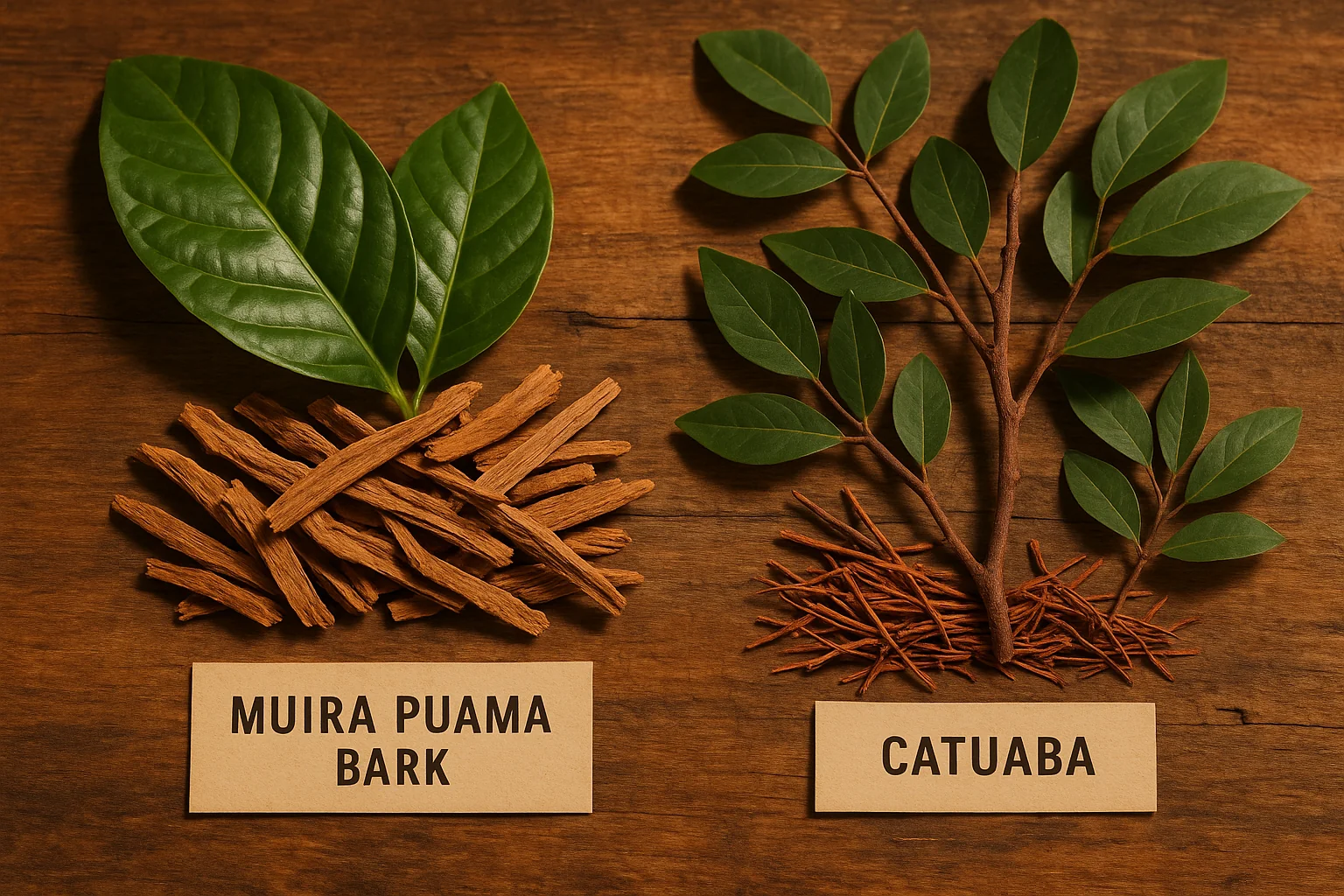
These are two unrelated Brazilian trees whose bark and roots have been used for generations in Amazonian folk medicine. Muira puama is Ptychopetalum olacoides from the Olacaceae family; the species name is unambiguous and does not raise doubts in the scientific literature. With catuaba, it is the opposite.
Under the trade name “catuaba,” raw materials from at least two types of plants are sold. In pharmacological studies, it almost always refers to Trichilia catigua from the Meliaceae family. The other plant called by the same name is Erythroxylum catuaba, related to the coca shrub and containing tropane alkaloids of the type katuabin. Results obtained for one do not transfer to the other, and the label often does not indicate which one has been powdered.
Muira puama is sometimes called the tree of strength in Brazil; it has been used for weakness and sexual life problems. Catuaba has been used similarly. However, tradition is a premise for research, not evidence.
| Feature | Muira puama | Catuaba |
|---|---|---|
| Species in studies | Ptychopetalum olacoides | Trichilia catigua |
| Confirmed components | Described composition of the essential oil from the root | Cinchonains Ia, Ib, and IIa, flavan-3-ol, flavonoids, procyanidins |
| Studies in humans | One, on a mixture with ginkgo, without placebo | No studies on the raw material itself |
| Studies on animals | Memory, acetylcholinesterase inhibition, neuron protection | Antidepressant effect, protection against ischemia, fatigue |
| Main caveat | The most frequently cited report on men was never published | The trade name encompasses several species |
What did Waynberg’s study of 262 men really show?
This cannot be verified, and that is the whole answer. Jacques Waynberg, a French sexologist, presented an observation of 262 men complaining of decreased libido and erectile difficulties at the First International Congress of Ethnopharmacology in Strasbourg in 1990. The report has never appeared as a peer-reviewed paper.
The Europe PMC database knows four works by Jacques Waynberg, and none of them is this observation. A query for all works that have Ptychopetalum olacoides in the title along with sexuality, libido, or erection returns not a single record. Therefore, the improvement percentages circulating on supplement seller pages come from the description of the presentation, not from a document where the selection of participants, dosage, duration, or measurement method could be verified.
Versions of this citation also diverge from each other: sometimes it is 1990, sometimes 1994, sometimes Waynberg alone, sometimes Waynberg with a co-author, and the two most frequently repeated percentages are sometimes attributed to libido, sometimes to erection. The fact remains that the 1990 observation had no control group, and its description remains outside the scientific literature.
Does muira puama also work in women?
There is one clinical study involving women that exists and is available, but it concerned a compound preparation, not muira puama alone. Waynberg and Brewer described in Advances in Therapy in 2000 202 healthy women reporting decreased sexual desire, both premenopausal and postmenopausal. They took a herbal preparation combining muira puama with Japanese ginkgo for a month.
The result: in 65% of the subjects, the total score of the self-assessment questionnaire significantly increased compared to the baseline. The improvement included frequency of desire, frequency of intercourse and fantasies, as well as satisfaction with sexual life and ability to achieve orgasm. The authors rated the tolerance of the preparation as good and concluded the work with an announcement of a double-blind study.
Three things diminish the evidential power of this result. There was no placebo group, so the comparison was made only with the baseline of the same individuals. The measurement was based on self-assessment, which is the parameter that reacts most strongly to placebo. The preparation contained two plants at once, so even if the effect were real, it cannot be attributed to muira puama. The announced double-blind study has not appeared in the database to this day.
What is known about the effect of muira puama on the brain?
Here, the evidence is stronger than in the sexual layer, but it comes exclusively from in vitro and rodent studies. Siqueira and colleagues demonstrated in 2003 in Pharmacology, Biochemistry, and Behavior that the ethanolic extract from muira puama root inhibits acetylcholinesterase activity in the frontal cortex, hippocampus, and striatum of rats, depending on concentration and time. The same effect was confirmed in the same brain areas in aging mice after a single intraperitoneal administration, thus not only in vitro but also in a living animal.
A year later, the same team described in Life Sciences the protective effect of the extract on rat hippocampal slices deprived of oxygen and glucose, i.e., in a laboratory model of stroke. The extract improved cell survival and prevented the increase in free radicals caused by hypoxia.
What does this mean for humans? For now, only that the traditional use of muira puama for age-related ailments has a probable biochemical counterpart. The authors of both works state directly that the plant deserves further research, not that its effects in humans have been demonstrated.
What do studies on catuaba show?
Catuaba has more published studies than muira puama, but none of them involved humans. Campos described in Psychopharmacology in 2005 the antidepressant effect of the extract from Trichilia catigua in the forced swimming test in mice and rats. The effect was blocked by dopamine receptor antagonists, and in synaptosomal preparations, the extract inhibited uptake and increased the release of serotonin and dopamine. Bonassoli and colleagues confirmed in 2012 in Journal of Ethnopharmacology that two weeks of administering the acetate-ethyl fraction to mice maintained this effect.
Kamdem demonstrated in 2012 in Neurochemical Research that the extract protects rat hippocampal slices from the effects of ischemia, but only when present before and during the return of blood flow. Administered after the incident, it did not protect anything. The authors concluded that catuaba is suitable for prevention, not for treatment.
The most instructive results are the negative ones. Martins and colleagues described in 2018 in BMC Complementary and Alternative Medicine the composition and action of four extracts, confirming cinchonains IIa, Ia, and Ib as the main components and antioxidant and anti-cholinesterase activity in vitro. However, in animals, the aqueous-alcoholic extract did not protect rats from cold immobilization stress and did not prevent scopolamine-induced amnesia in mice. It only partially reduced fatigue after running on a treadmill.
Who can muira puama and catuaba harm?
The greatest practical risk is not the raw material itself, but its interaction with medications. The extract from Trichilia catigua inhibits serotonin and dopamine uptake and increases their release in rat brain preparations. This is the same target point that antidepressants from the SSRI and SNRI groups and monoamine oxidase inhibitors act on. No one has checked what happens when one meets the other in humans, so in such treatment, the decision about the supplement is made by the doctor, not the seller.
There is simply no data on the safety of long-term use of both raw materials. The clinical studies that exist lasted a month or less and involved healthy individuals. Therefore, it is unknown what happens after six months of regular use or in someone with a chronic illness and polypharmacy.
Neither of these raw materials is used during pregnancy and breastfeeding, and not because harm has been demonstrated, but because no one has studied it. The absence of studied harm is not the same as demonstrated safety.
How do these raw materials compare to maca and tongkat ali?
They perform worse, regardless of which side of the comparison you take. The evidence base for Peruvian maca is thin, but it is based on studies with a placebo group, which do not exist at all for muira puama. The same goes for tongkat ali, where at least hard hormonal parameters were measured, not just self-assessment.
This pattern repeats across the entire family of these raw materials. Studies that are conducted usually test mixtures, not a single plant. Muira puama has been studied in women together with ginkgo, and in aging rats in a preparation containing ginger, citrulline, and guarana. From such a setup, no conclusions can be drawn about any single component, although the supplement label is eager to draw one.
We noticed while browsing offers that the species name on the package is the best single indicator of whether the producer knows what they are selling. A producer who writes only “catuaba” has not declared anything verifiable, as this name encompasses plants from two different families.
Frequently Asked Questions
What is the difference between muira puama and catuaba?
These are two unrelated species. Muira puama is Ptychopetalum olacoides, primarily studied for its effects on the cholinergic system and memory in rodents. Catuaba in studies refers to Trichilia catigua, a plant with effects described as dopaminergic. They are only connected by their Brazilian origin and similar uses in folk medicine, not by mechanism.
Is there a muira puama study with a placebo group?
There is no such study in the Europe PMC database. The only available clinical work, by Waynberg and Brewer from 2000, compared the state of 202 women before and after a month-long treatment, without a control group. The double-blind study announced in it has not been published.
Does catuaba really contain imbombine?
A compound by that name does not appear in the scientific literature; a query to Europe PMC returns not a single record. The described and confirmed components of Trichilia catigua are cinchonains Ia, Ib, and IIa, flavan-3-ol, and procyanidins. Alkaloids of the type katuabin belong to the genus Erythroxylum, which is another plant sold under the same trade name.
How long does it take to see an effect?
It is unknown because no one has measured this in humans for these raw materials alone. The only clinical study lasted a month and assessed the state only at the end, so it says nothing about when the change occurred. Claims of first effects after two weeks have no support in published data.
Can they be combined with antidepressants?
Not without consultation. The extract from Trichilia catigua alters serotonin and dopamine uptake and release in studies on rat brain tissue, acting in the same place as SSRIs, SNRIs, and MAO inhibitors. No one has studied the effects of such a combination in humans, so the decision is made by the attending physician.
What should you look for on a supplement label?
The full species name and what the extract is standardized against. For catuaba, reasonable standardization is cinchonains or flavan-3-ol, as these have been identified in this plant. The trade name alone without the species does not indicate which of several different plants you are getting, and a certificate of analysis allows you to verify this.
Neither muira puama nor catuaba is available in our store. Among supplements, you will find other raw materials described in the context of libido, including preparations with horny goat weed.
This article is for informational and educational purposes only and does not constitute medical advice. Before starting supplementation, consult your doctor, especially if you are taking medications regularly, are pregnant or breastfeeding, or have a chronic illness.
Author: Michał Waluk · Published: 2026-08-09 · Updated: 2026-08-16