
Full spectrum vs broad spectrum CBD: what is the difference and what to choose
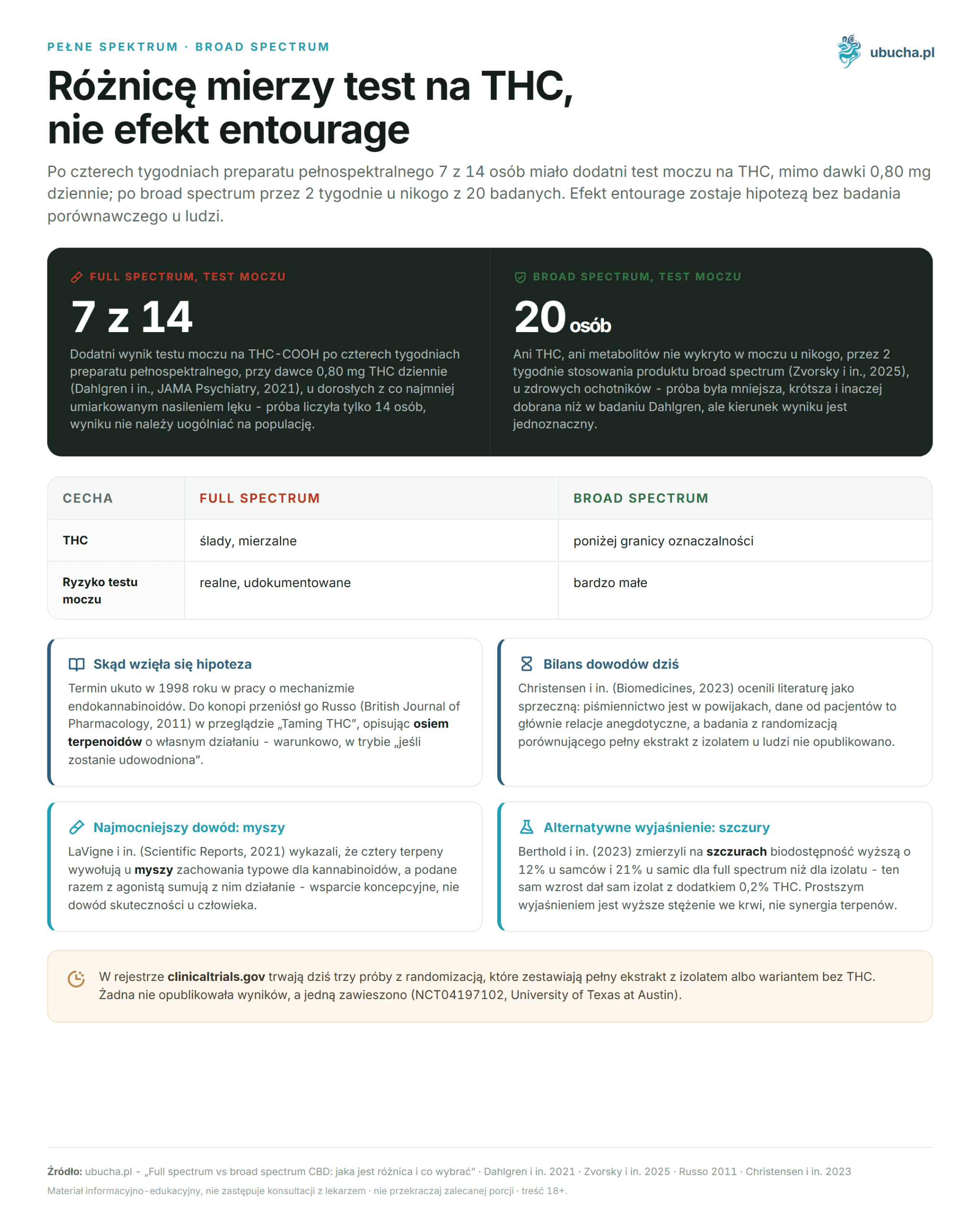
Full spectrum vs broad spectrum CBD without marketing. The entourage effect is a hypothesis, and after 4 weeks of full extract, 7 out of 14 people had THC in their urine.
After four weeks of taking full spectrum oil, 7 out of 14 participants in the clinical study had a positive urine test for THC metabolite. The daily dose of THC was 0.80 mg, and no one reported intoxication (Dahlgren et al., JAMA Psychiatry, 2021). This is the most practical difference between full spectrum and broad spectrum, and at the same time, it is something you will not read on the label. Instead, the argument about the entourage effect is repeated, which sounds scientific but still remains a hypothesis without confirmation in a published randomized study in humans. This article separates the two layers: what is known from data about the three types of extract and what is only probable. At the end, you will find a selection rule based on whether you are subject to testing, not on the promise of synergy.
KEY INFORMATION
• After 4 weeks of full spectrum preparation, with 0.80 mg THC per day, 7 out of 14 people had a positive urine test (Dahlgren et al., JAMA Psychiatry, 2021).
• The entourage effect is a hypothesis. No randomized study has been published comparing full extract with isolate in humans; the first such trials are just recruiting participants.
• In 20 people using broad spectrum for 2 weeks, no THC or metabolites were detected (Zvorsky et al., 2025).
• The THC content in the bottle is confirmed only by the certificate of analysis.
What is the difference between full spectrum, broad spectrum, and CBD isolate?
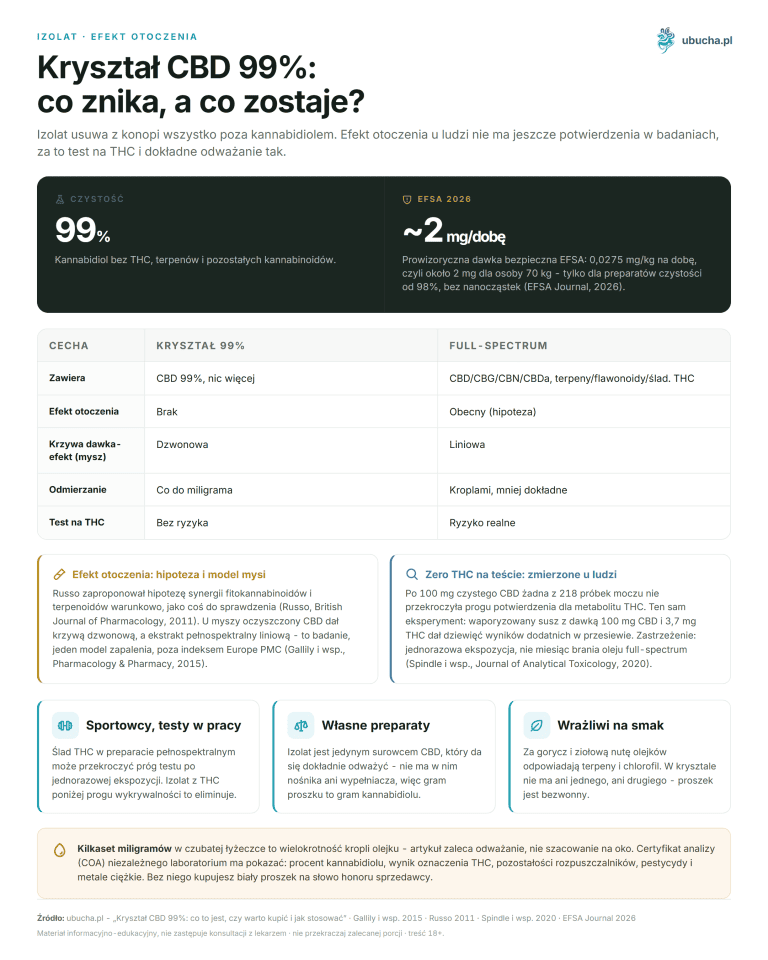
Full spectrum is an extract that retains the entire plant profile along with trace THC. Broad spectrum is the same extract after THC removal. Isolate is pure cannabidiol with 99% or more purity, without terpenes and other cannabinoids. Thus, the three names describe three levels of purification of the same raw material.
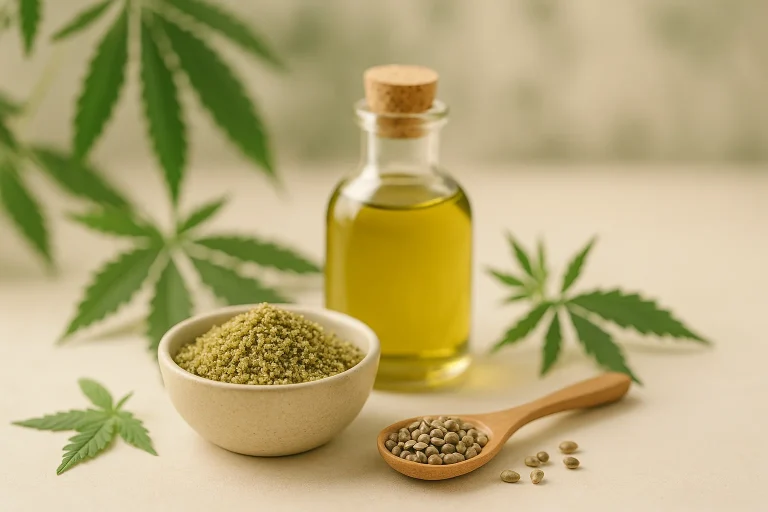
Hemp (Cannabis sativa L.) produces over a hundred cannabinoids and about two hundred terpenes. Supercritical carbon dioxide or ethanol extraction pulls this entire mixture from the dried plant at once. Only subsequent stages determine the commercial name: partial purification from waxes and chlorophyll gives full spectrum, selective chromatography removing THC gives broad spectrum, and crystallization leads to isolate in the form of a white powder, which is then dissolved in MCT or hemp oil.
It is worth addressing one pricing myth. Isolate is often described as a cheaper and weaker variant, while its production requires additional purification stages and equipment that full spectrum does not need. The price difference of the semi-finished product results from the market, not from the quality of the raw material.
| Feature | Full spectrum | Broad spectrum | Isolate |
|---|---|---|---|
| Other cannabinoids | present | present | absent |
| Terpenes and flavonoids | present | present | absent |
| THC | traces, measurable | below the limit of quantification | absent |
| Risk of positive urine test | real, documented | very low | very low |
| Taste | intense, plant-like | somewhat milder | practically neutral |
| Evidence base for advantage | entourage hypothesis | entourage hypothesis | not applicable |
Is the entourage effect proven?
No. The entourage effect is a hypothesis, not a finding. It assumes that cannabinoids and terpenes work together more strongly than separately, but no randomized study has yet been published comparing full extract with isolate in humans. All arguments are based on review papers, animal models, and observational data.
The term itself originated in 1998 in a preclinical paper on endocannabinoids, where inactive metabolites enhanced the action of the active compound. Russo transferred it to cannabis in a review “Taming THC” (British Journal of Pharmacology, 2011). He listed eight cannabis terpenoids: limonene, myrcene, alpha-pinene, linalool, beta-caryophyllene, caryophyllene oxide, nerolidol, and phytol. He described them as compounds with their own pharmacological action that could reasonably contribute to the effect of the extract. This was a literature review with a proposed mechanism, not a comparative experiment. Russo himself spoke conditionally about synergy, in the mode of “if proven,” and proposed methods for its future study.
Twenty years later, the balance of evidence looks modest. Christensen et al. (Biomedicines, 2023) reviewed works both supporting and undermining this concept. The conclusion: the literature is in its infancy, preclinical and clinical studies rely on simplified methods and yield contradictory results, and patient data is mainly anecdotal. The authors directly propose that instead of a separate term, we should simply talk about synergy and biopotentiation, known from other herbal medicines.
The strongest behavioral evidence comes from mice. LaVigne et al. (Scientific Reports, 2021) showed that alpha-humulene, geraniol, linalool, and beta-pinene induce cannabinoid-like behaviors in rodents, and when given together with an agonist, they sum their action. This provides conceptual support for the hypothesis, not proof of efficacy in humans.
Is anyone currently checking this in humans?
Yes, although results are still pending. Currently, three randomized trials are listed on clinicaltrials.gov, in which full extract is compared with isolate or with a THC-free variant. None have published results, and one has been suspended. The statement “there is no data on this” is therefore true today, but it speaks to the state of the literature, not that no one is studying it.
The closest to the question of this article is the pilot NCT07298408, conducted by Florida A&M University in people with painful diabetic neuropathy. The design is crossover and triple-blind, with three arms: cannabidiol isolate, full spectrum extract, and placebo in MCT oil. Twenty participants are planned, recruitment started in April 2026, and the first endpoint is expected to close in December 2026. With twenty participants, it is still a pilot, so there will be no definitive conclusions from it.
The second trial, NCT04197102 from the University of Texas at Austin, was supposed to compare isolate with broad spectrum in one hundred fifty people with post-traumatic stress disorder. It has been suspended and has no results. The third, NCT06290063 from the University of Colorado Boulder, compares full spectrum with broad spectrum in three hundred eighty-five older adults, and its completion is planned for 2028.
Until then, the closest answer lies in pharmacokinetics, measured in rats. Berthold et al. (European Journal of Drug Metabolism and Pharmacokinetics, 2023) administered the same dose of cannabidiol in three commercial forms to the animals. The full spectrum preparation provided 12% higher bioavailability in males and 21% higher in females than isolate and broad spectrum, and the same increase was replicated by adding 0.2% THC to the isolate itself. In the intestinal permeability test, THC facilitated the passage of cannabidiol through the intestinal wall and inhibited its pumping back. If full spectrum indeed works stronger, the simplest explanation is a higher concentration in the blood, not the synergy of terpenes.
What did the Pamplona meta-analysis show in drug-resistant epilepsy?
The only concrete clinical data comparing full extract with pure CBD in humans comes from an observational meta-analysis. Pamplona et al. (Frontiers in Neurology, 2018) gathered 11 studies and 670 patients with drug-resistant epilepsy to check if a CBD-rich extract performs better than a purified preparation.
The result depends on what we consider effectiveness. Any improvement in seizure frequency was reported by 71% of patients on extracts (318 out of 447) compared to 46% on pure CBD (81 out of 175), with p below 0.0001. At the standard clinical threshold, which is a reduction in seizures by at least half, the difference disappears: 37% (122 out of 330) versus 42% (94 out of 223), p equal to 0.52. At that point, 39% of all subjects were considered responders. The journal issued a correction to some of the numbers in this work, and we present them here in the corrected version.
Another striking number is the average daily dose, which was 6.0 mg/kg for extracts and 25.3 mg/kg for pure CBD. Mild adverse effects were reported by 76% of people on the purified preparation compared to 33% on extracts, and severe effects were reported by 26% and 7%, respectively. The authors themselves note that the cause may be synergy with other phyto-compounds, but this requires confirmation in controlled studies.
We noticed that this second result is often cited out of context. Patients on pure CBD are largely participants in registration trials with deliberately high doses, while those on extracts adjusted their dose themselves. The fourfold difference in dose is therefore partly a difference in protocol, not in pharmacology.
Can full spectrum give a positive THC test result?
Yes, and this is the best-documented practical difference between types of extract. Dahlgren et al. (JAMA Psychiatry, 2021) administered full spectrum preparation for four weeks to adults with at least moderate anxiety in the open phase of study NCT02548559. Fifteen people enrolled, one dropped out after using another cannabis product, and fourteen completed the protocol. After four weeks, 7 out of 14 people, or half, had a positive urine test for THC-COOH.
The conditions of this study were very conservative. The preparation contained 9.97 mg/ml CBD and 0.23 mg/ml THC, which is 0.02% THC, well below the 0.3% threshold. It was administered sublingually, 1 ml three times a day, resulting in an average of 34.73 mg CBD and 0.80 mg THC per day. All participants had a negative test result before starting and did not use other cannabis products throughout the month. The screening test results were confirmed by gas chromatography with mass spectrometry. The only variable associated with THC status was creatinine concentration, i.e., hydration and kidney function. Fourteen people is a small number, so the percentage of “half” should not be transferred to the population; the fact that this happens can be transferred.
In comparison, Zvorsky et al. (Experimental and Clinical Psychopharmacology, 2025) administered broad spectrum product for two weeks to 20 healthy individuals at a dose of 34.20 mg CBD per day. Neither THC nor its metabolites were detected in urine in anyone. The study was shorter and smaller, but the direction of the result is unequivocal. Participants also reported less sleep disturbance and less pain, with no adverse events.
The conclusion for the reader is uncomfortable for marketing. A legal full spectrum oil, taken according to the manufacturer’s recommendation and causing no intoxication, can lead to a positive test result at work after a month. This risk is real, measurable, and independent of whether the entourage hypothesis turns out to be true. Timing also matters: THC metabolites accumulate in fat tissue with daily use, so a single dose and a month of regular use are two different situations. The details of testing procedures are described in the article CBD and drug tests.
For whom is full spectrum, and for whom is broad spectrum?
The choice is determined by one question, not a comparison of promises. If you are subject to substance testing, take broad spectrum or isolate. If you are not subject to testing, full spectrum is a reasonable choice, although its advantage over broad spectrum is currently based on a hypothesis, not on the result of a comparative study.
Groups for whom the answer is decided in favor of a THC-free product:
- Professional drivers and those driving company vehicles, where zero tolerance applies.
- Employees tested periodically, especially in transport, industry, and security.
- Athletes subject to anti-doping regulations, as cannabidiol is excluded from the list of prohibited substances, while THC is not.
- Pregnant and breastfeeding women, for whom there is no safety data for any dose of THC.
- Parents giving a product to a child, only after consulting with the attending physician.
Outside of these groups, the difference comes down to two details. Broad spectrum has a somewhat milder taste, as the THC removal process also takes away some volatile components. Full spectrum can be cheaper at the same declared CBD content, as it skips one processing stage. Efficacy cannot be determined today by data, so treat both as equivalent and decide based on the risk profile. If you are changing products and feel a noticeable change in effect, check the terpene profile in the certificates of analysis for both batches. The difference often results from the strain of cannabis used for extraction rather than the presence or absence of trace THC. The choice of concentration is a separate matter, described in the article What concentration of CBD to choose.
When does CBD isolate make sense?
Isolate is chosen for predictability, not for potency. It contains 99% or more cannabidiol, so the dose in milligrams is exactly what is on the label, without the variable of terpenes and other cannabinoids. It works well wherever variability in composition is a hindrance.
The first reason is zero tolerance for THC, stricter than in the case of broad spectrum, where the note “below the limit of quantification” depends on the sensitivity of the laboratory method. The second is taste: isolate dissolved in MCT oil is practically odorless and tasteless, which can be decisive for those instinctively rejecting the bitter, earthy taste of full extracts. The third is precision in dosing when trying to combine CBD with pharmacotherapy, always under medical supervision, where any additional component complicates the assessment of interactions.
The opposing argument usually goes like this: isolate does not provide the entourage effect. It is hard to treat this as a charge since the effect itself has not been demonstrated in humans under controlled conditions. A fairer formulation: isolate gives up potential benefits, the magnitude of which has not yet been measured, in exchange for certainty about the composition. Data from the Pamplona meta-analysis suggest that higher doses may be needed with purified CBD, but this is an observation from drug-resistant epilepsy at doses several times higher than supplemental. Transferring it to 25 mg per day for sleep issues is an abuse that the data themselves do not justify. If you want to check the difference on yourself, change one thing at a time: for four weeks, note the effect with the current product, then for another four with the new one, keeping the same dose in milligrams.
What do terpenes, CBG, and CBN do in the extract?
They add their pharmacological action, although in amounts that are rarely stated on the label. The best-documented example is beta-caryophyllene, a terpene with a peppery scent, also present in cloves and hops. Its mechanism has been well understood and is undisputed.
Gertsch et al. (PNAS, 2008) demonstrated that beta-caryophyllene selectively binds to the CB2 receptor and acts as its agonist, inhibiting the production of pro-inflammatory cytokines in human blood. In mice lacking the CB2 receptor, the anti-inflammatory effect disappeared, which closes the proof of the mechanism. This is a single component with confirmed action, not proof of synergy of the entire extract.
With other cannabinoids, the situation is worse. Nachnani et al. (Journal of Pharmacology and Experimental Therapeutics, 2021) described cannabigerol as a molecule with an interesting receptor profile, intermediate between THC and CBD, with distinct affinity for alpha-2 adrenergic and 5-HT1A serotonin receptors. However, they noted that few studies have been conducted on CBG, and marketing has outpaced science.
The reputation of cannabinol as a “sleep cannabinoid” is even weaker. Corroon (Cannabis and Cannabinoid Research, 2021) searched the literature and found eight studies meeting the criteria, mostly from the 1970s and 1980s, on small groups. No clinical study has compared CBN with a sleep questionnaire or polysomnography. The author’s conclusion was clear: there is simply a lack of evidence for CBN’s sleep-inducing effect. More about CBG can be found in the article CBG vs CBD, properties and differences.
How to check what is really in the bottle?
Only through the certificate of analysis associated with the batch number on the label. Color, density, and intensity of smell carry no information about THC content. Two oils that look identical may differ in that one will pass a work test, and the other will not.
In the certificate, check three things. The batch number must match the one on the bottle, as a document from a year ago describes a different raw material. For THC, look for a specific number or the note ND, meaning not detected, along with the stated limit of quantification of the method. Compare the CBD content with the declaration on the packaging, as a discrepancy of more than a few percent indicates poor production control.
Separately about the 0.3% threshold, which is often misunderstood in two ways. First, it refers to the plant, not the finished oil: it counts the dry mass of flowering or fruiting tops from which resin has not been removed. Second, it is not the content of delta-9-THC itself, but the sum of delta-9-THC and tetrahydrocannabinolic acid (THCA), rounded to one decimal place. This is how Article 4 point 5 of the Act of July 29, 2005 on counteracting drug addiction (Journal of Laws 2023, item 1939) reads in the wording amended by the Act of March 24, 2022 (Journal of Laws 2022, item 763), effective from May 7, 2022. The content in the product, however, depends on the degree of concentration of the extract, and it is this that determines the test result. The study by Dahlgren et al. clearly demonstrated this: the preparation had 0.02% THC, fifteen times less than the limit for the raw material, and yet half of the participants tested positive.
Storage should be treated the same for all three types. A dark, cool place, a tightly closed bottle, and the expiration date read from the packaging, not from general advice. Full extracts in hemp oil have more unsaturated fatty acids than isolate in MCT oil, so they lose freshness faster after opening.
Frequently asked questions
Is the entourage effect scientifically proven?
No. The term was described by Russo (British Journal of Pharmacology, 2011) in a review paper, and Christensen et al. (Biomedicines, 2023) summarized the available data as few, methodologically simplified, and contradictory. No randomized study comparing full extract with isolate in humans has been published, and the first such trials are just recruiting participants.
Can full spectrum CBD give a positive THC test result?
Yes. In the study by Dahlgren et al. (JAMA Psychiatry, 2021), after four weeks of full spectrum preparation, 7 out of 14 participants had a positive urine test for THC-COOH, despite a dose of 0.80 mg THC per day. The result was confirmed by gas chromatography with mass spectrometry.
Does full spectrum CBD intoxicate?
No at typical supplemental doses. In the same four-week study, with 0.80 mg THC and about 35 mg CBD per day, no participant reported a psychoactive effect or serious adverse event. However, the absence of intoxication does not mean that THC will not appear in urine.
Which to choose: full spectrum or broad spectrum?
It depends on testing. If you are subject to testing at work, on the road, or in sports, choose broad spectrum or isolate. If you are not subject to testing, full spectrum is a reasonable choice, although its advantage is based on the entourage hypothesis, not on comparative data in humans.
When is CBD isolate a better choice?
When you need a precisely known dose in milligrams, zero THC content, or a neutral taste. Isolate contains 99% or more cannabidiol, without terpenes and other cannabinoids. It is also a choice for those who poorly tolerate the intense plant taste of full spectrum extracts.
How to distinguish full spectrum from broad spectrum when purchasing?
Only by the certificate of analysis associated with the batch number. Full spectrum will show measurable THC, broad spectrum will list ND or a value below the limit of quantification. The appearance, color, and consistency of the oil say nothing about THC content, so the label itself confirms nothing.
Oils in both variants, with certificates of analysis for each batch, can be found in the hemp oil section in the store at Bucha.
This article is for informational and educational purposes. It contains internal links to product categories available in the store at Bucha. Prices and specifications may change: check the current data on the product page before purchasing.
Author: Michał Waluk · Published: 2026-06-22 · Updated: 2026-08-15