
Dictionary of Cannabis Connoisseur: Terms from the Kitchen and Cannabis Culture
A dictionary of cannabis terms: terpenes, full spectrum, isolate, edibles, decarboxylation, and slang. In Polish, with sources and the legal status of the THC threshold.
The world of cannabis has its own language, borrowed from four places at once: botany, chemistry, cuisine, and slang. Someone who first enters a cannabis store encounters in one paragraph full spectrum, terpenes, isolate, decarboxylation, and entourage effect. Some of these words have precise chemical meanings, some are purely marketing terms, and recognizing which is which determines what you pay for. This guide organizes the most important concepts and provides sources for each. Separately, it clarifies three claims that circulate in Polish internet in a distorted version: about the focus cannabinoid, about WHO’s support for the safety of CBD, and about the origin of the term entourage effect.
KEY INFORMATION
• Hemp seed oil contains over 30% fat and about 25% protein, and the omega-6 to omega-3 ratio usually falls within the range of 2:1 to 3:1 (Callaway, Euphytica, 2004).
• The Polish threshold of 0.3% THC is calculated as the sum of delta-9-THC and THCA, not just delta-9-THC (Article 4 point 5 of the Act on Counteracting Drug Addiction).
• The entourage effect was described in 1998 for endogenous glycerol esters, not for plant terpenes; synergy with terpenes remains a hypothesis.
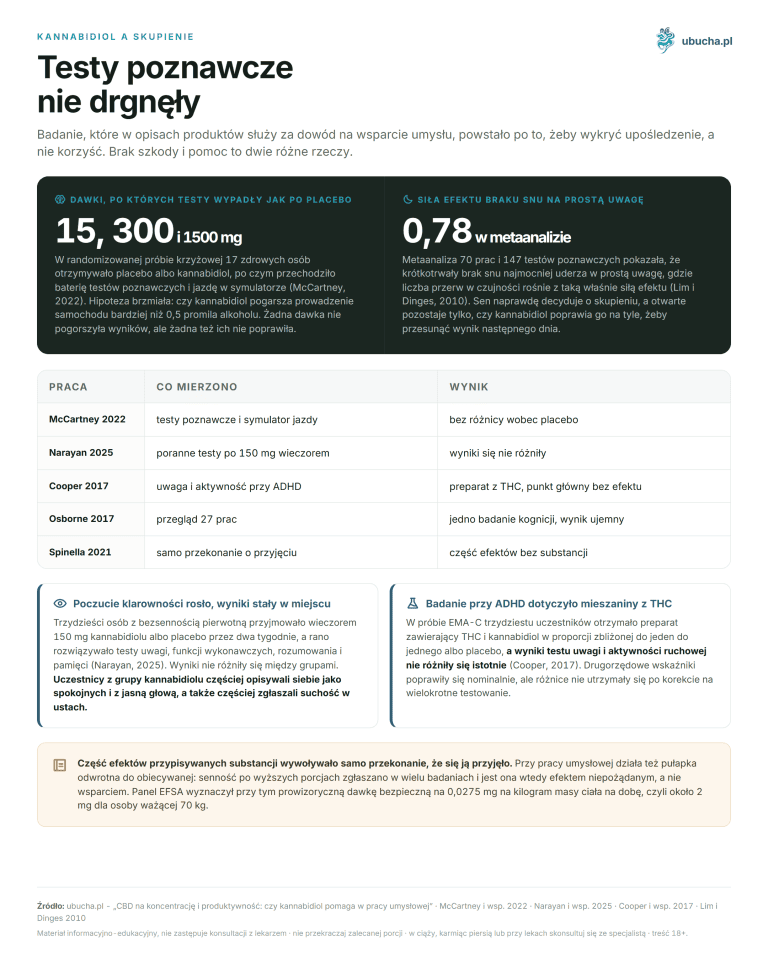
• EFSA in 2026 derived a temporary safe dose of CBD of 0.0275 mg per kilogram of body weight per day, about 2 mg for a person weighing 70 kg.
What do the basic terms from botany and chemistry of cannabis mean?
This is the most technical layer and also the most often distorted in product descriptions.
| Term | What it is |
|---|---|
| Cannabis sativa L. | The Latin name for hemp, the source species for hemp products in the EU |
| Phytocannabinoids | Compounds produced by the plant: CBD, CBG, CBC, CBN, THC, and several dozen rarer ones |
| Endocannabinoids | Anandamide and 2-AG, produced by the human body, acting on the same receptors |
| Terpenes | Volatile aromatic compounds of the strain. Myrcene gives an earthy note, linalool a floral note, limonene a citrus note |
| THC | Delta-9-tetrahydrocannabinol, the main psychoactive substance in cannabis |
| CBD | Cannabidiol, non-psychoactive, most widely used in supplementation |
| CBG | Cannabigerol, derived from CBGa, which is the parent molecule of CBD and THC |
| ECS System | CB1 and CB2 receptors, their natural ligands, and degrading enzymes |
| Decarboxylation | The removal of a carboxyl group under the influence of heat: CBDa gives CBD, THCa gives THC |
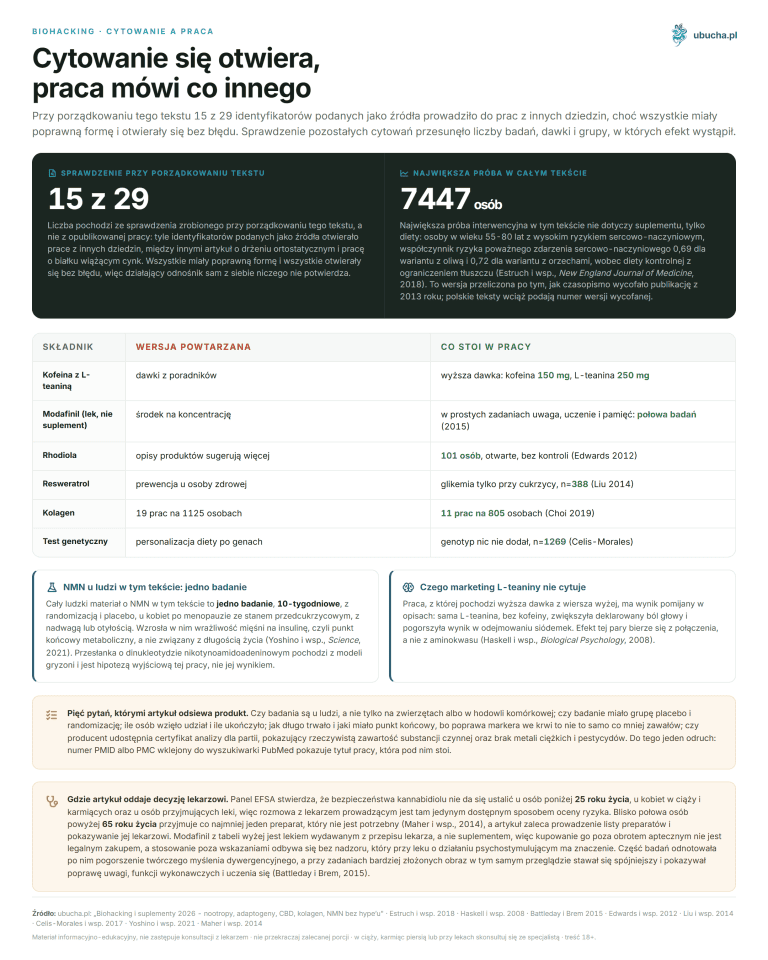
Two terms from this table are circulating in a false version. The first is CBG, advertised as the “focus cannabinoid”: in a survey among 127 people using CBG-dominant products, the most frequently indicated reasons were anxiety (51.2%), chronic pain (40.9%), and depression (33.1%), and improvement in concentration did not appear in this set (Russo et al., Cannabis and Cannabinoid Research, 2022). The second concerns the safety of CBD. The statement “WHO confirmed the safety of CBD” has been circulating in Polish internet for years, and the latest assessment sounds much more cautious: the EFSA panel derived a temporary safe dose of 0.0275 mg per kilogram of body weight per day, about 2 mg for a person weighing 70 kg, and stated that for individuals under 25 years of age, for pregnant and breastfeeding women, and for those taking medications, the safety of CBD cannot be established (EFSA NDA Panel, EFSA Journal, 2026).
How does Polish law define the THC threshold?
The threshold is 0.3% and is calculated as the sum of delta-9-THC and tetrahydrocannabinolic acid, rounded to one decimal place. It applies to the plant, specifically the flowering or fruiting tops, from which the resin has not been removed, calculated on a dry weight basis. The basis is Article 4 point 5 of the Act on Counteracting Drug Addiction (t.j. Dz.U. 2023 poz. 1939), as amended by the Act of March 24, 2022, Dz.U. 2022 poz. 763.
Two misunderstandings are so widespread here that it is worth listing them separately. The first: the threshold does not apply to delta-9-THC alone, so a certificate stating only this one value does not answer the question posed by the law. The second: the value of 0.20% ceased to apply on May 7, 2022, and is now a historical fact. The EU threshold of 0.3% for varieties eligible for subsidies comes from a separate act, Regulation 2021/2115. These are two independent regulations with the same numerical value, not one resulting from the other.
The third thing concerns the kitchen. Giving a new form to cannabis other than fiber, for example, making butter or cake at home, is treated by the law as processing in the sense of Article 4 point 20 in connection with Article 53. A prescription for pharmacy-grade cannabis does not change this, as Article 33a refers to raw materials for compounded medications prepared in pharmacies, not in home kitchens.
What do the terms from cannabis cuisine mean?
The culinary part of the dictionary is divided into two groups, the confusion of which is the source of most misunderstandings when shopping. Products from flowers contain phyto-cannabinoids by definition. Products from seeds carry at most traces, from contamination with resin during harvesting, and that is why EU law sets limits for them: 3.0 mg/kg for seeds and products from seeds and 7.5 mg/kg for oil.
| Term | What it is and how it behaves |
|---|---|
| Hemp seed oil | Pressed from seeds, without CBD and without THC. Seeds contain over 30% fat and about 25% protein, and over 80% of the fatty acids in the oil are polyunsaturated (Callaway, Euphytica, 2004). Dark green, nutty, for salads, not for frying |
| Hemp flour | Ground cake after oil pressing. Gluten-free, so it will not build the structure of dough on its own. The protein and fiber content depends on the degree of defatting and varies between producers |
| Hulled hemp seeds | Seeds without the hard shell. The two main proteins in the seeds are edestin and albumin, and the seeds are distinguished by a very high arginine content (Callaway, 2004) |
| Hemp butter | Butter saturated with material from flowers. Homemade from cannabis other than fiber is processing in the sense of the law |
| Edibles | Edible products with phyto-substances from flowers. They pass through the liver, so they work slower and longer than the same taken sublingually |
| Tincture | Extract from cannabis in alcohol or oil, a predecessor of today’s oils |
We have detailed the uses of hulled seeds in the text Hulled Hemp Seeds in the Kitchen, and the most common shopping mistake in the entire category in the text Hemp Oil vs CBD Oil: What are the Differences and What to Choose.
What do full spectrum, broad spectrum, and isolate mean?
These three terms describe how much of the original plant profile remains in the extract. Full spectrum retains CBD, trace amounts of other cannabinoids, and terpenes. Broad spectrum is the same profile after THC removal. Isolate is a crystalline, nearly pure cannabidiol, without the taste of cannabis, but the easiest to measure.
Alongside the spectrum, three terms describing the process and quality appear on labels. Supercritical carbon dioxide extraction leaves no solvent residues in the extract, as the gas evaporates after decompression. A certificate of analysis, or CoA, is a laboratory report with cannabinoid content and results of tests for pesticides and heavy metals; worth reading is one issued by a laboratory independent of the manufacturer, with a batch date. The carrier may be MCT oil, which is medium-chain triglycerides.
Regarding carriers, common knowledge diverges from the literature. It is repeated that MCT “increases the bioavailability of CBD through the lymphatic system,” while a systematic review of pharmacokinetic studies in humans states that the absolute bioavailability of cannabidiol has been reliably measured only for the inhalation route, about 31%, and for the oral route, no study has established it (Millar et al., Frontiers in Pharmacology, 2018). It is known, however, that a meal alters absorption, which is also confirmed by the EFSA assessment. Therefore, the choice of carrier may be significant, but the numbers used to justify it do not come from measurement. Oils, divided by spectrum and potency, are in the oils category.
Where did the entourage effect come from?
The term comes from the work of Ben-Shabat and Mechoulam’s team from 1998, but it referred to something different than today’s marketing suggests. The authors showed that inactive endogenous glycerol esters enhance the action of 2-arachidonoylglycerol, one of the endocannabinoids produced by the body (Ben-Shabat et al., European Journal of Pharmacology, 1998). It was about human molecules, not terpenes from the plant.
The transfer of the concept to plant cannabis is thanks to Ethan Russo’s review from 2011, which compared eight cannabis terpenes and described how they could modify the action of cannabinoids in pain, inflammation, anxiety, or infections. However, Russo formulates it conditionally. His own summary states that cannabinoid-terpene synergy, “if proven,” increases the chance for new therapeutic products, and a significant part of the text is a proposal of methods that could be used to study it (Russo, British Journal of Pharmacology, 2011).
For the reader of a store label, the conclusion is simple: the entourage effect is the name of a hypothesis, not a measured quantity. Choosing full spectrum instead of isolate provides a broader plant profile, not a proven enhancement of effect.
What do the words from cannabis slang mean?
The last layer of the dictionary has nothing to do with chemistry and everything to do with custom. You will encounter these words in conversations, on social media, and in descriptions on culinary profiles, and rarely in product descriptions.
| Expression | Meaning |
|---|---|
| Gastrofaza | Colloquial name for increased appetite after consuming cannabis containing THC. Biologically associated with the stimulation of CB1 receptors |
| Wake and bake | Morning consumption right after waking up, before breakfast. In the context of CBD, it simply means a morning dose of oil |
| Microdosing | Taking amounts significantly below the threshold of noticeable effect. The reference point for supplements with at least 98% purity of CBD remains the temporary dose from EFSA, about 2 mg per day for a person weighing 70 kg |
| Stonerchef | A cook or hobbyist specializing in cannabis dishes. A subculture mainly visible on social media |
| 710 | The date and slogan of the extract culture, read as the word “OIL” turned 180 degrees. The equivalent of 420, but for concentrates |
We have detailed where the numbers in this last line came from and how 710 differs from the much older 420 in the text 710, or Dabbing Day.
Frequently Asked Questions
What is the difference between hemp oil and CBD oil?
Hemp oil is pressed from seeds, so it does not contain CBD or THC. It is a food product: over 80% of the fatty acids in this oil are polyunsaturated (Callaway, 2004). CBD oil comes from flowers and leaves, contains cannabidiol and other phyto-substances. One is for eating, the other for supplementation.
What are terpenes and how do they affect the taste of cannabis?
Terpenes are volatile aromatic compounds produced by cannabis and many other plants. They are responsible for the aroma and flavor of the strain: myrcene gives an earthy note, linalool a floral note, limonene a citrus note, and beta-caryophyllene a spicy note. The terpene profile changes with the strain and storage conditions.
What is the entourage effect?
This is the name of the hypothesis that the components of cannabis work together differently than each one separately. The term comes from the work of Ben-Shabat and Mechoulam from 1998 on endogenous glycerol esters. Russo transferred it to plant terpenes in 2011, conditionally formulating synergy as something to be proven, not proven.
What do full spectrum, broad spectrum, and isolate mean?
Full spectrum retains CBD, trace amounts of other cannabinoids, and terpenes. Broad spectrum is the same profile with THC removed. Isolate is nearly pure cannabidiol, without terpenes and without the taste of cannabis. The first two provide a broader plant profile, the third allows for the most precise measurement of one substance.
What are edibles?
Edibles are edible products containing phyto-substances from cannabis flowers: gummies, cookies, capsules, drinks. They differ from products made from seeds, such as oil or hulled seeds, in which cannabinoids are present only in traces. Edibles pass through the liver, so they work slower and longer than a dose taken sublingually.
How does Polish law calculate the 0.3% THC threshold?
As the sum of delta-9-THC and tetrahydrocannabinolic acid, rounded to one decimal place, calculated on the dry weight of the plant tops. The basis is Article 4 point 5 of the Act on Counteracting Drug Addiction as amended by the Act of March 24, 2022. The value of 0.20% ceased to apply on May 7, 2022.
This article is for informational and educational purposes and does not replace consultation with a doctor. If you are pregnant, breastfeeding, taking medications, or have chronic conditions, consult the use of supplements or herbs with a specialist.
Author: Michał Waluk · Published: 2026-08-09 · Updated: 2026-08-15