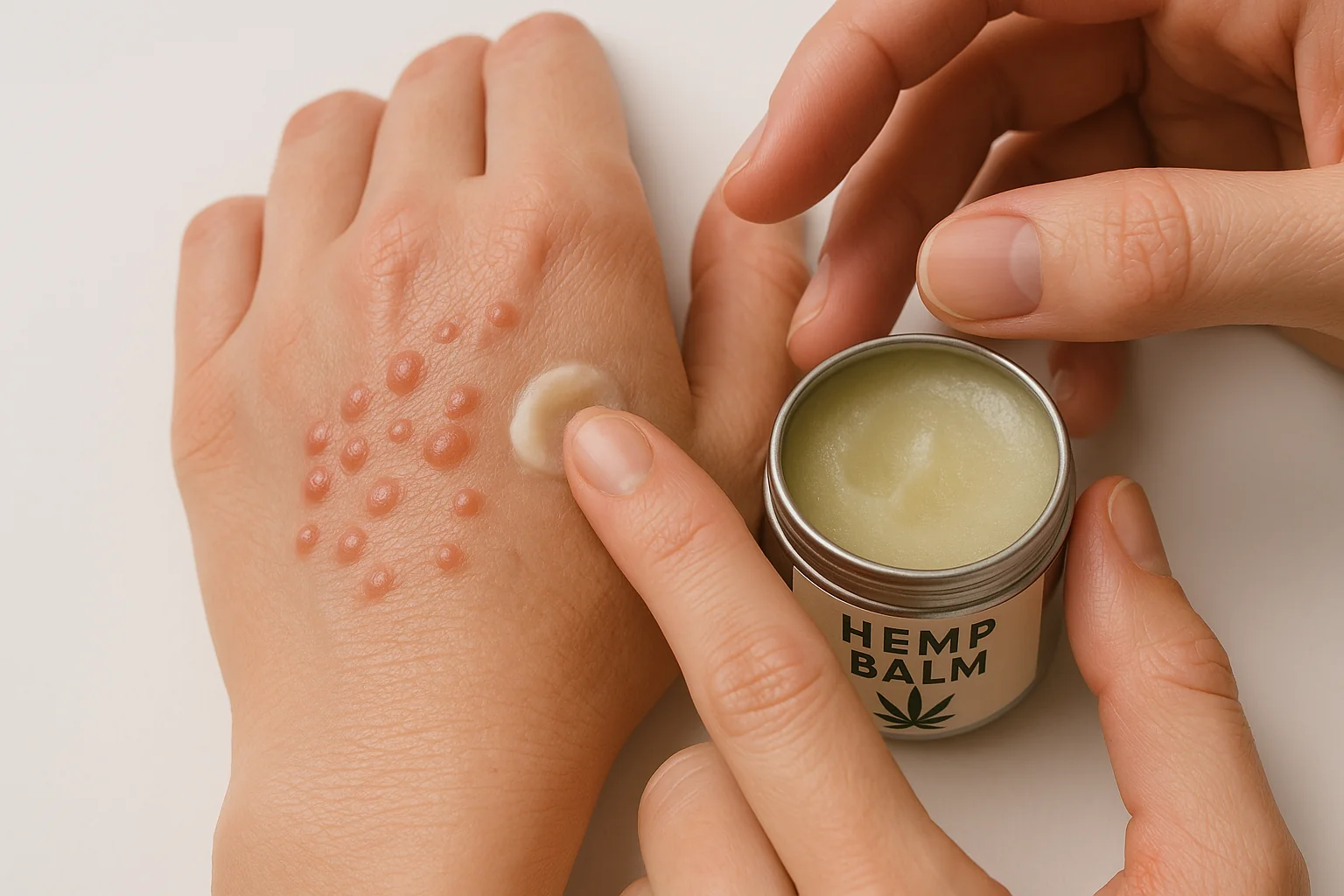

Pompholyx (dyshidrosis) and cannabis: do they alleviate symptoms (FAQ)
Does CBD and hemp oil alleviate dyshidrosis? We checked the research registry and studies on skin. A frequently cited publication says something different than it is attributed.
Pompholyx can make ordinary tasks difficult: blisters on the hands itch, burst, and the skin peels in flakes after an episode. It is no wonder that people with recurrent disease seek something gentler than steroids and turn to natural cosmetics. Cannabis creams and oils often appear in this context, usually referencing studies on skin and cannabinoid receptors. We checked these references at the sources, and one of them turned out to describe something completely different than it is attributed to. Below we have gathered the state of knowledge: what is known about the causes of the disease, where cannabis care actually makes sense, what has not been studied so far, and why in this particular disease the line between cosmetics and treatment is so important.
KEY INFORMATION
• There is not a single registered clinical study on cannabidiol in pompholyx (clinicaltrials.gov, as of August 16, 2026).
• Six studies on CBD in eczema concern other forms of the disease, mainly atopic dermatitis, and do not include dyshidrosis.
• The work that is cited online as evidence of CBD’s action through CB2 receptors states the opposite: cannabinoid receptors do not have a significant role here.
• Metal allergies, especially nickel and cobalt, are recognized as a causative factor and require diagnosis by a dermatologist.
• Emollients that rebuild the epidermal barrier make sense between episodes, but do not replace treatment prescribed by a doctor.
What is pompholyx and where does it come from?
It is a recurrent skin disease characterized by small, deeply embedded blisters on the hands, sides of the fingers, and soles of the feet. The lesions are tense and intensely itchy, and after a few weeks, they dry and peel, revealing dry, cracked skin. Clinical descriptions compare them to tapioca pudding, which well captures their appearance.
The disease mainly affects young adults and occurs equally often in women and men (Calle Sarmiento and Chango Azanza, Cureus, 2020). The cause is not fully understood. Histological examination shows an eczematous reaction around sweat ducts, although the ducts themselves are not abnormal, which undermines the old belief that retained sweat is the cause.
The best-documented causative factor is metal allergy. Nishizawa’s review from 2016 indicates that the presence of metal allergy in patients and improvement after the removal of the allergen make it one of the important causative factors in pompholyx. This primarily concerns nickel and cobalt, present in jewelry, tools, and parts of everyday products. Excessive sweating and pollen season are also significant.
The practical conclusion is that with recurrent changes, it is worth determining the cause before starting to choose care. Patch tests with a dermatologist determine whether contact allergy is involved, and this determination changes management more than any choice of cream.
Does CBD alleviate dyshidrosis symptoms?
It is unknown, as no one has studied it. A query to the public clinical trial registry about cannabidiol and pompholyx returns zero results, just like a query about the form called pompholyx (as of August 16, 2026). This is not a situation of ambiguous results, but an empty field.
The registry does contain six studies on cannabidiol in other forms of eczema. They concern atopic dermatitis, nummular eczema, papular urticaria, and chronic pruritus. None include dyshidrosis. This distinction is important because pompholyx differs from atopic dermatitis in clinical presentation, course, and most common triggering factors, so transferring results from one condition to another is an assumption, not evidence. We dedicated a separate article to what dermatology says about cannabis in atopic dermatitis.
What remains in practice? The argument from the epidermal barrier, which does not require referencing cannabidiol. Hemp seed oil contains linoleic and gamma-linolenic acids, substrates for building epidermal lipids. The skin after a dyshidrosis episode is dry and cracked, and regular moisturizing alleviates these consequences. This is the action of an emollient, common to many plant oils, and not a specific action of cannabis on the disease.
How do cannabis products affect the skin and what do studies not confirm?
The skin has its own endocannabinoid system. CB1 and CB2 receptors and enzymes that metabolize endocannabinoids have been detected in keratinocytes, Langerhans cells, mast cells, and fibroblasts. A review by Tóth and colleagues published in Molecules in 2019 describes how this system participates in maintaining skin balance, creating barriers, and regeneration, and lists diseases in which its dysregulation may be involved, including atopic dermatitis and psoriasis (Tóth et al., Molecules, 2019). However, the authors speak of research potential, not ready applications.
Here a misunderstanding arises that is worth clarifying. Guides circulate the statement that cannabidiol inhibits keratinocyte proliferation through CB2 and TRPV1 receptors. The study from which this statement originates says otherwise. Wilkinson and Williamson demonstrated in Journal of Dermatological Science in 2007 that the phytocannabinoids studied indeed inhibit keratinocyte proliferation depending on concentration, but selective agonists of the CB2 receptor provided only partial inhibition, and antagonists of CB1 or CB2 receptors did not block the actions. The authors conclude that cannabinoid receptors do not contribute significantly to this process (Wilkinson and Williamson, J Dermatol Sci, 2007).
Two things follow from this. The receptor mechanism on which many marketing descriptions are based has not been demonstrated here, but excluded as significant. Moreover, the study concerned psoriasis, a disease with excessive epidermal proliferation, and pompholyx does not belong to that group, so transferring the conclusion to dyshidrosis has no basis.
How to care for hands between relapses?
The starting point is the principle that cosmetics should not be applied to active changes, broken blisters, and oozing areas without a doctor’s consent, as the risk of bacterial superinfection increases. Emollient care applies to healed skin and periods between episodes.
Additionally, it is important to limit factors that damage the lipid barrier. Hot water removes epidermal lipids faster than lukewarm water, and alcohol-based products are irritating, so gentle cleansing agents and thorough, gentle drying work better for recurrent hand eczema. Protective gloves when working with detergents and solvents remove a significant part of the burden from the hands.
The composition of the product is more important than its brand name. For skin prone to eczema, alcohol, strong fragrance compositions, and essential oils, which can be contact allergens, as well as preservatives with known allergenic potential and lanolin should be avoided. A short ingredient list reduces the number of possible culprits, and it is reasonable to test a new product first on a small area of healthy skin. Cannabis cosmetics are no exception: they are subject to the same evaluation as any other emollient. We described how to read their composition and what to expect from them in the text about cannabis ointment for eczema and itching.
All of this is a supplement, not therapy. Pompholyx is treated with topical glucocorticoids, calcineurin inhibitors, and in severe cases, phototherapy or systemic treatment. The decision is up to the dermatologist.
What are the safety limits and legal status of cannabis cosmetics?
The origin of the raw material determines the legality of cosmetics. Annex II to the regulation on cosmetic products prohibits the use of substances covered by the lists of the 1961 convention, which include the flowering tops of cannabis with resin and their extracts. Allowed are raw materials obtained from seeds, namely oil and extract from seeds. This distinction determines the legality of the product and is worth knowing when reading the label.
For oral preparations, a different set of rules applies. Cannabidiol remains an unauthorized ingredient as a novel food in the European Union, and sanitary notification of a product’s introduction to the market is not authorization and does not change the status of the ingredient.
The European Food Safety Authority established a temporary safe dose of cannabidiol in 2026 at 0.0275 mg per kilogram of body weight per day, which is about 2 mg daily for a person weighing 70 kilograms, with an uncertainty factor of 400. This is a safety ceiling, not a recommendation. The authority notes that safety cannot be established for individuals under 25 years of age, pregnant and breastfeeding women, and individuals taking medications. People treated for chronic eczema often belong to the latter group.
Frequently Asked Questions
Does CBD treat pompholyx?
No. There is no registered clinical study on cannabidiol in this condition, and cannabidiol products are not medicinal products. Treatment is determined by a dermatologist, and cannabis cosmetics can at most be a supplementary care between episodes.
Are there studies on CBD for other forms of eczema?
Yes, there are six studies registered. They concern atopic dermatitis, nummular eczema, papular urticaria, and chronic pruritus. None include dyshidrosis, and the differences between these conditions do not allow for direct transfer of results.
Does CBD inhibit keratinocyte proliferation through CB2 receptors?
The study cited to support this claim excludes such a mechanism. Phytocannabinoids inhibited keratinocyte proliferation, but CB1 and CB2 receptor antagonists did not block this, and the authors deemed the involvement of these receptors insignificant. The study also concerned psoriasis, not pompholyx.
Can you apply cannabis ointment to blisters?
Cosmetics should not be applied to active, broken, or oozing lesions without a doctor’s consent, as the risk of bacterial superinfection increases. Emollients are used on healed skin and during periods between relapses, when the goal is to rebuild the epidermal barrier.
If allergic to nickel, should hemp seeds be avoided?
We did not find a study that would clarify this, so it cannot be confirmed or denied. Metal allergies are recognized as a contributing factor in pompholyx, and the scope of any elimination diet is determined with a doctor after patch testing.
How long does an episode last and can care shorten it?
Blisters usually dry and peel within a few weeks. There are no studies showing that cannabis care shortens the episode itself. Regular moisturizing alleviates dryness and skin cracking during the healing phase.
When should you contact a dermatologist?
When the lesions are extensive or painful, when symptoms of superinfection appear, such as pus, increasing redness, and fever, when symptoms persist for more than a few weeks, or when relapses disrupt daily functioning. Diagnosing contact allergies often changes further management.
You can find emollients and moisturizing cosmetics for hand care between episodes in the creams category.
This article is for informational and educational purposes and does not constitute medical advice. Before starting to use cannabis or CBD for therapeutic purposes, consult a doctor, especially if you are taking other medications, are pregnant, or breastfeeding.
Author: Michał Waluk · Published: 2026-08-09 · Updated: 2026-08-16