
Bulletproof coffee with hemp oil: coffee with power
Bulletproof coffee with hemp seed oil instead of ghee. Proportions, safe blending of hot coffee, and fat profiles according to Callaway and USDA.
Bulletproof coffee is traditionally made with ghee and MCT oil. Replacing ghee with hemp seed oil changes not only the taste but primarily the fat profile in the cup: ghee consists mostly of saturated fats, while hemp oil is over four-fifths polyunsaturated. The effect in the glass is similar, meaning a creamy, foamy coffee without sugar and without milk, only it gains a portion of acids that are typically lacking in the diet. Below you will find a recipe in five steps, rules for safely blending hot liquids, a comparison of both fats in numbers, and variants that actually add something. There is also a point that most recipes are silent about: on which days it is not worth drinking this coffee instead of breakfast and what is missing in it then.
KEY INFORMATION
• Hemp seed oil contains over 80 percent polyunsaturated fatty acids, and the ratio of omega-6 to omega-3 is usually between 2:1 and 3:1 (Callaway, Euphytica, 2004).
• Ghee contains 60 g of saturated fats and 4 g of polyunsaturated fats per 100 g (USDA FoodData Central, record 171314).
• Add oil after brewing the coffee, never to boiling water.
• This coffee does not provide protein or carbohydrates.
What changes when replacing ghee with hemp oil?
The type of fat, not its quantity. The classic recipe is based on the assumption that fat alone in the morning, without sugars, provides energy without a spike in glucose. However, ghee is almost exclusively saturated fats, which are not lacking in the Western diet. Hemp seed oil brings polyunsaturated fats instead.
Callaway in a review in Euphytica (2004) states that hemp seed oil contains over 80 percent polyunsaturated fatty acids and is an exceptionally rich source of both essential fatty acids, linoleic and alpha-linolenic. Their mutual ratio, that is, omega-6 to omega-3, is usually between 2:1 and 3:1 in this oil. The author himself calls this range optimal for human health, but that is his assessment, not a recommendation from any institution: no nutritional organization has announced a binding value for this ratio.
Why the ratio matters is explained by Simopoulos (Nutrients, 2016): throughout evolution, the ratio of omega-6 to omega-3 in the human diet was about 1:1, and today it reaches 20:1 or more, as the intake of omega-6 has increased while omega-3 has decreased. The author links this shifted balance to the rising prevalence of obesity and summarizes that for health, a balanced ratio of both families of acids matters. A teaspoon of hemp oil in coffee is about 5 ml, which is approximately 4.6 g of fat, of which over 3.5 g is polyunsaturated fatty acids.
From our experience, the best version is a mixed one: a teaspoon of hemp oil plus a teaspoon of ghee. Hemp oil alone gives a thinner coffee with a distinct greenish, nutty aftertaste, which may not appeal to everyone in the morning. Ghee alone is creamy but bland. Together, they hold the foam longer than either one alone. This is a taste observation from our kitchen, not a measurement result.
How do the two fats differ in numbers?
Calorically almost nothing, composition almost everything. Each pure fat is about 900 kcal per 100 g, so a tablespoon of either brings about the same amount of energy to the cup. The difference lies in what fatty acids make up that energy, and with polyunsaturated fats, it is over twentyfold.
| Per 100 g | Hemp seed oil | Ghee |
|---|---|---|
| Total fat | 100 g | 100 g |
| Polyunsaturated fatty acids | over 80 g | 4 g |
| Saturated fatty acids | not provided in the cited source | 60 g |
| Energy | about 900 kcal | 900 kcal |
Data on ghee comes from record 171314 in the USDA FoodData Central database, the share of polyunsaturated fatty acids in hemp oil from Callaway’s review. The database does not have a separate record for hemp seed oil among the reference data, so the field for saturated fatty acids was left empty instead of filled with an estimate. A tablespoon of oil is about 14 g of fat, which is approximately 125 kcal, and a teaspoon is about 4.6 g and 40 kcal. The brew itself adds almost nothing to this: record 2710375 (Coffee, brewed) states 1 kcal and 40 mg of caffeine per 100 g of black coffee, so a 250 ml cup brings about 2 kcal and roughly 100 mg of caffeine.
What do you need for this coffee?
Strong coffee, oil, and something to combine them. An emulsion only forms with vigorous mixing, so a blender or electric frother is needed here more than any additional ingredient. Without them, the oil will collect on the surface in spots, and the coffee will be oily instead of creamy.
For one large cup, about 250 ml, prepare:
- 200-250 ml of strong coffee from an espresso machine, moka pot, French press, or pour-over
- 1 teaspoon of cold-pressed hemp seed oil, which is 5 ml
- optionally 1 teaspoon of ghee or MCT oil for more creaminess
- optionally a few drops of CBD oil, added to the cup after blending
- optionally a pinch of cinnamon, cardamom, or turmeric
- blender or electric milk frother
Instant coffee will work the worst, as it gives a thinner brew and less material for the foam to hold onto. The French press performs best: after four minutes of extraction, a lot of oils from the coffee remain in the cup, which facilitate blending the fat. A paper filter in pour-over retains some of those oils, so pour-over coffee will yield a thinner foam, though still distinct. Buy cold-pressed hemp seed oil and keep it in the fridge: with such a high content of polyunsaturated fats, it spoils faster than olive oil.
How to make bulletproof coffee with hemp oil?
In five steps and with one condition: hot liquid in a closed blender behaves differently than cold. Steam expands in the jar and can push the lid off along with the contents. The rest of the recipe is trivial, but this one step cannot be shortcut.
Safety: When blending hot liquids, fill the jar no more than halfway and hold the lid with your hand through a folded cloth. Start at the lowest speed and only then increase. Hot liquid under pressure can push the lid off and cause burns.
- Brew 200-250 ml of strong coffee using your chosen method. Espresso diluted with hot water in a one-to-three ratio provides the most aromatic base, while a French press after four minutes of extraction gives the oiliest result.
- Pour the coffee into the blender jar, no more than halfway full. Add a teaspoon of hemp seed oil, and if you want a thicker foam, also add a teaspoon of ghee or MCT oil. Do not add milk, as it spoils the emulsion.
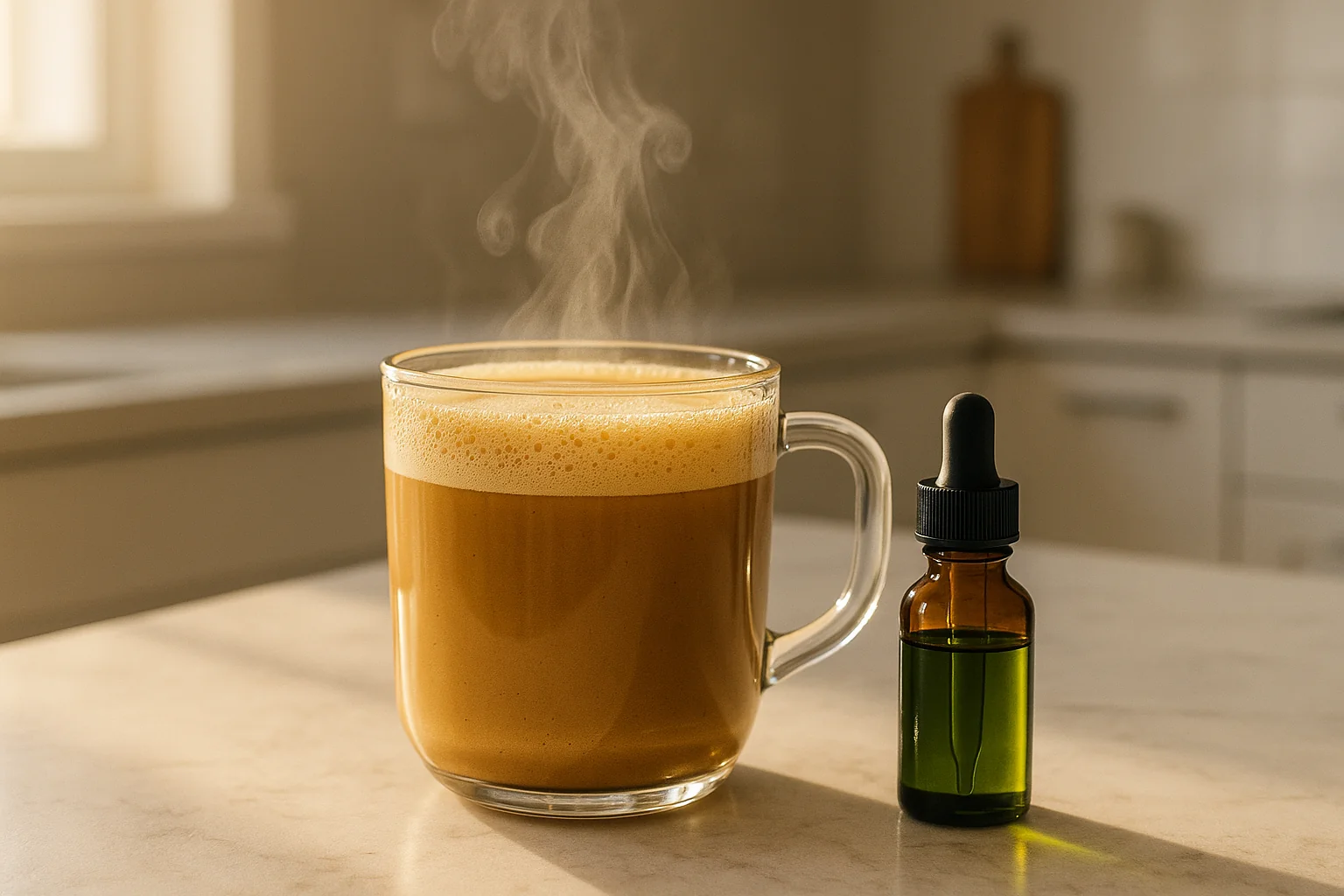
- Cover the jar and hold the lid with a cloth. Blend for five seconds on the lowest speed, then 20-25 seconds on the highest. The coffee will turn light brown and creamy, and the fat will disperse into a fine emulsion.
- Pour the coffee into a large cup. The foam will last for a few minutes. Now, outside the blender, add any drops of CBD oil and a pinch of cinnamon on top.
- Drink slowly, over several minutes, not in one gulp. Coffee with fat is filling and on non-training days can replace a small breakfast.
What variants of this coffee make sense?
Three, each addressing a different need. One adds CBD oil to the cup, another targets a ketogenic diet, and the third solves the problem of lacking a blender. Besides these, it is worth knowing on which days it is better not to drink this coffee instead of a meal.
Add drops of CBD oil to the cup, not to the blender jar. The fat from hemp oil serves as a carrier here, and this is not just a guess: Zgair and colleagues demonstrated in American Journal of Translational Research (2016) that administering cannabinoids orally together with fat increased systemic exposure to CBD threefold and to THC two and a half times. The study was conducted on rats, so the scale of the effect should not be directly transferred to humans, although the authors consider a similar mechanism in humans likely. You can find the oils in the oils category.
The ketogenic version involves adding a teaspoon of MCT oil alongside hemp oil: hemp oil brings polyunsaturated fats, MCT is a quick source of energy. The version without a blender relies on an electric frother immersed in the cup for 30 seconds or vigorous shaking in a sealed thermos. The foam will be smaller, but the coffee is equally well mixed. If you prefer cold coffee, the same oil works well in cold brew with hemp oil.
Do not drink this coffee instead of breakfast on days with morning training. The fat alone does not provide protein or carbohydrates, so it does not support recovery after exercise. On such days, it is better to have a full meal, for example, avocado toast with hemp oil, and drink the coffee separately.
Frequently asked questions
Can hemp oil be heated in coffee?
Add it to already brewed coffee, never to boiling water and never in a pan. Hemp seed oil is over 80 percent polyunsaturated fatty acids, which are the most sensitive to high temperatures of all types of fat. Blending itself does not raise the temperature of the drink above the temperature of the coffee.
How many calories are in bulletproof coffee with hemp oil?
With a teaspoon of oil, or 5 ml, it comes to about 40 kcal and 4.6 g of fat. With a full tablespoon, or 15 ml, about 125 kcal and 14 g of fat. This is a calculation based on the density and caloric content of fat, not a reading from a table. The brew itself adds about 1 kcal per 100 ml.
Does this coffee replace breakfast?
It provides fat and caffeine, but not a gram of protein and practically zero carbohydrates. In a ketogenic diet or during intermittent fasting, it can be treated as a meal. With morning training or physical work, it is better to treat it as an addition to breakfast, not a substitute.
How to make foamy coffee without a blender?
Immerse an electric milk frother in the cup with coffee and oil and froth for 20-30 seconds. Another way is to use a tightly closed thermos and shake vigorously for half a minute, being careful with the hot liquid. The foam will be smaller than with a blender, but the fat will disperse evenly.
Can CBD oil be added to this coffee?
Yes, but only to the cup, after blending. Do not pour drops into the hot jar or mix with boiling water. The amount depends on the concentration of the oil and what you are using it for, so stick to the recommendations on the producer’s label. If you are taking medication regularly, consult this with your doctor first.
This article is for informational and educational purposes and does not replace consultation with a doctor. If you are pregnant, breastfeeding, taking medications, or have chronic conditions, consult the use of supplements or herbs with a specialist.
Author: Michał Waluk · Published: 2026-05-29 · Updated: 2026-08-16