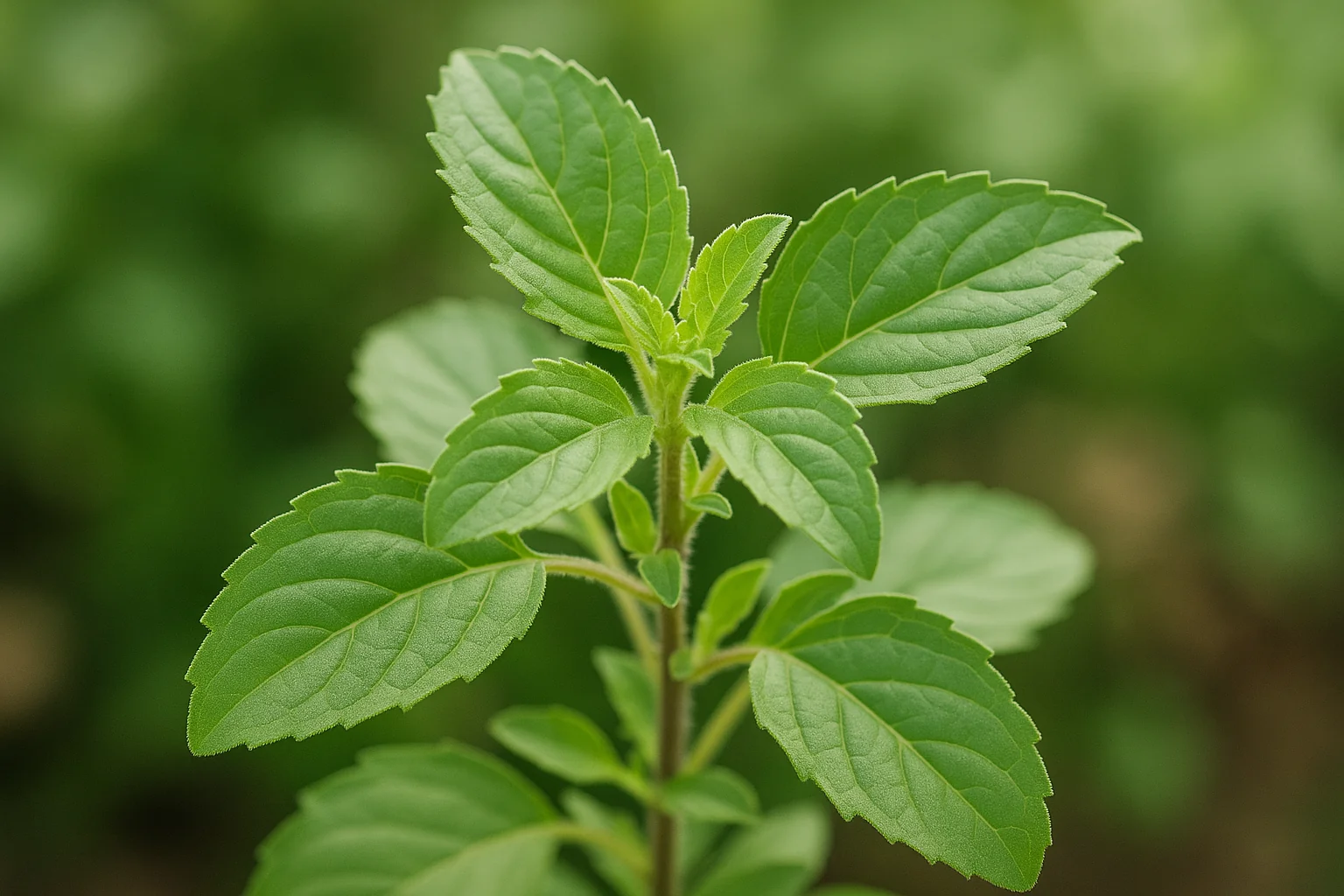

Tulsi (holy basil): adaptogen for stress (FAQ)
Holy basil in human studies: cortisol, sleep, memory. How many participants were there, how long did the trials last, and where do the data end and tradition begin.
Tulsi, or holy basil (Ocimum tenuiflorum), is a ceremonial plant and daily infusion in India, and Ayurveda describes it as rasayana. Modern data is narrower than tradition but not empty. A systematic review gathered 24 studies on humans and did not report significant adverse events (Jamshidi and Cohen, Evidence-Based Complementary and Alternative Medicine 2017). The strongest single result comes from a randomized placebo trial involving one hundred people: eight weeks of supplementation reduced cortisol levels in hair and improved scores on the insomnia scale. This text shows what exactly was measured, how many people participated, and for how long, as well as where the data ends and tradition begins.
KEY INFORMATION
• Eight weeks of supplementation reduced cortisol in hair and improved insomnia scale scores in 100 people (Lopresti et al., 2022).
• A review of 24 studies on humans did not report significant adverse events.
• Tulsi does not contain caffeine and is not the same species as culinary basil.
• The preparations in the studies differed so much that doses cannot be compared.
• Pregnant and nursing women were not included in the 2022 trial.
What is tulsi and how does it differ from Italian basil?
Tulsi is Ocimum tenuiflorum, also known in literature by the older name Ocimum sanctum. Culinary basil is Ocimum basilicum. The plants belong to the same genus and the mint family, but they are distinct species with different essential oil compositions and uses. They are not substitutes.
The difference is noticeable in aroma. Tulsi has a distinct clove note, while Italian basil is sweeter and more anise-like. This distinction is practically important when purchasing, as both are often simply described as basil in trade. On the packaging of supplements or tea, look for the species name, not just the trade name.
Tulsi’s position in India is not solely culinary or solely herbal. Marc Cohen, in a narrative review published in the Journal of Ayurveda and Integrative Medicine, describes it as the foremost plant among Ayurvedic herbs and notes that its cultivation and daily rituals involving it have both spiritual and practical significance (Cohen, 2014). The same work collects reports of protective effects against chemical, physical, metabolic, and psychological stress, but it is a narrative review, not a systematic one. This is how it differs from the 2017 work we cite below, and therefore the conclusions from it should be read as a description of the research field, not as a summary of evidence.
What do clinical studies show about tulsi?
A systematic review counted 24 studies on humans. Below are three interventional trials and the review itself, along with the number of participants and duration. The preparations in these works differ enough that they do not create a common scale.
| Study | Participants | Preparation and duration | Measured outcome |
|---|---|---|---|
| Lopresti et al., Frontiers in Nutrition 2022 | 100 people aged 18-65 reporting stress | Holixer hydroalcoholic extract, 125 mg twice daily, 8 weeks, randomized with placebo | Better scores on perceived stress scale and Athens insomnia scale; lower cortisol in hair at week 8; after laboratory stress test, lower cortisol and amylase in saliva, as well as lower systolic and diastolic blood pressure |
| Saxena et al., Evidence-Based Complementary and Alternative Medicine 2012 | 150 people with general stress symptoms (71 preparation, 79 placebo) | OciBest, 1200 mg of active substances daily, 6 weeks, double-blind with placebo | Decrease in severity of forgetfulness, fresh sexual problems, feelings of exhaustion, and fresh sleep problems; overall improvement 39% greater than in the placebo group |
| Sampath et al., Indian Journal of Physiology and Pharmacology 2015 | Healthy adult volunteers | Ethanolic extract of leaves, 300 mg daily, 30 days, placebo control | Shorter reaction time and lower error rate in Sternberg and Stroop tests, as well as shorter P300 latency compared to placebo; cortisol in saliva improved only within the group, intergroup difference not significant |
| Jamshidi and Cohen, Evidence-Based Complementary and Alternative Medicine 2017 | Systematic review of 24 studies on humans | Various preparations in different doses | Reports of effects on metabolic disorders, cardiovascular diseases, immunity, and cognitive functions; no significant adverse events reported |
Two notes regarding this table. All 24 works in the review reported a beneficial outcome, and the authors themselves state that further research is needed to clarify the dose and form of the preparation and to identify groups that benefit. A complete set of positive results with such a small number of studies should be read more cautiously than the result of a single large trial. Separately, it is worth noting that the Lopresti study was funded by the manufacturer of the extract used, although the authors note that it did not participate in data collection or analysis.
Does tulsi lower cortisol?
In one randomized trial, yes, measured by two independent methods. After eight weeks, cortisol levels in hair were lower in the tulsi group than in the placebo group, and after a laboratory stress test, both cortisol and amylase in saliva, blood pressure, and subjective stress assessment were lower (Lopresti et al., 2022).
Not every study confirms this. In healthy volunteers taking ethanolic extract for 30 days, cortisol in saliva improved within the tulsi group, but the difference compared to placebo was not statistically significant (Sampath et al., 2015). The discrepancy between these studies is likely explained by a different group, different preparation, and different duration, but there is no definitive resolution.
The mechanism was studied outside of humans. In a 2016 study, rats were subjected to variable chronic stress for 16 days, and concurrent cell and acellular tests were conducted. Extracts from Ocimum sanctum and ursolic acid inhibited cortisol release, blocked the CRHR1 receptor, and inhibited the activity of 11-beta-hydroxysteroid dehydrogenase type 1 and catechol-O-methyltransferase (Jothie Richard et al., Phytotherapy Research 2016). This is an animal model and cell experiment, so it describes a possible pathway of action, not an effect in humans. We write more broadly about this class of mechanisms in the text on adaptogens and the nervous system.
Does tulsi improve memory and concentration?
One controlled trial on healthy adults gives a positive result in a narrow range. After 30 days of taking ethanolic leaf extract, the tulsi group performed better than placebo in reaction time and error rate in the Sternberg test and in the Stroop interference task, as well as in P300 latency in electroencephalographic recording.
The scope of this result should be kept narrow. The improvement concerned the speed and accuracy of responses, which cognitive psychology measures as attention and executive control. Long-term memory or learning of material was not studied, so the statement that tulsi improves memory goes beyond measurement. The authors also noted that heart rate and skin conductance response did not change at all.
The systematic review mentions cognitive functions among the four areas where reports from human studies appeared. Alongside them are metabolic disorders, cardiovascular diseases, and immunity. However, the authors do not rank the strength of evidence among these areas, so from the review alone, it does not follow that cognitive functions are the best-studied.
What preparations and doses were used in studies?
Three interventional trials used three different preparations in three different amounts. Lopresti administered 125 mg of hydroalcoholic extract twice daily for eight weeks; this was a preparation standardized by chromatographic methods and produced in a facility with good manufacturing practice certification. Saxena used 1200 mg of active substances daily for six weeks. Sampath used 300 mg of ethanolic leaf extract for 30 days.
These numbers describe research protocols and nothing more. They are not recommendations, do not sum up, and cannot be converted into one another, as they concern extracts with different solvents and different standardizations. The authors of the systematic review state this matter directly: clarifying the dose and form of the preparation was among the things that still need to be established. If you are considering supplementation, the appropriateness and portion size are decided by a doctor or pharmacist, especially when taking medications regularly.
Tea is a separate case and cannot be compared to a capsule. In an infusion, the concentration of active substances depends on the amount of herb, water temperature, and steeping time, and none of the described trials studied the infusion. Transferring numbers from studies on extracts to cups of tea is therefore a calculation without a basis. Traditional tea drinking has centuries of practice behind it, but no measurements; this does not mean that the infusion does not work, only that no one has checked it. We compare which plants have stronger research backing in this area in the review of supplements for stress and cortisol.
When should caution be exercised with tulsi?
The starting point is that the review of 24 studies on humans did not report significant adverse events, and in Lopresti’s trial, the preparation was described as well-tolerated. However, the interventional trials described above lasted from one month to two and were conducted on small groups. There is no information on safety for use over a year.
Pregnancy and breastfeeding are areas without data, not areas with reassuring data. In the protocol of the 2022 trial, pregnant women, nursing mothers, and those planning pregnancy were explicitly excluded from recruitment. The same should be read for the lack of information about children and adolescents: no one has checked this.
Separately, it is worth monitoring blood glucose levels. Cohen’s narrative review mentions normalizing glucose levels among the described actions of tulsi, and the systematic review indicates metabolic disorders as one of the four areas where clinical reports appeared. If you are taking medications to lower blood sugar, discuss such a supplement with your doctor before using it. We did not find direct studies on interactions between tulsi and medications, which means that the question remains open, not that the answer is reassuring.
Frequently asked questions
How does tulsi differ from regular basil?
They are two distinct species of the same genus. Tulsi is Ocimum tenuiflorum, also described as Ocimum sanctum, while culinary basil is Ocimum basilicum. They differ in the composition of essential oil and aroma: tulsi has a clove note, while Italian basil is sweeter and has an anise note. They are not substitutes, even in cooking.
Does tulsi really lower cortisol?
In a randomized trial of 100 people, after eight weeks, cortisol in hair was lower than in the placebo group, and after a stress test, both cortisol and amylase in saliva were also lower. In another, shorter trial on healthy volunteers, the difference compared to placebo did not reach significance. One positive study does not close the topic.
Does tulsi help with sleep?
In a 2022 trial, participants taking tulsi had better scores on the Athens Insomnia Scale than the placebo group. The authors themselves note that these were subjective measures and that confirmation requires objective methods of studying sleep. Tulsi is not a sleep aid with immediate effects.
Does tulsi contain caffeine?
No. Holy basil belongs to the mint family and is not related to Chinese tea (Camellia sinensis), from which caffeine in tea comes. Therefore, tulsi tea can be consumed in the evening without caffeine stimulation. However, this does not mean it has a sedative effect.
What doses were used in studies on tulsi?
Three trials used three different preparations: 125 mg of hydroalcoholic extract twice daily for eight weeks, 1200 mg of active substances daily for six weeks, and 300 mg of ethanolic extract for 30 days. These numbers describe research protocols and are not recommendations. Supplementation is decided by a doctor.
Is tulsi safe for long-term use?
A review of 24 studies on humans did not report significant adverse events, but the trials described in this text lasted at most two months. There is no data on use for a year. Pregnant women, nursing mothers, and those planning pregnancy were excluded from recruitment in the 2022 trial, so there is no data for these groups.
Can tulsi be combined with diabetes medications?
This decision is made by a doctor. The literature describes the effect of tulsi on carbohydrate metabolism, and metabolic disorders are one of the areas mentioned in the systematic review. We did not find direct studies on interactions with hypoglycemic medications, so caution arises from a lack of data, not from described risk.
Holy basil in tablet form is available in the supplements category. Another plant described as an adaptogen is discussed in the text about tongkat ali for testosterone and libido.
This article is for informational and educational purposes and does not constitute medical advice. Before starting supplementation, consult a doctor, especially if you are taking medications regularly, are pregnant or breastfeeding, or have a chronic illness.
Author: Michał Waluk · Published: 2026-08-09 · Updated: 2026-08-16