
Beta-alanine: dosage, effects, and is it worth it (table)
How much beta-alanine to take, where the tingling comes from, and under what efforts it really works. Dosage according to the ISSN position and data from the meta-analysis.
Beta-alanine is one of the best-researched sports supplements, but popular descriptions of its effects diverge from what studies have shown. A meta-analysis of fifteen studies involving 360 participants confirmed improved performance in efforts lasting from 60 to 240 seconds, with no benefits in efforts shorter than a minute (Hobson et al., Amino Acids, 2012). This distinction determines who benefits from supplementation. A separate issue is the tingling of the skin, which can lead to discontinuation of the supplement within the first week, although it has a well-described mechanism and does not constitute an allergic reaction. Below you will find dosing according to the position of the International Society of Sports Nutrition, an explanation of the tingling mechanism, and data on combining beta-alanine with other ingredients.
KEY INFORMATION
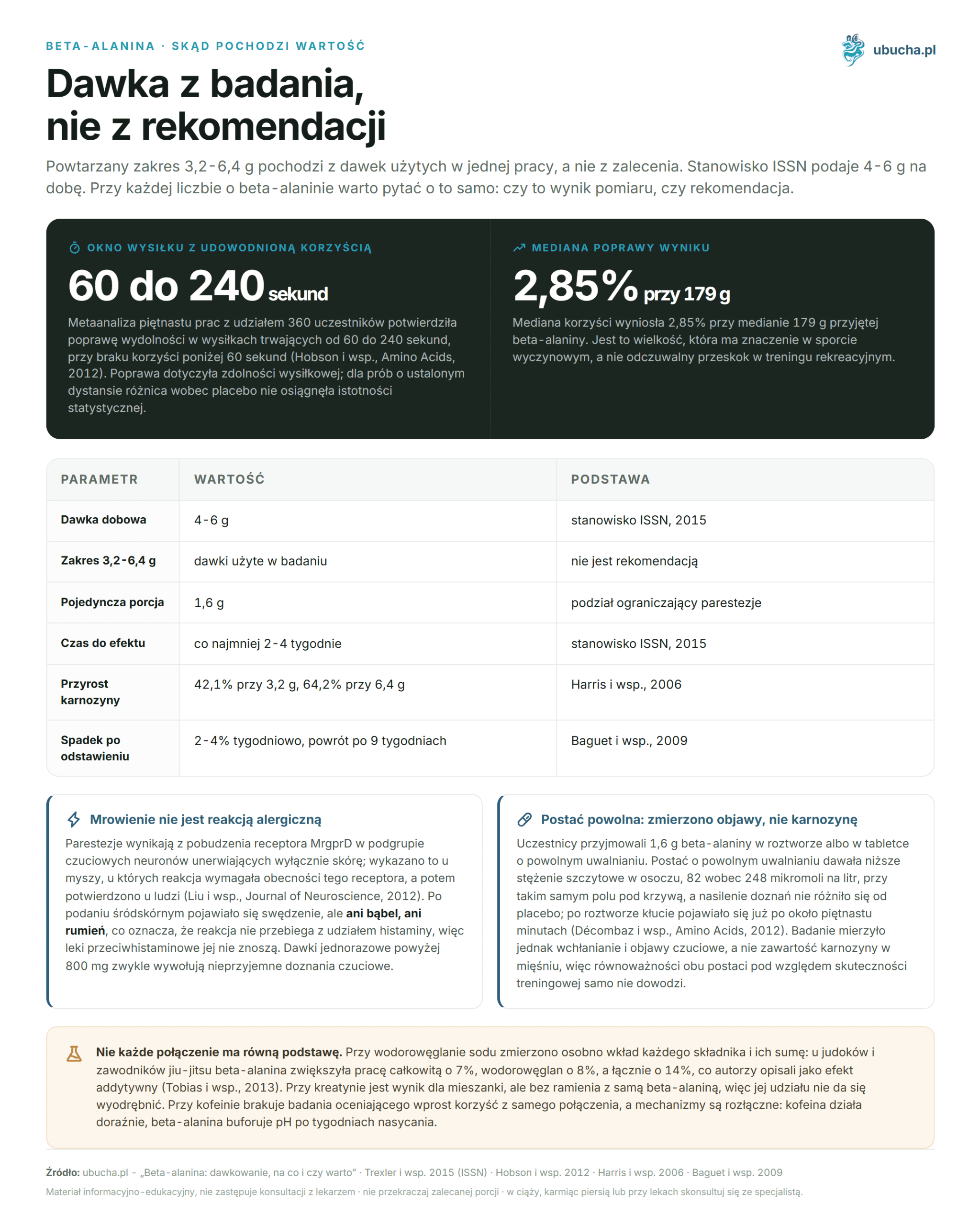
• The ISSN position states a dose of 4-6 g per day for at least four weeks, not 3.2-6.4 g as is often repeated.
• The effect pertains to efforts lasting from 1 to 4 minutes. Below 60 seconds, the meta-analysis showed no benefits.
• The median improvement in results is 2.85%, which is a real but modest size.
• Tingling results from the stimulation of the MrgprD receptor in sensory nerves of the skin and has no allergic basis.
• Single doses above 800 mg usually cause paresthesia, which is why the daily dose is divided into parts of 1.6 g.
• After discontinuation, carnosine decreases by 2-4% weekly and returns to baseline values in about nine weeks.
What is beta-alanine and how does it work in muscles?
Beta-alanine is a non-protein amino acid that combines with histidine in the body to form carnosine. This dipeptide accumulates in skeletal muscles and buffers hydrogen ions produced during intense exercise. It is beta-alanine, not histidine, that limits the rate of this synthesis.
During high-intensity exercise, anaerobic glycolysis leads to the accumulation of hydrogen ions, which lower the pH inside the muscle cell and inhibit the work of enzymes responsible for contraction. Carnosine binds these ions and delays the moment when the muscle can no longer maintain the required power.
The magnitude of the effect is well measured. In a study by Harris et al., supplementation for four weeks increased carnosine content in the vastus lateralis muscle by 42.1% at a dose of 3.2 g per day and by 64.2% at a dose of 6.4 g per day (Harris et al., Amino Acids, 2006). However, the variability among individuals can be large: in a later study, individuals who reacted strongly had an increase of 55%, while those who reacted weakly had an increase of about 15%.
It is worth noting what the meta-analysis did not show. The improvement pertained to exercise capacity, while for results in fixed-distance trials, the difference compared to placebo did not reach statistical significance. The median benefit was 2.85% with a median of 179 g of beta-alanine taken. This is a size that matters in competitive sports, but not a noticeable jump in recreational training. We discuss how beta-alanine compares to other legal performance enhancers in our review of supplements for athletes compliant with regulations.
How much beta-alanine should I take daily?
The International Society of Sports Nutrition recommends 4-6 g per day for at least two to four weeks, with full saturation of carnosine described after four weeks (Trexler et al., Journal of the International Society of Sports Nutrition, 2015). The commonly repeated range of 3.2-6.4 g comes from doses used in Harris’s study, not from recommendations.
| Parameter | Value | Basis |
|---|---|---|
| Daily dose | 4-6 g | ISSN position, 2015 |
| Single dose | 1.6 g | Division recommended to limit paresthesia |
| Time to effect | At least 2-4 weeks | ISSN position, 2015 |
| Carnosine increase after 4 weeks | 42.1% at 3.2 g per day, 64.2% at 6.4 g per day | Harris et al., 2006 |
| Type of effort with proven benefit | From 60 to 240 seconds; no benefits below 60 seconds | Hobson et al., 2012 |
| Decrease after discontinuation | 2-4% weekly, return to baseline values in about 9 weeks | Baguet et al., 2009 |
After discontinuing supplementation, carnosine does not disappear overnight. In a study using magnetic resonance spectroscopy, carnosine content increased by 39% in the soleus muscle, by 27% in the tibialis anterior, and by 23% in the gastrocnemius, and after stopping administration, it decreased at a rate of 2-4% weekly (Baguet et al., Journal of Applied Physiology, 2009). Missing a few days, therefore, has no practical significance.
Why does beta-alanine cause tingling?
Tingling of the skin, or paresthesia, results from the stimulation of the MrgprD receptor in a subgroup of sensory neurons innervating only the skin. This has been demonstrated in mice, where the reaction required the presence of this receptor, and then confirmed in humans (Liu et al., Journal of Neuroscience, 2012).
One detail from the human part of this study is decisive. After subcutaneous administration of beta-alanine, itching occurred, but neither a wheal nor erythema was present. The absence of these two symptoms means that the reaction does not involve histamine, and thus is not an allergic reaction. This distinguishes paresthesia after beta-alanine from hypersensitivity and explains why antihistamines do not alleviate it.
The intensity depends on the size of the single dose. Single doses exceeding 800 mg usually cause unpleasant sensory experiences, which is why protocols divide the daily dose into smaller parts. In a comparative study, participants took 1.6 g of beta-alanine in a solution or in a slow-release tablet. The slow-release form produced a lower peak concentration in plasma, 82 versus 248 micromoles per liter, with the same area under the curve and better retention in the body (Décombaz et al., Amino Acids, 2012).
The result regarding symptoms was unequivocal in this study: the intensity of sensations after the slow-release tablet did not differ from placebo, while after the solution, the tingling sensation appeared on the skin of the arms and torso after about fifteen minutes. However, it should be noted that the study measured absorption and sensory symptoms, not carnosine content in the muscle, so it does not itself prove the equivalence of both forms in terms of training effectiveness.
When to take beta-alanine and for how long?
Beta-alanine does not work immediately. Its effect depends on the gradual saturation of carnosine in muscle tissue, not on the concentration in the bloodstream at the time of training. This leads to a simple practical conclusion: regularity over four weeks matters more than the timing of intake.
Therefore, supplementation is also conducted on non-training days. Taking doses with meals is convenient and additionally alleviates paresthesia, and the ISSN position indicates dividing into smaller doses of 1.6 g as a way to limit symptoms. Those who take the entire daily amount at once before training expose themselves to the strongest tingling without any benefit in return, as the timing of intake does not affect the rate of saturation.
The duration of the effect after discontinuation depends on how strongly someone reacted to supplementation. In individuals with a significant increase in carnosine, returning to baseline values took about fifteen weeks, while in those with a small increase, about six. On average, this falls within nine weeks. A holiday break does not require building levels from scratch, while a several-month break does.
This distinguishes beta-alanine from supplements with immediate effects. Caffeine starts to work after several minutes and wears off the same day, as we discuss in the text about the minimum effective dose of caffeine pre-workout. Beta-alanine builds its effect over weeks and loses it just as slowly.
What to combine beta-alanine with?
The ISSN position allows combining beta-alanine with other ingredients, stipulating one condition: the dose must be 4-6 g per day, and supplementation must last at least four weeks. Below is a summary of combinations for which there is data from studies with a control group.
| Combination | What was shown | Caveat |
|---|---|---|
| Creatine | In football players after 10 weeks of resistance training, the group with creatine and beta-alanine achieved a greater change in lean body mass and fat tissue content than the group with creatine alone and than placebo (Hoffman et al., International Journal of Sport Nutrition and Exercise Metabolism, 2006) | The study did not have a group taking only beta-alanine, so its contribution cannot be isolated |
| Sodium bicarbonate | In judokas and jiu-jitsu athletes, beta-alanine increased total work by 7%, bicarbonate by 8%, and together by 14%, which the authors described as an additive effect (Tobias et al., Amino Acids, 2013) | 0.5 g of bicarbonate was used per kilogram of body weight, which causes gastrointestinal discomfort in some individuals |
| Caffeine | The mechanisms are separate: caffeine blocks adenosine receptors and acts immediately, while beta-alanine buffers pH inside the cell after weeks of saturation | There is no study directly assessing the benefit of combining both ingredients |
The summary shows that not every popular combination has an equal basis. The best-documented pair is with sodium bicarbonate, where the individual contributions of each ingredient and their sum were measured separately. With creatine, we have results for the mixture, but without a group taking only beta-alanine, which limits conclusions about its role. The dosing of creatine alone is discussed in a separate text about its timing and loading phase, and the pre-workout use of citrulline in the guide on dosing citrulline malate.
Frequently Asked Questions
How many grams of beta-alanine should I take daily?
The International Society of Sports Nutrition recommends 4-6 g per day for at least two to four weeks. The dose should be divided into smaller parts of about 1.6 g to limit tingling. The commonly repeated range of 3.2-6.4 g comes from doses used in one study, not from recommendations.
Why does beta-alanine cause tingling?
Beta-alanine stimulates the MrgprD receptor in sensory neurons innervating the skin. After subcutaneous administration in humans, itching occurs, but without a wheal and erythema, which excludes the involvement of histamine. Therefore, it is not an allergic reaction or a symptom of tissue damage. Single doses above 800 mg intensify the symptom.
Should I take beta-alanine before or after training?
The timing of intake is not significantly important, as the effect depends on the saturation of carnosine in the muscle, not on the concentration in the bloodstream during exercise. Daily regularity for at least four weeks counts, even on non-training days. Taking it with meals additionally alleviates paresthesia.
What does beta-alanine do and who benefits the most?
A meta-analysis of fifteen studies involving 360 participants showed improvement in efforts lasting from 60 to 240 seconds and no benefits below 60 seconds. The median improvement was 2.85%. Therefore, athletes in interval sports and combat sports gain the most, not those performing short sets with long breaks.
Can beta-alanine be combined with creatine and citrulline?
There are no known contraindications to combining them, and the ISSN position allows it provided the dose is 4-6 g per day for at least four weeks. However, it is necessary to distinguish between lack of interaction and proven benefit: there is no study directly assessing the additional effect of combining beta-alanine with citrulline.
This article is for informational and educational purposes only and does not constitute medical advice. Before starting supplementation, consult your doctor, especially if you are taking medications regularly, are pregnant or breastfeeding, or have a chronic illness.
Author: Michał Waluk · Published: 2026-08-09 · Updated: 2026-08-10