
L-arginine and citrulline for erection and blood pressure: what studies say
Arginine and citrulline increase the availability of nitric oxide. We check what studies really showed about erection and blood pressure and who arginine harmed.
L-arginine has been returning in supplements for potency as a milder equivalent of erectile medications for years. The idea makes biological sense, as arginine is a raw material for nitric oxide production, and nitric oxide dilates blood vessels. The problem arises with absorption: oral arginine largely breaks down before it reaches circulation. Citrulline, an amino acid associated with watermelon, handles this better. Studies on both exist, but they are small and say less than the descriptions on labels suggest. Below, we break them down: who studied, how many people, for how long, and what came of it. We also separately show the situation where arginine turned out to be harmful.
KEY INFORMATION
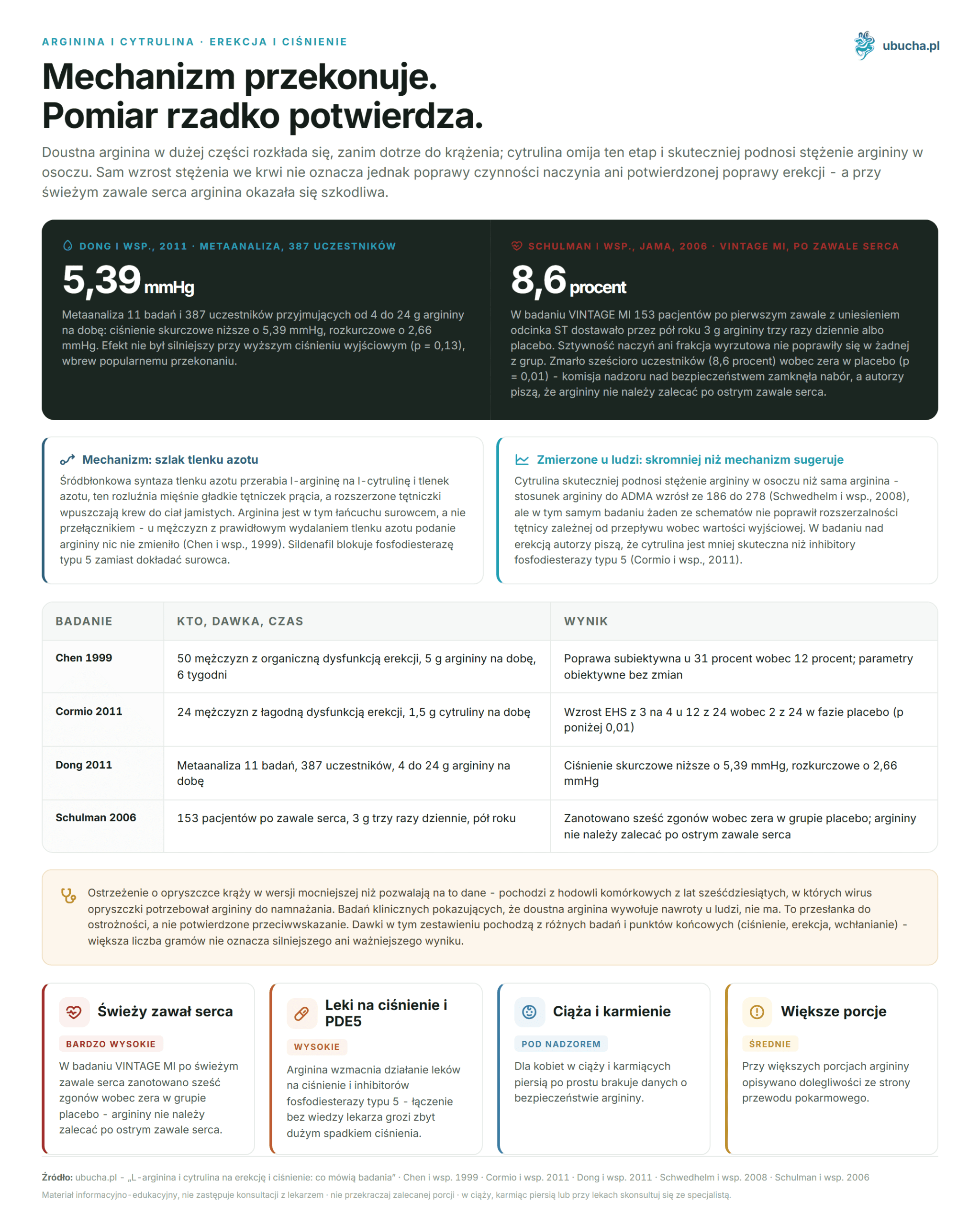
• Meta-analysis of 11 studies with 387 participants: arginine lowered systolic blood pressure by 5.39 mmHg (Dong et al., American Heart Journal, 2011).
• Citrulline raises arginine levels in plasma more effectively than arginine itself, but in the same study did not improve vessel function (Schwedhelm et al., 2008).
• Studies on erection are single and small: 50 and 24 participants.
• After a recent heart attack, arginine was harmful: six deaths compared to none in the placebo group (VINTAGE MI, JAMA 2006).
How does arginine convert to nitric oxide and what does it do for erection?
Erection is a vascular event. Endothelial nitric oxide synthase converts l-arginine to l-citrulline and nitric oxide, which relaxes the smooth muscles of the penile arterioles, allowing blood to flow into the corpora cavernosa. Arginine is a raw material in this chain, not a switch.
The signal continues inside the muscle cell: nitric oxide stimulates guanylate cyclase, increasing cGMP levels, which then relaxes the muscle. Sildenafil and related drugs do not add raw material; they only block phosphodiesterase type 5, the enzyme that breaks down cGMP. The point of action is therefore different and much stronger than simply providing the substrate.
Where does the idea come from that adding arginine will change anything? From the observation that in some men, nitric oxide production is reduced. In Chen’s 1999 study, improvement was reported only by those participants who started with low nitrate and nitrite excretion in urine, which is a marker of poor nitric oxide production. In men with normal baseline results, nothing happened.
This distinction has practical significance. Supplementing the missing raw material may help where there is indeed a deficiency, and it will not help where the problem lies in nerves, hormones, or psychology. Erectile dysfunction has many causes, and none of them disappear with an amino acid. We wrote about another frequently asked question in this area in the text about how cannabidiol affects intimate life.
Why does citrulline raise arginine levels more effectively than arginine itself?
Because it bypasses breakdown in the intestine and liver. Oral arginine first encounters arginase, which breaks it down to ornithine and urea before the amino acid reaches systemic circulation. Citrulline passes this segment intact and only converts to arginine in the kidneys.
The difference was measured by Schwedhelm’s team. Twenty healthy volunteers received in a crossover, double-blind, placebo-controlled design six different dosing schemes of citrulline and arginine, each for a week. Citrulline increased the area under the curve and peak arginine concentration in plasma more than arginine itself, depending on the dose (p below 0.01). At the highest dose of citrulline, the ratio of arginine to ADMA, an endogenous inhibitor of nitric oxide synthase, increased from 186 to 278, and the excretion of nitrates and cGMP in urine also rose (Schwedhelm et al., British Journal of Clinical Pharmacology, 2008).
One caveat from the same study is often overlooked: none of the schemes improved flow-mediated dilation compared to baseline values. The authors observed improvements in biochemical markers, but not in vessel function measured directly. Therefore, higher arginine levels in the blood do not equate to better functioning vessels.
For the reader, this implies one more thing. In sports supplements, citrulline usually appears as citrulline malate in a 2:1 ratio, so the mass of malate stated on the package corresponds to about two-thirds of pure citrulline. Manufacturers sometimes provide one value, sometimes the other, and comparing products without checking which one is being referred to leads to confusion.
What did the studies on erection really show?
Two studies, both small. Chen and colleagues administered 5 g of arginine per day or placebo to 50 men with confirmed organic erectile dysfunction for 6 weeks. Subjective improvement was reported by 9 out of 29 treated (31 percent) and 2 out of 17 in the control group. All objectively measured parameters remained unchanged.
This last sentence weighs more than the percentage: the hemodynamics of the corpora cavernosa did not budge, and the improvement concerned only the participants’ declarations. The authors narrow the conclusion even further: arginine seems to improve sexual function only in men with reduced nitric oxide excretion (Chen et al., BJU International, 1999).
The study on citrulline is even smaller. Cormio and colleagues conducted a single-blind study without randomization: 24 men with mild erectile dysfunction received placebo for a month, followed by 1.5 g of citrulline for another month. Erection hardness was assessed on the EHS scale, not in the IIEF questionnaire. Improvement from 3 to 4 points occurred in 2 out of 24 men in the placebo phase and in 12 out of 24 in the citrulline phase (p below 0.01). The authors themselves state that citrulline is less effective than phosphodiesterase type 5 inhibitors (Cormio et al., Urology, 2011).
| Study | Who and how many | Time and dose in the study | Result |
|---|---|---|---|
| Chen 1999, BJU International | 50 men with organic erectile dysfunction | 6 weeks, 5 g of arginine per day | Subjective improvement in 31 percent vs 12 percent; objective parameters unchanged |
| Cormio 2011, Urology | 24 men with mild erectile dysfunction | Two months, 1.5 g of citrulline per day | EHS increase from 3 to 4 in 12 out of 24 vs 2 out of 24 in placebo phase |
| Dong 2011, American Heart Journal | Meta-analysis of 11 studies, 387 participants | Arginine from 4 to 24 g per day | Systolic blood pressure lower by 5.39 mmHg, diastolic by 2.66 mmHg |
| Schulman 2006, JAMA | 153 patients after the first heart attack with ST elevation | 6 months, 3 g three times a day | No improvement; six deaths vs none in placebo, recruitment closed |
By how much does arginine lower blood pressure?
By about 5 mmHg in systolic value. Dong’s meta-analysis included 11 randomized studies with double-blinding and placebo, totaling 387 participants taking between 4 to 24 g of arginine per day. Systolic blood pressure decreased on average by 5.39 mmHg, and diastolic by 2.66 mmHg.
Sensitivity analyses limited to studies lasting at least four weeks and to participants not taking antihypertensive medications yielded similar results, reinforcing confidence in this number (Dong et al., American Heart Journal, 2011).
The circulating version that the effect is significantly stronger in people with hypertension than in those with normal blood pressure has no support in this work. Meta-regression showed an inverse relationship to baseline systolic blood pressure, but statistically insignificant (p = 0.13). The authors noted this as a suggestion, not a finding.
The mechanism is the same as with erection: nitric oxide dilates peripheral arterioles and reduces vascular resistance. This also leads to the most common interaction. Arginine adds to the effect of blood pressure-lowering medications and phosphodiesterase type 5 inhibitors, so combining them without a doctor’s knowledge risks a drop in blood pressure deeper than anyone planned. A similar question about the effect on blood pressure arises with another amino acid, which we discussed in the text about taurine, performance, and blood pressure.
Who can arginine harm?
Primarily people after a recent heart attack. The VINTAGE MI study involved 153 patients after their first heart attack with ST elevation, who received 3 g of arginine three times a day or placebo for six months. Neither vascular stiffness nor ejection fraction improved in either group.
What matters is what happened outside the main goal of the study. In the arginine group, six participants died (8.6 percent), while no one in the placebo group did (p = 0.01). The safety monitoring board closed recruitment, and the authors stated outright that arginine should not be recommended after an acute heart attack (Schulman et al., JAMA, 2006).
The second risk group is those taking blood pressure medications and phosphodiesterase type 5 inhibitors. The third is pregnant and breastfeeding women, for whom there is simply a lack of safety data. Larger doses of arginine have also been reported to cause gastrointestinal discomfort.
Separately, it is worth organizing the warning about herpes, as it circulates in a stronger version than the data allow. It comes from studies on cell cultures from the 1960s, where the herpes virus needed arginine to replicate. There are no clinical studies showing that oral arginine triggers recurrences in humans. This is a premise for caution, not a confirmed contraindication.
Does citrulline improve training results?
Here, the evidence is stronger than in the topic of erection, although it concerns something different. Pérez-Guisado and Jakeman administered 8 g of citrulline malate or placebo in a crossover double-blind design to 41 men, and then counted repetitions in the bench press.
The advantage grew with each subsequent set: in the last assessed set, the citrulline group performed 52.9 percent more repetitions. Muscle soreness after 24 and 48 hours was reduced by 40 percent. Gastrointestinal discomfort was reported by 14.6 percent of participants (Pérez-Guisado and Jakeman, Journal of Strength and Conditioning Research, 2010).
This is a study about one exercise, one dose, and one day. It says nothing about blood pressure or erection and does not authorize transferring pre-workout doses to other purposes. We described the protocols of sports supplements separately in the text about citrulline malate in pre-workout dosing.
It is worth remembering the ratio mentioned earlier. Eight grams of citrulline malate in a 2:1 ratio is about five grams of pure citrulline, which is more than three times the amount in Cormia’s study on erection. Pre-workout supplements and products from urological studies operate on different orders of magnitude, so transferring numbers between them makes no sense.
Frequently asked questions
Does l-arginine work like sildenafil?
No. Both pathways meet at nitric oxide, but at different points. Sildenafil blocks the enzyme that breaks down cGMP, while arginine merely provides the raw material for nitric oxide production. In the Cormia study, the authors themselves wrote that citrulline is less effective than phosphodiesterase type 5 inhibitors, at least in the short term.
Is citrulline better than arginine?
Yes, for raising blood arginine levels. In Schwedhelm’s study on twenty healthy volunteers, citrulline increased the area under the curve and peak arginine concentration more than arginine itself. However, no scheme improved flow-mediated dilation, so the biochemical benefit did not translate into a measurement of vessel function.
How many people participated in erection studies?
Not many. Chen’s work involved 50 men with organic erectile dysfunction, while Cormia’s work involved 24 men with mild forms. Both were conducted by one center and both based their results on self-assessment by the participants. This is too few to speak of established effects, yet enough to justify further research.
By how much does arginine lower blood pressure?
Dong’s meta-analysis of 11 studies and 387 participants showed a decrease in systolic blood pressure by 5.39 mmHg and diastolic by 2.66 mmHg compared to placebo. Participants took between 4 to 24 g of arginine per day. This effect does not replace hypertension treatment and does not eliminate the need for medical supervision.
Who should avoid arginine?
People after a recent heart attack. In the VINTAGE MI study, six of those taking arginine died, while no one in the placebo group did, leading the safety committee to close recruitment. Caution is also required for those taking blood pressure medications or phosphodiesterase type 5 inhibitors, as well as pregnant and breastfeeding women.
Does arginine worsen herpes?
It is unknown. The premise comes from cell culture studies from the 1960s, where the herpes virus needed arginine to replicate. There are no clinical studies checking whether oral arginine triggers recurrences in humans. People with frequent recurrences may discuss this issue with their doctor before taking the supplement.
Does citrulline help with training?
In one study, yes. Forty-one men performed 52.9 percent more repetitions in the last set of bench press after a single dose of 8 g of citrulline malate, and muscle soreness after one and two days was reduced by 40 percent. Gastrointestinal discomfort was reported by 14.6 percent of participants.
This article is for informational and educational purposes only and does not constitute medical advice. Before starting supplementation, consult your doctor, especially if you are taking medications regularly, are pregnant or breastfeeding, or have chronic illnesses.
Author: Michał Waluk · Published: 2026-08-09 · Updated: 2026-08-16