
Saw palmetto (palma sabałowa) for prostate enlargement: what the studies say
Saw palmetto and symptoms of prostate enlargement. What did the Cochrane 2023 review, STEP and CAMUS studies show, and why the story about underestimating PSA is false.
Saw palmetto is one of the best-studied plants in urology and at the same time one of the most frequently described inconsistently with sources. For years, it was sold as a natural equivalent of finasteride, and then two large public trials were funded for it, among the most carefully designed herbal studies in history. Their results surprised both sides of the dispute. We checked what the latest Cochrane review says, why old and new studies diverge so much, and where the repeated story in Polish internet about underestimating PSA came from. The latter turned out to be false, and in a way that is worth knowing before visiting a urologist. Separately, we explain why the two Latin names of this plant describe one species, and the difference that really divides products on the shelf concerns something completely different.
KEY INFORMATION
• The Cochrane review from 2023 (27 studies, 4656 participants) states that saw palmetto alone provides little or no benefit, with high certainty of evidence (Franco et al., Cochrane Database of Systematic Reviews, 2023).
• Ten of the 27 studies in this review were funded by the pharmaceutical industry.
• Saw palmetto did not lower PSA in either of the two large public trials; in the CAMUS study, the result even slightly increased in both groups.
• Serenoa repens and Sabal serrulata are two names for the same plant, not two raw materials.
Does saw palmetto alleviate symptoms of prostate enlargement?
The current Cochrane review answers that saw palmetto alone provides little or no benefit. It included 27 studies and 4656 participants, of which 19 trials compared the raw material with placebo, and 8 concerned mixtures with other plants. Participants were mainly men over fifty with moderate symptoms (Franco et al., Cochrane, 2023).
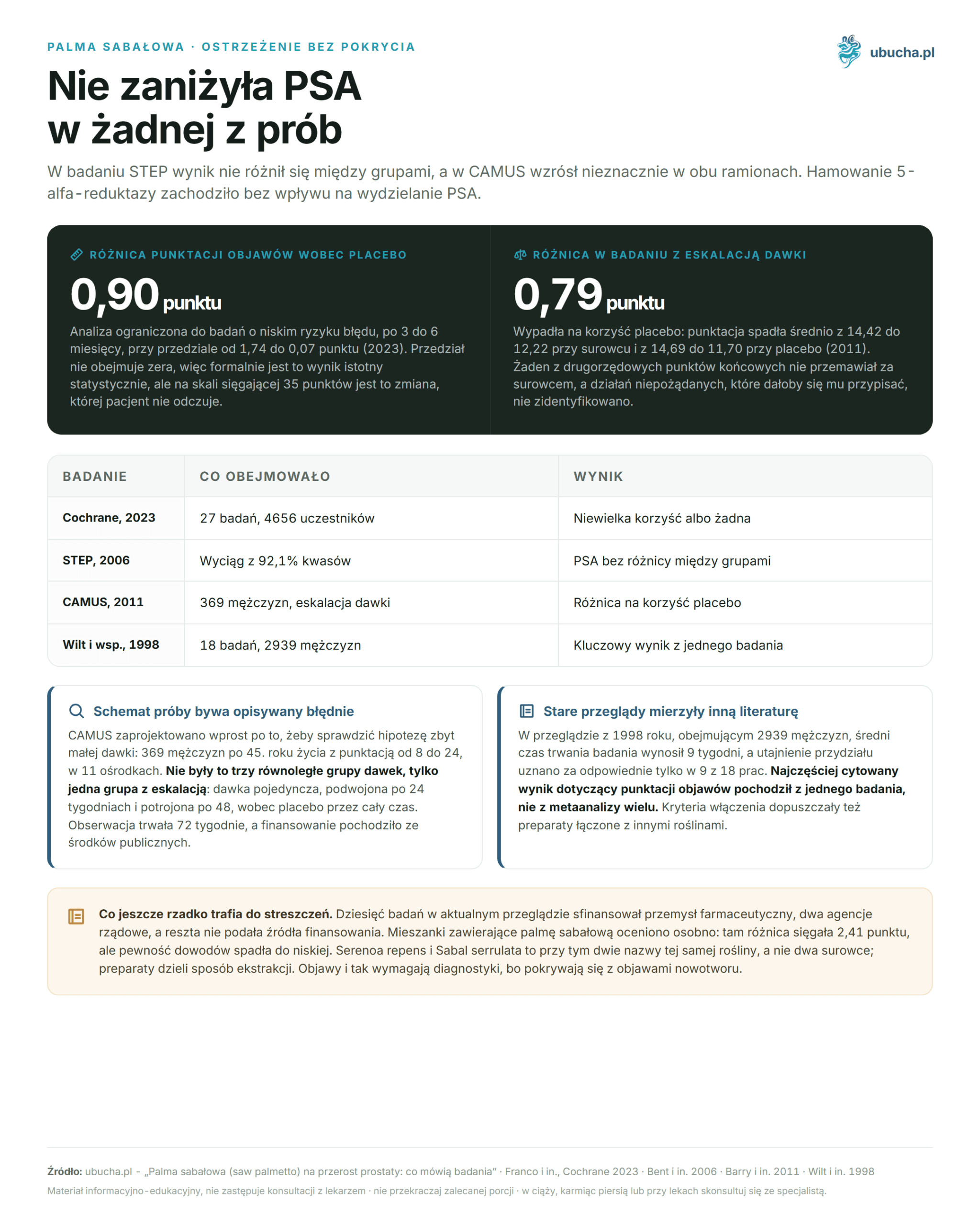
In the analysis limited to studies with low risk of bias, the difference in IPSS scores after 3 to 6 months was 0.90 points in favor of the raw material, with a confidence interval from 1.74 to 0.07 points, all on the same side. The interval does not include zero, so it is formally a statistically significant result, but on a scale reaching 35 points, it is a change that the patient will not feel. The authors directly call it a lack or almost lack of difference and attribute high certainty of evidence to this finding. After a year and longer, the difference was 0.07 points, with the interval including zero.
Two things from this review rarely make it into summaries. Ten studies were funded by the pharmaceutical industry, two by government agencies, and the rest did not provide a source of funding. Mixtures containing saw palmetto were assessed separately: there the difference reached 2.41 points, but the certainty of evidence dropped to low, and the confidence interval was wide. How to read such assessments is explained in the text about how supplements are assessed on the scale of strength of evidence.
Why did earlier reviews perform favorably?
Because they measured different literature. The systematic review from 1998 included 18 randomized studies and 2939 men, and its conclusions were positive: improvement in symptom scores, fewer nighttime urinations, higher peak urine flow (Wilt et al., JAMA, 1998).
However, the details of this work explain why the conclusion did not hold. The average study duration was 9 weeks, with a range from 4 to 48. Blinding was applied in 16 studies, but allocation concealment was deemed adequate in only 9. The result regarding symptom scores, which is the most frequently cited, came from one study, not from a meta-analysis of many. The effect regarding nocturia was gathered from 10 studies, and flow from 8. Inclusion criteria also allowed for preparations combined with other plants, so part of the material did not concern saw palmetto at all.
The authors themselves concluded the work with a caveat that the literature is limited by the short duration of studies and variability of preparations and reporting methods, and that further studies on standardized extracts are needed. This caveat usually fell out of later citations, and only the conclusion remained. Subsequent updates of the Cochrane review, to which new and larger trials were added, lowered this assessment down to today.
What did the STEP study show?
The first major verification was a double-blind trial involving 225 men over the age of 49 with moderate to severe symptoms, conducted over a year. Participants received saw palmetto fruit extract twice daily or placebo.
No significant difference was found in any endpoint. The difference in change in AUASI scores between groups was 0.04 points, with a confidence interval from minus 0.93 to 1.01. For maximum urine flow, the difference was 0.43 ml per minute, with an interval from minus 0.52 to 1.38. The volume of the gland, post-void residual, quality of life, and PSA levels also showed no difference. The frequency of adverse events was similar in both groups (Bent et al., New England Journal of Medicine, 2006).
The study was criticized for the choice of preparation, and this accusation has verifiable content. The report assessing the European Medicines Agency indicates that an extract obtained by supercritical carbon dioxide was used, containing 92.1% fatty acids. The regulator noted that only one well-conducted controlled trial had been published for this type of extract and that the data were insufficient to grant it the status of a product with recognized efficacy. In other words: a preparation was tested that the regulator itself does not recognize as the best documented.
Does a higher dose change the result?
This question was answered by the CAMUS study, designed specifically to test the hypothesis of too low a dose. It involved 369 men over the age of 45 with AUASI scores from 8 to 24, in 11 centers in North America, between June 2008 and October 2010.
The scheme is sometimes incorrectly described as three parallel dose groups. In reality, there was one group with escalation: a single daily dose, then doubled after 24 weeks and tripled after 48, against placebo all the time. The observation lasted 72 weeks. The AUASI score dropped on average from 14.42 to 12.22 with saw palmetto and from 14.69 to 11.70 with placebo. The difference between groups was 0.79 points and favored placebo. None of the secondary endpoints supported the raw material, and no adverse events were identified that could be attributed to it (Barry et al., JAMA, 2011).
The funding for this trial came from public funds: from the American Institute of Diabetes and Digestive and Kidney Diseases, with support from the Center for Complementary Medicine and the Office of Dietary Supplements. The preparation and placebo were provided by the manufacturer, Rottapharm/Madaus. Some researchers declared consulting fees from pharmaceutical companies, which, given the negative result for the supplement, works rather against it than in its favor.
Does saw palmetto interfere with PSA test results?
No, and this is the most frequently repeated mistake in Polish descriptions of this plant. Both large trials measured PSA and found no difference. In the STEP study, PSA levels were listed among parameters without significant change. In the CAMUS study, the average PSA increased from 2.20 to 2.41 with saw palmetto and from 1.93 to 2.07 with placebo, meaning it slightly increased in both groups, with no difference between them.
This is confirmed by the report assessing the European Medicines Agency, which, when describing the inhibition of 5-alpha-reductase in laboratory conditions, notes that it occurred without affecting PSA secretion. The claim of lowering the marker by a few percent has no support in clinical studies or preclinical data, and is the opposite of what was measured.
However, caution is needed here for a completely different reason. Difficulty starting urination, weak stream, and frequent urination accompany both benign enlargement and prostate cancer, and only examination can distinguish them. A normal PSA result does not exclude cancer by itself. European monographs for raw materials used for these symptoms condition their use on the exclusion of serious causes by a doctor. Taking a supplement instead of visiting delays diagnosis, and that is a real risk, not a falsified laboratory result.
What does the European monograph say and why can the names be misleading?
Let’s start with the names, as this is where the most confusion arises. Serenoa repens and Sabal serrulata are two botanical names for the same plant, listed as synonyms in both the European monograph and in Cochrane reviews. A preparation described by one of them is not a different raw material than a preparation described by the other.
The European monograph distinguishes, however, something that disappears in commercial descriptions: the method of extraction. A soft extract obtained with hexane has the status of a product with recognized efficacy for the indication of benign prostatic hyperplasia symptoms. The ethanol extract has only traditional status, and extracts obtained by supercritical carbon dioxide have been deemed insufficiently documented by the regulator. None of the two large public trials studied the hexane extract, and that is a fair boundary of their conclusion (EMA monograph, Sabalis serrulatae fructus).
The monograph also results in two practical notes. The raw material is intended only for adult men and older individuals, with no use in children, adolescents, and women. There have also been isolated suspicions of interactions with warfarin, with an increase in INR, and out of caution, a relevant warning has been placed in the monograph. In our store, saw palmetto is not available in any form; among the raw materials described for these ailments, nettle is available, which we discuss in the text about nettle root for benign prostatic hyperplasia.
Frequently asked questions
Does saw palmetto work for prostate enlargement?
A Cochrane review from 2023, covering 27 studies and 4656 participants, states that saw palmetto alone provides little or no benefit, with high certainty of evidence (Franco et al., Cochrane, 2023). The difference in IPSS scores was 0.90 points on a scale reaching 35.
Does a higher dose of saw palmetto help?
The CAMUS study doubled the dose after 24 weeks and tripled it after 48, observing 369 men over 72 weeks. The difference compared to placebo was 0.79 points AUASI and favored placebo (Barry et al., JAMA, 2011). The argument of too low a dose was checked and was not confirmed.
Does saw palmetto lower PSA and hinder prostate cancer detection?
No. In the STEP study, PSA did not differ between groups, and in CAMUS it slightly increased in both arms. The EMA assessment report notes that the inhibition of 5-alpha-reductase by this raw material occurred without affecting PSA secretion. Symptoms still require diagnostics, as they overlap with cancer symptoms.
What is the difference between Serenoa repens and Sabal serrulata?
Nothing but the name. They are botanical synonyms for the same plant, listed side by side in the European monograph and in Cochrane reviews. The difference that really distinguishes products concerns the method of extraction: hexane, ethanol, and carbon dioxide extracts have different statuses in the monograph.
Why did older studies of saw palmetto perform better?
They were shorter and less well-controlled. In the 1998 review, the average study duration was 9 weeks, allocation concealment was deemed adequate in 9 out of 18 studies, and the most frequently cited result regarding symptom scores came from one study (Wilt et al., JAMA, 1998).
Is saw palmetto safe?
In the Cochrane review, the frequency of adverse events did not differ from placebo, with moderate certainty of evidence. The European monograph notes isolated suspicions of interactions with warfarin and increased INR and restricts use only to adult men and older individuals.
What instead of saw palmetto for lower urinary tract symptoms?
For severe symptoms, elevated PSA, or suspected urinary retention, the answer is a urologist, not switching one supplement for another. Alpha-blockers and 5-alpha-reductase inhibitors have stronger evidence, and the choice depends on gland volume and urinary retention. We gathered more context in the text about supplements for men over forty.
This article is for informational and educational purposes and does not constitute medical advice. Before starting supplementation, consult your doctor, especially if you are taking medications regularly, are pregnant or breastfeeding, or have chronic illnesses.
Author: Michał Waluk · Published: 2026-08-09 · Updated: 2026-08-16