
Astaxanthin: what research really shows (table)
Where did the 6000 times more than vitamin C come from, what the meta-analysis of skin studies showed, and why the measurement in vitro says nothing about action in the body.
Astaxanthin is a red carotenoid from the microalga Haematococcus pluvialis, the same one that colors salmon meat and crustacean shells. In marketing materials, it almost exclusively appears alongside the number: six thousand times stronger than vitamin C, five hundred fifty times than vitamin E. This number is the starting point of this text, because upon checking it at the source, it turns out that it is not found where it is linked, and the comparison that actually exists in the literature has a different order of magnitude and concerns a different vitamin. Similarly, the numbers attributed to studies on skin and performance diverge: sometimes the dose is swapped, sometimes the gender of participants, sometimes the species. Below, three layers are separated: what was measured in vitro, what was checked on humans, and what was not checked at all.
KEY INFORMATION
• The numbers 6000 and 550 are not found in the paper they are linked to (Ambati et al., Marine Drugs, 2014), nor in the extensive review of this substance from 2023.
• Comparisons like “X times stronger” describe a single chemical reaction in vitro and do not transfer to the human body.
• A meta-analysis of human studies showed improvement in hydration and elasticity of the skin, but not a significant reduction in wrinkle depth (Zhou et al., Nutrients, 2021).
• The content of astaxanthin in the dry mass of algae reaches 3.8 percent, not 4 percent.
• The store u Bucha does not have astaxanthin in its offer, in any form and in any category.
Is astaxanthin really the strongest antioxidant?
The answer is: it is unknown, because the question posed this way does not have answers from studies on humans. Comparisons of multiplicity come from in vitro tests, where the speed of one specific reaction is measured, most often the quenching of singlet oxygen, in a specific solvent. The result of such a measurement depends on the conditions and does not indicate what a given molecule does in tissue.
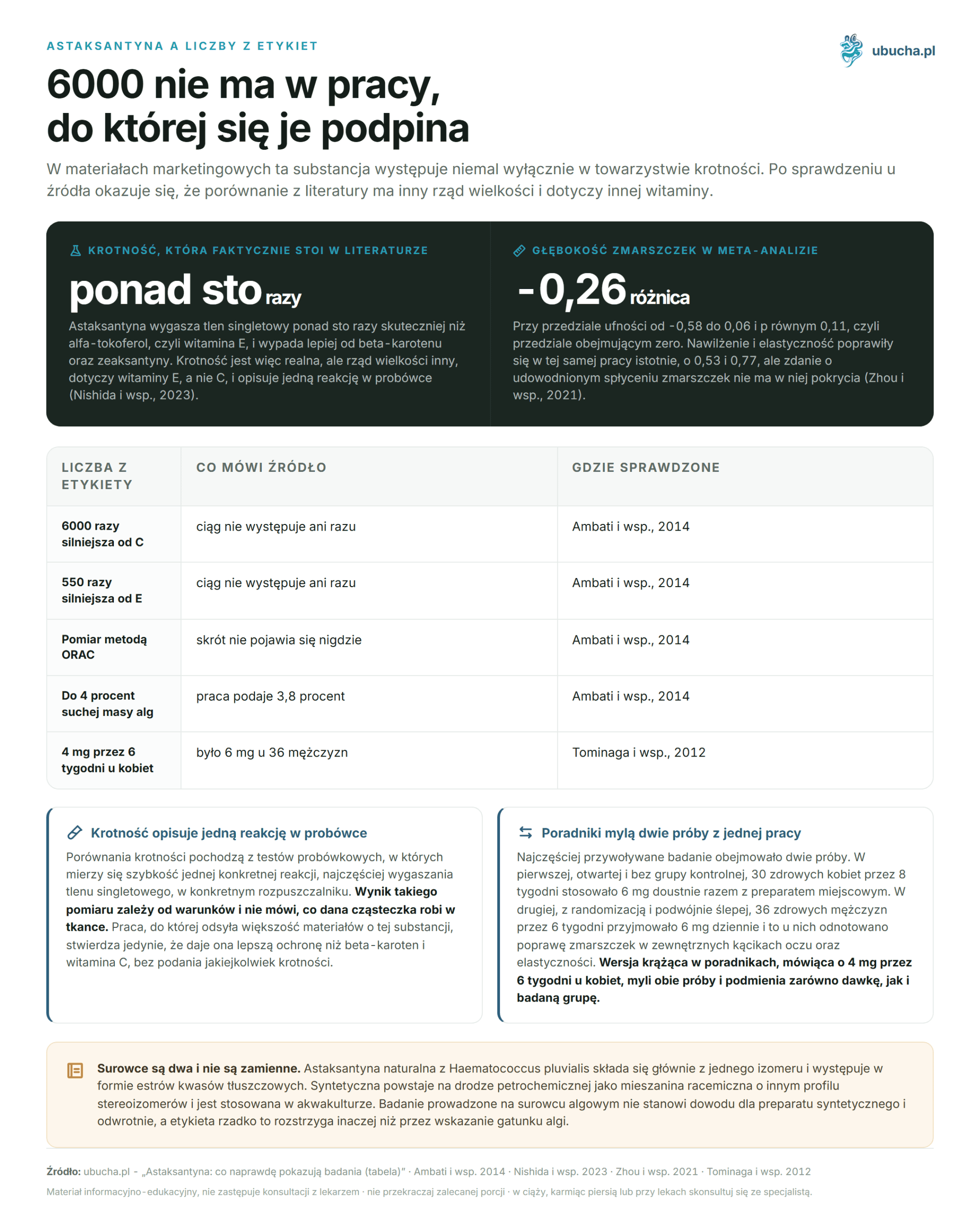
Both numbers can be checked at the source, as the papers are open access in Europe PMC. In the full text of the review to which most materials on astaxanthin refer (Ambati et al., Marine Drugs, 2014), the string “6000” does not appear even once, “550” not once, and the abbreviation ORAC, which is sometimes given as a measurement method, also does not appear anywhere. The paper only states that astaxanthin provides better protection than beta-carotene and vitamin C, without providing multiplicity.
The same check in a much more extensive review from 2023 (Nishida et al., Marine Drugs, 2023) gives the same result for the number 6000. However, there is a comparison that actually comes from the literature: astaxanthin quenches singlet oxygen over one hundred times more effectively than alpha-tocopherol, i.e., vitamin E, and performs better than beta-carotene and zeaxanthin. The review provides a table of rate constants, i.e., laboratory values. The multiplicity is therefore real, but the order of magnitude is different, it concerns vitamin E, not C, and describes one reaction in vitro.
Where does astaxanthin come from and what are its forms?
The microalga Haematococcus pluvialis produces astaxanthin as protection against oxidative stress caused by radiation or nutrient deficiency. Ambati’s review states that under such conditions, the substance accumulates to 3.8 percent of the dry mass of algae, and this same value is repeated in the table of microbiological sources. The commonly cited “up to 4 percent” is an upward rounding of the maximum value, not a reading from the paper.
The form of the substance has practical significance here, as there are two raw materials and they are not interchangeable. Natural astaxanthin from H. pluvialis mainly consists of the 3S,3’S isomer and occurs in the form of fatty acid esters. Synthetic astaxanthin is produced petrochemically as a racemic mixture with a different profile of stereoisomers and is used in aquaculture. A study conducted on algal raw material does not constitute evidence for a synthetic preparation and vice versa, and the label rarely resolves this differently than by indicating the species of the alga.
The molecule is lipophilic and incorporates into cell membranes. Its described feature is the orientation across the lipid bilayer, causing one end to reach the outer surface and the other the inner surface. This leads to the explanation of why absorption increases after a meal containing fat. This is consistent with what is known about lipophilic carotenoids for a long time.
What have studies shown about astaxanthin on the skin?
This is the best-studied application and at the same time a place where the result is often presented more broadly than it turned out. The decisive meta-analysis from 2021 (Zhou et al., Nutrients, 2021) included eleven studies: nine with randomization, assessing oral administration, and two open studies concerning topical and mixed use.
The results spread across three pages, and this is the most important thing here. Hydration improved significantly, with a standardized mean difference of 0.53 with a confidence interval from 0.05 to 1.01 and p equal to 0.03. Elasticity improved significantly, with a difference of 0.77, an interval from 0.19 to 1.35 and p equal to 0.009. However, the depth of wrinkles did not significantly decrease: the difference was -0.26 with an interval from -0.58 to 0.06 and p equal to 0.11, meaning the confidence interval includes zero. Therefore, the statement about proven reduction of wrinkles has no support in this meta-analysis, although hydration and elasticity do.
The most frequently cited single study (Tominaga et al., Acta Biochimica Polonica, 2012) included two trials. In the first, open and without a control group, 30 healthy women used 6 mg orally together with a topical preparation for 8 weeks. In the second, with randomization and double-blind, 36 healthy men took 6 mg daily for 6 weeks, and it was in them that improvement in wrinkles in the outer corners of the eyes and elasticity was noted. The version circulating in guides, stating 4 mg for 6 weeks in women over forty, confuses both trials and swaps both the dose and the studied group.
What do studies show about astaxanthin in sports?
Here the basis is much thinner, and the most frequently cited number comes from a study on animals. The paper to which guides refer (Ikeuchi et al., Biological and Pharmaceutical Bulletin, 2006) involved male mice aged four weeks, who were given 1.2, 6, or 30 mg per kilogram of body weight orally for five weeks.
The groups receiving astaxanthin swam significantly longer to exhaustion, and the lactate concentration in their blood was significantly lower than in the control group. The authors explain this by increased utilization of fatty acids as an energy source. However, the summary does not provide any percentage value for the extension of time, particularly the stated 8.8 percent. There is also no conversion to a human dose, and simply dividing milligrams by kilograms is not such a conversion.
It is worth noting what the substitution here consists of. The result concerning lactate comes from this study on mice, and in guides, it is sometimes attributed to a supposed trial on humans with a cycling test lasting six months. No studies with such a description could be found, and the author and year that are sometimes signed lead to a paper on a completely different subject: the effect of astaxanthin on the oxidation of phospholipids in red blood cells (Nakagawa et al., British Journal of Nutrition, 2011). That study involved 30 people of middle and older age for 12 weeks and did not measure either lactate or performance.
What doses were used in studies on astaxanthin?
The table below shows what was given to whom in the studies described above, not how much the reader should take. The difference is fundamental, as the populations of these studies are narrow and none were designed to establish a dose for a healthy person.
| Study | Who and how many | How much was given | How long | What came out |
|---|---|---|---|---|
| Zhou 2021 (meta-analysis) | 11 studies, including 9 with randomization | orally, variable doses | depending on the study | hydration and elasticity significantly better; wrinkles without significant difference |
| Tominaga 2012, open trial | 30 healthy women | 6 mg orally plus topical preparation | 8 weeks | improvement in several skin parameters, but without a control group |
| Tominaga 2012, placebo trial | 36 healthy men | 6 mg daily | 6 weeks | improvement in wrinkles in the corners of the eyes and elasticity |
| Nakagawa 2011 | 30 people of middle and older age | 6 or 12 mg daily | 12 weeks | less hydroperoxides in red blood cells |
| Ikeuchi 2006 | mice, males | 1.2, 6 or 30 mg per kg body weight | 5 weeks | longer swimming to exhaustion, lower lactate |
This table shows two things. First, the doses in human studies are surprisingly consistent and amount to 6 or 12 mg daily, not the wide range that circulates in guides. Second, in human studies, the observation time was nowhere shorter than six weeks, so assessment after two or three weeks has no support in any of these works.
What to combine astaxanthin with and what to watch out for?
The rationale for combining antioxidants of different solubility is biochemical, not clinical, and should be read as such. Astaxanthin works in the lipid environment of membranes, vitamin C in the aqueous environment, and vitamin E at the boundary of both. However, no study has tested such a set as a whole in humans for an endpoint significant for health, so we are talking about complementary mechanisms, not a studied combination. The same applies to resveratrol.
Caution with anticoagulant medications is sometimes given as a warning specific to astaxanthin, and no clinical studies on humans have been found to support this. A more honest formulation is general: if you are taking warfarin, clopidogrel, or another medication affecting coagulation, report any new supplement to your doctor. This applies to carotenoids just as it does to the rest.
Carotenoids taken in large amounts can color the skin yellowish or orange. At the doses from the studies described above, this phenomenon is not observed, and the threshold above which it is described is clearly higher. Separately, it is worth noting what is missing in this area: there is no study directly comparing an oil capsule with a dry powder in the same participants, so statements about one form having several times the advantage over the other are conclusions from the general properties of carotenoids, not readings from measurement.
Frequently asked questions
Is astaxanthin 6000 times stronger than vitamin C?
This number is not found in the paper it is linked to, nor in the extensive review from 2023. The literature provides a different comparison: over a hundred times more effective quenching of singlet oxygen than by vitamin E. This is a laboratory measurement of a single reaction, not a property of the body.
Does astaxanthin smooth wrinkles?
A meta-analysis of eleven studies from 2021 showed a significant improvement in skin hydration and elasticity, but for wrinkle depth, the difference was not significant, with p equal to 0.11. Individual studies with 6 mg daily noted improvement in the corners of the eyes.
What doses were used in human studies?
Most often 6 mg or 12 mg daily, for 6 to 12 weeks, in groups of several dozen people. These numbers describe what was given to participants in specific studies. Discuss the dosage for yourself with a doctor or pharmacist, especially when taking medications regularly.
What is the difference between natural and synthetic astaxanthin?
Natural comes from the microalga Haematococcus pluvialis and consists mainly of the 3S,3’S isomer in the form of esters. Synthetic is produced petrochemically as a racemic mixture with a different profile of stereoisomers and is used in aquaculture. These are two different raw materials, so studying one does not support claims about the other.
Should astaxanthin be taken with fat?
Yes, it is lipophilic and incorporates into lipid membranes, so the presence of fat in the meal is more important for absorption than the time of day. However, there is no study directly comparing an oil capsule with a dry powder in the same participants.
Does the store u Bucha have astaxanthin?
No. We reviewed all items in the offer and astaxanthin is not present in any of them, neither alone nor as an ingredient in a mixture. Status as of August 16, 2026. In the supplements category, you will find other antioxidants, including vitamin C.
Since astaxanthin is not available in the offer, we do not direct you to any category with the promise of its purchase. If you are looking for antioxidants with better-described effects on the skin and vessels, check out the texts on alpha-lipoic acid and pycnogenol from pine bark. The topic of post-workout regeneration is further developed in the article CBD for athletes.
This article is for informational and educational purposes and does not constitute medical advice. Before starting supplementation, consult your doctor, especially if you are taking medications regularly, are pregnant or breastfeeding, or have a chronic illness.
Author: Michał Waluk · Published: 2026-08-09 · Updated: 2026-08-16