
CBD as an antipsychotic compound: raising anandamide instead of blocking dopamine
CBD in schizophrenia: what the Leweke 2012 and McGuire 2018 studies showed, how the inhibition of anandamide breakdown works, and why it is not a substitute for treatment.
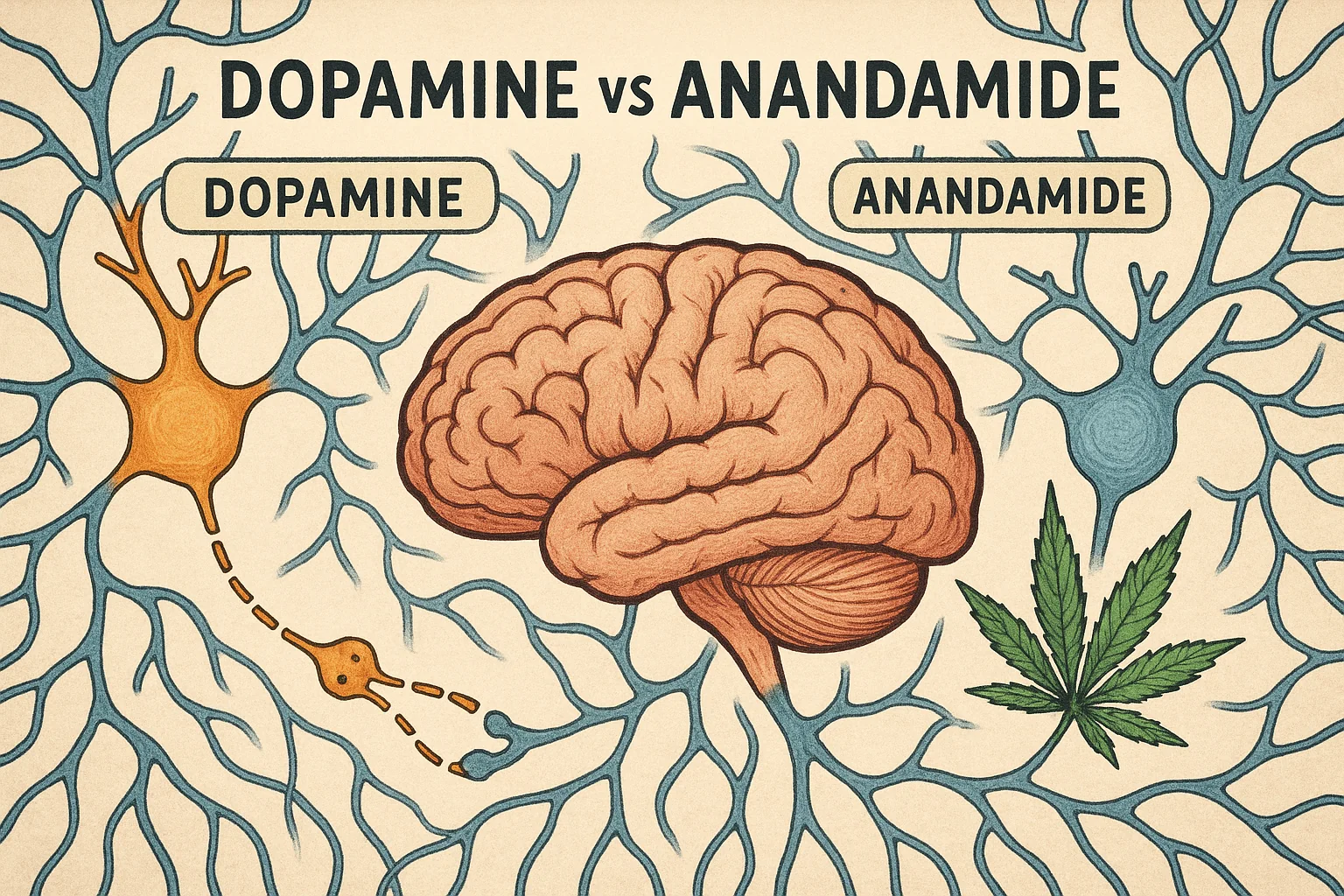
Antipsychotic drugs block D2 dopamine receptors. They effectively suppress positive symptoms but at the cost of extrapyramidal symptoms, weight gain, and increased prolactin. Cannabidiol works differently: it does not stimulate cannabinoid receptors but moderately inhibits the breakdown of anandamide, an endocannabinoid produced by the body. In the randomized study by Leweke et al., it was directly compared to amisulpride in patients with acute schizophrenia. Both therapies resulted in significant improvement, and cannabidiol performed clearly better in terms of side effects. This article describes what exactly was measured in this and the subsequent study and where the limits of these conclusions lie. The doses provided further come from clinical trial protocols and serve to describe these studies. They are not recommendations for the reader, and the treatment of schizophrenia is conducted solely by a psychiatrist.
KEY INFORMATION
• Cannabidiol does not activate cannabinoid receptors but moderately inhibits the breakdown of anandamide (Leweke et al., Translational Psychiatry 2012).
• In a randomized study of 42 patients with acute schizophrenia, cannabidiol and amisulpride resulted in significant clinical improvement, with cannabidiol having a clearly more favorable side effect profile.
• The increase in anandamide concentration was measured in serum, not in cerebrospinal fluid, and was significantly associated with clinical improvement.
• In the McGuire et al. study, cannabidiol was administered at a dose of 1000 mg per day as an adjunct to treatment in 88 patients; improvement in positive symptoms was significant, while improvement in cognitive functions did not reach statistical significance.
• The safety of cannabidiol cannot be established in individuals under 25 years of age, in pregnant and breastfeeding women, and in those taking medications (EFSA, 2026).
How do classic antipsychotic drugs work?
They work by blocking the D2 dopamine receptor and differ more in side effects than in efficacy. The network meta-analysis by Leucht et al. included 212 randomized studies and data from 43,049 participants, comparing 15 antipsychotic drugs with placebo (Leucht et al., Lancet 2013). All drugs were found to be significantly more effective than placebo.
The range of efficacy was moderate: the standardized mean difference ranged from 0.88 for clozapine and 0.66 for amisulpride to 0.33 for lurasidone and iloperidone. The range of side effects, however, was very large. The odds ratio for extrapyramidal symptoms compared to placebo ranged from 0.30 for clozapine to 4.76 for haloperidol, and the differences in weight gain ranged from haloperidol as the best drug to olanzapine as the worst.
The authors draw a conclusion that changes the way we think about this group of drugs. The division into first and second-generation drugs does not correspond to the data, as hierarchies in individual domains are arranged differently. The choice of drug is therefore a matter of matching the side effect profile to the specific patient, rather than reaching for a newer generation.
What is the anandamide hypothesis?
It posits that anandamide signaling acts as an endogenous brake against psychosis. The authors of the 2012 study summarize their earlier findings: elevated anandamide levels in cerebrospinal fluid correlated inversely with the severity of psychotic symptoms, and enhanced anandamide signaling was associated with a lower rate of transitions from prodromal state to full-blown psychosis and with a delay of that transition (Leweke et al., Translational Psychiatry 2012).
Cannabidiol fits into this picture through its chemical property, not through receptor affinity. It does not activate cannabinoid receptors but moderately inhibits the breakdown of anandamide, leading to an increase in its concentration. If anandamide indeed has a protective effect, then raising its level should translate into alleviation of symptoms.
However, it is necessary to separate two things that blend into one in popular discussions. Measurements in cerebrospinal fluid come from earlier work by this team, referenced in the 2012 study as background. The randomized study itself measured anandamide in blood serum, at the beginning, on the fourteenth, and on the twenty-eighth day. More about the molecule itself is discussed in the text about anandamide as the endocannabinoid responsible for the feeling of bliss.
What did the Leweke study in 2012 show?
The study included 42 patients hospitalized due to acute schizophrenia, of which 39 were evaluated in an intention-to-treat analysis, and 33 according to protocol. Both substances, cannabidiol and amisulpride, were started at 200 mg per day and gradually increased to 800 mg per day administered in four doses; after the second week, a reduction to 600 mg per day was allowed due to side effects. Treatment lasted four weeks.
The result was dual. Both therapies were found to be safe and led to significant clinical improvement, with no significant difference between the arms. Cannabidiol had a clearly more favorable side effect profile: fewer extrapyramidal symptoms, less weight gain, and lower prolactin increase. Treatment with cannabidiol was accompanied by a significant increase in anandamide concentration in serum, and this increase was significantly associated with clinical improvement.
| Feature | Antipsychotic drugs | Cannabidiol |
|---|---|---|
| Point of action | blocking D2 dopamine receptor | inhibiting the breakdown of anandamide |
| Evidence of efficacy | 212 randomized studies, 43,049 participants | two randomized studies, a total of 130 participants |
| Extrapyramidal symptoms | odds ratio compared to placebo from 0.30 to 4.76 depending on the drug | less frequent than with amisulpride in a four-week study |
| Weight gain | from haloperidol as the best to olanzapine as the worst | less than with amisulpride |
| Status | drugs approved for use | no registration for psychiatric indication |
What did the McGuire study in 2018 add?
It examined cannabidiol not as a substitute but as a drug added to existing treatment. In a randomized, double-blind study, patients with schizophrenia were assigned in a one-to-one ratio to receive cannabidiol at a dose of 1000 mg per day (43 individuals) or placebo (45 individuals), alongside their existing antipsychotic medication (McGuire et al., American Journal of Psychiatry 2018).
After six weeks, the group receiving cannabidiol had lower severity of positive psychotic symptoms, with a difference in the PANSS scale of minus 1.4 with a 95 percent confidence interval from minus 2.5 to minus 0.2. The treating physicians more often rated these patients as improved and as not being in a severe state. Cannabidiol was well tolerated, and the frequency of side effects was similar in both groups.
Two things in this work are as important as the result itself. Improvement in cognitive function tests and in the overall functioning scale occurred, but did not reach statistical significance, so the claim of improvement in memory or concentration is not supported here. The second thing is the dose scale. One thousand milligrams per day is a size from a clinical trial, not comparable to the content of typical over-the-counter preparations, and is not a recommendation for the reader.
Does CBD reduce the risk of psychosis after cannabis?
Data suggest such a direction, but only in part of the studied group. Morgan et al. examined 120 cannabis users, including 66 daily and 54 occasional users, and assigned them to groups based on hair analysis detecting the presence of cannabidiol and high or low levels of tetrahydrocannabinol (Morgan et al., Psychological Medicine 2012).
Individuals in whom cannabidiol was detected had lower severity of psychotic-like symptoms than those without it. However, the authors clearly note that this effect occurred only in occasional users, whose levels of tetrahydrocannabinol in hair were higher. There was no difference in daily users.
The rest of the results concern the harms associated with tetrahydrocannabinol itself. Higher levels of it in hair were associated with increased depression and anxiety, and in daily users with poorer text recall and worse source memory. Recognition was better in individuals with detected cannabidiol. The authors cautiously conclude: cannabidiol alleviates the psychotic-like effects of cannabis in occasional users, while strains completely devoid of it raise concerns.
What do these studies not resolve?
They do not resolve whether cannabidiol is suitable for treating schizophrenia, as both randomized studies are small. Forty-two and eighty-eight patients are sufficient numbers to formulate a hypothesis, but not to change clinical practice. The authors of the 2018 study themselves describe it as exploratory, and the difference in the PANSS scale was 1.4 points, with the lower limit of the confidence interval reaching 0.2 points.
They also do not resolve the question of the safety of combining. The opinion of the European Food Safety Authority states that the safety of cannabidiol cannot be established in individuals under 25 years of age, in pregnant and breastfeeding women, and in those taking medications (EFSA, 2026). A person receiving psychiatric treatment belongs to the last of these groups, which in itself closes the topic of independently adding the product to therapy.
However, there remains a conclusion that the authors of the 2018 study state directly and which concerns the mechanism. Since the action of cannabidiol does not seem to depend on antagonism against the dopamine receptor, it may represent a new class of treatment for this disorder. This hypothesis requires larger and longer studies. The related mechanism is described more broadly in the text about inhibiting the FAAH enzyme and raising anandamide levels in the brain, and we have gathered a review of the clinical studies in the text about CBD in schizophrenia.
Frequently asked questions
How does cannabidiol work differently than antipsychotic drugs?
Antipsychotic drugs block the D2 dopamine receptor. Cannabidiol does not activate cannabinoid receptors and does not block D2, but moderately inhibits the breakdown of anandamide, leading to an increase in its concentration. The authors of the 2018 study consider this difference in mechanism to be the reason why cannabidiol may represent a new class of treatment.
Did cannabidiol perform better than amisulpride?
Not in terms of efficacy. In a study involving 42 patients with acute schizophrenia, both therapies were safe and resulted in significant clinical improvement, with no significant difference between them. However, cannabidiol had a clearly more favorable side effect profile: fewer extrapyramidal symptoms, less weight gain, and lower prolactin increase.
Where was the increase in anandamide level measured?
In the blood serum, at the beginning of the study and on the fourteenth and twenty-eighth days. Measurements in cerebrospinal fluid come from earlier work by the same team, referenced in the 2012 study as background. The increase in anandamide concentration in serum was significantly associated with clinical improvement.
What dose of cannabidiol was administered in the McGuire study?
One thousand milligrams per day as an adjunct to existing antipsychotic treatment, for six weeks, in 43 individuals compared to 45 receiving placebo. This is the dose from the clinical trial protocol, not a recommendation for the reader. The choice of treatment in schizophrenia is solely up to the treating psychiatrist.
Did cannabidiol improve cognitive functions?
Improvement occurred, but did not reach statistical significance. In the McGuire et al. study, the difference in the cognitive function test was 1.31 with a confidence interval including zero, similar to the difference in the overall functioning scale. The claim of improvement in memory or concentration is not supported in this work.
Can cannabidiol be added to one’s own psychiatric treatment?
Not on its own. The opinion of the European Food Safety Authority states that the safety of cannabidiol cannot be established in individuals taking medications, as well as in those under 25 years of age and in pregnant and breastfeeding women. The decision is made by the treating psychiatrist.
This article is for informational and educational purposes and does not replace consultation with a physician. If you are pregnant, breastfeeding, taking medications, or have chronic conditions, consult the use of supplements or herbs with a specialist.
Author: Michał Waluk · Published: 2026-08-09 · Updated: 2026-08-11