
CBD Hemp Ointment: What It Helps With, How to Use It, and Does It Work
What studies have shown about CBD applied to the skin, where the evidence ends, and how to read the composition of hemp ointment. No promises that the literature does not confirm.
CBD hemp ointment promises relief from joint and muscle pain without affecting the entire body. The promise sounds reasonable, as the skin indeed has its own cannabinoid receptors, and the topically applied product bypasses the stomach and liver. The trouble begins with the question of what has been demonstrated. The most frequently cited study concerns rats, the only large double-blind trial in humans yielded a negative result, and most numbers circulating in product descriptions do not come from any scientific work. This text separates these layers: what the mechanism shows, what studies show, and what this means for someone standing in front of a shelf with a hemp product for a painful knee.
KEY INFORMATION
• The skin has its own endocannabinoid system regulating cell proliferation, inflammation, and local immunity (Bíró et al., Trends in Pharmacological Sciences, 2009).
• CBD gel reduced joint swelling and pain symptoms in rats with knee joint inflammation, with CBD being measurable in plasma, and its concentration increasing linearly with the dose (Hammell et al., European Journal of Pain, 2016).
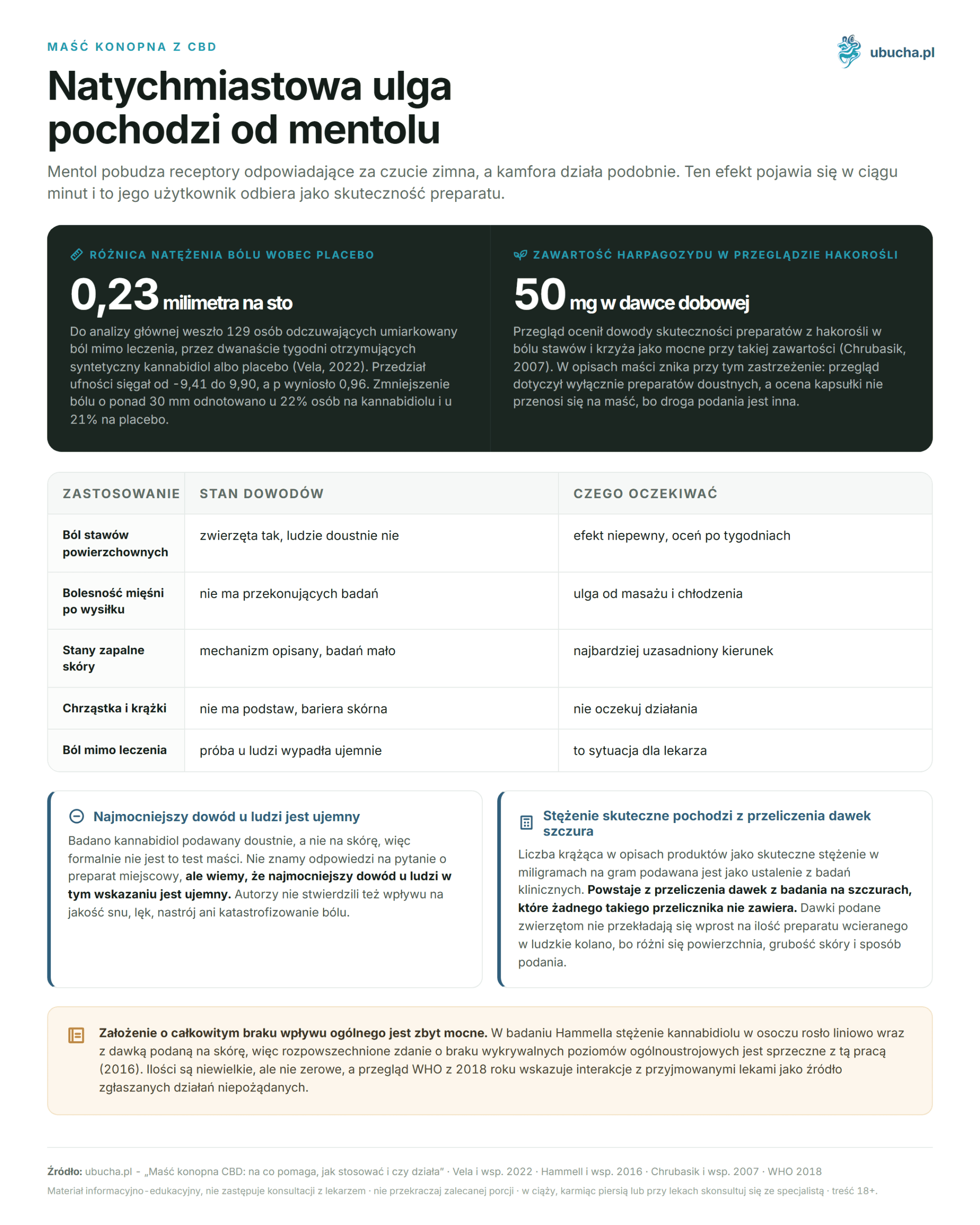
• The only large trial in humans did not show an advantage of CBD over placebo: the difference in pain intensity was 0.23 mm with p = 0.96 (Vela et al., Pain, 2022).
• The WHO considers CBD to be well-tolerated and without signs of addictive potential, while also indicating interactions with medications as a source of adverse effects.
• In cases of pain persisting despite treatment, the decision lies with the doctor, not the product from the shelf.
How does CBD hemp ointment work on the skin?
Through receptors that the skin has on its own. It is not necessary to assume that CBD reaches the blood to explain its local action: the endocannabinoid system exists in the skin itself and regulates processes that become uncontrolled in inflammatory conditions.
This was described by Bíró and colleagues in a review in Trends in Pharmacological Sciences. According to this work, the primary role of the skin’s endocannabinoid system is to maintain balance in the life cycle of skin cells, from their proliferation to maturation, as well as regulating local immunity. Disruption of this balance is associated with the development of skin diseases, including acne, seborrhea, allergic dermatitis, and psoriasis (Bíró et al., 2009). This is a well-documented mechanistic basis and is not disputed.
The second described point of action is the TRPV1 vanilloid receptors, the same ones that capsaicin from peppers acts on. Costa and colleagues demonstrated in the British Journal of Pharmacology that the analgesic effect of CBD in rats with acute inflammation is abolished by capsazepine, a substance that blocks TRPV1, while blocking CB1 and CB2 receptors did not change this effect (Costa et al., 2004). It is worth noting the limitation of this evidence, as it can be stretched: CBD was administered systemically, not topically, so the work speaks about the mechanism of action of the substance, not the effectiveness of the ointment.
What did the Hammell 2016 study really show?
Less and something different than is attributed to it. This study involved rats with induced knee joint inflammation, and its most frequently repeated conclusion, that CBD does not penetrate the blood, is the opposite of what the authors wrote.
The animals were given CBD gel in four daily doses: 0.6, 3.1, 6.2, and 62.3 mg, for four consecutive days after inducing inflammation. The two higher doses proved effective. They reduced joint circumference, inflammatory cell infiltration, and thickening of the synovial membrane, improved the assessment of limb positioning treated as a measure of spontaneous pain, and in the spinal cord and spinal ganglia reduced pro-inflammatory markers depending on the dose. Pain sensitivity was assessed by the time of paw withdrawal in response to a thermal stimulus, not by a mechanical test, as some summaries state. The exploratory behaviors of the animals did not change, which the authors interpret as a lack of effect on the central nervous system (Hammell et al., European Journal of Pain, 2016).
However, the most important clarification concerns plasma. The authors measured the concentration of CBD in the blood and found a linear increase in the range of doses from 0.6 to 6.2 mg per day. Therefore, CBD penetrated into circulation, rather than remaining solely in the tissue. The statement about “purely local action, without detectable systemic levels” circulates in product descriptions, but does not come from this work and contradicts it. This has practical significance: since the substance reaches the blood, the argument that a topical product does not interact with medications by definition is no longer certain. We have developed the difference between local action and absorption into the blood in the text about ointment vs transdermal patch.
What did the double-blind trial in humans show?
A negative result, and this must be stated clearly. The largest controlled trial to date on CBD in joint pain did not show an advantage over placebo. It is worth knowing about it, as promotional materials usually cite observations without a control group, which say much less.
Vela and colleagues randomly assigned 136 patients with osteoarthritis of the hands or psoriatic arthritis, experiencing moderate pain despite treatment. A total of 129 individuals were included in the main analysis. For twelve weeks, they received synthetic CBD or placebo. The difference in pain intensity between the groups after twelve weeks was 0.23 mm on a hundred-millimeter scale, with a confidence interval from -9.41 to 9.90 and a p-value of 0.96. A reduction in pain of over 30 mm was recorded in 22% of those receiving CBD and 21% receiving placebo. The authors also found no impact on sleep quality, anxiety, mood, or catastrophizing pain (Vela et al., Pain, 2022).
It should be noted what this trial does not resolve. CBD was administered orally, not topically, so formally it is not a test of the ointment. Therefore, we do not know the answer to the question about topical preparations, but we do know that the strongest evidence in humans for this indication is negative. Anyone claiming otherwise should point to the work, not an opinion.
What can hemp ointment help with, and what can it not?
A reasonable range of expectations is defined by two boundaries: the depth to which the substance actually reaches and the strength of evidence for a given indication. The following table organizes both without smoothing.
| Application | State of Evidence | What to Expect |
|---|---|---|
| Superficial joint pain | Positive animal study, negative trial in humans with oral CBD | Effect uncertain, worth evaluating independently after a few weeks |
| Muscle soreness after exercise | No convincing studies, anecdotal reports | Relief may come from massage and cooling ingredients |
| Skin inflammations | Mechanism well described, few clinical studies | Most justified direction, requires dermatologist evaluation |
| Deep structures: cartilage, intervertebral discs | No basis, skin barrier limits penetration | Do not expect action, this is beyond the reach of the product |
The practical conclusion is therefore cautious. CBD hemp ointment has the strongest justification where the problem lies superficially, that is, in the skin itself. The deeper the structure, the weaker the basis for expecting an effect. A detailed discussion of skin applications has been gathered in the text about hemp ointment for eczema and skin itching. In cases of pain that persists despite treatment, a product from the shelf does not replace diagnostics: joint pain lasting for weeks, swelling with redness and fever, or pain after an injury with limited mobility are situations for a doctor.
How to use CBD hemp ointment?
The method of application changes the effect more than the packaging suggests, and most recommendations boil down to four steps, none of which require measuring milligrams.
- Start with an allergy test. Apply a small amount to the inner side of your wrist and wait a day. Beeswax, lanolin, and essential oils are more likely to cause allergies than CBD itself, and the term \”natural\” guarantees nothing here.
- Apply to clean, dry skin, without previously used lotion. A layer of fat from another cosmetic limits the contact of the product with the skin.
- Massage for a minute or two. Massage improves local circulation and is the part of the treatment that works independently of the product’s composition.
- Use regularly for at least two weeks before assessing effectiveness. A single application does not provide a basis for any conclusion.
The product should not be applied to open wounds, cracked skin, or areas with active infections. During pregnancy, while breastfeeding, and when taking anticoagulants, leave the decision to the doctor. This has additional justification following Hammell’s findings: since CBD from the product applied to the skin can be measurable in the blood, the assumption of a complete lack of systemic influence is too strong.
How to evaluate the composition of hemp ointment?
By what is in the composition and in what order, not by the number on the front of the package. There is no confirmed concentration of CBD that guarantees the effectiveness of a topical preparation, so any stated threshold value is a calculation from the seller, not a conclusion from the literature.
It is worth knowing the origin of the number that circulates in product descriptions as \”effective concentration\” in milligrams per gram. It is presented as a determination from clinical studies, while it arises from converting doses from a study on rats, which contains no such conversion. The doses given to animals do not directly translate to the amount of product rubbed into a human knee, as the surface area, skin thickness, and method of administration differ.
So what to check. The manufacturer should provide the CBD content numerically, not just the term \”hemp extract\”, and should provide a certificate of analysis. Since the ingredients on the INCI list are listed in descending order by concentration, the position of the extract at the end of the list says more than the advertising slogan at the front. It is also worth knowing that in stores, hemp products for muscles and joints most often appear as massage gels, not as ointments in the strict sense: ointment has a fat base and occludes the skin more, while gel evaporates and provides a cooling effect. This is a difference in the carrier, not in the CBD itself.
What else is found in hemp ointments?
Usually ingredients with their own well-known effects, and they often account for the noticeable effect. It is worth knowing them, as they help understand why the product \”works\” immediately, even though CBD itself would act slowly.
Menthol stimulates TRPM8 receptors responsible for the sensation of cold, which gives an immediate feeling of coolness and temporarily distracts from pain. Camphor works similarly. This effect appears within minutes and is what the user perceives as the effectiveness of the product, regardless of the CBD content. Arnica montana contains helenalin with anti-inflammatory action, and essential oils, such as rosemary or eucalyptus, serve a dual role: they have their own anti-inflammatory action and facilitate the penetration of lipophilic substances through the epidermis. We have gathered a comparison of these ingredients separately in the text about menthol, arnica, and capsaicin in muscle pain ointments.
Separately stands devil’s claw, or harpagophytum procumbens. A review by Chrubasik and colleagues in Phytotherapy Research assessed the evidence of the effectiveness of devil’s claw preparations in joint and back pain as strong, with a content of over 50 mg of harpagoside in the daily dose (Chrubasik et al., 2007). However, it should be added that this review concerned only oral preparations. The assessment of the effectiveness of devil’s claw taken in a capsule does not transfer to devil’s claw in ointment, as the route of administration is different.
Summary: what to expect from hemp ointment
The mechanistic basis is real. The skin has its own endocannabinoid system, CBD has described points of action in it, and a study on animals showed a reduction in joint inflammation when applied to the skin. At this level, the topic is not a marketing gimmick.
However, the layer of evidence in humans is significantly weaker than the market suggests. The largest controlled trial did not show an advantage of CBD over placebo in joint pain, and there are few studies on topical preparations in humans. An honest summary is therefore as follows: CBD hemp ointment is a product with low risk and uncertain effectiveness, which is worth evaluating independently after a few weeks of regular use, without expecting an effect comparable to treatment. The WHO in a 2018 review recognized CBD as well-tolerated and showing no signs of addictive potential, while also noting that reported adverse effects may result from interactions with medications (WHO, Cannabidiol Critical Review Report, 2018). This caution applies to anyone who is on long-term treatment. If after a few weeks you see no difference, do not increase the amount of the product or the frequency: a lack of response to a topical product usually means that the source of pain lies deeper than anything applied to the skin, and that it is time for diagnostics.
Frequently Asked Questions
What does CBD hemp ointment help with?
The strongest justification is its use for skin ailments, as the substance actually reaches there. For joint pain, the evidence is ambiguous: a study on rats showed a reduction in joint inflammation after applying CBD gel, but a controlled trial in humans with oral CBD did not show an advantage over placebo.
How much CBD should an effective hemp ointment contain?
There is no confirmed concentration threshold for topical preparations, so the values given in advertisements have no basis in the literature. However, check whether the manufacturer provides the CBD content numerically and whether they offer a certificate of analysis, as the term \”hemp extract\” means nothing on its own.
Does CBD hemp ointment enter the bloodstream?
Partially yes. In Hammell’s study on rats, the concentration of CBD in plasma increased linearly with the dose applied to the skin, so the widespread belief about the lack of detectable systemic levels contradicts this work. The amounts are small, but not zero, which is significant when taking medications regularly.
What is the difference between hemp ointment, gel, and cream?
The base, not the CBD content. Ointment is fat-based, occludes the skin more strongly, and stays on longer. Cream is an emulsion, absorbs faster, and occludes less. Gel evaporates and usually contains cooling ingredients, which is why it provides the quickest relief, unrelated to the action of CBD itself.
When does CBD hemp ointment start to work?
The feeling of coolness or warmth appears within a few minutes, but it comes from menthol, camphor, or the massage itself, not from CBD. Any anti-inflammatory effect builds up more slowly, so the product should be evaluated only after two weeks of regular use.
Is CBD hemp ointment safe for long-term use?
The safety profile is favorable. The WHO in a 2018 review recognized CBD as well-tolerated and without signs of addictive potential. The most common problem remains contact dermatitis caused by excipients such as waxes and essential oils, not CBD itself.
Can hemp ointment interact with medications?
This cannot be ruled out. The WHO indicates interactions with medications as a source of reported adverse effects of CBD, and Hammell’s study showed that CBD applied to the skin can be measurable in the blood. If you are taking medications regularly, especially anticoagulants, consult the use of the product with your doctor.
This article is for informational and educational purposes and does not constitute medical advice. Before starting to use cannabis or CBD for therapeutic purposes, consult your doctor, especially if you are taking other medications, are pregnant, or breastfeeding.
Author: Michał Waluk · Published: 2026-06-22 · Updated: 2026-08-15