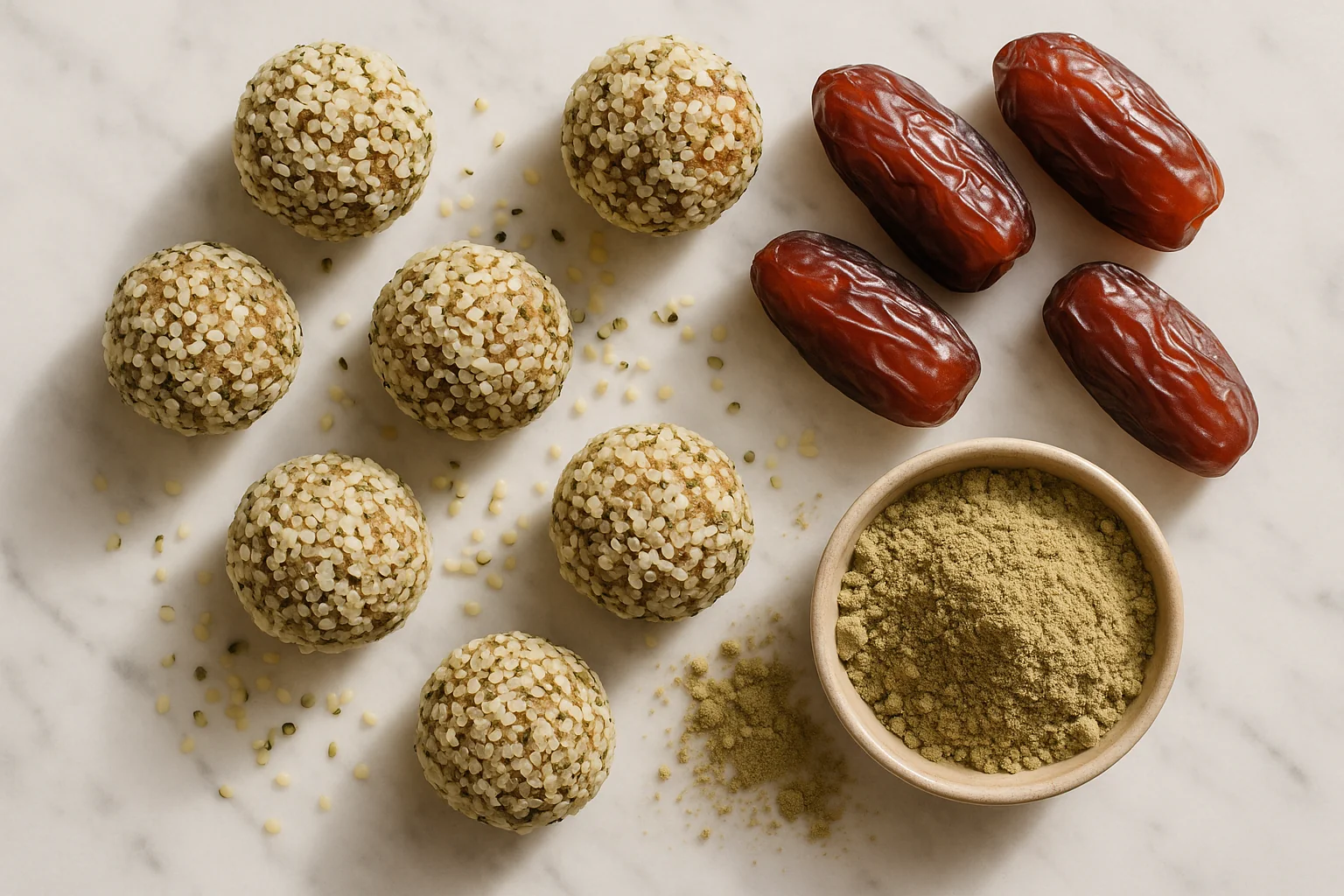

Energy balls with hemp protein and dates: power balls
Energy balls made from dates and hemp protein without baking: 20 minutes of work, 12-14 balls with about 3 g of protein each. Proportions, rescue for crumbling mixture, and variations.
A snack that doesn’t need an oven and doesn’t crumble in your bag is a rarity in the kitchen. Energy balls made from dates and hemp protein take twenty minutes, and the fridge does the rest of the work. Hulled hemp seeds contain 31.6 g of protein and 48.8 g of fat per 100 g (USDA FoodData Central, record 170148), and the powder from defatted seeds raises this ratio even higher. One batch yields 12-14 balls weighing just under 30 g each, each with about 3 g of protein. This is a snack you can prepare once a week and keep in the fridge without losing shape. Below you will find the proportions that hold together even outside the fridge, four flavor variations, and an answer to the question of why the mixture sometimes crumbles and what to do about it.
KEY INFORMATION
• Hulled hemp seeds: 31.6 g of protein and 700 mg of magnesium per 100 g (USDA FoodData Central, record 170148).
• PDCAAS of hulled seeds is 63-66 percent, with lysine being the first limiting amino acid (House et al., 2010).
• Two balls provide about 6-7 g of protein and about 220 kcal, based on the ingredient composition of the recipe.
• The mixture does not require baking: twenty minutes of work plus half an hour of chilling.
What does hemp protein provide in energy balls?
Three tablespoons of hemp powder add about 10-12 g of protein to the entire batch, increasing its protein content by about one third. The base of dates, almond butter, and oats is filling but carbohydrate-rich, so the addition changes the macronutrient ratios, not just the flavor.
Powders vary more between brands than the label suggests. Brand records in the USDA FoodData Central database show protein content ranging from 38.7 to 50 g per 100 g of powder and fat content from 6.5 to 11.7 g, with fiber content ranging from 16.7 to 35.5 g. A 30 g serving thus contains between 12-15 g of protein, not the round 18 g often stated in recipes.
The quality of this protein has been described by Callaway (Euphytica, 2004) and Tang et al. (Journal of Agricultural and Food Chemistry, 2006). Callaway points out edestin and albumin as the two main proteins in the seeds, both easily digestible and containing nutritionally significant amounts of all essential amino acids. Tang compared hemp isolate with soy isolate and found that, apart from lysine, hemp isolate matches or exceeds soy, and all essential amino acids except lysine and sulfur-containing ones meet the needs of children aged 2-5 years according to FAO and WHO standards.
The taste of hemp powder is nutty-earthy, more pronounced than whey. Combined with dates and cocoa, it enhances the chocolate profile. However, there is a hard limit: above four tablespoons per batch, the bitterness of the powder starts to overshadow the sweetness of the dates. Stick to two or three tablespoons.
We noticed in tests that powders with higher fat content bind the mixture better than defatted ones, and the difference is reflected in the numbers: among brands, fat content ranges from 6.5 to 11.7 g per 100 g. If your balls are crumbling, check the label. Powders at the lower end of this range require an extra tablespoon of nut butter or coconut oil.
How much protein does a serving of two balls really provide?
Two balls weighing just under 30 g provide about 6-7 g of protein and about 220 kcal. This number comes from a simple calculation based on the recipe ingredients: dates contribute 3.6 g of protein, almond butter 13.4 g, hemp powder 10-12 g, oats and cocoa a few grams each, and the coating of hulled seeds another 9.5 g. The total breaks down to 12-14 balls.
However, the protein content alone does not tell everything about its usefulness. House et al. (Journal of Agricultural and Food Chemistry, 2010) examined thirty samples of hemp products and calculated their PDCAAS, which adjusts the amino acid composition for digestibility. Hulled seeds performed best, while the cake left after oil pressing performed the worst.
This same work contains a caveat that gets lost in recipes: lysine is the first limiting amino acid in all tested hemp products. This means that hemp needs to be supplemented with lysine from other sources, not the other way around. In practice, this means that the balls are a good snack but do not replace dairy or legumes during the day. The authors add that the PDCAAS of hemp products matches or exceeds some grains, nuts, and certain legumes.
What do you need for energy balls with hemp protein?
The proportions below yield 12-14 balls, or about 360 g of mixture including the coating. The preparation time is twenty minutes, plus half an hour of chilling. All ingredients can be purchased at a regular store, and the only equipment you really need is a food processor or a strong blender.
- 200 g Medjool dates, pitted, about 10-12 pieces
- 3 tablespoons hemp protein powder, about 25 g
- 4 tablespoons unsweetened almond or peanut butter
- 1 tablespoon unrefined coconut oil
- 2 tablespoons raw cocoa
- 2 tablespoons rolled oats
- pinch of sea salt
- optional: teaspoon of vanilla extract or a pinch of cinnamon
- for coating: 3 tablespoons hulled hemp seeds or coconut flakes
Medjool dates are a conscious choice, not a whim. They contain 75 g of carbohydrates and 6.7 g of fiber per 100 g (USDA FoodData Central, record 168191), and their flesh is moist enough to act as a binder. Cheaper deglet nour dates will also work, but they require longer soaking and usually one extra tablespoon of water. Choose raw cocoa, as it gives a darker color and a more pronounced bitterness that balances the sweetness of the fruits. Rolled oats work better than instant oats, as they leave a noticeable texture in the mixture.
How to make energy balls step by step?
The entire recipe boils down to three steps: soften the dates, blend the mixture in two stages, form and chill. The second stage is the most crucial, as it determines the consistency, which is later hard to fix without ruining the texture of the oats.
- Place pitted dates in a bowl and cover with warm water for 5-10 minutes. Fresh and soft fruits can be blended immediately. Drain the water but keep two tablespoons.
- Transfer the drained dates to a food processor. Add almond butter, coconut oil, and a pinch of salt. Blend for about 60 seconds until the mixture starts to pull away from the sides. A powerful blender needs 40 seconds.
- Add hemp powder and cocoa, and finally the oats. Now blend briefly, 20-30 seconds in pulses. The mixture should remain slightly grainy from the oats, as excessive blending changes the texture to rubbery.
- Take a spoonful of the mixture and try to form a ball in your hands. If the mixture is too dry, it crumbles at the edges: add a tablespoon of soaking water or coconut oil. If the mixture is too wet, it sticks to your fingers: add a tablespoon of hemp powder or oats.
- Wet your hands with cold water and take portions of 25-30 g, which is the size of a large spoon. Roll them in a circular motion to form a smooth ball and place them on a baking sheet lined with paper. Wet your hands again every three or four balls.
- Coat each ball in hulled hemp seeds or coconut flakes, then place the baking sheet in the refrigerator for at least 30 minutes. Chilled balls are firmer and can be transported to work without losing shape.
What variations of energy balls work best?
The base of dates and hemp powder accepts substitutes without recalculating the entire recipe. Four variations below were tested in the same proportion of mixture, changing only one ingredient at a time. For each, we provide an adjustment needed for consistency or sweetness.
| Variant | Substitution | Adjustment |
|---|---|---|
| Matcha | cocoa for 2 teaspoons of matcha | add a teaspoon of honey, matcha is more bitter; coat in coconut flakes |
| Nutty | add 30 g of walnuts to blend | reduce almond butter by a tablespoon, otherwise the mixture becomes greasy |
| Citrus | grated zest of orange or lime | no adjustment needed; the acidity of the zest suppresses the earthy aftertaste of the powder |
| Nut-free | almond butter for sunflower or pumpkin seed paste | the mixture will be less sweet and greenish; add half a teaspoon of honey |
If you are looking for a snack with the same profile but in a different form, check out our homemade protein bars with hemp protein. For post-workout, a protein shake with hemp protein is better, and for breakfast prepared the night before, try chia pudding with hemp protein and cocoa.
Frequently asked questions
How much protein do energy balls with hemp protein have?
One ball weighing about 28 g provides approximately 3 g of protein, so two balls give 6-7 g. This number comes from calculating the ingredient composition of the recipe. The hemp powder contributes 10-12 g to the total batch, while the rest comes from almond butter, dates, and the coating.
Do energy balls with hemp protein need to be baked?
No, this is a no-bake snack. The crushed dates act as a binder, so the mixture holds together without eggs and without heat treatment. You need a blender, twenty minutes of work, and half an hour in the fridge. Chilling is not optional: without it, the balls soften in your hands.
How long can energy balls be stored?
In an airtight container in the fridge, the balls last up to two weeks, in the freezer up to three months. Take them out of the freezer fifteen minutes before eating, as they are hard when frozen. Always store them separately from strongly scented products, as the fat from the coating absorbs aromas.
How much hemp protein should be added to one batch of mixture?
Two or three tablespoons, which is 20-25 g for 12-14 balls. Above four tablespoons, the earthy bitterness of the powder starts to dominate over the sweetness of the dates. Powders vary in protein content: brand records in the USDA FoodData Central database range from 38.7 to 50 g per 100 g of product.
What can replace dates in energy balls?
Dried plums are the closest substitute, less sweet and slightly sour. Dried apricots provide a more pronounced acidity, while figs offer a stronger flavor and small seeds in the texture. Each of these fruits requires five minutes of soaking in warm water, as they are drier than Medjool dates.
This article is for informational and educational purposes and does not replace consultation with a doctor. If you are pregnant, breastfeeding, taking medications, or have chronic conditions, consult a specialist before using supplements or herbs.
Author: Michał Waluk · Published: 2026-06-02 · Updated: 2026-08-16