
Preemptive Nausea: Why Cannabis Works Where Serotonin Antagonists Fail
Why pre-chemotherapy nausea escapes serotonin antagonists and what preclinical studies show about cannabinoids. The CB1 and 5-HT1A mechanism without simplifications.
Preemptive nausea is one of the more challenging problems in oncology care: a patient feels weak even before the drug is administered, at the sight of the hospital or the smell of the ward. Classic antiemetic medications handle this worse than nausea occurring after infusion, because the mechanism is different. Research on the endocannabinoid system describes a pathway that fits this mechanism better, and it is on this that the interest in cannabinoids for this specific indication is based. This article explains the difference between the two types of nausea, what has been shown, what research material was used, and why we are talking about preclinical data rather than a ready therapeutic recommendation for the patient.
KEY INFORMATION
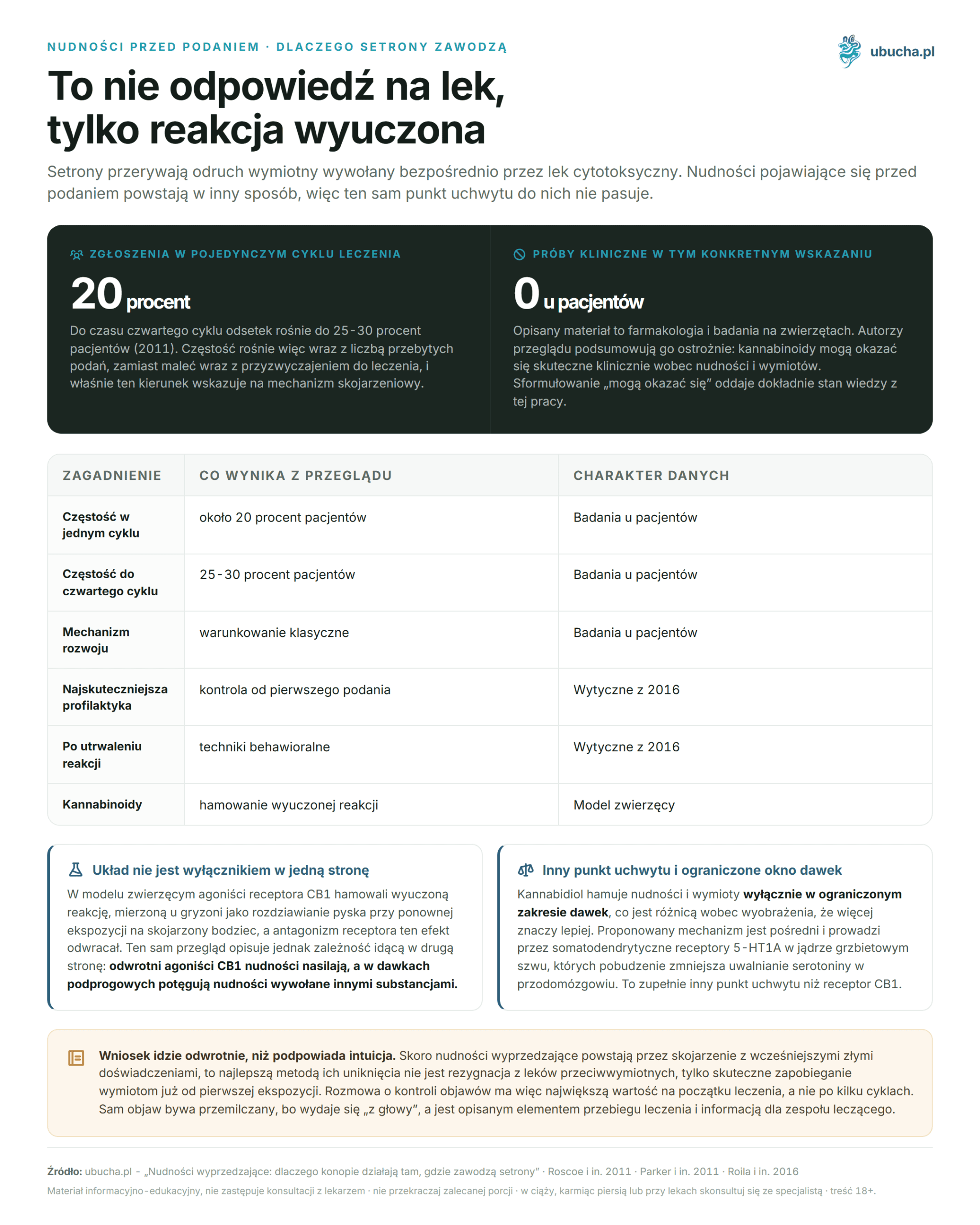
• Pre-chemotherapy nausea is reported by about 20 percent of patients in a single cycle and 25-30 percent by the fourth cycle (Roscoe et al., Supportive Care in Cancer, 2011).
• Studies in adult patients suggest that classical conditioning elements are involved in the development of this nausea.
• The best method to avoid the problem is effective prevention of vomiting and nausea from the first exposure to chemotherapy.
• Data from animal studies indicate that cannabinoids may be useful against symptoms that are harder to control, including preemptive nausea, which is less well controlled by available conventional medications (Parker et al., British Journal of Pharmacology, 2011).
• CBD inhibits nausea and vomiting only within a limited dose range, and its action is associated with the 5-HT1A receptor, not with CB1.
• Every decision during chemotherapy is made by the attending physician.
What is preemptive nausea and how often does it occur?
It is nausea that occurs before the administration of the drug, not after it. In published works, it is reported by about 20 percent of patients in any single cycle of chemotherapy and 25-30 percent of patients by the time of the fourth cycle. The frequency thus increases with the number of administrations (Roscoe et al., 2011).
The mechanism of development is well described: studies in adult patients suggest the involvement of classical conditioning elements. Previously neutral stimuli present during subsequent drug administrations become associated with the nausea that followed them. After several repetitions, the stimuli alone are enough to trigger a reaction. This explains why the problem increases with each subsequent cycle, rather than diminishing as one becomes accustomed to the treatment.
| Issue | What the data review indicates |
|---|---|
| Frequency in a single cycle | about 20 percent of patients |
| Frequency by the fourth cycle | 25-30 percent of patients |
| Mechanism of development | classical conditioning elements |
| Most effective prevention | controlling vomiting and nausea from the first exposure |
| Management after occurrence | behavioral techniques, such as systematic desensitization |
| Role of benzodiazepines | potentially useful in combination with behavioral techniques or antiemetic medications |
Why do classic antiemetic medications fail for this nausea?
Because they were developed to combat a different phenomenon. Serotonin antagonists are antagonists of the 5-HT3 serotonin receptor, and their role is to interrupt the vomiting reflex directly triggered by the cytotoxic drug. Preemptive nausea is not a response to the substance, but a learned reaction to a stimulus that does nothing by itself.
This difference translates into the clinical picture. Authors of cannabinoid pharmacology reviews state directly that nausea and preemptive nausea are among the symptoms that are harder to control, less well managed by available conventional medications (Parker et al., 2011).
The practical conclusion, however, is not to abandon antiemetic medications, but rather the opposite. Since preemptive nausea arises from associations with previous negative experiences, the best method to avoid it is effective prevention of vomiting and nausea from the first exposure to chemotherapy. Prevention here precedes treatment, because once conditioning is established, mainly behavioral techniques remain available. Guidelines from MASCC and ESMO, updated in 2016, organize the approach in this area (Roila et al., Annals of Oncology, 2016).
How do cannabinoids affect conditioned nausea?
The influence has been described in animal models, and this caveat is important here. Rats and mice do not vomit, so it is not possible to measure vomiting directly in them. Instead, a characteristic gaping response is observed, which occurs upon re-exposure to stimuli, tastes, or contexts previously associated with the substance causing nausea. This is a measurable and repeatable behavior, accepted in this field as an indicator of nausea in rodents. It is the animal equivalent of preemptive nausea.
In this model, cannabinoid receptor agonists, including THC, and fatty acid amide hydrolase inhibitors inhibited the learned gaping response, just as they inhibit vomiting in species capable of vomiting. Stimulation of CB1 suppresses vomiting, and antagonism of this receptor reverses this effect (Parker et al., 2011). More about the distribution and role of these receptors can be found in the guide to CB1 and CB2 receptors.
The same review describes a relationship worth remembering, as it goes the other way. Inverse agonists of the CB1 receptor, unlike neutral antagonists, exacerbate nausea, and at subthreshold doses, they amplify nausea caused by other substances. The endocannabinoid system is therefore not a switch that can be flipped one way without consequences.
How does CBD differ in this mechanism?
CBD takes a different route than THC and has clearer limitations. The review describes it as the main non-psychoactive compound of cannabis, which also inhibits nausea and vomiting, but only within a limited dose range. This is a significant difference from the notion that more means better.
The proposed mechanism is indirect. The anti-nausea action of CBD may result from indirect stimulation of somatodendritic 5-HT1A receptors in the dorsal raphe nucleus; stimulation of these autoreceptors reduces serotonin release in target areas of the forebrain. It is noteworthy that this is a completely different target than the CB1 receptor (Parker et al., 2011). The 5-HT1A receptor itself and its role are described more broadly in the entry about the anxiolytic mechanism of CBD.
The authors cautiously summarize their review: preclinical studies indicate that cannabinoids, including CBD, may prove clinically effective against nausea and vomiting induced by chemotherapy or other treatments. The formulation “may prove” accurately reflects the state of knowledge from this work. The mechanism and results in animal models are described, not an effect confirmed in patients.
What does this mean for patients undergoing chemotherapy?
First of all, that the problem has a name and is a recognized phenomenon. Nausea occurring before a visit is often silenced, as it is difficult for a patient to report a symptom that seems “in their head.” Meanwhile, it is a described element of the treatment process, taken into account in guidelines, and information for the treating team, not a reason for embarrassment.
The second conclusion concerns the timing of action. Since the most effective method is to prevent nausea and vomiting from the first administration, discussing symptom control is most valuable at the beginning of treatment, not after several cycles. Once the reaction is established, behavioral techniques, such as systematic desensitization, have shown effectiveness, and benzodiazepines can be useful in combination with them or with antiemetic medications.
The third conclusion concerns cannabinoids and is the most cautious of the entire article. The material described here is pharmacology and animal studies, not clinical trials in patients with preemptive nausea. Cannabinoid medications used in oncology are prescription drugs, and their inclusion is up to the attending physician, who knows the chemotherapy regimen and other medications being taken. Self-medicating with products during oncological treatment is risky, among other things due to possible interactions. The context of CBD and nausea is further developed in the entry about whether CBD helps with nausea.
Frequently Asked Questions
What is preemptive nausea and who does it affect?
It is nausea that occurs before chemotherapy administration, triggered by stimuli associated with previous administrations. About 20 percent of patients report it in a single cycle and 25-30 percent by the fourth cycle. Studies in adults suggest the involvement of classical conditioning elements in its development.
Why do serotonin antagonists work poorly for this nausea?
Because they are antagonists of the 5-HT3 receptor and interrupt the vomiting reflex directly triggered by the cytotoxic drug. Preemptive nausea is a learned reaction to a stimulus that does nothing by itself. Reviews describe it as a symptom that is harder to control with available conventional medications.
What have studies shown about cannabinoids?
In animal models, CB1 receptor agonists, including THC, inhibited the learned response corresponding to preemptive nausea, and CB1 antagonism reversed this effect. CB1 inverse agonists exacerbated nausea. These are preclinical data describing the mechanism, not a confirmed clinical effect in patients.
Does CBD alone help with preemptive nausea?
A pharmacological review describes CBD as a compound that inhibits nausea and vomiting, but only within a limited dose range. The proposed mechanism is indirect stimulation of 5-HT1A receptors in the dorsal raphe nucleus, thus a different target than CB1. The data comes from preclinical studies.
How can preemptive nausea be best prevented?
By effectively controlling vomiting and nausea from the first exposure to chemotherapy, before an association is formed. Once the reaction is established, behavioral techniques, such as systematic desensitization, have shown effectiveness. Benzodiazepines can be useful in combination with them or with antiemetic medications.
This article is for informational and educational purposes and does not constitute medical advice. Before starting to use cannabis or CBD for therapeutic purposes, consult with a physician, especially if you are taking other medications, are pregnant, or breastfeeding.
Author: Michał Waluk · Published: 2026-08-09 · Updated: 2026-08-11