
Hemp Oil in the Kitchen: How to Use It, What It Pairs Well With, and What to Avoid
Hemp oil in the kitchen: why it is not suitable for frying, how to store it, what studies really say about the ratio of omega, and what THC limit applies.
Hemp seed oil comes with two promises: that it has a perfect fatty acid composition and that it is a healthier substitute for other oils. The first is largely true, the second can be misunderstood and ends up on the frying pan. This oil consists of over 80% polyunsaturated fatty acids, and it is these that oxidize the fastest, even with regular standing in the kitchen. Meanwhile, we checked the most commonly repeated number from the descriptions of this oil, namely the omega-6 to omega-3 ratio, and it turned out that the institution we refer to says something contrary. Below: where this oil really fits, how to store it so it doesn’t go rancid within a month, what THC content limit applies to it in the EU, and what measurements have shown.
KEY INFORMATION
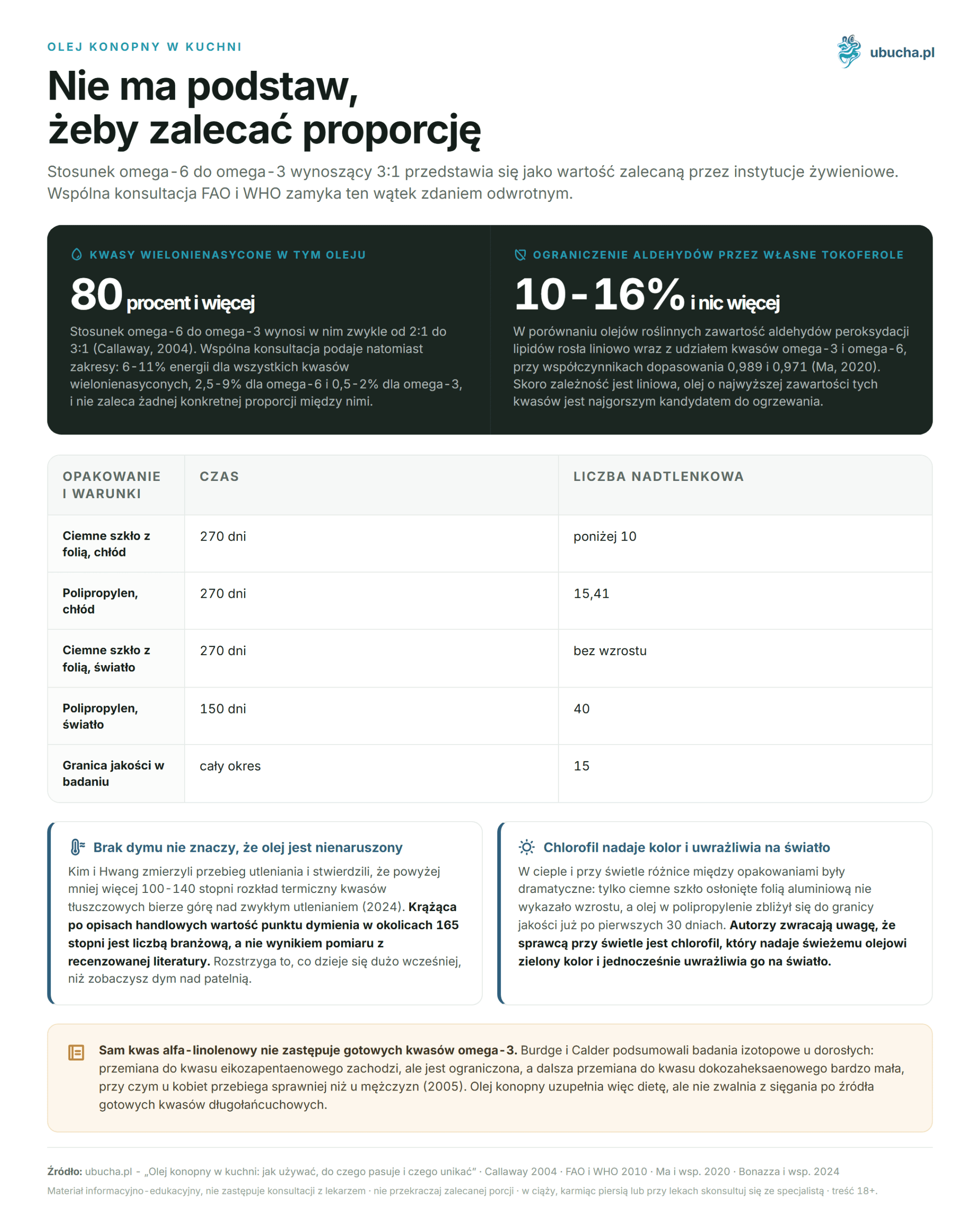
• Hemp seed oil is over 80% polyunsaturated fatty acids, and the omega-6 to omega-3 ratio usually ranges from 2:1 to 3:1 (Callaway, Euphytica, 2004).
• A joint consultation by FAO and WHO concluded that there is no basis for recommending any specific omega-6 to omega-3 ratio.
• Above approximately 100-140 degrees, the thermal breakdown of the fatty acids in this oil takes precedence over oxidation (Kim and Hwang, Journal of Food Science, 2024).
• EU law allows up to 7.5 mg/kg THC in hemp seed oil.
What is hemp oil and what distinguishes its composition?
It is cold-pressed oil from hemp seeds, ranging in color from greenish to golden, with a distinctly nutty-grassy flavor. Its hallmark is a very high content of polyunsaturated fatty acids: Callaway in a review of the nutritional value of hemp seeds states that over 80% of such acids are in the oil, and the omega-6 to omega-3 ratio is usually in the range of 2:1 to 3:1 (Callaway, Euphytica, 2004).
The second peculiarity is gamma-linolenic acid. It is omega-6, but with a different metabolic pathway than regular linoleic acid, known mainly from evening primrose oil and practically absent in sunflower, canola, or olive oil. A review of the composition of hemp seeds lists it alongside stearidonic acid as a component that distinguishes this oil from other plant oils (Tănase Apetroaei et al., Molecules, 2024).
This same review points out a third element that commercial descriptions are silent about: tocopherols, or natural vitamin E, predominantly in the gamma form. They protect lipids from oxidation, so the oil has its own built-in buffer. However, this buffer is limited, as we will see shortly. The pressing occurs at a controlled temperature of around 45-50 degrees precisely to avoid losing this layer during production.
The set is therefore unusual: a very high amount of polyunsaturated fatty acids, a rare gamma-linolenic acid, and its own antioxidants in one product. This also explains why this oil is so sensitive. The more double bonds in a molecule, the easier it is for radicals to form, and hemp oil has an exceptionally high number of them.
Why should hemp oil not be used for frying?
Because the temperature of the pan breaks down exactly what you pay for in this oil, and in the process creates compounds that we do not want to consume. Kim and Hwang measured the oxidation of hemp seed oil and found that above approximately 100-140 degrees, the thermal breakdown of fatty acids takes precedence over regular oxidation (Kim and Hwang, Journal of Food Science, 2024). This threshold is significantly lower than the typical frying temperature.
The circulating value of the smoke point around 165 degrees is an industry number, not a result from peer-reviewed literature, and it does not determine the issue. What matters is what happens to the fatty acids long before you see smoke over the pan. The absence of smoke does not mean that the oil is intact.
What is produced when heating? Lipid peroxidation aldehydes, including 4-hydroxy-2-alkenal. This has been measured: compared to plant oils, the content of these aldehydes increased linearly with the proportion of omega-3 and omega-6 acids in the oil, with fitting coefficients of 0.989 and 0.971 respectively (Ma et al., Food Chemistry, 2020). Since the relationship is linear, oil with the highest content of these acids is the worst candidate for heating. The same study showed that the oil’s own tocopherols only limit the formation of aldehydes by 10-16%, so natural vitamin E is not a shield.
Can hemp oil be used for warm dishes? Yes, provided you add it to a finished dish, not cook in it. Drizzling over soup after removing it from the heat, mixing into pasta before serving, adding to sauce after turning off the burner: the temperature of the dish drops quickly and does not approach the breakdown threshold. The principle can be summed up in one sentence: oil to the dish, never the dish to the oil.
Should the omega-6 to omega-3 ratio really be 3:1?
This number is the most frequently repeated argument for hemp oil and at the same time the least well-founded. In product descriptions, and even in some review literature, the 3:1 ratio is presented as a value recommended by nutritional institutions. We checked this at the source, and the result is the opposite.
A joint consultation of FAO and WHO experts dedicated to fats in human nutrition closes this topic in one paragraph. In the chapter directly addressing the omega-6 to omega-3 ratio, we read that in light of the available evidence and conceptual limitations, there is no basis for recommending a specific ratio of these acids or a specific proportion of linoleic to alpha-linolenic acid, as long as the intake of both falls within the ranges established in the report (FAO and WHO, Fats and fatty acids in human nutrition, 2010). These ranges are given separately: 6-11% of energy for all polyunsaturated acids, 2.5-9% for omega-6, and 0.5-2% for omega-3.
What remains for hemp oil? A fact that needs no myth: it is one of the few oils that provides both essential fatty acids simultaneously and in a comparable order of magnitude. Sunflower and corn oils practically only provide omega-6, while flaxseed oil predominates in the other direction. The value of hemp oil lies in the fact that it does not need to be balanced with something else, not in hitting a magic ratio.
It is also worth remembering how little alpha-linolenic acid alone provides as a source of long-chain acids. Burdge and Calder summarized isotopic studies in adults: conversion to eicosapentaenoic acid occurs, but it is limited, and further conversion to docosahexaenoic acid is very small, with the process being more efficient in women than in men (Burdge and Calder, Reproduction Nutrition Development, 2005). Thus, hemp oil complements the diet but does not replace sources of ready omega-3 acids.
How to store hemp oil so it doesn’t go rancid?
Three things are decisive: light, temperature, and contact with oxygen. These are not tips from a leaflet, but conclusions from an experiment in which cold-pressed hemp oil was poured into containers made of four materials and kept for 270 days under two conditions: in darkness at 10 degrees and in diffuse light at 25 degrees (Bonazza et al., Molecules, 2024).
The results are unequivocal. In cool and dark conditions, all containers maintained a peroxide value below 10 milliequivalents of oxygen per kilogram throughout the period, except for polypropylene, which allows oxygen to pass through and reached 15.41 after 270 days. In heat and light, the differences were dramatic: only dark glass covered with aluminum foil showed no increase, while oil in polypropylene approached the limit after the first 30 days and reached 40 milliequivalents after 150 days. The authors note that the culprit in light is chlorophyll, which gives fresh oil its green color and simultaneously makes it sensitive to light.
Practical conclusions are self-evident. The cited review of the composition of hemp seeds indicates a proper storage range of 8-15 degrees, which is exactly the conditions of the lower shelf of the refrigerator. Additionally, dark glass instead of plastic, a tightly screwed cap after each use, and a bottle size that you can realistically use within a few weeks.
We noticed in tests exactly what is visible in the numbers above: oil purchased in a plastic bottle loses its characteristic flavor two to three weeks after opening, even in the refrigerator. The same oil transferred to a dark jar with a seal lasted significantly longer. Recognizing rancidity is simple: pour a teaspoon onto a white plate and smell it. Fresh oil smells green and nutty, while spoiled oil smells sharp, sour, or even like paint.
What to use hemp oil for in the kitchen?
For everything that does not require fire underneath. Its pronounced, slightly grassy flavor pairs well with acidity and bitterness, so the natural environment for this oil is dressings, spreads, and dishes finished with fat after removing from heat. Below is a set of applications that work well without any fuss.
- Dressing for arugula with parmesan: hemp oil, lemon juice, a pinch of salt. The green note of the oil plays well with the bitterness of arugula.
- Pesto with hemp oil instead of olive oil, with basil and garlic, using hemp seeds instead of pine nuts.
- Hummus finished with a spoon of oil just before serving; the nutty flavor enhances the creaminess of the spread.
- Pumpkin or broccoli cream soup, drizzled on the plate, not in the pot.
- Green smoothie with spinach and banana: the fat from the oil aids in the absorption of fat-soluble vitamins.
- Vinaigrette for beets with Dijon mustard and apple cider vinegar; the earthy flavor of the oil complements the sweetness of the beet.
- Cold maceration with rosemary and garlic in a sealed jar in the fridge for a few days.
- Avocado on toast: a few drops of oil instead of olive oil, salt, and chili flakes.
- Pasta salad with sun-dried tomatoes, with oil added after cooling the pasta.
- Risotto finished with a spoon of oil after turning off the burner, instead of classic butter.
From our experience, the biggest obstacle is not the price, but the intensity of the flavor. People accustomed to neutral canola oil describe hemp oil as too pronounced. A simple way to get used to it is to start with a mix: a teaspoon of hemp oil to a tablespoon of olive oil in a dressing, gradually shifting the proportions over two to three weeks.
A separate topic is combining oil with hemp oil in one dish. The fat in the meal significantly changes the absorption of cannabidiol, and this is substantial: in a study on eight adults with drug-resistant epilepsy, the same dose taken after a fatty meal resulted in fourteen times higher maximum concentration and four times greater area under the curve than on an empty stomach (Birnbaum et al., Epilepsia, 2019). The study concerned capsules with pure cannabidiol and a standardized meal worth over 800 kcal, not a tablespoon of dressing, so do not directly transfer these numbers to the kitchen. The mechanism breaks down the entry how to add CBD to dishes.
Which oil to choose for which application?
There is no one oil for everything, and hemp oil is no exception to this rule. The determining factor is the temperature at which the oil is to work, and only then flavor and composition. Below is a division that suffices in a home kitchen.
For frying and baking at high temperatures, choose an oil with a low content of polyunsaturated fatty acids, such as refined canola or coconut oil. This is the same relationship that Ma and colleagues measured: the fewer double bonds, the fewer aldehydes when heated. Do not place hemp or flaxseed oil in this role at all.
For cold sauces and dressings, hemp oil is in its element alongside extra virgin olive oil and nut oils. Here, flavor matters, and the fat has not been heated. Hemp oil is sometimes used in baking, but it changes the flavor profile to distinctly earthy, so it mainly works in chocolate cakes and requires recipe adjustments.
If you are only interested in alpha-linolenic acid, flaxseed oil provides more and costs less. The advantage of hemp oil lies elsewhere: in the presence of gamma-linolenic acid and in the fact that it does not tilt the diet in either direction. More about other culinary forms of hemp can be found in the entry hemp in the kitchen, and one of the more interesting cold applications is described in the recipe for cold brew with hemp oil.
How much THC can hemp seed oil contain?
Up to 7.5 mg per kilogram of oil. The limit is set by the Commission Regulation (EU) 2023/915 on the maximum permissible levels of certain contaminants in food, effective from May 25, 2023 (Regulation 2023/915, EUR-Lex). For the seeds themselves and products from the seeds, the limit is lower at 3.0 mg/kg.
The method of counting can be a source of misunderstandings, so it is worth naming it directly. The level refers to the sum of delta-9-THC and delta-9-tetrahydrocannabinolic acid, expressed as delta-9-THC, with the content of the acid form multiplied by a factor of 0.877. A laboratory reporting only delta-9-THC does not answer the question of whether the batch meets the limit.
Where does THC in seed oil come from, since the seeds do not produce it? From contamination during harvesting: cannabinoids come from the resin on the surfaces of other parts of the plant and transfer to the seed hull. Therefore, the limit applies to the final product, not the raw material, and that is why oil has a higher limit than the seeds themselves: fat binds these compounds more effectively than the rest of the seed.
For the buyer, this means one practical thing. Food oil from hemp seeds sold legally in the EU falls within this limit and has no psychoactive effects. If a product advertises cannabinoid content, it is no longer food oil in the sense of this regulation, but another product assessed according to different rules.
Frequently Asked Questions
What does hemp oil pair best with in the kitchen?
For cold applications: dressings, sauces, hummus, pesto, smoothies, and drizzling over finished dishes. It is not suitable for frying or baking at high temperatures. Flavor-wise, it pairs well with arugula, beets, citrus, and herbs, as its grassy note complements acidity and bitterness.
Can hemp oil be heated?
Not in a pot or on a pan. Measurements have shown that above approximately 100-140 degrees, the thermal breakdown of the fatty acids in this oil takes precedence over regular oxidation (Kim and Hwang, Journal of Food Science, 2024). However, it can be added to a dish after removing it from the heat when the temperature of the dish is already dropping.
Is the omega-6 to omega-3 ratio in hemp oil 3:1?
It usually falls within the range of 2:1 to 3:1 (Callaway, Euphytica, 2004). However, this is not a value recommended by institutions: a joint consultation by FAO and WHO stated that there is no basis for recommending a specific ratio of these acids, as long as the intake of both falls within established ranges.
How long can hemp oil be stored after opening?
After opening, keep it in the refrigerator in dark glass and use it within a few weeks. In an experiment, oil in dark glass covered with foil lasted 270 days without an increase in peroxide value, while the same oil in polypropylene in heat and light exceeded the quality limit after about 30 days (Bonazza et al., Molecules, 2024).
How much hemp oil should be used daily?
We do not provide a serving size, as the requirement is determined individually. The FAO and WHO consultation expresses it as a percentage of energy: 2.5-9% for omega-6 and 0.5-2% for omega-3, not in tablespoons. It is worth remembering that a tablespoon of any oil is about 120 kcal, so it counts towards the daily energy balance.
Does hemp oil have a strong flavor?
Yes, it has a nutty-grassy flavor, with a green note coming from the chlorophyll present in mature seeds. The intensity depends on the variety and method of pressing; cold-pressed oils are more pronounced than refined ones. People accustomed to neutral canola oil usually need two to three weeks to get used to this flavor.
What can replace hemp oil in recipes?
In dressings, extra virgin olive oil is the closest match, although it has a different fatty acid profile. If you are mainly interested in alpha-linolenic acid, flaxseed oil provides more, also only for cold use. Neither of them provides gamma-linolenic acid, which distinguishes hemp oil among plant oils.
Does hemp oil have psychoactive effects?
No. Food oil from hemp seeds is subject to a limit of 7.5 mg THC per kilogram, established by regulation (EU) 2023/915, calculated as the sum of delta-9-THC and its acid form. Seeds do not produce cannabinoids, and their trace amounts come from contamination of the hull during harvesting.
For hemp food in the store at Bucha, look in the food category; there is no hemp seed oil in this offer (as of August 15, 2026).
This article is for informational and educational purposes and does not replace consultation with a doctor. If you are pregnant, breastfeeding, taking medications, or have chronic conditions, consult the use of supplements or herbs with a specialist.
Author: Michał Waluk · Published: 2026-06-22 · Updated: 2026-08-15