
Lion’s mane (soplówka jeżowata) properties, effects and dosage 2026
Lion's mane (soplówka jeżowata) and NGF: what the Mori 2009 study showed, what the work on hericenones does not say, and how to read the extract label before purchase.
Lion’s mane looks like a white pom-pom hanging from a trunk. In English, it is called lion’s mane, in Japanese yamabushitake, and in scientific literature, Hericium erinaceus. The mushroom’s reputation as a “brain” fungus is built on its ability to stimulate NGF synthesis, or nerve growth factor. However, there is a significant gap between this reputation and the state of research. There are few human trials, they are small, and they measured things other than those promised on the label. Below you will find each of these studies detailed so that you can check them: who conducted them, how many participants there were, how long they lasted, and what exactly improved. You will also find a list of claims that none of these studies confirm, although they circulate in product descriptions.
KEY INFORMATION
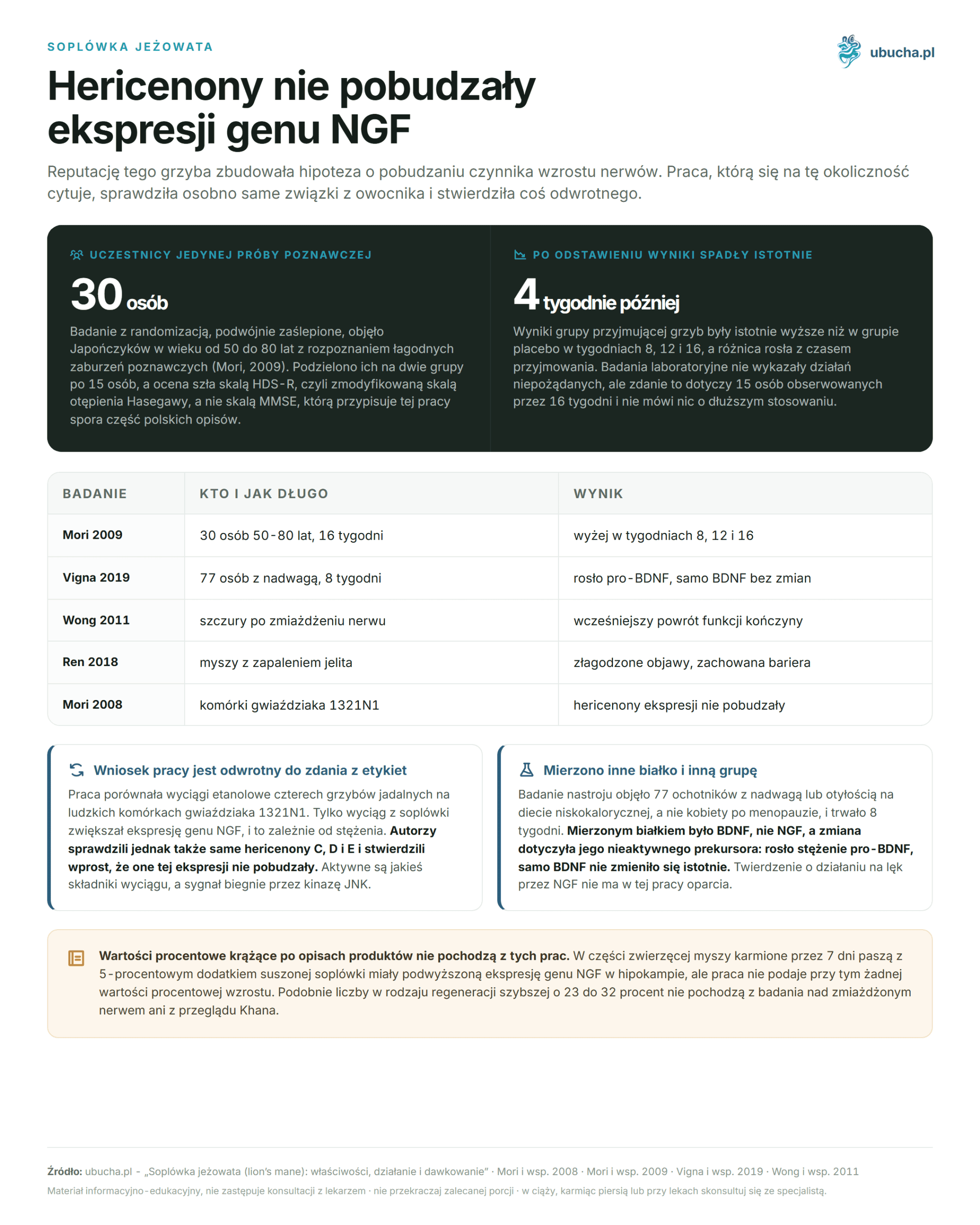
• The randomized study by Mori et al. (Phytotherapy Research, 2009) involved 30 Japanese individuals aged 50-80 with mild cognitive impairment; they were assessed using the HDS-R scale, not MMSE.
• Improvement increased over 16 weeks and dropped significantly 4 weeks after discontinuation.
• The work by Mori et al. (2008) showed something contrary to what product descriptions repeat: hericenones C, D, and E did not stimulate NGF gene expression.
• No human study lasted longer than several weeks, so nothing is known about long-term safety.
What is lion’s mane and where does it grow?
Hericium erinaceus is a wood-dwelling mushroom that grows on weakened and dead hardwood in Europe, Asia, and North America. The fruiting body hangs from the trunk like a ball densely covered with soft spines, and it is this that gives the mushroom all its names. In Poland, it can be found in old beech forests and is protected, so the raw material for supplements comes exclusively from cultivation, most often Asian. In traditional Chinese and Japanese medicine, it has been used for centuries as a strengthening agent and digestive support.
The review by Khan et al. (Journal of Complementary and Integrative Medicine, 2013) gathers what is known about the composition of the mushroom from studies. The most attention is drawn to beta-glucan polysaccharides: the authors attribute anti-cancer, immunomodulating, and neuroprotective effects to them. Besides them, two groups of low-molecular compounds return in the literature on lion’s mane, named after the species: hericenones, associated with the fruiting body, and erinacines, associated with the mycelium. This distinction comes back later when choosing a preparation, as labels rarely indicate which part of the mushroom the extract was made from.
The mushroom also contains ergosterol, a precursor of vitamin D, and a set of amino acids and elements typical of edible mushrooms. However, these components do not distinguish it from other cultivated species and are not what built its popularity. Its popularity was built on the hypothesis of stimulating NGF, which we will transition to in the next section.
How does lion’s mane stimulate NGF?
NGF is a protein discovered by Rita Levi-Montalcini, who was awarded the Nobel Prize for it in 1986, which regulates the growth and survival of neurons. NGF itself does not cross the blood-brain barrier, so it cannot be administered orally. Hence the interest in compounds that prompt the brain to produce its own NGF.
This is where the most commonly repeated error in descriptions of lion’s mane occurs. The study by Mori et al. (Biological and Pharmaceutical Bulletin, 2008) compared ethanol extracts of four edible mushrooms on human astrocyte cells 1321N1. Only the extract from lion’s mane increased NGF gene expression, and that was dependent on concentration. However, the authors also checked the hericenones C, D, and E and stated directly that they did not stimulate this expression. Therefore, the conclusion of the study is the opposite of the statement repeated on labels: some components of the extract are active, but not the hericenones.
The signal runs through the JNK kinase, which the authors demonstrated by inhibiting the effect with the inhibitor SP600125. In the animal part, mice fed for 7 days with a diet containing 5 percent dried lion’s mane had increased NGF gene expression in the hippocampus. However, the study does not provide any percentage value of the increase, so the numbers circulating on the internet regarding this experiment have no basis.
What exactly did the Mori clinical study from 2009 show?
This is the only trial on which the reputation of lion’s mane as a support for cognitive functions realistically stands, and it is worth knowing it in detail. It was a randomized, double-blind, placebo-controlled study published in Phytotherapy Research (Mori et al., 2009).
The participants were 30 Japanese individuals aged 50 to 80 diagnosed with mild cognitive impairment. After a two-week preliminary period, they were randomly divided into two groups of 15. The experimental group took four tablets of 250 mg three times a day for 16 weeks; the tablets contained 96 percent dried lion’s mane. The assessment was done using the HDS-R scale, which is a modified Hasegawa dementia scale, not the MMSE scale, which a significant portion of Polish descriptions assigns to this study.
The results of the group taking the mushroom were significantly higher than in the placebo group at weeks 8, 12, and 16, and the difference increased over time. Four weeks after the end of supplementation, the results dropped significantly. Laboratory tests did not show any side effects. However, this last sentence refers to 15 individuals observed for 16 weeks and does not say anything about the safety of longer use.
| Study | Who and how many | Time | What was measured | Result |
|---|---|---|---|---|
| Mori et al., 2009 | 30 individuals aged 50-80 with mild cognitive impairment | 16 weeks | HDS-R scale | significantly higher results at weeks 8, 12, and 16; drop 4 weeks after discontinuation |
| Vigna et al., 2019 | 77 individuals with overweight or obesity, with mood or sleep disorders | 8 weeks | mood and sleep questionnaires, pro-BDNF and BDNF in serum | fewer symptoms of depression, anxiety, and sleep disorders; increase in pro-BDNF, BDNF unchanged |
| Wong et al., 2011 | rats after crushing the peroneal nerve | until recovery of function | gait analysis, nerve and neuromuscular junction staining | earlier return of limb function than in the control group |
Does lion’s mane improve mood and sleep?
One trial in humans says something specific here, but it concerns a different group than is usually mentioned. The study by Vigna et al. (Evidence-Based Complementary and Alternative Medicine, 2019) involved 77 volunteers with overweight or obesity, recruited from a Milan preventive medicine clinic, who were on a low-calorie diet.
Only individuals who reported mood disorders, sleep disorders, or binge eating in self-assessment questionnaires were qualified for the study. After 8 weeks of oral lion’s mane supplementation, the severity of depression, anxiety, and sleep disorders was lower. The authors also searched for a biomarker and measured pro-BDNF and BDNF in serum. The concentration of pro-BDNF, a precursor, increased; BDNF itself did not change significantly.
Three details are important here, as they usually get lost in summaries. The group was not postmenopausal women, but individuals with overweight or obesity of both sexes. The supplementation lasted 8 weeks, not 4. The measured protein was BDNF, not NGF, and the change concerned its inactive precursor. The claim that lion’s mane “works on anxiety through NGF” has no basis in this work.
Does lion’s mane support the regeneration of peripheral nerves?
The data here is exclusively animal-based and should be read as such. In the study by Wong et al. (Evidence-Based Complementary and Alternative Medicine, 2011), Sprague-Dawley rats had their peroneal nerve crushed, and then they were given an aqueous extract of fresh lion’s mane fruiting bodies orally.
The return of limb function was assessed by gait trace analysis, and the state of the nerve and neuromuscular junction was examined histologically. The animals receiving the extract regained function earlier than the control group, and axon regrowth and reinnervation of the toe extensor muscle were better in them. The comparison group with active treatment was mecobalamin, a form of vitamin B12 used in neuropathies. The nerve crushing model is a standard in regeneration studies precisely because the damage heals itself, and the intervention can at most accelerate this process.
What this study does not say: it does not provide any percentage acceleration of regeneration, it does not concern the sciatic nerve, and it has not been repeated in humans. Numbers like “regeneration faster by 23 to 32 percent” that circulate in product descriptions do not come from this work or from Khan’s review. The mechanism is biologically credible, but a credible mechanism is not a clinical result.
What does lion’s mane do for immunity and the gut?
This part is attributed to polysaccharides, not low-molecular compounds. The review by Khan et al. (2013) attributes immunomodulating, antioxidant, and lipid-lowering effects to the beta-glucans from lion’s mane, described mainly in laboratory and animal studies.
The closest to specifics is the experiment by Ren et al. (The Journal of Nutritional Biochemistry, 2018) on mice with colitis induced by dextran sulfate. The polysaccharide from lion’s mane alleviated symptoms, reduced markers of oxidative stress and cytokine release, reversed disease-induced dysbiosis, and maintained the integrity of the gut barrier. This is a model of inflammatory disease in mice, not an observation in healthy humans.
The repeated statement online that lion’s mane “increases microbiome diversity and multiplies Lactobacillus and Bifidobacterium in humans” has no basis in this work. However, from its action on the immune system, a practical note arises: individuals who have undergone organ transplants and are taking immunosuppressive drugs should discuss the use of lion’s mane with a doctor, just like any other mushroom rich in beta-glucans. A comparison with other species can be found in the post Adaptogenic mushrooms: which to choose and when.
How to choose a good lion’s mane supplement?
The label says more than the price if you know what to look for. The first thing is the part of the mushroom. The fruiting body contains hericenones; mycelium grown on grain substrate contains erinacines, but also starch from the substrate, which dilutes the raw material. A preparation described only as “mycelium on grain” is practically a mixture of mycelium and grain in an unknown proportion.
The second thing is the method of extraction. A water extract better extracts polysaccharides, an alcohol extract better extracts low-molecular compounds, and a two-step extract includes both groups. A declaration of the percentage of “polysaccharides” without specifying the content of beta-glucans means little, as starch from the substrate is also a polysaccharide. Manufacturers who label beta-glucans separately provide verifiable information.
The third thing is purity testing. Mushrooms accumulate heavy metals from the substrate, so results of cadmium and lead measurements and mycotoxins are what to ask the manufacturer about. You can find ready-made mushroom preparations in the adaptogens category; if you are considering a chewable form, a comparison is in the post Lion’s mane gummies: is this an effective form of lion’s mane and who are they best for?.
For whom does lion’s mane make sense, and for whom does it not?
Our observations from reading these works are as follows: lion’s mane has the best-documented position exactly where it has been studied, namely in older individuals with already diagnosed cognitive decline. Outside of this group, evidence in humans ends with one trial concerning mood and sleep in individuals with overweight.
This is not a preparation for Alzheimer’s disease or other neurodegenerative diseases; these require neurological treatment, and lion’s mane has not been studied in them. It is also not a stimulant. Nothing in the cited works indicates an effect felt on the same day, and in the only cognitive study, the difference appeared only in the eighth week.
Finally, there is a question that descriptions are silent about: all trials in humans lasted from 8 to 16 weeks. No one has checked what happens after a year, so opinions about long-term safety are unsupported. If you are taking medications regularly or have chronic illnesses, make the decision about supplementation with a doctor, not based on the label. A review of other ingredients for cognitive function can be found in the post Supplements for concentration and memory.
Frequently asked questions
What is lion’s mane and how does it work?
Hericium erinaceus is a wood-dwelling mushroom used for centuries in traditional Asian medicine. Its extract increased the expression of the NGF gene in human astrocytes and in the hippocampus of mice (Mori et al., Biological and Pharmaceutical Bulletin, 2008). The same study showed that the hericenones alone did not do this.
Does lion’s mane improve memory?
One randomized study checked this. In 30 Japanese individuals aged 50-80 with mild cognitive impairment, scores on the HDS-R scale were significantly higher than in the placebo group at weeks 8, 12, and 16 (Mori et al., Phytotherapy Research, 2009). Four weeks after discontinuation, they dropped.
How long does it take for lion’s mane to work?
In the only cognitive study, the difference from placebo appeared only in the eighth week and increased until the sixteenth. In the mood and sleep study, the supplementation period was 8 weeks. None of these studies describe an effect felt after a single dose or after a few days.
Does lion’s mane affect anxiety and mood?
In 77 overweight or obese individuals reporting mood or sleep disorders, 8 weeks of supplementation reduced the severity of depression, anxiety, and sleep disorders (Vigna et al., 2019). The concentration of pro-BDNF increased, while BDNF itself did not change. The study did not involve postmenopausal women.
Does lion’s mane help with peripheral nerves?
Data comes exclusively from animals. Rats with crushed peroneal nerves that were given an aqueous extract of fruiting bodies regained limb function earlier than the control group (Wong et al., 2011). This has not been tested in humans, and the circulating percentage values do not come from this study.
What are the side effects of lion’s mane?
In the study by Mori et al. from 2009, laboratory tests did not show any side effects over 16 weeks in 15 individuals taking the mushroom. This is a small group and a short period. Individuals allergic to mushrooms and those taking immunosuppressive drugs should consult their use with a doctor.
How long can lion’s mane be used?
It is unknown. The longest published trial in humans lasted 16 weeks, and the mood and sleep study lasted 8 weeks. There is no data on use longer than several weeks, so claims about the safety of year-long supplementation are not supported by the literature.
This article is for informational and educational purposes and does not replace consultation with a doctor. If you are pregnant, breastfeeding, taking medications, or have chronic conditions, consult the use of supplements or herbs with a specialist.
Author: Michał Waluk · Published: 2026-05-29 · Updated: 2026-08-11