
Why CBD oil stopped working: what research says about tolerance
Does CBD cause tolerance, what PET imaging has really proven, and why Dr. Sulak's reset protocol is not in the peer-reviewed literature.
You used the oil for several weeks and felt a difference, then the effect disappeared. This is one of the most commonly reported scenarios, and there is a ready answer on the internet: a two-day break according to Dr. Sulak’s protocol. We checked this answer at the source, and the result is uncomfortable. The name is real, the protocol has no confirmation in the peer-reviewed literature, and the studies it is usually based on concern THC, not cannabidiol. Below you will find what has really been measured in this area, who and in how many people, and three other explanations for the loss of effect, each of which can be verified without any break in taking. There are no dosage tables or schedules in this text, and this is a conscious decision: the numbers describing studies remain, the numbers telling the reader how much to take do not.
KEY INFORMATION
• A systematic review of evidence on tolerance in humans concerns cannabis and THC, not cannabidiol (Colizzi and Bhattacharyya, Neuroscience and Biobehavioral Reviews, 2018).
• PET imaging showed reduced availability of CB1 receptors in daily cannabis smokers and its return after 26 plus minus 5 days of abstinence (Hirvonen et al., Molecular Psychiatry, 2012).
• Dr. Sulak’s tolerance reset protocol is not in the peer-reviewed literature; it is only published in a consensus he co-authored on dosing in chronic pain (Bhaskar et al., Journal of Cannabis Research, 2021).
• In a study of 60 healthy individuals, anxiety was reduced only by the 300 mg CBD dose, while 100 mg and 900 mg did not differ from placebo (Zuardi et al., Frontiers in Pharmacology, 2017).
• Among 84 products purchased online, 31% were compliant with the label, and THC was detected in 21.4% (Bonn-Miller et al., JAMA, 2017).
Does cannabidiol even cause tolerance?
For cannabidiol itself, there is no measurement that would resolve this. All the works that this thesis is sometimes supported by concern cannabis and THC, which are substances with a completely different affinity for the CB1 receptor. This distinction disappears in guides, and it determines everything that follows.
A systematic review of studies on the development of tolerance in humans included works in which cannabinoids were administered either once or multiple times and compared them according to the prior exposure of participants to cannabis (Colizzi and Bhattacharyya, Neuroscience and Biobehavioral Reviews, 2018). The authors’ conclusion is as follows: the acute effect of cannabinoids is weaker in regular users, the strongest tolerance is seen in cognitive functions, where it can be complete, and partial in intoxicating and cardiac effects. However, all this material describes cannabis, not cannabidiol administered separately.
Pharmacologically, the difference is fundamental. THC directly and strongly stimulates the CB1 receptor, leading to its desensitization and internalization, which is the classic mechanism of tolerance. Cannabidiol is not a strong ligand of this receptor and acts on the endocannabinoid system through indirect pathways. From the fact that one compound induces tolerance, it does not follow that the other does, and transferring that conclusion without measurement is precisely the error that has solidified the two-day break as a fact.
Does Dr. Sulak’s tolerance reset protocol exist in the literature?
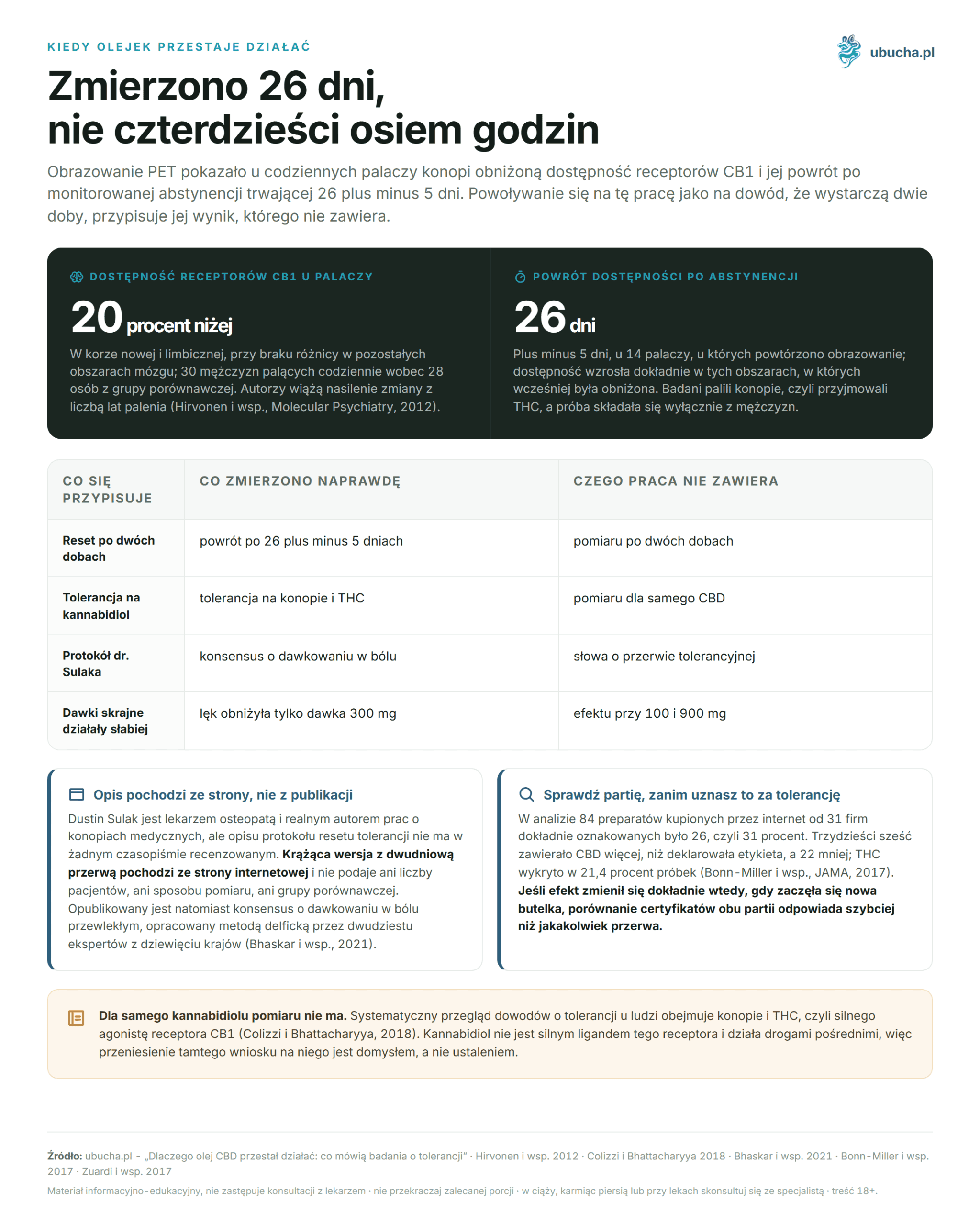
Not in this form. Dustin Sulak is an osteopathic physician and a real author of works on medical cannabis, but there is no description of the tolerance reset protocol in any peer-reviewed journal. The circulating version with a two-day break, symptom assessment on a scale, and return to a fraction of the previous dose comes from a website, not from a publication.
What is published under this name. Sulak is the first author of a paper on the state of cannabis use in the treatment of epilepsy in the United States (Sulak et al., Epilepsy and Behavior, 2017) and one of twenty experts from nine countries who developed recommendations for dosing medical cannabis in chronic pain using the Delphi method (Bhaskar et al., Journal of Cannabis Research, 2021). This second document is addressed to the physician treating the patient with diagnosed pain, describes three treatment schemes, and calls itself a consensus, not a research result. It says nothing about a tolerance break.
The practical difference between the two is that the description from the website does not provide the number of patients, measurement method, or control group, so it cannot be verified whether two days change anything. Therefore, you will not find the steps of this protocol in this text. Not because they are harmful, but because there is nothing to support them, and we do not publish schedules for taking here anyway.
What did brain imaging really show?
It showed a change in cannabis smokers and its reversibility, but on a scale of weeks, not hours. A study using positron emission tomography included 30 men who smoked cannabis daily and 28 individuals from the control group and showed about a 20% lower availability of CB1 receptors in the new cortex and limbic cortex in smokers, with no difference in other areas of the brain.
The reversibility was checked in a subgroup. The measurement was repeated in 14 smokers after 26 plus minus 5 days of monitored abstinence, and the availability of receptors increased exactly in those areas where it was previously reduced (Hirvonen et al., Molecular Psychiatry, 2012). The authors associate the severity of the change with the number of years of smoking.
Three things need to be said directly about this work, as they get lost in summaries. The subjects smoked cannabis, meaning they consumed THC, not cannabidiol. The measurement after the break was performed after nearly a month, so the work says nothing about what happens after two days. The sample consisted solely of men. Citing this study as evidence that forty-eight hours is enough assigns it a result that it does not contain.
Does increasing the dose help when the effect weakens?
The reflex is understandable, but a study that tested three different doses of cannabidiol in one experimental setup argues against it. The higher dose did not produce a stronger effect, only none.
Sixty healthy individuals aged 18-35 were randomly assigned to five groups of twelve: placebo, clonazepam 1 mg, and CBD at doses of 100, 300, and 900 mg. Participants spoke publicly in front of the other subjects, and anxiety was measured on a visual analog scale at four time points. In the post-speech phase, anxiety was significantly reduced by clonazepam and the 300 mg CBD dose, while the 100 mg and 900 mg doses did not differ from placebo (Zuardi et al., Frontiers in Pharmacology, 2017).
In guides, this work circulates in a distorted form, attributed to other authors and another journal, claiming that the extreme doses also worked, just weaker. This is not true, and the difference is significant: the inverted U-shaped curve here means that above a certain dose, the effect disappears, not that it gradually decreases. The phenomenon was described at one endpoint, in healthy individuals and after a one-time administration, so no rule for daily supplementation can be derived from it. More about the dose-effect relationship itself we gathered in the text about why more means worse.
What else explains the loss of effect?
Before concluding that the cause is tolerance, it is worth checking simpler and better-documented things. The first is the content of substances in a specific batch of the product, the second is a new drug, the third is a change in the reference point.
The scale of the first problem is measured. In the analysis of 84 products purchased online from 31 companies, exactly 26 were properly labeled, which is 31%. Thirty-six contained more CBD than the label declared, and 22 less; THC was detected in 21.4% of samples (Bonn-Miller et al., JAMA, 2017). If the effect changed exactly when a new bottle started, comparing the analysis certificates of both batches answers the question faster than any break.
The second path is interactions. Cannabidiol is metabolized by cytochrome P450 enzymes and itself affects their activity, so a new prescription drug can change its metabolism in both directions. The third is the reference point: if sleep has improved in the meantime or a period of strong stress has passed, the same change will be less noticeable. The safety threshold is set at a provisional dose of 0.0275 mg per kilogram of body weight per day, which is about 2 mg for a person weighing 70 kg, and the safety of cannabidiol cannot be established today in individuals under 25 years of age, in pregnant and breastfeeding women, and in individuals taking medications (EFSA, 2026).
Frequently Asked Questions
Does CBD cause tolerance like THC?
It is unknown, as there is no measurement for cannabidiol in humans. A systematic review of evidence on tolerance concerns cannabis and THC, a strong CB1 receptor agonist (Colizzi and Bhattacharyya, 2018). Cannabidiol acts on the endocannabinoid system through indirect pathways, so transferring that conclusion to it is a guess, not a determination.
Is Dr. Sulak’s tolerance reset protocol published?
Not in a peer-reviewed journal. Dustin Sulak is a real author of works on medical cannabis and a co-author of a consensus on dosing in chronic pain (Bhaskar et al., 2021), but the description of the two-day break comes from a website and does not provide the number of patients, measurement method, or control group.
How long does it take for CB1 receptor sensitivity to return?
The only measurement in humans concerns cannabis smokers. The availability of CB1 receptors returned to the level of the control group after 26 plus minus 5 days of monitored abstinence, in 14 subjects, in whom imaging was repeated (Hirvonen et al., 2012). For cannabidiol itself, there is no equivalent measurement, so no number of hours or days can be provided honestly.
Should I increase the dose when the oil stops working?
A study that compared three doses in humans argues against this reflex: anxiety was reduced only by the middle dose, and the highest did not differ from placebo (Zuardi et al., 2017). However, this is not a dosing guideline for the reader, but a result of a one-time administration in healthy individuals. Discuss any changes in dosage with a doctor.
How to distinguish tolerance from other causes?
By checking simpler things. Compare the certificate of analysis of the current and previous batch, as in the analysis of 84 products compliant with the label, there was 31% (Bonn-Miller et al., 2017). Check if the loss of effect coincided with a new drug metabolized by cytochrome P450 or a change in the baseline state against which you assess the difference.
The oils available in our store are gathered in the oils category. The very idea of a tolerance break and what is known about it is broken down in our text about tolerance break with THC and CBD.
This article is for informational and educational purposes and does not constitute medical advice. Before starting to use cannabis or CBD for therapeutic purposes, consult a doctor, especially if you are taking other medications, are pregnant, or breastfeeding.
Author: Michał Waluk · Published: 2026-08-09 · Updated: 2026-08-16