
Black cohosh for hot flashes: what does Cochrane say
Does black cohosh alleviate hot flashes? The Cochrane review included 16 studies and 2027 women. Check what the research really shows and where the 26 percent figure comes from.
Black cohosh is one of the most studied menopausal herbs and also one of those surrounded by the most misunderstandings. In Polish internet, there is a statement that the Cochrane review confirmed a reduction in hot flashes by more than a quarter. This review exists, it included 16 randomized studies and 2027 women, but its result sounds different than this repeated version. The difference is not academic, as hot flashes can disrupt sleep and workdays, and the decision to reach for the herb instead of consulting a gynecologist is often based on such statements. Below we separate these two things: what Cochrane actually found, where the 26 percent figure comes from, and what is known about the safety of black cohosh, including the discussion around the liver and its use after breast cancer.
KEY INFORMATION
• The Cochrane review (16 studies, 2027 women) found no difference compared to placebo in the frequency of hot flashes (Leach and Moore, Cochrane, 2012).
• The 26 percent figure comes from another meta-analysis, involving 9 studies and burdened with significant heterogeneity.
• The mechanism is not estrogenic: the extract binds serotonin receptors, most strongly 5-HT7.
• The European Medicines Agency allows use for up to 6 months without consulting a doctor.
Does black cohosh work for hot flashes?
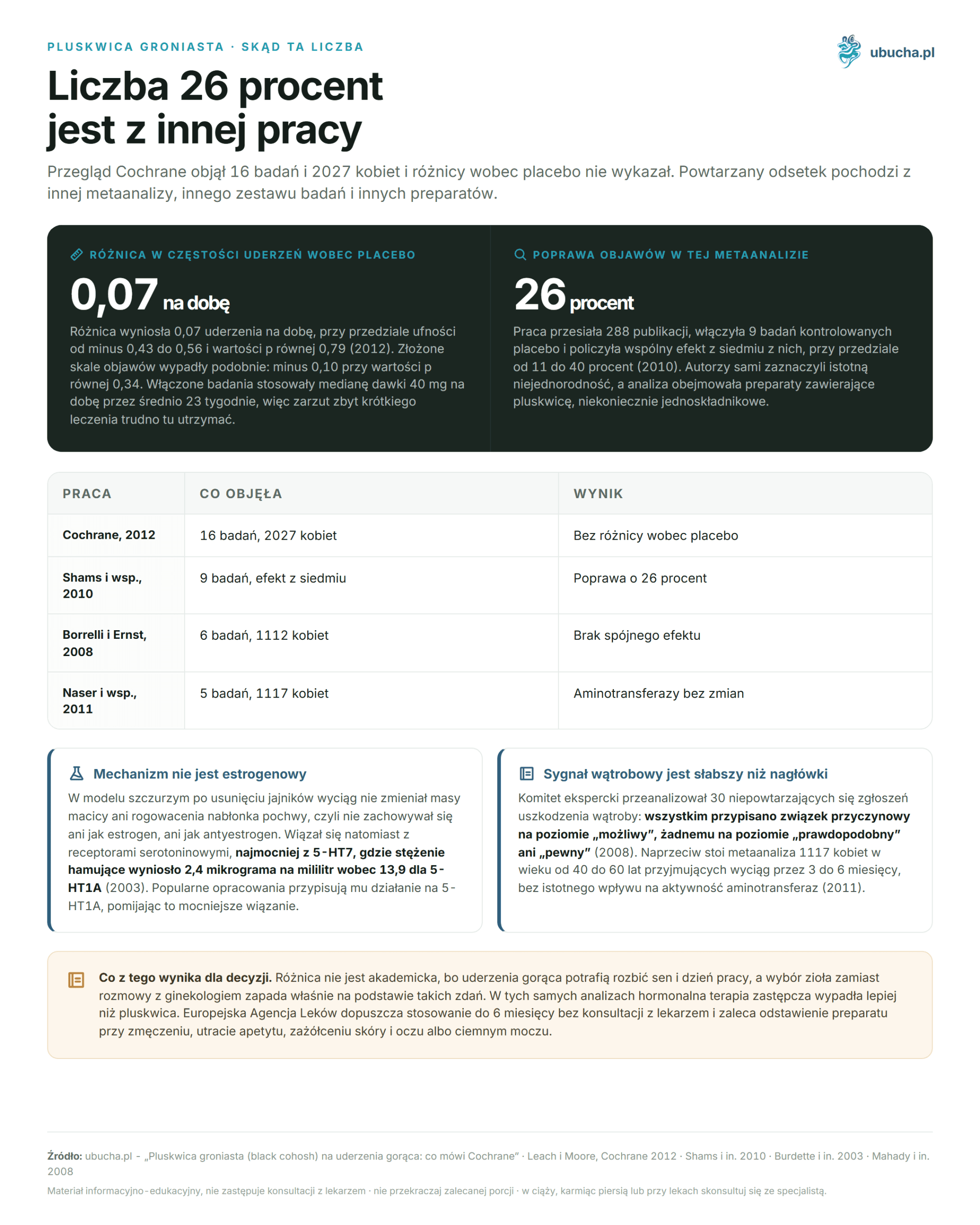
The Cochrane review answers negatively. It included 16 randomized studies and 2027 women in the perimenopausal and postmenopausal period, and the difference in the frequency of hot flashes compared to placebo was 0.07 flashes per day with a confidence interval from minus 0.43 to 0.56 and a p-value of 0.79 (Leach and Moore, Cochrane, 2012).
Similarly, complex scales of menopausal symptoms showed a standardized mean difference of minus 0.10 with a range from minus 0.32 to 0.11 and a p-value of 0.34. In both cases, the confidence interval includes zero, meaning the result is consistent with a lack of effect. The authors’ conclusion is straightforward: the evidence is insufficient to support the use of black cohosh for menopausal symptoms.
In the same analyses, hormone replacement therapy performed better than black cohosh, both in the frequency of hot flashes and in symptom scales, where the standardized difference was 0.32 with a range from 0.13 to 0.51. The studies included in the review used a median dose of 40 mg per day for an average of 23 weeks, so the criticism of too short or too weak treatment is hard to maintain here.
Where does the frequently cited 26 percent figure come from?
From another work and another set of studies. The meta-analysis by Shams and colleagues sifted through 288 publications, included 9 placebo-controlled randomized studies, and calculated a pooled effect from seven of them. Preparations containing black cohosh improved vasomotor symptoms by 26 percent with a confidence interval from 11 to 40 percent (Shams et al., Alternative Therapies in Health and Medicine, 2010).
The authors themselves noted significant heterogeneity among the studies, and the analysis included preparations containing black cohosh, not necessarily single-ingredient ones. Cochrane included only oral single-ingredient preparations, which is one of the reasons for the discrepancy.
We have noticed that in popular texts, both figures merge into one sentence: the 26 percent effect is attributed to the Cochrane review along with its methodological weight. This is the most serious informational defect on this topic. A third voice in the matter belongs to Borrelli and Ernst, who in six double-blind studies with a total of 1112 women found no consistent effect, although they did not rule out benefits for women in the perimenopausal period (Borrelli and Ernst, Pharmacological Research, 2008).
Does black cohosh act like estrogen?
There is no data to support this, and both animal studies and human observations argue against it. In a rat model after ovariectomy, the extract did not change uterine weight or vaginal epithelium, meaning it did not behave like either estrogen or anti-estrogen (Burdette et al., Journal of Agricultural and Food Chemistry, 2003).
This same work showed what the mechanism likely involves. The extract strongly bound to serotonin receptor subtypes 5-HT1A, 5-HT1D, and 5-HT7, with the strongest binding to 5-HT7, where the inhibitory concentration was 2.4 micrograms per milliliter compared to 13.9 for 5-HT1A. Against 5-HT7, the extract behaved as a partial agonist, raising cyclic AMP levels.
It is worth emphasizing this, as popular summaries attribute action to 5-HT1A, omitting the stronger binding to 5-HT7. In humans, confirmation comes from a six-month study by Liske and colleagues, in which two doses of the extract, 39 mg and 127.3 mg, were administered for 24 weeks. The response rate was 70 percent in perimenopausal women and 72 percent in postmenopausal women, vaginal cytology did not change, and levels of gynecologically relevant hormones remained without significant changes (Liske et al., Journal of Women’s Health and Gender-Based Medicine, 2002). The study did not have a placebo group, so the response rates should not be read as a measure of effectiveness.
Does black cohosh harm the liver?
A safety signal exists, but it is weaker than suggested by headlines. The expert committee of the American Pharmacopeia analyzed 30 unique reports of liver damage after black cohosh preparations. All were attributed a causal relationship at the “possible” level, none at the “probable” or “certain” level, and pharmacokinetic and toxicological data did not turn out unfavorably (Mahady et al., Menopause, 2008).
Nevertheless, the committee concluded that labels should contain a warning, changing its position from 2002. On the other hand, there is a meta-analysis of clinical trial data: five double-blind trials, 1117 women aged 40 to 60 taking isopropanol extract for 3 to 6 months, with no significant effect on aminotransferase activity (Naser et al., Menopause, 2011).
The practical conclusion is that the risk appears to be low, but not zero, and the reports concerned individual cases. The European Medicines Agency recommends discontinuing the preparation and urgent contact with a doctor if symptoms indicating a liver problem occur: fatigue, loss of appetite, yellowing of the skin and eyes, severe abdominal pain with nausea and vomiting, or dark urine (EMA, monograph Cimicifugae rhizoma).
Can black cohosh be used after breast cancer?
This question requires a discussion with an oncologist, not a decision made based on an article. Available observational data do not indicate an increased risk of recurrence. A retrospective cohort study included 18,861 breast cancer patients in Germany, of whom 1102 used isopropanol extract of black cohosh, with an average follow-up time of 3.6 years.
The risk ratio for recurrence was 0.83 with a confidence interval from 0.69 to 0.99. Two years after diagnosis, recurrence occurred in 14 percent of women in the control group, while in the group using the extract, the same percentage was reached only after 6.5 years (Henneicke-von Zepelin et al., International Journal of Clinical Pharmacology and Therapeutics, 2007). The authors formulate the conclusion cautiously: the increase in recurrence risk is unlikely.
Caution is warranted here, as the study was observational and retrospective, so it does not determine causality, and the TNM status was not known; however, the statistical model did account for age and tamoxifen use. Separately, the concern about interaction with tamoxifen, whose conversion to the active form depends on the CYP2D6 enzyme, was checked. In a study involving 16 healthy volunteers taking standardized extract for 14 days, significant inhibition of this enzyme’s activity was shown by Canadian golden seal, not black cohosh (Gurley et al., Molecular Nutrition and Food Research, 2008). This is one small study, so any supplement during oncological treatment still requires the approval of the attending physician. A broader overview of support during this life period is gathered in the post about menopause supplements.
How long can black cohosh be used without consulting a doctor?
The European Medicines Agency indicates a limit of 6 months. The monograph allows black cohosh preparations for menopausal complaints such as hot flashes and excessive sweating, and notes that they should not be taken for longer than six months without consulting a doctor.
This limitation does not arise from proven harm but from a lack of data on longer use. The studies included in the Cochrane review lasted an average of 23 weeks, and the meta-analysis of liver safety covered periods from 3 to 6 months. Beyond this horizon, there is simply nothing to rely on. The monograph also recommends discontinuing the preparation and contacting a doctor if liver symptoms occur, regardless of how long the treatment lasts.
When making decisions, it is worth remembering the proportions. The strongest review found no advantage over placebo, and hormone replacement therapy performed better in the same analyses, so discussing available options with a gynecologist takes precedence over self-supplementation. A similar discrepancy between the reputation of the herb and the state of evidence is described in the post about ginkgo and tinnitus, and a broader support plan after forty is discussed in the text about supplements for women over 40.
Frequently asked questions
Does black cohosh work for hot flashes?
The Cochrane review involving 16 studies and 2027 women found no difference compared to placebo in the frequency of hot flashes: 0.07 flashes per day with a confidence interval from minus 0.43 to 0.56 (Leach and Moore, 2012). The authors deemed the evidence insufficient.
Where does the 26 percent figure come from?
From a meta-analysis by Shams and colleagues, which included 9 placebo-controlled studies and calculated a pooled effect from seven of them: a 26 percent improvement in vasomotor symptoms, with a range from 11 to 40 percent, with significant heterogeneity (Shams et al., 2010). This is not a Cochrane result.
Does black cohosh act like estrogen?
There is no data to support this. In rats after ovariectomy, the extract did not change uterine weight or vaginal epithelium, but it did bind serotonin receptors, most strongly 5-HT7 (Burdette et al., 2003). In women, it did not change levels of gynecologically relevant hormones.
Does black cohosh harm the liver?
The American Pharmacopeia analyzed 30 reports of liver damage and attributed a possible relationship to all of them (Mahady et al., 2008). A meta-analysis of five studies involving 1117 women found no effect on aminotransferases (Naser et al., 2011).
Can black cohosh be used after breast cancer?
The decision is up to the oncologist. In a cohort of 18,861 patients, the risk ratio for recurrence in those using the extract was 0.83 with a range from 0.69 to 0.99, and the authors considered the increase in risk unlikely (Henneicke-von Zepelin et al., 2007). The study was observational.
How long can black cohosh be used without consulting a doctor?
Up to 6 months. The European Medicines Agency allows black cohosh preparations for menopausal complaints and notes that they should not be taken for longer than six months without consulting a doctor (EMA, Cimicifugae rhizoma). Longer use has not been studied.
This article is for informational and educational purposes and does not replace consultation with a doctor. If you are pregnant, breastfeeding, taking medications, or have chronic conditions, consult a specialist before using supplements or herbs.
Author: Michał Waluk · Published: 2026-08-09 · Updated: 2026-08-11