
Ginger for Painful Menstruation: Does It Match Ibuprofen (RCT)
Does ginger match ibuprofen for painful menstruation? We compare the Ozgoli study, the meta-analysis from Pain Medicine, and the EMA's stance on safety.
Primary dysmenorrhea, or menstrual pain without an identifiable gynecological cause, affects 45 to 95% of menstruating women (Iacovides et al., Human Reproduction Update, 2015). First-line treatment remains non-steroidal anti-inflammatory drugs, but some women seek herbal solutions, and ginger often comes up in this context. The question posed in the title is specific and can be verified, as there is a study in which ginger and ibuprofen were administered to women from the same group under the same protocol, as well as a systematic review collecting comparisons of ginger with placebo. Below, we describe what these studies really indicate, where the scope of their conclusions ends, and which questions remain unresolved. We start with the mechanism, as it is difficult to assess why a kitchen spice would compete with an anti-inflammatory drug without it.
KEY INFORMATION
• In the Ozgoli et al. study (Journal of Alternative and Complementary Medicine, 2009), 150 students were divided into three groups: ginger, mefenamic acid, and ibuprofen. After one menstrual cycle, no differences were found between the groups in pain intensity or treatment satisfaction. There was no placebo group in this study.
• A meta-analysis of four randomized studies showed a significant advantage of ginger over placebo on the PVAS pain scale (Daily et al., Pain Medicine, 2015).
• Ginger inhibits cyclooxygenases COX-1 and COX-2 and 5-lipoxygenase; this second point of action distinguishes it from classical anti-inflammatory drugs (Grzanna et al., Journal of Medicinal Food, 2005).
• The European Medicines Agency lists skin reactions and nausea of unknown frequency for ginger rhizome, as well as infrequent gastrointestinal complaints.
• All this data pertains to primary dysmenorrhea. In cases of suspected endometriosis or fibroids, gynecological diagnostics are necessary.
How does ginger affect menstrual pain?
Menstrual pain arises from the overproduction of prostaglandins in the endometrium. They cause uterine contractions and local ischemia, which is what we perceive as pain. A substance that limits the synthesis of prostaglandins should therefore reduce pain, and this premise underlies both the action of ibuprofen and the hypothesis regarding ginger.
The pharmacology of ginger was summarized by Grzanna et al. (Journal of Medicinal Food, 2005). The discovery of ginger’s inhibition of prostaglandin biosynthesis dates back to the early 1970s and has been repeatedly confirmed; it occurs through the inhibition of cyclooxygenases COX-1 and COX-2. Later observations expanded this picture: ginger also inhibits 5-lipoxygenase, thereby limiting the formation of leukotrienes. This second property distinguishes it from non-steroidal anti-inflammatory drugs, which act solely on cyclooxygenases.
The authors also describe an extract designated EV.EXT.77, obtained from ginger and galangal, which inhibits the induction of cytokine and chemokine genes as well as the COX-2 gene itself; this would be a mechanism of action in chronic inflammatory states. Caution in interpretation is warranted here: these findings come from laboratory studies, not measurements in women with painful menstruation. They explain why ginger might work, not how strongly it works in practice.
What did the direct comparison of ginger with ibuprofen show?
A comparison exists and did not show a difference between ginger and two anti-inflammatory drugs, but it has a structure that does not allow for a conclusion of equivalence. This distinction determines how strongly one can refer to this study.
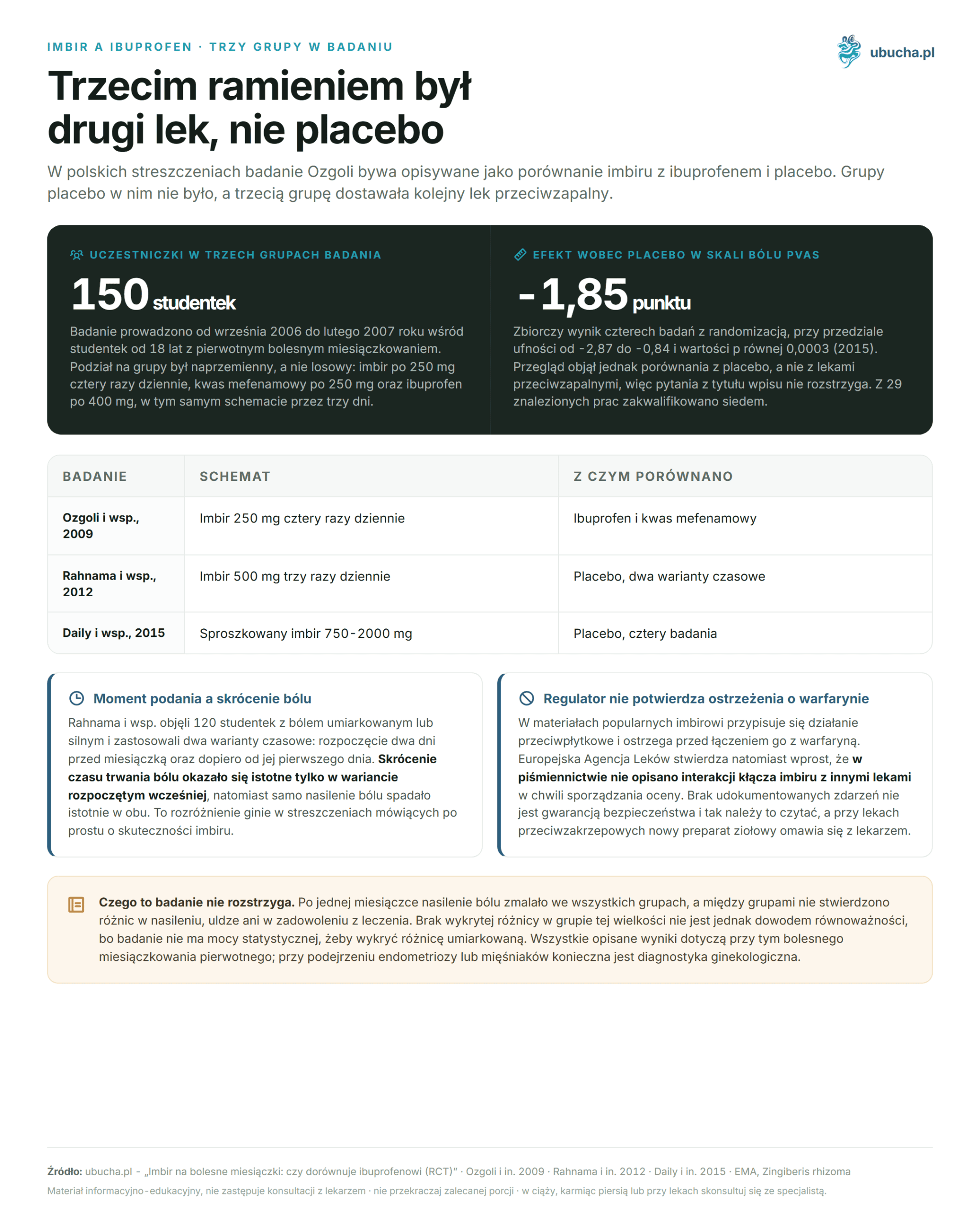
Ozgoli et al. (Journal of Alternative and Complementary Medicine, 2009) conducted a double-blind comparative study from September 2006 to February 2007 on 150 students aged 18 years with primary dysmenorrhea. Participants were alternately divided into three equal groups: powdered ginger rhizome in capsules of 250 mg four times a day, mefenamic acid at 250 mg, and ibuprofen at 400 mg, all in the same regimen for three days from the start of menstruation. The severity of complaints was assessed using a verbal multidimensional scale. After one menstrual cycle, pain severity decreased in all groups, and no differences were found between the groups in severity, pain relief, or treatment satisfaction. No serious adverse effects were reported.
We noted that in Polish internet sources, this study is sometimes summarized as a comparison of ginger with ibuprofen and placebo. There was no placebo group in it, and the third arm was mefenamic acid, another anti-inflammatory drug. The division into groups was alternating, not random. The lack of a significant difference between groups is not the same as evidence of equivalence: a study of this size simply does not have the statistical power to detect a moderate difference, and the unwarranted reversal of this conclusion is the most common misuse committed regarding this work.
What did the 2015 meta-analysis show?
The strongest collective evidence comes from a systematic review published in Pain Medicine. Daily et al. (2015) searched twelve databases, including Chinese, Korean, and Indian, and from 29 identified works, they qualified seven.
The meta-analysis itself included four randomized studies comparing ginger with placebo in the first three to four days of the cycle. The pooled result showed a significant reduction in pain on the visual analog scale PVAS in women with primary dysmenorrhea: the effect size was -1.85 with a confidence interval from -2.87 to -0.84 and a p-value of 0.0003. Six of the seven studies had low to moderate risk of systematic error. The authors concluded that these works provide evidence suggesting the effectiveness of powdered ginger in doses ranging from 750 to 2000 mg in the first three to four days of the cycle.
Two caveats must be stated directly. First, the meta-analysis included comparisons with placebo, not with anti-inflammatory drugs, so it does not resolve the question posed in the title of this entry. Second, all included studies pertained to primary dysmenorrhea, meaning pain without an identifiable gynecological cause. The results should not be applied to secondary dysmenorrhea associated with endometriosis or fibroids.
What doses and regimens were used in the studies?
The amounts and timing of administration varied among the studies enough that it is worth comparing them side by side. The table below describes what participants actually received and is not a recommendation for the reader: the use of any preparation for painful menstruation is decided by a doctor.
| Study | Participants | Regimen | Outcome |
|---|---|---|---|
| Ozgoli et al., 2009 | 150 students, 3 groups | Ginger 250 mg 4 times a day for 3 days from the start of menstruation | No differences compared to ibuprofen and mefenamic acid |
| Rahnama et al., 2012 | 120 students, 2 groups | Ginger 500 mg 3 times a day; variant starting 2 days before menstruation for the first 3 days | Significant difference compared to placebo in pain intensity in both variants |
| Daily et al., 2015 | Review of 7 studies, 4 in meta-analysis | Powdered ginger 750-2000 mg in the first 3-4 days of the cycle | Effect on PVAS scale -1.85 compared to placebo |
It is also worth noting what results from the second of these studies. Rahnama et al. (BMC Complementary and Alternative Medicine, 2012) included 120 students with moderate to severe pain and applied two timing variants. The reduction in pain duration was significant only when ginger was administered from two days before menstruation, not just from its onset. The pain level decreased significantly in both variants.
Is ginger safe and what might it interact with?
The European Medicines Agency maintains a herbal monograph for ginger rhizome and lists two categories of adverse effects: skin allergic reactions or nausea of unknown frequency and gastrointestinal complaints classified as infrequent, meaning they may occur in no more than one in a hundred people (EMA, Zingiberis rhizoma). No serious adverse effects were reported in any of the clinical studies described above.
The issue of interactions requires clarification, as the popular version diverges from the regulator’s position. In popular materials, ginger is attributed with antiplatelet action and warnings against combining it with warfarin. The Agency states, however, that no interactions of ginger rhizome with other medications were reported in the literature at the time of the assessment. This does not mean a guarantee of safety, only a lack of documented events, and this should be read accordingly.
The practical conclusion remains cautious despite the absence of described interactions. A person taking anticoagulant medications should discuss any new herbal preparation with their doctor, as the doctor knows the entire therapy and can order monitoring of coagulation parameters. The same principle applies during pregnancy, breastfeeding, and in chronic diseases.
What other methods have been studied for painful menstruation?
Ginger is not the only studied option, although not every popular method has a randomized study behind it. Distinguishing one from another has practical significance, as it prevents spending money on something that has never been tested.
Vitamin D was evaluated in a randomized, double-blind, placebo-controlled study, whose authors noted improvement in primary dysmenorrhea after a single oral dose (Lasco et al., Archives of Internal Medicine, 2012). This work is sometimes described in Polish texts as a Polish study, which is a mistake: it was published in an American journal, and the study was conducted in Italy.
We have noted, however, that many recommendations repeated in this context, from warm compresses to specific plant oils, circulate without citing any studies. This does not mean they do not work; it only means that no one has measured them, so their effectiveness cannot be compared to ginger or a drug. If you are looking for a summary of evidence for another substance used for menstrual pain, we have described it in the entry about CBD for Menstrual Pain. Ginger is also studied for a completely different indication, which we discuss in relation to ginger for nausea.
Frequently Asked Questions
Does ginger really help with painful menstruation?
The evidence is moderate, but it exists. A meta-analysis of four randomized studies showed a significant reduction in pain compared to placebo on the PVAS scale, with a result of -1.85 (Daily et al., Pain Medicine, 2015). The authors described this evidence as suggestive of effectiveness, not conclusive.
Does ginger match ibuprofen?
One study found no differences between ginger, ibuprofen, and mefenamic acid after one menstrual cycle in 150 students (Ozgoli et al., 2009). However, the lack of detected difference in a small group is not evidence of equivalence, so the answer is: it is unknown.
What doses of ginger were used in clinical studies?
A 2015 review included studies using 750 to 2000 mg of powdered ginger in the first three to four days of the cycle. The Ozgoli study used 250 mg four times a day, while the Rahnama study used 500 mg three times a day. Decide on the use of the preparation with your doctor.
When was ginger administered in the studies?
In the Rahnama et al. study, two variants were compared: starting two days before menstruation and only from the first day of menstruation. The reduction in pain duration was statistically significant only in the earlier-started variant, while the intensity of pain decreased significantly in both.
Is ginger safe?
The European Medicines Agency lists skin reactions and nausea of unknown frequency for ginger rhizome, as well as infrequent gastrointestinal complaints, occurring in no more than one in a hundred people. No serious adverse effects were reported in the described studies.
Does ginger interact with anticoagulant medications?
The European Medicines Agency states that no interactions of ginger rhizome with other medications were reported in the literature at the time of the assessment. However, the absence of reported events does not replace consultation: with warfarin and similar medications, any new herbal preparation should be discussed with a doctor.
Herbal preparations for oral use can be found in the herbs category in our store.
This article is for informational and educational purposes and does not replace consultation with a doctor. If you are pregnant, breastfeeding, taking medications, or have chronic conditions, consult the use of supplements or herbs with a specialist.
Author: Michał Waluk · Published: 2026-08-09 · Updated: 2026-08-11