
Ginger in Shots: What Studies Confirm (Nausea and Vomiting)
Does ginger work for nausea? A meta-analysis of 12 studies involving 1278 pregnant women and a trial on 576 oncology patients. Check what was confirmed and what was not.
Ginger is one of the few plant ingredients that has undergone serious clinical verification. It is not solely backed by tradition: we have meta-analyses of randomized studies, trials involving hundreds of oncology patients, and a described receptor mechanism. This is good news for ginger shots, but not good enough to transfer it unconditionally to any product labeled “with ginger.” The evidence is uneven: very strong for pregnancy-related nausea, moderate after chemotherapy, weaker and based on small trials for motion sickness. It is also worth knowing how quickly ginger components appear in the blood and how long they stay there, as this determines when a shot makes sense and when it is just a tasty drink. Below, we have gathered what exactly was tested, on how many people, at what doses, and with what results.
KEY INFORMATION
• A meta-analysis of 12 randomized studies involving 1278 women showed improvement in pregnancy-related nausea compared to placebo (Viljoen et al., Nutrition Journal, 2014).
• The number of vomiting episodes did not significantly decrease.
• In a trial involving 576 oncology patients, ginger reduced the severity of acute nausea as an adjunct to standard medications.
• Ginger inhibits platelet aggregation in laboratory conditions, which requires caution with anticoagulant medications.
Does ginger really work for nausea?
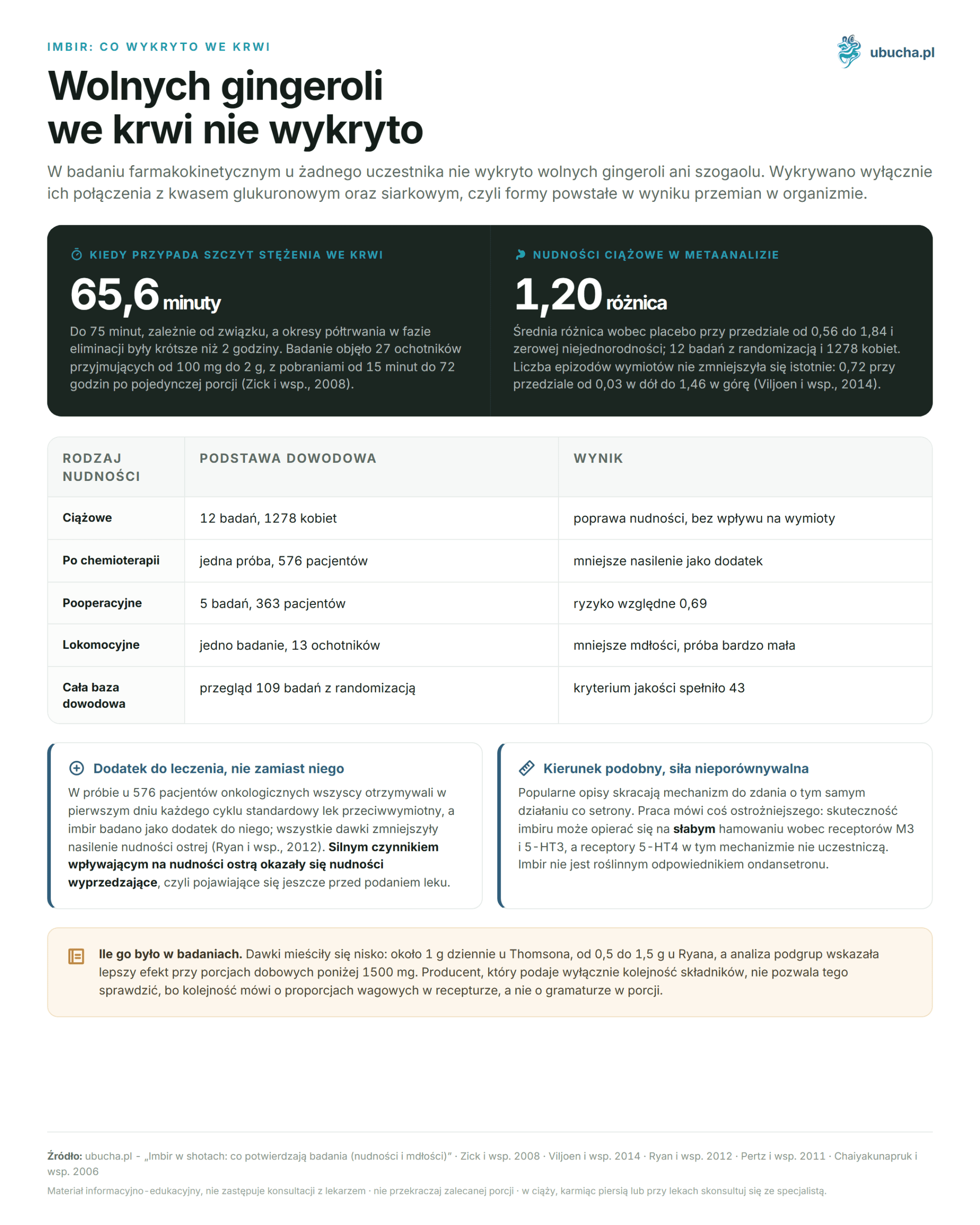
Yes, for pregnancy-related nausea, and this is the best-documented indication. A systematic review with meta-analysis included 12 randomized studies involving 1278 pregnant women. Ginger significantly reduced the severity of nausea compared to placebo, with a mean difference of 1.20 and a confidence interval from 0.56 to 1.84 and zero heterogeneity between studies (Viljoen et al., Nutrition Journal, 2014).
However, it is important to note what this same analysis did not show. The number of vomiting episodes did not significantly decrease: the mean difference was 0.72 with a range from minus 0.03 to 1.46, with high heterogeneity between studies. Thus, ginger alleviates the feeling of nausea better than it prevents vomiting itself, and it is worth describing it that way.
A second picture is provided by a smaller meta-analysis by Thomson and colleagues, which included 6 studies out of 135 reviewed, with a total of 508 participants, 256 on ginger and 252 on placebo. Using about 1 g of ginger daily for at least four days was associated with a fivefold greater likelihood of improvement (Thomson et al., Journal of the American Board of Family Medicine, 2014). The authors noted the heterogeneity of studies when interpreting the result.
How does ginger work for nausea?
Through receptors that are also targeted by antiemetic drugs, but much weaker. Pertz and colleagues studied gingerols and shogaols on guinea pig intestine samples and rat esophagus. Gingerols and 6-shogaol slightly but significantly reduced the maximum response to carbachol at a concentration of 10 micromoles, corresponding to action on muscarinic M3 receptors.
On the serotonin receptor 5-HT3, 10-gingerol had the strongest effect: it reduced the maximum response to serotonin from 93 percent to 65 percent at a concentration of 3 micromoles and to 48 percent at 5 micromoles. 6-shogaol at a concentration of 3 micromoles reduced it to 61 percent. The authors concluded that the effectiveness of ginger may be based on weak inhibitory action on M3 and 5-HT3, and 5-HT4 receptors are not involved in this mechanism (Pertz et al., Planta Medica, 2011).
We noticed that popular descriptions shorten this to a statement about “the same mechanism as setrons.” The paper states something more cautious: the direction of action is similar, but the strength is incomparable. Ginger is not a plant equivalent of ondansetron and does not replace antiemetic medication. How cannabinoids interact with the same receptor is described in our post about anticipatory nausea.
What did the study on chemotherapy patients show?
That ginger works as an adjunct to treatment, not instead of it. In a multicenter double-blind trial, 744 oncology patients were randomly assigned to four groups: placebo or ginger at doses of 0.5 g, 1 g, or 1.5 g daily. A total of 576 individuals were included in the final analysis, 91 percent of whom were women, with a mean age of 53 years.
All participants received standard antiemetic medication from the 5-HT3 antagonist group on the first day of each cycle. The tested preparation was taken for 6 days, starting 3 days before chemotherapy. All doses of ginger significantly reduced the severity of acute nausea on the first day of chemotherapy, with the greatest reduction noted at 0.5 g and 1 g (Ryan et al., Supportive Care in Cancer, 2012).
Another observation from the study, rarely mentioned, is that a strong factor influencing acute nausea was anticipatory nausea, which occurs before the medication is administered. This is a reminder that nausea has a central component, which the plant preparation alone is insufficient to address.
Does ginger help with motion sickness and postoperative nausea?
In both indications, the data is weaker than for pregnancy, but not zero. Motion sickness was mainly studied in small experimental trials. In a crossover double-blind study, 13 volunteers with a history of motion sickness were subjected to a visual stimulus that induced nausea.
Ginger at doses of 1000 mg and 2000 mg reduced nausea, abnormal gastric rhythm, and vasopressin release, as well as prolonged the time to onset of nausea and shortened recovery time after the stimulus ended (Lien et al., American Journal of Physiology, 2003). However, thirteen participants is a sample from which no clinical recommendation can be derived.
For postoperative nausea, there is a meta-analysis of five randomized studies involving 363 patients. The relative risk of nausea and vomiting after surgery was 0.69 with a confidence interval from 0.54 to 0.89, and for vomiting alone, it was 0.61 with a range from 0.45 to 0.84 (Chaiyakunapruk et al., American Journal of Obstetrics and Gynecology, 2006). The only reported adverse effect was abdominal discomfort.
| Type of Nausea | Evidence Base | Outcome |
|---|---|---|
| Pregnancy | 12 studies, 1278 women | Improvement in nausea, no effect on vomiting |
| Post-Chemotherapy | 1 trial, 576 patients | Reduced severity of acute nausea as an adjunct |
| Postoperative | 5 studies, 363 patients | Relative risk 0.69 (0.54-0.89) |
| Motion Sickness | 1 study, 13 volunteers | Reduced nausea, very small sample |
How quickly does ginger start to work after drinking a shot?
The peak concentration in the blood occurs about an hour after ingestion. In a pharmacokinetic study, 27 volunteers received ginger in doses ranging from 100 mg to 2 g, and blood samples were taken from 15 minutes to 72 hours after a single dose.
The time to reach maximum concentration ranged from 65.6 to 75 minutes depending on the compound, and the half-lives in the elimination phase were less than 2 hours (Zick et al., Cancer Epidemiology, Biomarkers and Prevention, 2008). Practically, this means that a shot taken about an hour before the expected onset of nausea hits the peak concentration, and the effect does not last all day.
There is a detail in this study that changes the way we think about “gingerol content.” No participant had free gingerols or shogaol detected in their blood. Only their conjugates with glucuronic and sulfuric acid were detected, which are forms produced as a result of metabolism in the body. Therefore, the declared percentage of gingerols in a product does not directly translate to what circulates in the blood after consumption.
How much ginger was used in the studies and what does it say about shots?
The doses in the studies were low: about 1 g daily in Thomson’s study, from 0.5 g to 1.5 g in Ryan’s study, and subgroup analysis in Viljoen indicated that better effects on nausea were achieved with daily doses below 1500 mg. This is not a recommendation for the reader, but a description of what was given to study participants.
For shots, this leads to a simple consequence: the order of magnitude of the tested portions is small, but the declaration of composition still matters, as without it, one cannot assess whether the product is in that range. A manufacturer that only lists the order of ingredients does not allow for this verification. We also noted that the order only indicates the weight proportions in the recipe, not the gram weight per serving, so without a number on the label, one cannot relate the product to the doses used in studies.
The scale of the entire evidence base is well illustrated by a review of 109 randomized studies on ginger. Consistent support was found for pregnancy-related nausea and vomiting, inflammation, metabolic syndrome parameters, gastrointestinal function, and colorectal cancer markers, while other expected effects were ambiguous, and only 43 studies, or 39.4 percent, met the high-quality evidence criterion (Anh et al., Nutrients, 2020). What is actually found in popular products is compiled in our post about functional shots.
When should caution be exercised with ginger?
Primarily with medications affecting coagulation. In a study on whole human blood outside the body, 8-gingerol, 8-shogaol, and 8-paradol inhibited platelet aggregation induced by arachidonic acid at inhibitory concentrations ranging from 3 to 7 micromoles, while for acetylsalicylic acid, this value was 20 micromoles (Nurtjahja-Tjendraputra et al., Thrombosis Research, 2003).
This result was obtained in vitro, on blood taken from donors, and not in clinical conditions, so it does not prove an increased risk of bleeding in people drinking shots. However, it is enough for individuals taking warfarin, acetylsalicylic acid, or clopidogrel to discuss regular consumption of larger amounts of ginger with their attending physician.
During pregnancy, the safety profile was calm. The meta-analysis by Viljoen found no significant increase in the risk of spontaneous abortion compared to placebo or vitamin B6, nor was there a significant risk of heartburn and drowsiness. Nevertheless, persistent or severe pregnancy-related nausea requires medical evaluation, not self-supplementation. Comparisons with other pathways for addressing nausea are gathered in our posts about CBD and nausea and about ginger for painful menstruation.
Frequently Asked Questions
Does ginger work for nausea?
Yes, for pregnancy-related nausea. A meta-analysis of 12 randomized studies involving 1278 women showed a significant improvement compared to placebo, with a mean difference of 1.20 and a confidence interval from 0.56 to 1.84 (Viljoen et al., Nutrition Journal, 2014). The number of vomiting episodes did not significantly decrease.
Which component of ginger is responsible for antiemetic action?
Gingerols and shogaols. In guinea pig intestine samples, 10-gingerol had the strongest effect, reducing the maximum response to serotonin from 93 to 48 percent. The authors described the action on M3 and 5-HT3 receptors as weak inhibition (Pertz et al., Planta Medica, 2011).
Can ginger replace antiemetic medication after chemotherapy?
No. In a trial involving 576 patients, all received standard medication from the 5-HT3 antagonist group, and ginger was studied as an adjunct (Ryan et al., Supportive Care in Cancer, 2012). All tested doses reduced the severity of acute nausea compared to placebo.
How quickly does ginger start to work?
The peak concentration in the blood occurs 65 to 75 minutes after ingestion, and the half-life is less than 2 hours (Zick et al., 2008). Only processed forms of gingerols were detected in the blood, not their free form.
Does ginger help with motion sickness?
Data is limited. In a crossover study, 13 volunteers found that ginger reduced nausea, abnormal gastric rhythm, and vasopressin release triggered by visual stimuli (Lien et al., 2003). With such a small number of participants, this is a suggestion, not clinical evidence.
Can ginger interact with medications?
Outside the body, ginger components inhibited platelet aggregation more strongly than acetylsalicylic acid, with inhibitory concentrations ranging from 3 to 7 micromoles (Nurtjahja-Tjendraputra et al., 2003). People taking anticoagulants should discuss regular consumption of larger amounts of ginger with their doctor.
Is ginger safe during pregnancy?
A meta-analysis of 12 studies found no significant increase in the risk of spontaneous abortion compared to placebo or vitamin B6, nor was there a significant risk of heartburn and drowsiness (Viljoen et al., 2014). However, severe pregnancy-related nausea requires medical evaluation.
Ready-made ginger drinks can be found in the shots category, where the composition of each item is provided on the product card.
This article is for informational and educational purposes and does not replace consultation with a doctor. If you are pregnant, breastfeeding, taking medications, or have chronic conditions, consult the use of supplements or herbs with a specialist.
Author: Michał Waluk · Published: 2026-08-09 · Updated: 2026-08-11