
Anandamide: the endocannabinoid responsible for the feeling of bliss
Anandamide is an endocannabinoid discovered in 1992. Check how it binds to CB1, why it disappears after a few minutes, and what actually raises its level.
Your brain produces a molecule that targets the same receptors as THC. It is called anandamide and is the first endocannabinoid described by science: in 1992, the team of Devane, Hanus, and Mechoulam isolated it from the brain of a pig and named it after the Sanskrit word “ananda”, meaning bliss (Devane et al., Science, 1992). Since then, anandamide has ceased to be a curiosity and has become the starting point for an entire field of research on the endocannabinoid system. Below you will find what can be said about this molecule today based on published works: where it binds, why it disappears after a few minutes, what measurements after physical exercise have shown, and where CBD fits into this picture.
KEY INFORMATION
• Anandamide was isolated in 1992 from the brain of a pig; it behaved at the cannabinoid receptor like a typical competitive ligand (Devane et al., Science, 1992).
• Mice lacking the FAAH enzyme have fifteen times more anandamide in their brains and feel less pain (Cravatt et al., PNAS, 2001).
• The concentration of endocannabinoids in the blood increases after running only at moderate intensity; very light and very heavy exercise does not change it (Raichlen et al., 2013).
• In a 2012 study, treatment with cannabidiol raised serum anandamide levels, and the increase was associated with clinical improvement (Leweke et al., Translational Psychiatry, 2012).
What is anandamide and how was it discovered?
Anandamide, or arachidonoylethanolamide (AEA), is a derivative of arachidonic acid that the body produces itself. The Devane team found it in the brain of a pig while screening for an endogenous ligand for the cannabinoid receptor, and confirmed its structure using mass spectrometry, nuclear magnetic resonance, and synthesis (Devane et al., Science, 1992).
The 1992 paper showed two things at once. Anandamide displaced a labeled cannabinoid probe from synaptosomal membranes in a manner typical of competitive ligands. It also dose-dependently inhibited the contraction of the vas deferens in mice induced by electrical stimulation, which is a reaction characteristic of psychoactive cannabinoids. Only together did these two results justify the conclusion that the molecule could serve as a natural ligand for this receptor.
The sequence of events was the opposite of what one might intuitively expect. First, the receptor that binds THC was described, and only then was the search conducted for what binds to it in the body without the involvement of the plant. Anandamide was the answer to that question and led to another: since there is one endocannabinoid, it is likely that it is not alone. The second described compound from this family is 2-AG, which occurs in the brain in much larger quantities.
The name was not a coincidence. Mechoulam chose the Sanskrit word meaning bliss because such a character was attributed to the action of cannabinoids at that time. The label turned out to be catchy and misleading at the same time: anandamide is not a happiness switch, but a regulator that dampens excess signal where there is too much of it. We discuss the discovery itself in a separate article about the circumstances of the isolation of anandamide in 1992.
How does anandamide work in the nervous system?
Anandamide acts as a retrograde messenger. In a typical synapse, the signal travels from the presynaptic neuron to the postsynaptic neuron, while anandamide goes against the flow: it is produced in the receiving cell and returns to the sending cell, where it stimulates CB1 receptors. The result is the dampening of excessive neurotransmitter release by the presynaptic neuron (Piomelli, Nature Reviews Neuroscience, 2003).
This reversal of direction has practical consequences. Anandamide does not send new information; it regulates the volume of the information that is already flowing. It is also not stored in vesicles like classical neurotransmitters: it is produced from membrane lipids when the cell needs it and breaks down immediately after it acts.
CB1 receptors are unevenly distributed in the brain. They are most abundant in the hippocampus, amygdala, basal ganglia, and prefrontal cortex, which are structures responsible for memory, emotions, movement, and planning. This map explains why one molecule can affect so many different functions at once. Besides CB1, anandamide also interacts with other proteins, although not with the same strength.
| Molecular target | Where it occurs | What its action concerns |
|---|---|---|
| CB1 | Brain (hippocampus, amygdala, cortex), spinal cord | Inhibition of neurotransmitter release, mood, pain, memory |
| CB2 | Immune system tissues, microglia | Modulation of inflammatory response |
| TRPV1 | Sensory neurons conducting pain | Perception of pain and temperature |
| PPAR-gamma | Cell nucleus | Regulation of lipid metabolism and inflammatory processes |
Why does anandamide act so briefly?
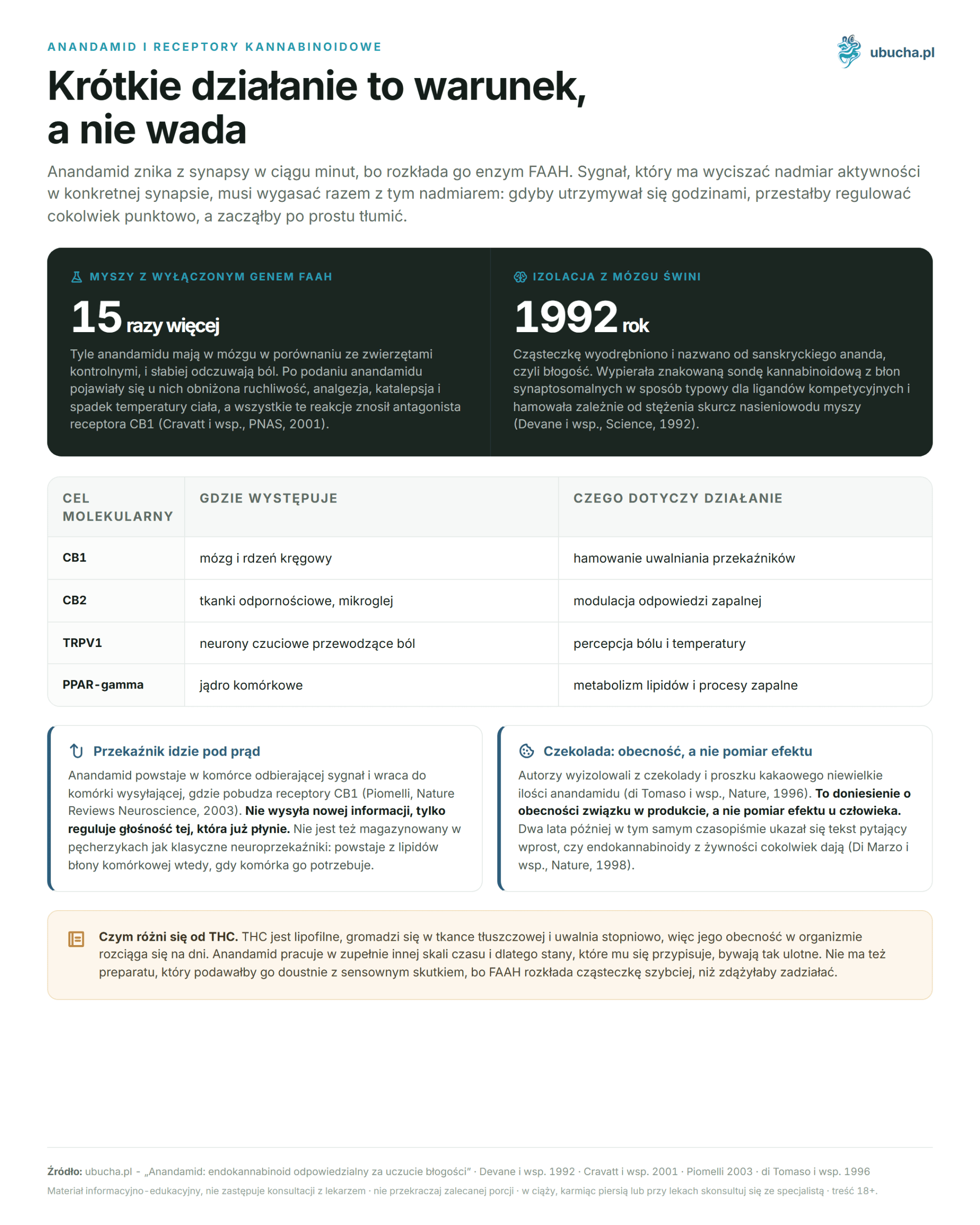
Anandamide disappears from the synapse within minutes because it is broken down by the FAAH enzyme, or fatty acid amide hydrolase. FAAH cleaves the molecule into arachidonic acid and ethanolamine, and the scale of this process is easy to measure: mice lacking the FAAH gene have fifteen times higher levels of anandamide in their brains than control animals (Cravatt et al., PNAS, 2001).
These same mice reacted to administered anandamide much more strongly than animals with a functioning enzyme. They exhibited reduced mobility, analgesia, catalepsy, and decreased body temperature, all of which were reversed by a CB1 receptor antagonist. The authors described FAAH as a key enzyme for maintaining the so-called endocannabinoid tone, or the baseline level at which the system operates on a daily basis.
The short duration of action is not a flaw, but a condition for the sensibility of the entire mechanism. The signal that is meant to dampen excess activity in a specific synapse must fade along with that excess. If anandamide were to persist for hours, it would cease to regulate anything specifically and would simply begin to suppress.
This also highlights the difference from THC. THC is lipophilic, accumulates in fatty tissue, and is released gradually, so its presence in the body extends over days. Anandamide operates on a completely different time scale, and that is why the states attributed to it can be so fleeting.
What connects CBD with anandamide?
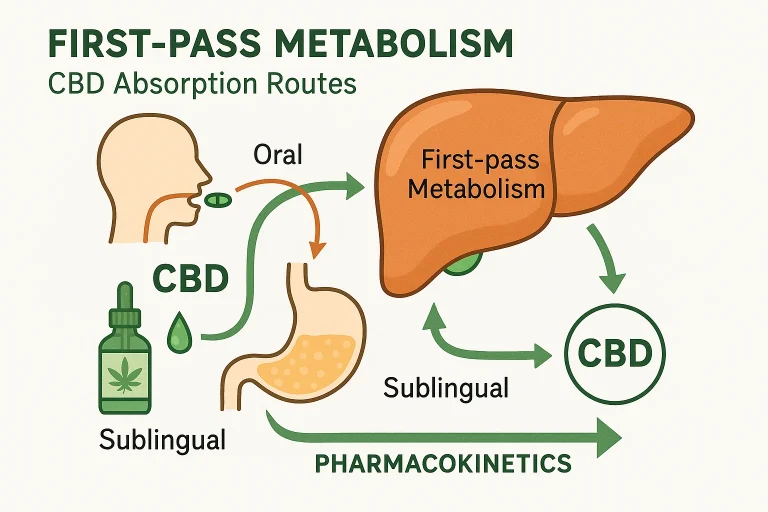
Cannabidiol does not directly stimulate cannabinoid receptors, but it moderately inhibits the breakdown of anandamide. Leweke and colleagues investigated whether this translates into clinical outcomes: in a double-blind study with random assignment, they compared cannabidiol with amisulpride in patients with acute schizophrenia (Leweke et al., Translational Psychiatry, 2012).
Both therapies were safe and both resulted in significant clinical improvement, with cannabidiol performing significantly better in terms of side effects. Treatment with cannabidiol was accompanied by a significant increase in serum anandamide levels, and this increase was associated with an improvement in patient condition. Previous works by the same team indicated that anandamide levels in cerebrospinal fluid inversely correlate with the severity of psychotic symptoms.
It is important to maintain proportions here. This study was conducted in a hospital setting, with individuals diagnosed with psychiatric conditions, and it does not say anything about the doses found in supplements or about healthy individuals. It shows the mechanism and its clinical significance in one specific situation, not a rule transferable to any context.
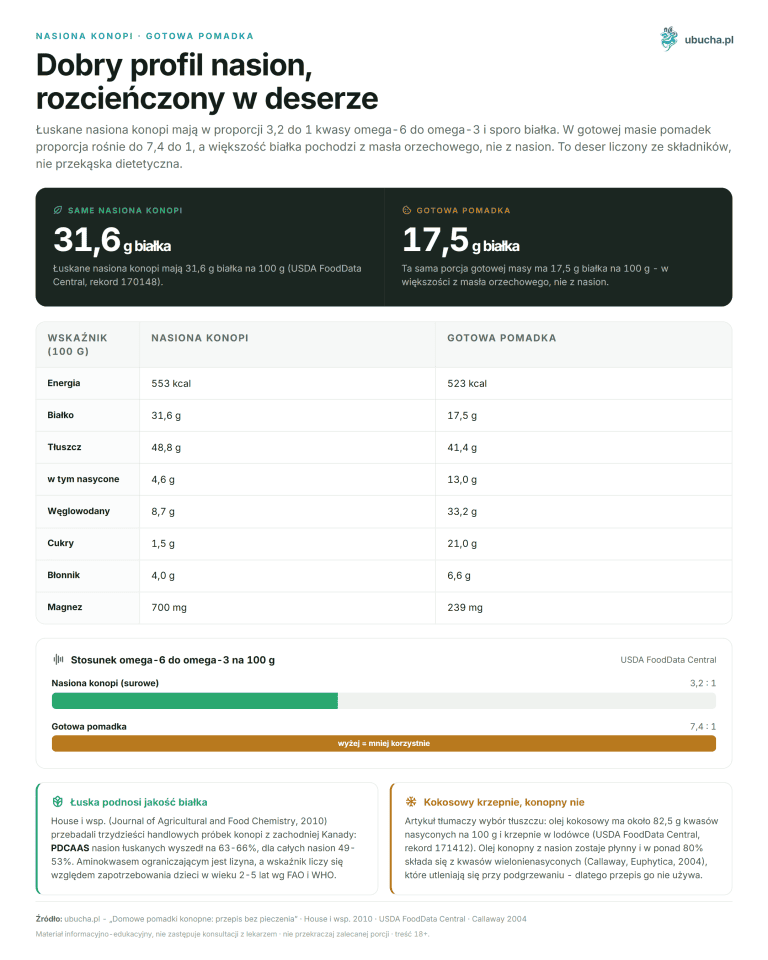
We have noticed that in questions from readers, this topic often returns in one form: whether the change in well-being when using oils is due to the action of cannabidiol itself or something else. Inhibiting FAAH is a sensible explanation, as it shifts the focus from external substances to the body’s own system. We develop this thread separately in the text about inhibiting the FAAH enzyme and raising anandamide levels.
What naturally increases anandamide levels?
The best-documented stimulus is aerobic exercise, but the result depends on the intensity. Raichlen and colleagues measured endocannabinoid levels in the blood of runners at four different loads and found a significant change only during moderate exercise; very light and very heavy loads did not change the result (Raichlen et al., 2013).
A year earlier, the same team compared humans, dogs, and ferrets on a treadmill. In humans and dogs, species adapted to endurance running, endocannabinoid levels increased after intense running, but not after low-intensity walking. In ferrets, which do not engage in endurance running, there were no changes at any load (Raichlen et al., 2012). The mechanism described as runner’s high is discussed more broadly in a separate guide on this phenomenon.
The popular chocolate thread has weaker foundations than suggested by headlines. The following summary shows what has been demonstrated in each case.
| Factor | What was demonstrated | Study |
|---|---|---|
| Moderate intensity running | Significant increase in endocannabinoids in the blood only at this intensity | Raichlen et al., 2013 |
| Endurance running in humans and dogs | Increase after running, no increase after walking; no changes in ferrets | Raichlen et al., 2012 |
| Chocolate and cocoa powder | Small amounts of anandamide were detected in the material; no effect was measured in humans | di Tomaso et al., Nature, 1996 |
| Inhibition of FAAH enzyme | Higher levels of anandamide in the brain and behavioral changes in animals | Cravatt et al., 2001; Kathuria et al., 2003 |
The study on chocolate deserves a separate comment, as it is often cited more widely than its content allows. The authors isolated small amounts of anandamide from chocolate and cocoa powder (di Tomaso et al., Nature, 1996). This is a report of the presence of the compound in the product, not a measurement of the effect in humans. Two years later, the same journal published a text directly questioning whether endocannabinoids from food provide any benefit (Di Marzo et al., Nature, 1998).
How does anandamide affect emotions, pain, and memory?
The impact on anxiety is best demonstrated by studies on FAAH inhibition. Kathuria and colleagues administered selective inhibitors of this enzyme to rats and obtained a profile similar to anxiolytic drugs: changes in behavior in the elevated zero maze test and a decrease in vocalizations caused by isolation. The effects were accompanied by an increase in anandamide levels in the brain, and blocking the CB1 receptor reversed them (Kathuria et al., Nature Medicine, 2003).
In the area of pain, the picture is two-sided. Through CB1 receptors in the spinal cord and brain, anandamide dampens the conduction of pain signals, as seen in studies of mice without FAAH, which showed reduced pain sensitivity that was reversed by a CB1 antagonist. Through TRPV1 receptors, the same ones that respond to capsaicin from chili peppers, it can act in the opposite direction. This duality is not a flaw: anandamide modulates pain perception depending on the situation, rather than unconditionally turning it off.
Memory is a more subtle matter. CB1 receptors are densely distributed in the hippocampus, and endocannabinoid signaling participates not only in the consolidation of memory traces but also in their extinction. Actively dampening memories that are no longer needed sounds less impressive than memorizing, but it is the subject of research into post-traumatic stress disorder, where the problem is precisely the excessive permanence of the trace.
Frequently Asked Questions
What is anandamide and where did its name come from?
Anandamide (AEA) is an endocannabinoid, a signaling molecule produced by the body that binds to cannabinoid receptors. It was isolated in 1992 from the brain of a pig, and its name was derived from the Sanskrit word \”ananda\”, meaning bliss (Devane et al., Science, 1992). It is produced on demand from membrane lipid.
How does anandamide work in the brain?
Anandamide acts as a retrograde messenger: it is produced in the receiving neuron and travels back to the sending neuron, where it stimulates CB1 receptors and dampens excessive neurotransmitter release (Piomelli, Nature Reviews Neuroscience, 2003). It does not carry new information, but regulates the intensity of the information already flowing through the synapse.
Why does anandamide break down so quickly?
It is broken down by the FAAH enzyme, which splits the molecule into arachidonic acid and ethanolamine. The scale of this process is evident in mice lacking the FAAH gene: they have fifteen times higher levels of anandamide in their brains and feel less pain, and the effect is reversed by a CB1 receptor antagonist (Cravatt et al., PNAS, 2001).
Does physical exercise increase anandamide levels?
Yes, but it depends on the intensity. Measurements in runners at four different loads showed a significant increase in blood endocannabinoid levels only during moderate exercise; very light and very heavy loads did not change the levels (Raichlen et al., 2013). The blood measurement result does not indicate the level in the brain.
What is the relationship between CBD and anandamide?
Cannabidiol moderately inhibits the breakdown of anandamide, rather than stimulating cannabinoid receptors. In a 2012 study, treatment with cannabidiol in patients with acute schizophrenia was associated with a significant increase in serum anandamide levels, correlated with clinical improvement (Leweke et al., Translational Psychiatry, 2012).
Can anandamide be supplemented?
There is no preparation that would effectively deliver anandamide orally, as the molecule is broken down by FAAH faster than it could take effect. The strategies being studied are indirect: inhibiting this enzyme and stimuli such as moderate-intensity aerobic exercise.
If you are looking for products where CBD is the ingredient described in this article, browse the hemp oil category in the u Bucha store.
This article is for informational and educational purposes only and does not constitute medical advice. Before starting to use cannabis or CBD for therapeutic purposes, consult your doctor, especially if you are taking other medications, are pregnant, or breastfeeding.
Author: Michał Waluk · Published: 2026-08-09 · Updated: 2026-08-10