
Grass-fed collagen vs marine: what is the difference and which one to choose
Grass-fed or marine collagen? We compare types, evidence of absorption, and the cost per gram of collagen in seven products from the store u Bucha. Prices: 2026-08-08.
Manufacturers of marine collagen advertise it as better absorbed, while manufacturers of the grass-fed version claim it is richer in types. Both sides are only partially correct. The only human study that directly compared collagen sources compared hydrolysate from fish scales with pig skin, not beef, and involved five volunteers (Ohara et al., 2007). The rest of the differences come down to the degree of hydrolysis, the set of types, and the price. In the store u Bucha, there are currently seven collagen products: six based on fish collagen and one based on grass-fed bovine collagen. We compare them using one common measure, which is the cost per gram of collagen, and check what clinical studies indicate for skin and what for joints. You will learn when the extra cost for the marine version is justified and when you are just paying for the label.
KEY INFORMATION
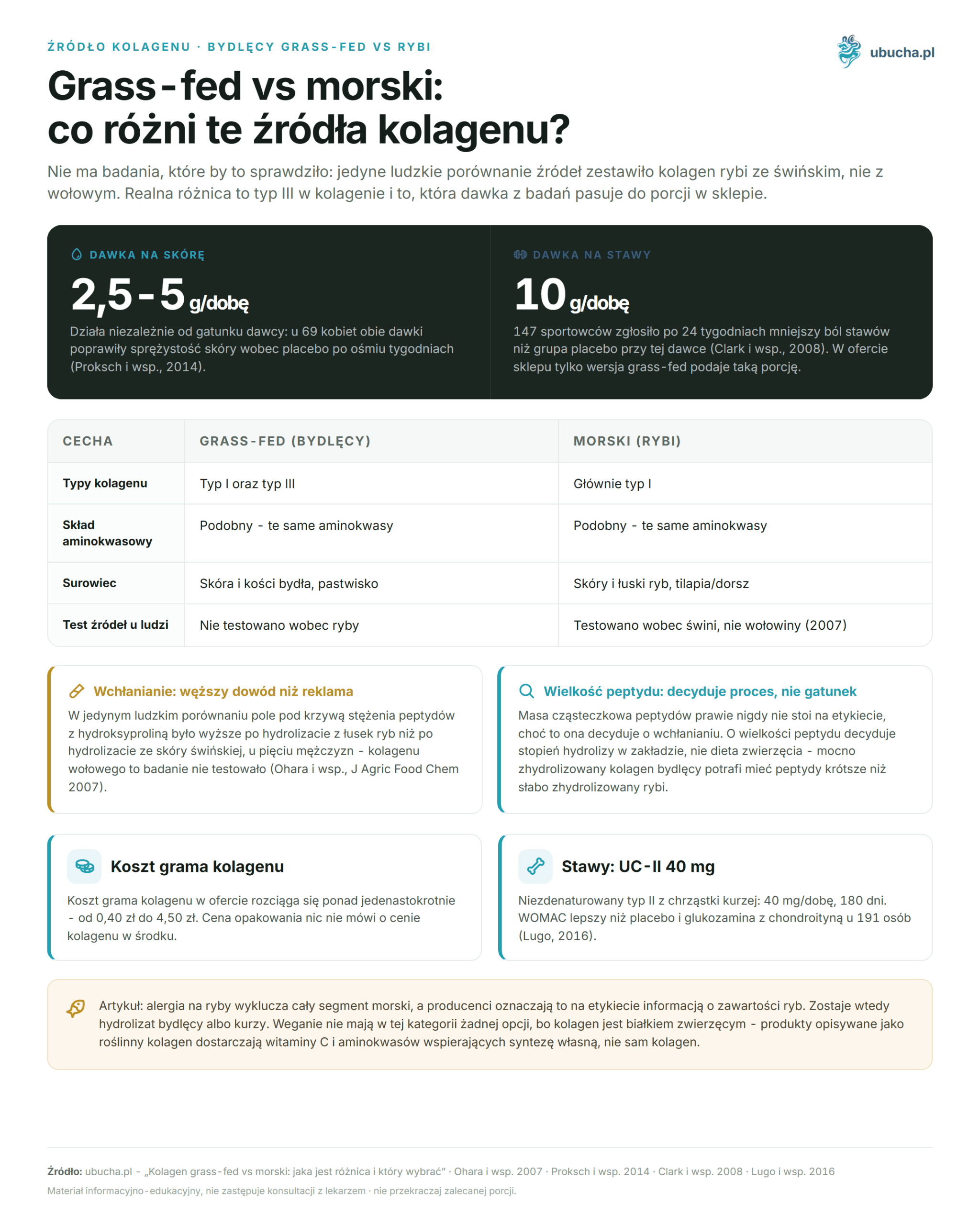
• The only human comparison of sources compared fish collagen with pig collagen in five volunteers, not with beef (Ohara et al., 2007).
• Marine collagen provides type I, grass-fed bovine provides types I and III.
• In the store’s offer, the cost per gram of collagen ranges from 0.40 PLN to 4.50 PLN.
• In case of fish allergy, bovine or chicken collagen remains.
What is the difference between grass-fed collagen and marine collagen?
They differ in the species of the donor and the set of collagen types. Grass-fed is a hydrolysate from the skins and bones of grass-fed cattle, providing type I and type III. Marine is derived from fish skins and scales, and its main component is type I. The grass-fed label describes the breeding method, not the peptide composition.
The amino acid composition of both forms is very similar, as glycine, proline, and hydroxyproline dominate in every collagen. The practical difference lies elsewhere: type III co-creates the reticular layer of the dermis and the walls of blood vessels, and it is usually absent in fish preparations. Therefore, the bovine producer sells two types in one portion, while the fish producer sells one.
The grass-fed certification has breeding and environmental significance, not biochemical. It does not change the sequence of peptides or their length, as this is determined by enzymatic hydrolysis in the facility, not the animal’s diet. Compare the declared mass of collagen in the portion, not the slogan on the front of the package. Fish raw material is most often derived from the skins and scales of tilapia or cod, i.e., from a by-product of processing. What each type does in the body and why type II stands alone, we have detailed in the text about types of collagen I, II, and III.
Does marine collagen really absorb better?
Probably yes compared to pig collagen, but the evidence is narrower than advertising suggests. In the only human comparative study, the area under the curve of peptide concentration with hydroxyproline was significantly higher after hydrolysate from fish scales than after hydrolysate from pig skin (Ohara et al., J Agric Food Chem 2007). The study involved five men and did not test bovine collagen.
Earlier work by the same team showed what these peptides are: after drinking the hydrolysate, the main compound detected in plasma is the dipeptide Pro-Hyp, and the peak concentration occurs 1-2 hours after consumption (Iwai et al., J Agric Food Chem 2005). They tested pig skin, chicken feet, and cartilage, so none of these publications speak about the advantage of fish over beef.
We noticed when comparing labels that the molecular weight of peptides is almost never stated on them, although it determines absorption. The size of the peptide results from the degree of hydrolysis, i.e., from the process, not from the species of the donor: highly hydrolyzed bovine collagen can have peptides shorter than poorly hydrolyzed fish collagen. Numbers like “twice better absorption” have no backing in the work we managed to access. How collagen peptides differ from unprocessed collagen and what this means for the label, we compared in the text about collagen peptides.
Which collagen to choose for skin and which for joints?
For skin, 2.5-5 g of hydrolysate daily is sufficient and it works regardless of the donor species: in a study involving 69 women, both doses improved skin elasticity compared to placebo after eight weeks (Proksch et al., 2014). For joints, the evidence concerns a dose of 10 g daily or a separate preparation, i.e., undenatured type II collagen.
The second work by this team involved 114 women aged 45-65 taking 2.5 g of collagen peptides. After eight weeks, the volume of wrinkles around the eyes decreased by 20% compared to placebo, and the content of type I procollagen in the skin increased by 65% (Proksch et al., 2014). This is the strongest skin evidence we have, and it does not resolve the dispute about the donor species.
For joints, the reference point is a study with 147 athletes who took 10 g of hydrolysate in liquid form for 24 weeks and reported less joint pain than the placebo group (Clark et al., 2008). A literature review from 2006 adds that oral hydrolysate is absorbed and accumulates in cartilage (Bello and Oesser). A separate path is undenatured type II from chicken sternum: 40 mg daily for 180 days improved the WOMAC score more than placebo and than glucosamine with chondroitin in 191 people (Lugo et al., 2016). We described how long it takes for the effect to be measurable and how to bring different forms to a common denominator in the text about collagen for joints and skin.
What collagen products does the store u Bucha have and how much do they cost?
Seven preparations, six based on fish collagen and one on grass-fed bovine collagen. Prices of packages range in a narrow range from 99 to 139 PLN, but the cost of one gram of collagen differs in this sevenfold by more than eleven times, as the daily portion contains from 0.73 g to 12 g. The comparison organizes them from the cheapest gram.
| No | Product | Source and what distinguishes it | Collagen per portion | Price | Cost per 1 g |
|---|---|---|---|---|---|
| 1 | Divine Collagen 315 g | grass-fed bovine, type I and III | 10 000 mg | 118.99 PLN | 0.40 PLN |
| 2 | Aura Care Power of Beauty 500 ml | liquid fish, with hyaluronic acid | 12 000 mg | 139 PLN | 0.58 PLN |
| 3 | Aura Care Power of Youth 500 ml | liquid fish, with MSM and adaptogens | 11 000 mg | 139 PLN | 0.63 PLN |
| 4 | Aura Care PREMIUM Beauty 200 g | powdered fish, with silicon and biotin | 5 500 mg | 129 PLN | 0.78 PLN |
| 5 | Aura Care PREMIUM Activity 200 g | powdered fish, with glucosamine and chondroitin | 5 500 mg | 129 PLN | 0.78 PLN |
| 6 | Aura Care Collagen Coffee 220 g | fish in instant coffee, with zinc | 2 000 mg | 99 PLN | 1.38 PLN |
| 7 | Aura Care Collagen Essence 50 ml | liquid type I fish drops, with B vitamins | 733 mg | 99 PLN | 4.50 PLN |
Prices are from the store ubucha.pl, as of August 8, 2026. We calculated the cost per gram from the declared collagen content in the daily portion and the number of portions in the package. The only grass-fed in this comparison is the cheapest per gram and is the only one that provides a 10 g portion, which is the joint dose from clinical studies. Fish preparations target the skin and are closer to the 2.5-5 g dose. You can find the full list in the supplements category.
What to look for on the collagen label?
Look for three numbers: the mass of collagen in the daily portion, the number of portions in the package, and the species of the donor. Only from these does the cost per gram emerge, and this varies in the offer from 0.40 PLN to 4.50 PLN. The price of the package itself says nothing about how much collagen you are actually buying.
The extreme values from the chart have their explanation. Collagen coffee and essence in drops are convenient forms, not economical: the first contains 2 g of collagen per portion, the second 0.73 g, so you also pay for the method of delivery. If the dose matters, you choose powder or liquid with several grams of collagen in the daily portion.
Fish allergy excludes the entire marine segment, and manufacturers mark this on the label with information about fish content. This leaves bovine or chicken hydrolysate. Vegans have no option in this category, as collagen is an animal protein: products described as plant-based collagen provide vitamin C and amino acids supporting the body’s own synthesis, which is not the same product and has much narrower documentation. We also noticed that some fish preparations declare types I and III, although collagen from skins and scales is predominantly type I, so read the type declaration together with the composition.
Frequently asked questions
What is the difference between grass-fed collagen and marine collagen?
Grass-fed comes from cattle fed on grass and provides types I and III. Marine is derived from fish skins and scales, so it mainly provides type I. The amino acid composition of both forms is similar, and the size of the peptides is determined by the degree of hydrolysis, not the species of the donor.
Does marine collagen absorb better than bovine collagen?
There is no study that has verified this. The only human comparison of sources showed a higher concentration of peptides after hydrolysate from fish scales than after hydrolysate from pig skin, in five volunteers (Ohara et al., 2007). Bovine collagen was not included in this study.
Which collagen is better for joints?
For joints, a dose of 10 g of hydrolysate daily was tested: 147 athletes reported less pain after 24 weeks than the placebo group (Clark et al., 2008). More specific is undenatured type II collagen from chicken cartilage, at a dose of 40 mg daily.
How much collagen daily makes sense?
For skin, 2.5-5 g daily, as this was the amount given in studies measuring elasticity and wrinkles (Proksch et al., 2014). For joints, 10 g daily. In the store’s offer, the daily portion contains from 0.73 g to 12 g of collagen, so the label needs to be recalculated.
Which collagen to choose if allergic to fish?
Marine collagen is then excluded, including liquids, powders, and collagen coffee based on fish. A safe alternative is grass-fed bovine hydrolysate or chicken. Manufacturers of fish products provide information about the fish content in the allergen list.
Is there collagen for vegans?
Not in the literal sense, as collagen is an animal protein. Products described as plant-based collagen are sets of vitamin C and amino acids that support the body’s own synthesis. Their clinical documentation is clearly poorer than that of animal hydrolysates.
Fish and grass-fed bovine collagens from this comparison can be found in the supplements category in the store u Bucha.
This article is for informational and educational purposes and does not replace consultation with a doctor. If you are pregnant, breastfeeding, taking medications, or have chronic conditions, consult the use of supplements or herbs with a specialist.
Author: Michał Waluk · Published: 2026-06-15 · Updated: 2026-08-08