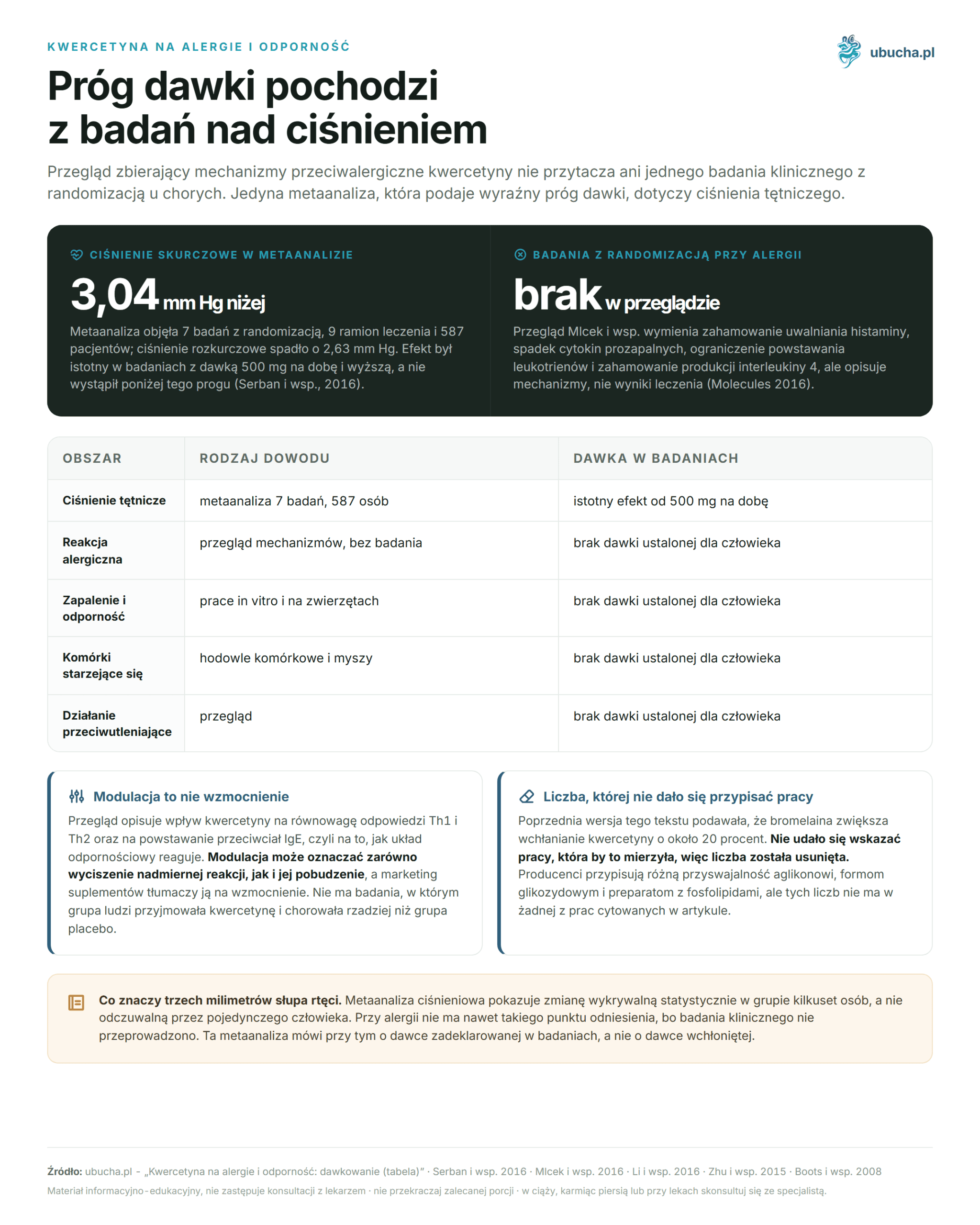

Quercetin for allergies and immunity: dosage (table)
Quercetin for allergies and immunity: what has really been shown in humans, what doses were used in randomized studies, and where the scientific evidence ends.
Quercetin is a flavonoid found in onions, apples, berries, and tea. It is described as a natural response to hay fever, and dosage tables circulate online in dozens of versions. Most of them lack support from human studies. The review by Mlcek et al. in the journal Molecules collects the anti-allergic mechanisms of quercetin but does not cite a single randomized clinical study in patients. The only meta-analysis of randomized studies that provides a clear dosage threshold concerns blood pressure, not allergies. This text shows what has actually been tested in humans, what doses were used in these studies, and where the evidence ends. You will find a table comparing areas of action with the type of evidence that supports them, as well as an indication of which popular numbers have been removed from this article because no source could be identified.
KEY INFORMATION
• The anti-allergic mechanism of quercetin is described in detail, but the review that collects it does not cite a clinical study with randomization in allergy patients (Mlcek et al., Molecules 2016).
• The only clear dosage threshold in humans comes from a meta-analysis of 7 randomized studies with 587 participants, concerning blood pressure: the effect was significant from 500 mg per day (Serban et al., Journal of the American Heart Association 2016).
• The action of removing aging cells has been demonstrated in cultures and in mice, not in humans (Zhu et al., Aging Cell 2015).
• This article does not contain dosage recommendations. The choice of a supplement for allergies, asthma, or while taking medications is determined by a doctor.
What is quercetin and where is it found?
Quercetin is a flavonol, one of the subtypes of flavonoids, and the most abundant flavonol in the diet. Boots et al. in a review published in European Journal of Pharmacology describe it as one of the best-known dietary antioxidants, commonly found in vegetables, fruits, tea, and wine, as well as in countless supplements (Boots et al., European Journal of Pharmacology 2008).
This same review indicates how its antioxidant action works: quercetin captures highly reactive molecules, including peroxynitrite and hydroxyl radical. The authors list diseases for which its protective action is attributed, from osteoporosis to lung and cardiovascular diseases, but they do so in a mode of declared benefits requiring evidence, not findings.
It is worth remembering this difference, as it recurs throughout the text. Quercetin has well-described chemistry and a wide range of effects observed in vitro. The translation of these effects to humans after consuming a capsule is a separate question, to which significantly fewer studies respond. The authors of the review formulate this cautiously: they write that the aim of their work is to assess the gathered studies to clarify the possible beneficial action of quercetin, not to confirm it in advance. They also separately discuss toxicological aspects, which, for a compound sold over the counter, is information as important as the list of potential benefits.
How does quercetin affect allergic reactions?
Quercetin inhibits the release of histamine and suppresses the production of inflammatory mediators. The review by Mlcek et al. in Molecules lists specific points of action: inhibition of histamine release, a decrease in pro-inflammatory cytokine levels, a reduction in leukotriene formation, and inhibition of interleukin 4 production (Mlcek et al., Molecules 2016).
The authors also describe the impact on the balance of Th1 and Th2 immune responses and the reduction of antigen-specific IgE antibody formation. This last point is significant because IgE triggers the entire allergic cascade. Additionally, there is inhibition of enzymes: lipoxygenase and eosinophil peroxidase. One comparison with a drug is made directly. The authors write that the plant extract containing quercetin, which is the main ingredient in many potential anti-allergic preparations, inhibits interleukin 8 more effectively than disodium cromoglycate, an anti-allergic drug.
However, a fundamental caveat exists. The review describes mechanisms and possible applications, not treatment results. The authors write about potential use in the late phase of the asthmatic reaction, in allergic rhinitis, and to a limited extent in peanut anaphylaxis, but do not cite a randomized clinical study that would confirm this in patients. A person with seasonal allergic rhinitis will not find a basis here to replace treatment. However, they will find a reason why quercetin is being further studied. If you are looking for a comparison with other plant-based directions, we have described them in the text about whether CBD alleviates allergic rhinitis and seasonal allergies.
What doses of quercetin have been tested in humans?
The only compilation of randomized studies that provides a specific dose and specific outcome in humans does not concern allergies. The meta-analysis by Serban et al. included 7 randomized studies, 9 treatment arms, and 587 patients, with blood pressure as the endpoint. Quercetin supplementation lowered systolic blood pressure by an average of 3.04 mm Hg and diastolic by 2.63 mm Hg (Serban et al., Journal of the American Heart Association 2016).
The breakdown by dose is what you came here for. The authors found a significant effect in studies with a dose of 500 mg per day or higher, and no significant effect below this threshold. They themselves note that the intermediate comparison between doses did not show a significant difference, so the threshold is a guideline, not a boundary of action. The table below summarizes what can be attributed to specific studies.
| Area | Type of evidence | What was shown | Dose in studies | Source |
|---|---|---|---|---|
| Blood pressure | meta-analysis of 7 randomized studies, 587 participants | decrease in systolic blood pressure by 3.04 mm Hg and diastolic by 2.63 mm Hg | significant effect from 500 mg per day, no significant effect below | Serban et al. 2016 |
| Allergic reaction | review of mechanisms, no clinical study | inhibition of histamine release, decrease in interleukin 4 and 6, inhibition of lipoxygenase | no dose established for humans | Mlcek et al. 2016 |
| Inflammation and immunity | review of in vitro and animal studies | anti-inflammatory and antiviral action, effect on capillary permeability | no dose established for humans | Li et al. 2016 |
| Aging cells | cell cultures and mice | quercetin removed aging endothelial cells, dasatinib removed precursors of fat cells | no dose established for humans | Zhu et al. 2015 |
| Antioxidant action | review | capture of peroxynitrite and hydroxyl radical | no dose established for humans | Boots et al. 2008 |
Why is quercetin absorption sometimes a problem?
The review by Li et al. in the journal Nutrients devotes a separate section to the physicochemical properties of quercetin, its sources in the diet, absorption, bioavailability, and metabolism in the body (Li et al., Nutrients 2016). The very fact that bioavailability requires a separate discussion in the review speaks to the scale of the issue.
In circulation, you will encounter several forms: aglycone, glycosidic forms from food, and preparations combined with phospholipids. Manufacturers attribute different absorbability to them and provide comparative numbers. You will not find these numbers in any of the studies cited in this article, which is why we do not repeat them here. The previous version of this text stated that bromelain increases quercetin absorption by about 20 percent. No study measuring this could be identified, so the number has been removed.
The practical consequence is that comparing doses between preparations of different forms has no solid basis. The blood pressure meta-analysis speaks of the dose declared in studies, not the absorbed dose. This is another reason not to treat the number on the label as a measure of action.
What is known about the effect of quercetin on immunity?
The review by Li et al. describes a wide range of biological actions of quercetin: anti-cancer, anti-inflammatory, and antiviral, as well as limiting lipid peroxidation, platelet aggregation, and capillary permeability. The authors summarize that the prospects are good but close the work with the statement that further research is needed to characterize the mechanisms underlying these benefits.
This statement should be read literally. The listing of effects comes from in vitro studies and animal models, which the authors note in the first sentence of the summary. There is no study in which a group of people took quercetin and got sick less often than a placebo group. Popular comparisons of quercetin with vitamin C and zinc for the infection season are based on mechanisms, not on such an outcome.
There is one more reason for caution, which arises directly from the structure of both reviews. Mlcek et al. describe the effect of quercetin on the Th1 and Th2 balance and on the formation of IgE antibodies, that is, on how the immune system reacts. This is not the same as strengthening immunity in the common sense, as modulation can mean both dampening an excessive reaction and stimulating it. The marketing of supplements usually translates modulation into strengthening, and studies do not make such a translation.
If you are building a set of supplements for the cold months, a more sensible approach than multiplying ingredients is to check which of them have data in humans. We have gathered them in the review of supplements for autumn and immunity.
Does quercetin remove aging cells?
Quercetin belongs to the first described group of compounds called senolytics, but the evidence comes from cell cultures and mice. The work by Zhu et al. in Aging Cell described how this group was identified: aging cells have enhanced survival pathways, and silencing their nodes kills aging cells while sparing dividing and resting cells (Zhu et al., Aging Cell 2015).
The division of roles between the two compounds was clear in this work. Dasatinib removed aging human precursors of fat cells, while quercetin acted more effectively against aging human endothelial cells and mouse bone marrow stromal cells. The combination of both proved effective against mouse embryonic fibroblasts and reduced the burden of aging cells in old, irradiated mice and those with a mutation accelerating aging.
None of these results are outcomes in humans, and none provide an oral dose for humans. Dasatinib is a prescription anti-cancer drug, so protocols described online as home recreations of this experiment have no relation to the cited work. We expand on this topic in the text about fisetin and quercetin as senolytics.
What to check before reaching for a supplement?
The first thing is the reason. Seasonal allergies, asthma, and chronic rhinitis are medical diagnoses, and quercetin does not have a clinical study that justifies replacing treatment with it. If symptoms interfere with sleep or work, the starting point is a visit to a doctor, not a change of supplement.
The second is medications taken regularly. Interactions of flavonoids with drugs metabolized in the liver are a researched topic, but none of the studies cited in this article provide a list of substances or the scale of concentration change, so you will not find such a list here. This is determined by a pharmacist or the attending physician, having insight into the full list of medications taken.
The third is pregnancy and breastfeeding. The lack of safety data is not the same as proof of safety, and in this group, the decision is made by a doctor.
The fourth is expectations regarding the number on the package itself. The blood pressure meta-analysis shows an effect of about three millimeters of mercury, which is a statistically detectable change in a group of several hundred people, but not perceivable by an individual. In the case of allergies, there is not even such a reference point, as a clinical study has simply not been conducted. You can find supplements with quercetin and other flavonoids in the supplements category, but the choice of a preparation does not replace diagnosis or treatment.
Frequently asked questions
Does quercetin help with seasonal allergies?
The mechanism is described, but the clinical outcome is not. The review by Mlcek et al. in Molecules mentions the inhibition of histamine release, a decrease in pro-inflammatory cytokines, and a reduction in leukotriene formation, but it describes mechanisms, not treatment results. It does not cite a randomized study in patients with allergic rhinitis that would show the superiority of quercetin over placebo.
What dose of quercetin has been studied in humans?
The meta-analysis by Serban et al. included 7 randomized studies with 587 participants, and the endpoint was blood pressure. A significant effect was observed in studies with a dose of 500 mg per day or higher, and none was observed below this threshold. This is a description of studies, not a dosage recommendation for the reader.
Does quercetin with bromelain absorb better?
We did not find a study that measured this. The previously mentioned number in this article indicating an increase in absorption by about 20 percent had no source and has been removed. The review by Li et al. discusses the bioavailability of quercetin but does not compare it with bromelain or provide such a multiplier.
Is quercetin a senolytic in humans?
This has not been demonstrated. The work by Zhu et al. in Aging Cell described quercetin as a compound that removes aging endothelial cells in culture and, in combination with dasatinib, reduces the burden of aging cells in mice. Dasatinib is a prescription drug, and the transfer of these results to humans has not been confirmed.
In which products is quercetin most abundant?
The review by Boots et al. indicates vegetables, fruits, tea, and wine as common sources of quercetin in the diet, while the review by Mlcek et al. lists onions as the best-studied food source, along with broccoli, apples, berries, and grapes. None of these studies provide the content in milligrams per 100 grams.
This article is for informational and educational purposes and does not replace consultation with a doctor. If you are pregnant, breastfeeding, taking medications, or have chronic conditions, consult the use of supplements or herbs with a specialist.
Author: Michał Waluk · Published: 2026-08-09 · Updated: 2026-08-11