
Iron in Excess: Overload, Oxidation and Who Should NOT Supplement
Excess iron: why EFSA did not establish an upper limit for it, how free iron damages cells, and which groups should not supplement without testing.
Iron is one of the few elements that the human body cannot actively excrete. Absorption can be slowed down, but there is no excretion. Everything that the intestine does not retain remains in the tissues and accumulates over the years. Therefore, supplementation “just in case” is not neutral: for some people, it shifts the balance towards a point of no return without treatment. This does not mean that iron is dangerous. It means that it is an element where the order is often reversed: first testing, then the supplement. Below you will find the mechanism of damage at the cellular level, the current position of EFSA, which in 2024 refused to establish an upper limit for iron, a table of risk groups, and a set of tests after which the decision to supplement is no longer a guess.
KEY INFORMATION
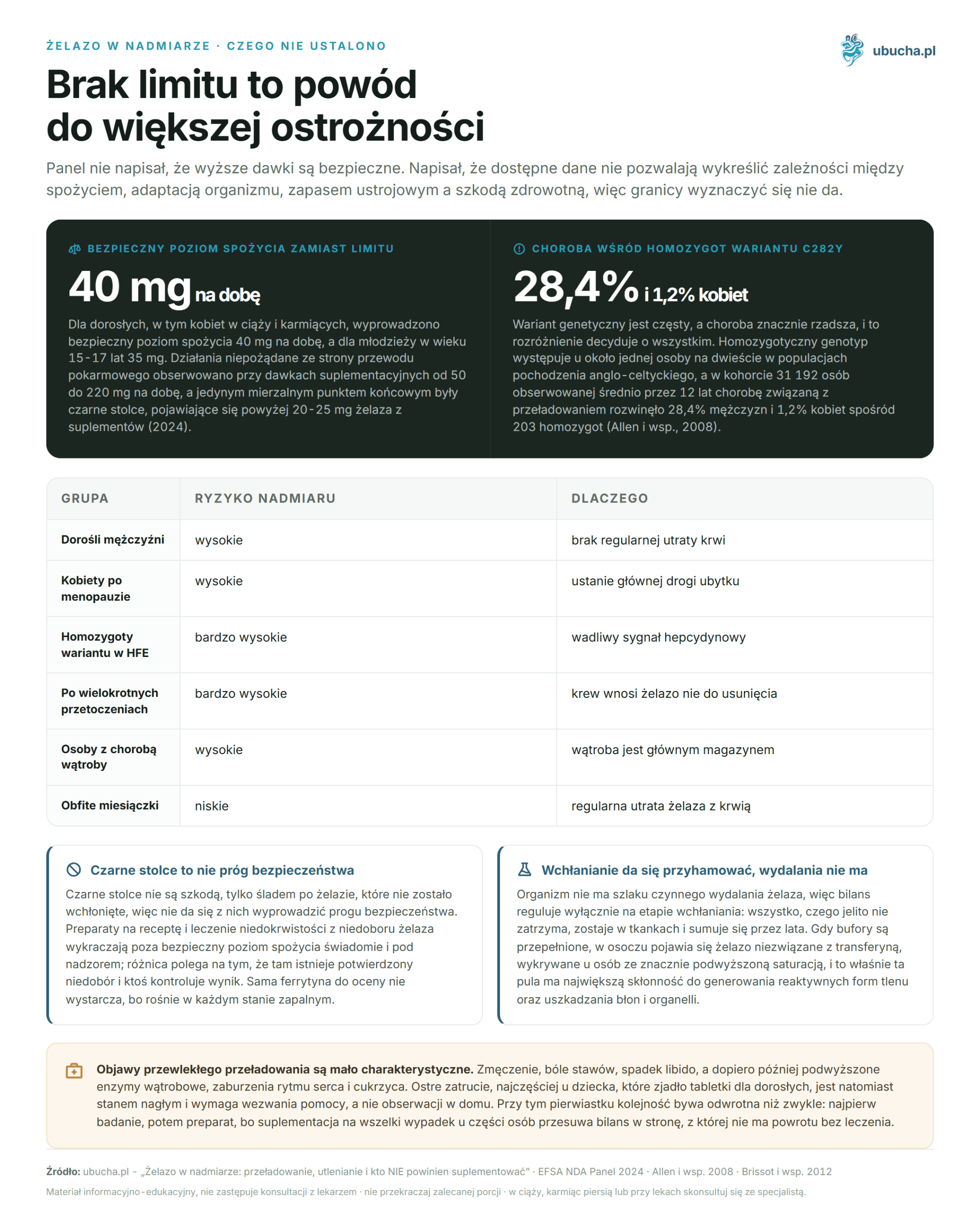
• EFSA has not established a tolerable upper intake level for iron; instead, it derived a safe intake level of 40 mg per day for adults (EFSA Journal 2024).
• Free iron drives the Fenton cycle and produces hydroxyl radicals that damage DNA and cell membranes.
• Disease related to overload developed in 28.4% of men and 1.2% of women with homozygous C282Y variant (Allen et al., 2008).
• Ferritin alone is not sufficient, as it increases in any inflammatory state.
How does excess iron damage the body?
Through chemistry, not mass. Trace amounts of unbound iron catalyze the Fenton and Haber-Weiss reaction cycles, in which hydroxyl radicals are produced, one of the most reactive molecules in the cell. It damages membrane lipids, proteins, and DNA (Kruszewski, Mutation Research 2003).
The cell defends itself by keeping the pool of labile iron at the lowest possible level, and the body does the same on a systemic scale: transferrin binds iron in circulation, ferritin stores it in a safe form, and hepcidin inhibits its entry into plasma. The problem begins when these buffers are overwhelmed.
Then unbound iron appears in the plasma, referred to as NTBI. It is detected in individuals with significantly elevated transferrin saturation, both in hemochromatosis and in post-transfusion overload, and this pool has the greatest tendency to generate reactive oxygen species and damage membranes and organelles (Brissot et al., Biochimica et Biophysica Acta 2012).
Above all this hangs an anatomical fact: the body has no active pathway for iron excretion, so the balance is regulated solely at the absorption stage (Abbaspour et al., Journal of Research in Medical Sciences 2014). Symptoms of chronic overload are also nonspecific: fatigue, joint pain, decreased libido, and only later elevated liver enzymes, heart rhythm disturbances, and diabetes. Acute poisoning, most often in a child who ingested adult tablets, is an emergency and requires calling for help, not observation at home.
What is the upper safe limit of iron?
There is none in the classical sense. In 2024, the EFSA panel stated that a tolerable upper intake level for iron cannot be established, as the available data do not allow for a delineation of the relationship between intake, body adaptation, body stores, and health harm. Instead of a limit, the panel derived a safe intake level.
For adults, including pregnant and breastfeeding women, it is 40 mg per day, and for adolescents aged 15-17 years, it is 35 mg per day. The panel noted that adverse gastrointestinal effects were observed at supplemental doses ranging from 50 to 220 mg per day, and the only measurable endpoint that could be captured was black stools, which appeared above 20-25 mg of iron from supplements (EFSA NDA Panel, EFSA Journal 2024).
This caution has practical implications. Black stools are not harm, but a trace of iron that was not absorbed, so a safety threshold cannot be derived from them. The panel did not state that higher doses are safe. It stated that there is no data to set a limit, and this is a reason for greater caution, not less.
Prescription preparations and treatment of iron deficiency anemia consciously exceed this level and under supervision. The difference is that there is a confirmed deficiency and someone monitors the outcome. A review of other ingredients with a narrow safety margin is described in the text about upper limits of supplements.
Who should not supplement iron without testing?
Everyone for whom a deficiency has not been confirmed, and most cautiously three groups: men, postmenopausal women, and carriers of the C282Y variant in the HFE gene. They share one thing, which is the lack of regular blood loss or faulty absorption regulation. The table below organizes this by risk.
| Group | Risk of Excess | Why | What to Do |
|---|---|---|---|
| Adult Men | High | No regular blood loss, and the body does not actively remove iron | Complete blood count, ferritin, and transferrin saturation before any supplementation |
| Postmenopausal Women | High | The cessation of menstruation removes the main route of iron loss | Do not reach for multivitamin preparations with iron without indications |
| Homozygotes p.Cys282Tyr in HFE | Very High | Faulty hepcidin signaling, iron accumulates in the liver, heart, and endocrine glands | Treatment with bloodletting under medical supervision, no iron preparations |
| Individuals after multiple transfusions | Very High | Transfused blood introduces iron that cannot be removed | Chelation under the supervision of a hematologist |
| Individuals with liver disease | High | The liver is the main iron store and the first target of the NTBI pool | Decision on supplementation after hepatological consultation |
| Women with heavy menstruation | Low | Regular loss of iron with blood | Most common justified indication, but after confirming deficiency through testing |
| Pregnant and breastfeeding women | Under supervision | Demand increases, and the safe intake level remains the same as for other adults | Only preparations recommended by the attending physician |
How common is hemochromatosis and who does it really affect?
The genetic variant is common, but the disease is much rarer, and this distinction is crucial. The homozygous C282Y genotype in the HFE gene occurs in about one in two hundred individuals in Anglo-Celtic populations, but symptomatic disease develops in a minority of carriers (Rossi and Jeffrey, The Clinical Biochemist Reviews 2004).
The best measure of this difference comes from a cohort of 31,192 individuals of Northern European descent, observed for an average of 12 years. Among 203 homozygous C282Y individuals, documented disease related to iron overload was found in 28.4% of men (95% confidence interval from 18.8 to 40.2) and in 1.2% of women (from 0.03 to 6.5). The disease was defined as cirrhosis, liver fibrosis, hepatocellular carcinoma, elevated aminotransferases, diagnosed symptomatic hemochromatosis, or metacarpophalangeal joint arthropathy (Allen et al., New England Journal of Medicine 2008).
The mechanism is known: the mutation disrupts hepcidin signaling, so the intestine absorbs iron regardless of body stores. A review in Gastroenterology states this cautiously, and it is worth repeating this caution: homozygotes C282Y are merely predisposed to hemochromatosis, and full-blown organ disease develops in a minority, more often with alcohol abuse and other still unrecognized modifying factors (Pietrangelo, Gastroenterology 2010).
The practical conclusion, however, remains unchanged. A person with this genotype who takes iron “for energy” for years accelerates accumulation instead of treating fatigue, and the first symptoms can appear only after many years.
How to read iron test results?
Never from ferritin alone. Ferritin is an acute phase protein, so its concentration increases in infection and any inflammatory state, regardless of actual iron stores; in infectious diseases, interpreting this indicator alone can be impossible (Abbaspour et al., 2014).
The second indicator is transferrin saturation, which is the percentage of transferrin saturated with iron. EASL guidelines from 2022 set thresholds differentiated by sex: in women, saturation above 45% together with ferritin above 200 µg/l, in men and postmenopausal women, saturation above 50% together with ferritin above 300 µg/l. In a person with the homozygous p.Cys282Tyr variant, such results are sufficient to diagnose hemochromatosis, and in other genotypes, confirmation of liver overload by MRI or biopsy is needed (EASL, Journal of Hepatology 2022).
These same guidelines provide the treatment goal for bloodletting: ferritin below 50 µg/l in the induction phase and below 100 µg/l in the maintenance phase. It is worth knowing these numbers, as they show how low the target is intentionally set to stop organ damage.
Hence the practical consequence for the average patient. If a doctor ordered only ferritin, and you have an active infection or inflammatory disease, the result may be inflated and mask a deficiency. This same trap has a second end: elevated ferritin with normal transferrin saturation more often indicates an inflammatory state than iron excess. About how low the threshold can be for fatigue without anemia, we write in the text about ferritin in women without anemia.
What affects iron absorption?
The form in which iron enters the gastrointestinal tract changes the most. Heme iron from meat, poultry, and fish is absorbed at 15-35% and is less sensitive to the rest of the meal. Non-heme iron from plants and most supplements is absorbed at 2-20% and depends on what is nearby (Abbaspour et al., 2014).
Absorption is increased by ascorbic acid, depending on the dose. It reduces trivalent iron to divalent iron and binds it in soluble complexes, thus overcoming the inhibitory effects of phytates, polyphenols, calcium, and milk proteins. Calcium, on the other hand, inhibits absorption, which, unlike other inhibitors, affects both forms of iron; the effect is seen in single-meal studies with 75-300 mg of calcium added to bread, and in studies covering the entire diet, it is much weaker (Abbaspour et al., 2014).
On the medication side, it is worth remembering two. Proton pump inhibitors significantly reduce non-heme iron absorption, so they are used as an adjunct in hemochromatosis to reduce the frequency of bloodletting in the maintenance phase (Liu Yin et al., Journal of Clinical and Experimental Hepatology 2023). Iron sulfate, on the other hand, binds levothyroxine in the intestine, and cases of hypothyroidism resulting from this combination have been described (Fiaux et al., La Revue de Médecine Interne 2010).
For a person supplementing iron for a justified reason, this means one thing: effectiveness depends on what you swallow the tablet with, not just on its dose. The intake schedule also matters, which we describe in the text about iron every other day.
Frequently Asked Questions
What is the upper safe limit of iron for adults according to EFSA?
EFSA has not established a tolerable upper intake level for iron, as the data did not allow for a link between intake and health harm. Instead, it derived a safe intake level: 40 mg per day for adults, including pregnant and breastfeeding women, and 35 mg per day for adolescents aged 15-17 years (EFSA Journal 2024).
Who should not supplement iron without testing?
Adult men, postmenopausal women, individuals with liver disease, and carriers of the C282Y variant in the HFE gene. In these groups, there is no regular blood loss or absorption regulation failure, and the body does not actively remove iron, so excess accumulates in organs for years without symptoms.
How does excess iron damage cells?
Unbound iron catalyzes the Fenton and Haber-Weiss cycles, in which hydroxyl radicals are produced that damage membranes, proteins, and DNA (Kruszewski, 2003). With high transferrin saturation in plasma, an additional pool of NTBI appears, particularly prone to generating reactive oxygen species (Brissot et al., 2012).
Does high ferritin always indicate excess iron?
No. Ferritin is an acute phase protein and increases in infection and inflammatory states regardless of iron stores. The determination is made by comparing it with transferrin saturation: EASL guidelines state that overload is only indicated when elevated ferritin is accompanied by saturation above 45% in women or above 50% in men.
Can heme iron from meat also lead to overload?
Yes, although more slowly than supplements. Heme iron is absorbed at 15-35% and is resistant to the inhibitory effects of other meal components (Abbaspour et al., 2014). With defective hepcidin regulation, even a regular meat diet gradually increases stores, as the body has no way to remove it.
This article is for informational and educational purposes only and does not constitute medical advice. Before starting supplementation, consult with a doctor, especially if you are taking medications regularly, are pregnant or breastfeeding, or have a chronic illness.
Author: Michał Waluk · Published: 2026-08-09 · Updated: 2026-08-15