
Inhibition of FAAH Enzyme and Neuroinflammation: How to Raise Anandamide Levels in the Brain
What studies show about the inhibition of the FAAH enzyme: Cravatt's mice, lack of inhibition of the human enzyme by cannabidiol, and the disaster of the BIA 10-2474 drug.
Anandamide is sometimes called the bliss molecule, but its career in the synapse is short-lived. It is produced on demand and almost immediately hits one enzyme: fatty acid amide hydrolase, or FAAH for short. This enzyme determines how long the endocannabinoid signal lasts in the brain, and thus how strongly it acts. The idea of inhibiting this enzyme and raising anandamide levels without administering it externally has driven neuropharmacology for over two decades. Below we describe what has really come of this idea: what studies on mice lacking the FAAH gene have shown, why cannabidiol inhibits this enzyme in rodents but not in humans, why one phase one study ended with the death of a participant’s brain, and where the documented knowledge about the relationship between FAAH and inflammation ends.
KEY INFORMATION
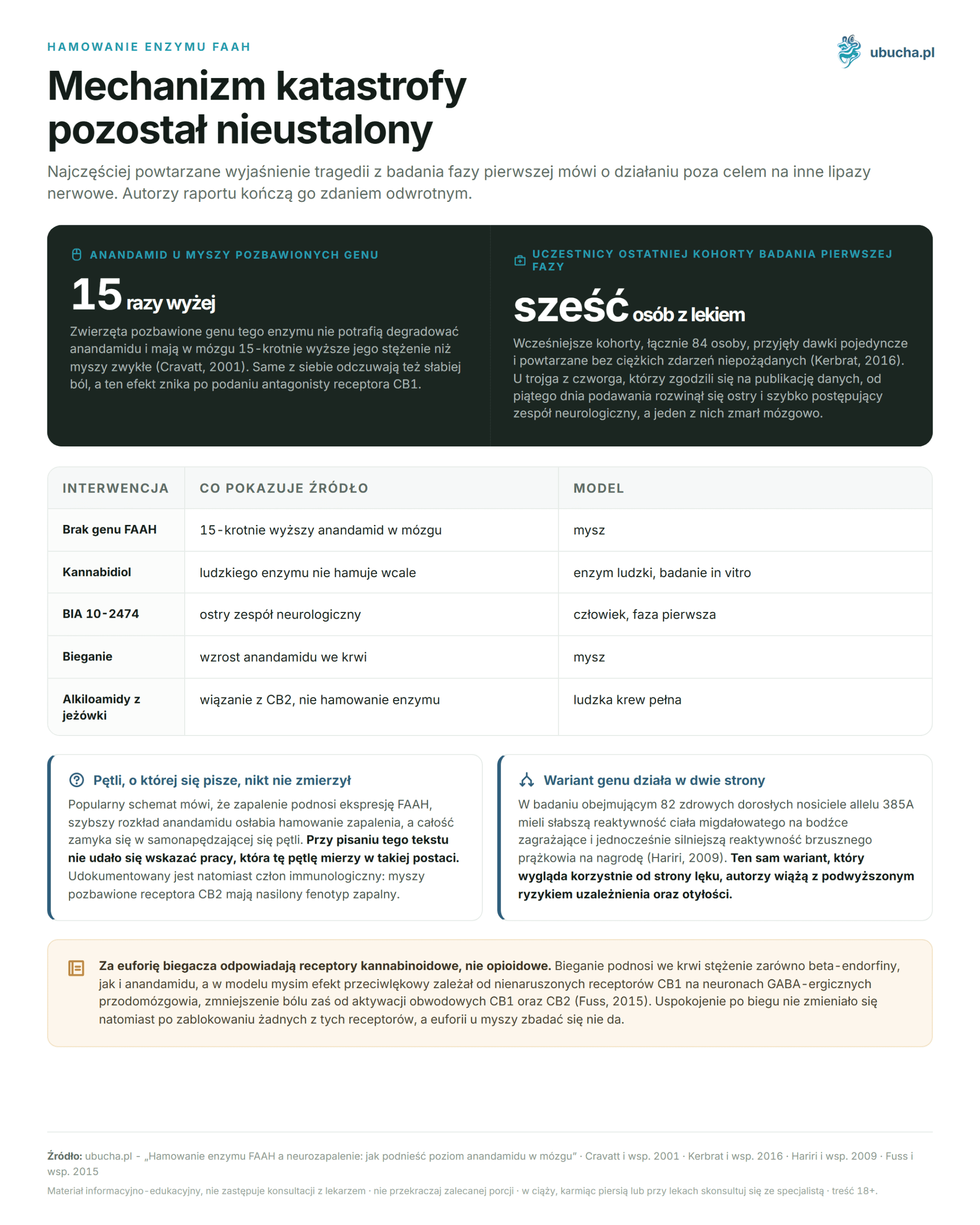
• Mice lacking the FAAH gene have 15 times higher levels of anandamide in their brains and feel less pain, and the effect is reversed by the CB1 receptor antagonist (Cravatt et al., PNAS 2001).
• Cannabidiol weakly inhibits the hydrolysis of anandamide by rat brain membranes, with a half-maximal concentration of 27.5 micromoles (Bisogno et al., British Journal of Pharmacology 2001), and does not inhibit human FAAH at all (Elmes, J Biol Chem, 2015).
• A synthetic FAAH inhibitor called BIA 10-2474 caused an acute neurological syndrome in 2016 in three out of four study participants; one of them died brain-dead, and the mechanism of toxicity remains undetermined.
• The loop “inflammation raises FAAH, higher FAAH suppresses anandamide” circulates in popular materials, but there is no work behind it that could be pointed out. The role of the CB2 receptor as a regulator of inflammation is documented.
• Running raises both beta-endorphin and anandamide levels in the blood, and in a mouse model, cannabinoid receptors are responsible for the anxiolytic and analgesic components of runner’s euphoria.
What does the FAAH enzyme do to anandamide?
FAAH breaks down anandamide and thus determines its duration of action. The strongest evidence comes from the work of Cravatt’s team, which bred mice lacking the gene for this enzyme. These animals cannot degrade anandamide and have 15 times higher concentrations of it in their brains than normal mice (Cravatt et al., PNAS 2001).
The behavioral consequences are clear. After administration of anandamide, FAAH-deficient mice exhibit a set of symptoms dependent on the CB1 receptor: decreased mobility, analgesia, catalepsy, and lowered body temperature. They also feel less pain on their own, and this effect disappears after administration of the CB1 antagonist called SR141716A. The authors draw a conclusion from this that still organizes the entire field: FAAH sets the endogenous cannabinoid tone and is therefore an attractive pharmacological target in pain and neuropsychiatric disorders.
It is worth remembering that anandamide is not the only endocannabinoid, and FAAH is not the only exit route. The review by Lu and Mackie reminds us that anandamide and 2-arachidonoylglycerol are produced and degraded by separate enzymatic pathways, which gives them distinct physiological roles (Lu and Mackie, Biological Psychiatry 2016). Inhibiting FAAH thus raises one branch of the system, not the entire system at once. Those who want to trace the molecule from the beginning can find its history in the text about the discovery of anandamide in 1992.
Does neuroinflammation really drive the breakdown of anandamide?
Here we need to draw a line between what is documented and what is repeated. The popular scheme says that inflammation raises FAAH expression, faster breakdown of anandamide weakens the inhibition of inflammation, and the whole closes in a self-perpetuating loop. At the time of writing this text, it was not possible to identify a study that measures this loop in such a form, so we treat it as a hypothesis rather than a finding.
However, the immunological component is documented. The CB2 receptor is a peripheral cannabinoid receptor, mainly present in immune system tissues, and mice lacking this receptor have an exacerbated inflammatory phenotype (Turcotte et al., Cellular and Molecular Life Sciences 2016). The authors of the review indicate modulation of CB2 signaling as a promising strategy in inflammatory diseases, but directly mention questions that need to be answered before this receptor can be considered a validated therapeutic target.
Additionally, there is something that popular descriptions usually omit: anandamide does not act solely through cannabinoid receptors. Lu and Mackie note that some cannabinoids also engage TRP family channels and PPAR receptors. The practical conclusion is cautious. Raising anandamide by inhibiting FAAH is an intervention with many points of action, not a precise adjustment of a single anti-inflammatory switch. Similarly, the family of related lipids branches out, which we describe in the text about PEA, OEA, and related compounds.
Does cannabidiol inhibit FAAH in humans?
No, and this is the most important sentence of this section. A study that compared both enzymes side by side showed that unlike rodent FAAH, cannabidiol does not inhibit human FAAH, so the inhibition of this enzyme cannot explain the increase in anandamide observed in humans after its administration (Elmes, J Biol Chem, 2015).
Where did the opposite belief come from? From measurements on rodent tissue. In the work of Bisogno and colleagues, cannabidiol reduced the hydrolysis of anandamide by rat brain membranes with a half-maximal inhibitory concentration of 27.5 micromoles, which is still difficult to call a strong enzymatic action (Bisogno et al., British Journal of Pharmacology 2001). This result was then attributed to humans, although the work did not measure anything in humans.
This same work shows a second pathway by which cannabidiol raises anandamide: inhibiting its cellular uptake, with a half-maximal concentration of 22 micromoles. Uptake and hydrolysis are two different stages of signal termination. Elmes and colleagues add an explanation that fits the measurement in humans: cannabidiol binds to intracellular transport proteins from the FABP family, which are carriers that deliver anandamide to the degrading enzyme, thus slowing its removal without touching the enzyme itself.
Is this visible in patients? The increase itself is visible, not the mechanism. In a randomized study comparing cannabidiol with amisulpride in patients with acute schizophrenia, treatment with cannabidiol was associated with a significant increase in serum anandamide levels, and this increase correlated with clinical improvement (Leweke et al., Translational Psychiatry 2012). This is a measurement of concentration, not a measurement of enzyme activity, so it does not resolve which pathway the increase arose from. One trial in one population is also not evidence of action in a healthy person reaching for cannabis oils. Draw conclusions about doses for yourself with a doctor, not from an abstract.
Why did the BIA 10-2474 study end in tragedy?
In 2016 in France, healthy volunteers were given a synthetic, reversible FAAH inhibitor called BIA 10-2474. Previous cohorts, including 84 people, received single and repeated doses without serious adverse events. The last cohort included six people receiving the drug and two placebo (Kerbrat et al., New England Journal of Medicine 2016).
Four treated participants agreed to publish their data. In three of them, starting from the fifth day of administration, an acute and rapidly progressing neurological syndrome developed: headache, cerebellar symptoms, memory disturbances, and consciousness disorders. MRI showed bilateral, symmetrical brain damage with microbleeds, mainly involving the pons and hippocampi. One patient died brain-dead. The other two improved, but one had memory disturbances, and the other had cerebellar syndrome. The fourth participant remained asymptomatic.
The most commonly repeated explanation for this catastrophe speaks of off-target action on other neural lipases. However, it is worth knowing that the authors of the report in the New England Journal of Medicine conclude it with the opposite statement: the mechanism of this toxic brain syndrome remains unknown. The conclusion for the reader is therefore not “inhibiting FAAH is dangerous,” but “the strength and selectivity of the molecule determine everything, and natural cannabidiol does not inhibit human FAAH at all.”
Does the FAAH gene change anandamide levels in humans?
It does, and this is visible in brain imaging. The common variant of the FAAH gene designated as C385A is associated with reduced enzyme activity. In a study involving 82 healthy adults, carriers of the 385A allele had weaker amygdala reactivity to threatening stimuli and at the same time stronger ventral striatum reactivity to reward (Hariri et al., Biological Psychiatry 2009).
The divergence of these two effects is more interesting than either of them alone. In carriers of 385A, the correlation between amygdala reactivity and anxiety as a trait weakened, while the correlation between striatal reactivity and impulsivity measured by delayed reward discounting increased. This same variant, which appears beneficial from the anxiety perspective, is associated by the authors with an increased risk of addiction and obesity.
The practical consequence is that the response to anything that raises anandamide does not have to be the same in two people. Those with initially low FAAH activity likely have an elevated endocannabinoid tone and may feel less difference after intervention. This is a hypothesis derived from genetics, not a result of a study comparing the response to cannabidiol between genotypes.
What else besides cannabidiol raises anandamide?
The best-documented factor is movement. Running raises both beta-endorphin and anandamide levels in the blood, and studies in mice have shown that it is cannabinoid receptors, not opioid ones, that are responsible for the two main components of runner’s euphoria (Fuss et al., PNAS 2015).
The details are instructive. The anxiolytic effect depended on intact CB1 receptors on GABAergic neurons in the forebrain, and the reduction of pain depended on the activation of peripheral CB1 and CB2 receptors. The calming after running did not change after blocking cannabinoid or opioid receptors, and euphoria in mice cannot be studied. We expand on this topic in the post about runner’s euphoria and the endocannabinoid system.
Plant modulators of this system exist, but they act differently than the popular version claims. Alkylamides from echinacea bind to the CB2 receptor more strongly than endogenous cannabinoids, with a binding affinity of about 60 nanomoles compared to over 1500 nanomoles for CB1, and modulate cytokine secretion in human whole blood (Raduner et al., Journal of Biological Chemistry 2006). This is receptor binding, not FAAH inhibition, and this difference should not be blurred.
| Intervention | What the source shows | Model |
|---|---|---|
| Lack of FAAH gene | 15 times higher anandamide in the brain, weaker pain perception | Mouse |
| Cannabidiol | Inhibits hydrolysis in rodents, does not inhibit human enzyme; inhibits cellular uptake | Rat brain membranes and human enzyme, in vitro study |
| BIA 10-2474 | Acute neurological syndrome, mechanism undetermined | Human, phase one |
| Running | Increase in anandamide in the blood; anxiolytic effect dependent on CB1 | Mouse |
| Alkylamides from echinacea | Binding to CB2 stronger than that of endocannabinoids | In vitro study, human whole blood |
Frequently Asked Questions
Does cannabidiol inhibit the human FAAH enzyme?
No. Cannabidiol inhibits FAAH in rodents, but not in humans, so the inhibition of this enzyme does not explain the increase in anandamide in humans after its administration. This increase is due to competition for intracellular transport proteins from the FABP family, which deliver anandamide to the degrading enzyme (Elmes, J Biol Chem, 2015).
Does high anandamide mean less anxiety?
Not in a simple way. Carriers of the FAAH 385A variant, with reduced enzyme activity, had weaker amygdala reactivity to threats, but at the same time stronger reward system reactivity and higher impulsivity. This same variant is associated with an increased risk of addiction and obesity.
How does cannabidiol differ from the BIA 10-2474 inhibitor?
In strength, selectivity, and target. BIA 10-2474 was an experimental drug designed to inhibit FAAH and after five days of administration caused an acute neurological syndrome. Cannabidiol does not inhibit human FAAH at all, and the rodent enzyme only at micromolar concentrations, so it does not reproduce that profile of action in any way.
Does echinacea raise anandamide levels?
The study by Raduner and colleagues shows something different: alkylamides from echinacea bind to the CB2 receptor themselves, with a binding affinity of about 60 nanomoles, and modulate cytokine secretion in human whole blood. This action is on the receptor, not the inhibition of the enzyme that degrades anandamide.
Does physical exercise replace supplementation?
We do not make such a comparison because no one has measured it. It is known that running raises anandamide and beta-endorphin levels in the blood, and in a mouse model, the anxiolytic component of runner’s euphoria depends on CB1 receptors. There is no study comparing this effect with the intake of cannabidiol in humans.
This article is for informational and educational purposes only and does not constitute medical advice. Before starting to use cannabis or CBD for therapeutic purposes, consult with a doctor, especially if you are taking other medications, are pregnant, or breastfeeding.
Author: Michał Waluk · Published: 2026-08-09 · Updated: 2026-08-17