
Is CBD Non-Psychoactive: The Difference Between Psychoactive and Intoxicating
CBD affects mood and anxiety, so scientifically it is psychoactive, but it does not intoxicate. We explain the difference, studies on driving, and the Polish THC threshold.
“CBD is non-psychoactive” is a statement found on almost every oil label and in every promotional text. Technically, it is incorrect. Cannabidiol affects mental processes: it reduces anxiety and alters pain perception, as described in a review of studies published in Neurotherapeutics (Blessing et al., 2015). The question that is truly worth asking is different: does CBD intoxicate? Here, the answer is unequivocal and is “no”. The entire misunderstanding arises from the fact that in colloquial Polish, “psychoactive” has merged with “intoxicating”, while in scientific literature, these are two separate concepts describing two different things. Below, we show where this difference comes from, what clinical studies say about it, and what it means when driving, during a drug test, and in conversations with a doctor.
KEY INFORMATION
• CBD is psychoactive in a scientific sense because it affects anxiety and mood (Blessing et al., Neurotherapeutics, 2015).
• CBD is not intoxicating: it does not induce euphoria or disrupt perception.
• In a driving study involving 26 individuals, a CBD-rich strain did not differ from placebo in driving performance (Arkell et al., JAMA, 2020).
• The Polish threshold for hemp is 0.3% of the sum of delta-9-THC and THCA, not 0.2%.
• EFSA derived a provisional safe dose of 0.0275 mg/kg body weight per day, which is about 2 mg for a person weighing 70 kg.
What does it mean for a substance to be psychoactive?
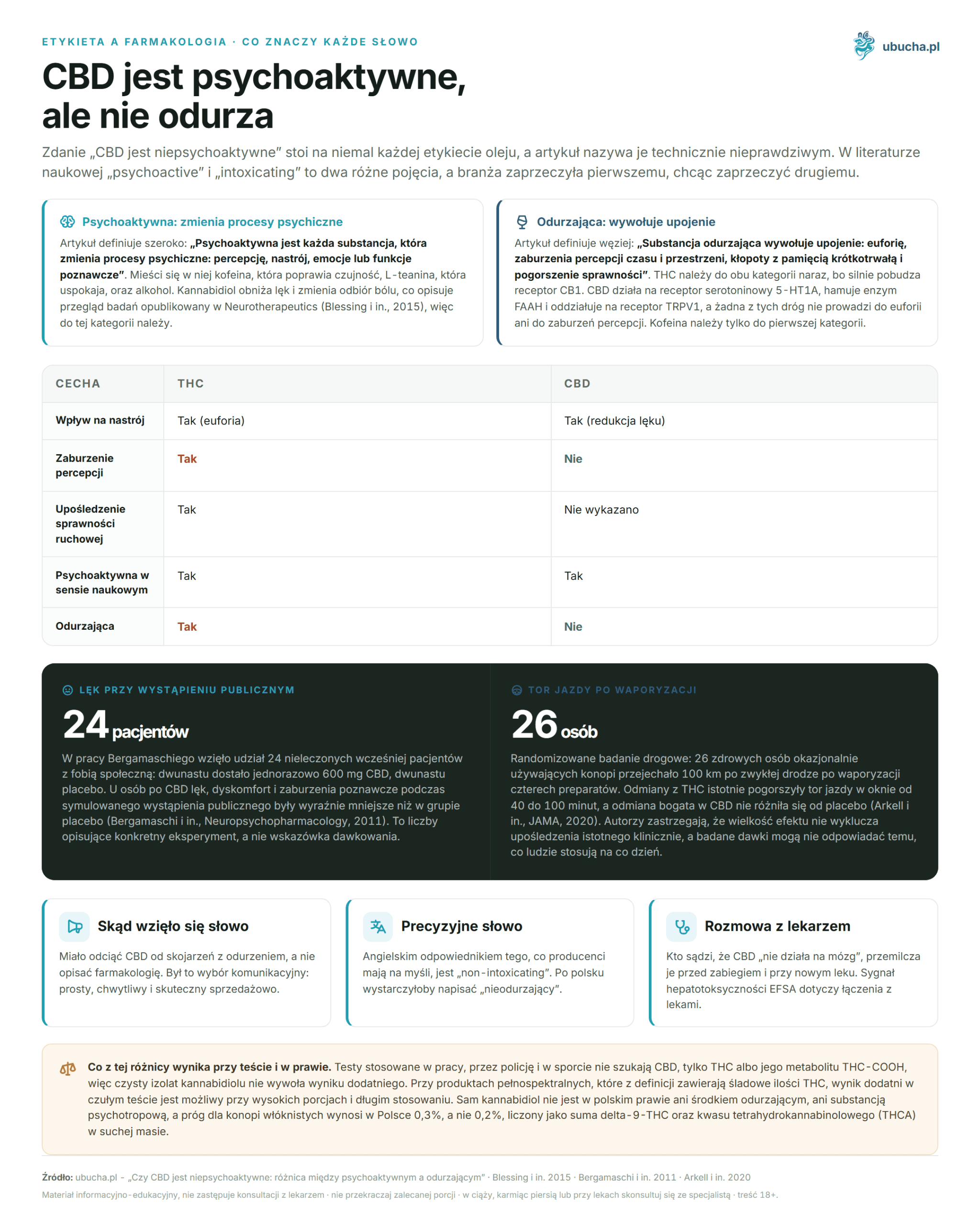
A psychoactive substance is any substance that alters mental processes: perception, mood, emotions, or cognitive functions. This is a very broad category. It includes caffeine, which enhances alertness, L-theanine, which calms, and alcohol. The common denominator is the mere fact of affecting the brain, not the strength of that effect or whether it is pleasurable.
Intoxication is something narrower. An intoxicating substance induces intoxication: euphoria, disruptions in the perception of time and space, short-term memory problems, and impaired functioning. THC belongs to both categories at once because it strongly stimulates the CB1 receptor in the reward system and in the prefrontal cortex. Caffeine belongs only to the first.
CBD behaves like caffeine, not like THC. It acts on the serotonin receptor 5-HT1A, inhibits the FAAH enzyme, and interacts with the TRPV1 receptor. None of these pathways lead to euphoria or perceptual disturbances because none strongly stimulate the CB1 receptor, which is responsible for the intoxicating effects of THC. If you are just starting and want to clarify concepts, our guide on what CBD actually is will be helpful.
What is the difference between psychoactive and intoxicating effects?
The difference boils down to one question: does the substance disrupt contact with reality and functioning? Psychoactivity means the mere influence on the psyche. Intoxication means euphoria, which makes this influence dangerous when driving or at work. Simply put: psychoactivity indicates that something is happening in the head, while intoxication indicates that it is happening strongly enough that you stop being responsible for the consequences. Caffeine changes alertness, but no one claims that you shouldn’t drive after an espresso. The table below compares three substances on both axes.
| Feature | THC | CBD | Caffeine |
|---|---|---|---|
| Effect on mood | Yes (euphoria) | Yes (anxiety reduction) | Yes (stimulation) |
| Perception disruption | Yes | No | No |
| Motor skill impairment | Yes | Not demonstrated | No |
| Psychoactive in a scientific sense | Yes | Yes | Yes |
| Intoxicating | Yes | No | No |
The comparison shows why the word “psychoactive” alone does not resolve anything: in this column, all three substances have “yes”. The last two rows are decisive because they separate a substance that allows normal functioning from one that does not. We elaborate on the differences between cannabinoids in the text comparing CBD, THC, and CBG.
What do studies say about the effect of CBD on anxiety and mood?
The effect is documented and forms the basis for the therapeutic applications of cannabidiol. The review by Blessing et al. from 2015, published in Neurotherapeutics, gathered evidence from animal studies and human studies. The authors state that preclinical evidence strongly supports the anxiolytic effect of CBD administered acutely, while data from human studies are limited to single doses and come from few studies in clinical populations (Blessing et al., Neurotherapeutics, 2015).
The most frequently cited single study is the work by Bergamaschi et al. from 2011. It involved 24 previously untreated patients with social phobia: twelve received a single dose of 600 mg of CBD, twelve received placebo, and a separate group of twelve healthy volunteers underwent the test without any preparation. The task was a simulated public speaking exam. In those who received CBD, anxiety, discomfort, and cognitive disturbances during the presentation were significantly lower than in the placebo group (Bergamaschi et al., Neuropsychopharmacology, 2011).
These are numbers describing a specific experiment, not a guideline on how much you should take. It is worth remembering where the caution threshold lies: EFSA in its updated position from 2026 derived a provisional safe dose of 0.0275 mg per kilogram of body weight per day, which is about 2 mg for a person weighing 70 kg, and cautioned that this applies only to supplements with at least 98% purity of CBD without nanoparticles (EFSA NDA Panel, EFSA Journal, 2026). The panel states explicitly that the safety of CBD cannot be established in individuals under 25 years of age, in pregnant and breastfeeding women, and in individuals taking medications.
Does CBD impair driving ability?
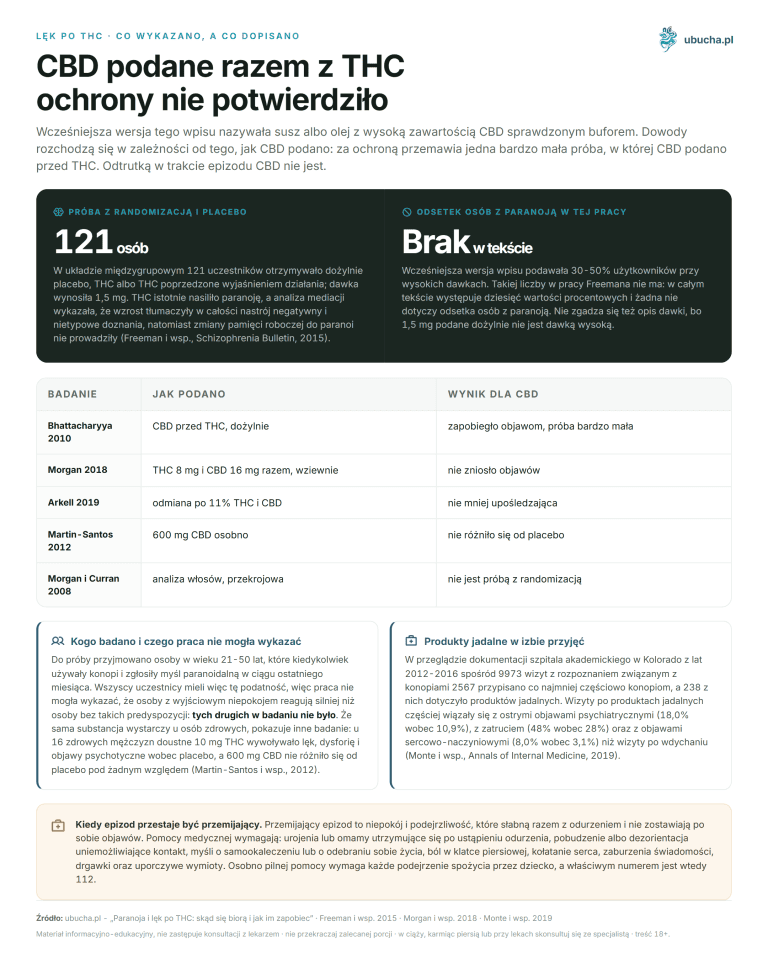
The available data have not demonstrated such impairment, but they are narrower than the popular narrative suggests. The strongest single evidence is a randomized driving study published in JAMA: 26 healthy individuals who occasionally used cannabis drove 100 km on a regular road after vaporizing four preparations, including a CBD-rich strain and placebo. The dose of THC and CBD was 13.75 mg. The standard deviation of position in the lane, known as weaving, was measured.
The THC-rich strain and the strain with equal amounts of THC and CBD significantly worsened driving performance in the window from 40 to 100 minutes after vaporization. The CBD-rich strain did not differ from placebo (Arkell et al., JAMA, 2020). The authors themselves add a caveat that marketing does not repeat: the magnitude of the effect for the CBD-rich strain does not rule out clinically significant impairment, and the doses studied may not correspond to what people use daily.
The practical consequences during a traffic stop are described separately in the text about whether you can drive after taking CBD oil. For the record: with THC, impairment of driving ability is repeatedly documented, and it is THC that police testers detect.
Why does the industry call CBD non-psychoactive?
Because the word was meant to cut CBD from associations with intoxication, not to describe pharmacology. It was a communication choice: simple, catchy, and effective for sales. The problem is that in scientific literature, “psychoactive” and “intoxicating” are two different concepts, and the industry denied the first to deny the second. The precise English equivalent of what producers mean is “non-intoxicating”. In Polish, it would suffice to say “nieodurzający” and the whole matter would be closed, without dispute with pharmacology.
We have noticed that this shortcut rarely harms the users themselves, but regularly disrupts conversations with doctors and employers. A person convinced that CBD “does not affect the brain” does not mention it in the pre-operative interview or when starting a new medication. This is a real risk, as EFSA notes a signal of hepatotoxicity precisely with the concurrent use of CBD with other medications. A more accurate statement is: cannabidiol does not intoxicate, but it affects mood and anxiety levels, so the doctor should be aware of it. It is a few words longer and worth that difference.
Drug tests and Polish law: what follows from this difference
Tests used in work, by the police, and in sports do not look for CBD. They look for THC or its metabolite THC-COOH. Pure cannabidiol isolate will not produce a positive result. The situation is different with full-spectrum products, which by definition contain trace amounts of THC: with high doses and prolonged use, a positive result in a sensitive test is possible.
Here comes the number that texts about CBD most often misstate. In Poland, the threshold for hemp is 0.3%, not 0.2%, and it is calculated as the sum of delta-9-THC and tetrahydrocannabinolic acid (THCA) in dry mass, rounded to one decimal place. The basis is Article 4 point 5 of the Act of July 29, 2005 on Counteracting Drug Addiction (t.j. Dz.U. 2023 poz. 1939) as amended by the Act of March 24, 2022 (Dz.U. 2022 poz. 763), effective from May 7, 2022. The value of 0.2% was in effect until that date.
The national threshold corresponds to the EU threshold, but it does not follow from it: these are two separate regulations with the same numerical value. Cannabidiol itself is neither a narcotic nor a psychotropic substance in Polish law. However, since the test result is determined by the THC content in a specific batch, the only way to know it is through laboratory testing assigned to the batch, i.e., a certificate of analysis.
Frequently Asked Questions
Is CBD psychoactive?
In a strict scientific sense, yes. Cannabidiol affects mental processes: it reduces anxiety, improves mood, and alters pain perception. However, it is not intoxicating, as it does not induce euphoria or disrupt perception of reality. The popular term “non-psychoactive” does not capture this difference (Blessing et al., Neurotherapeutics, 2015).
What is the difference between psychoactive and intoxicating?
Psychoactive means “affecting mental processes” and also includes caffeine and theanine. Intoxicating means “inducing intoxication”, which is a disruption of perception and impairment of functioning. THC is both psychoactive and intoxicating. CBD falls exclusively into the first category.
Does CBD affect driving ability?
In a driving study involving 26 individuals, a CBD-rich cannabis strain did not differ from placebo in driving performance, while THC strains significantly impaired it (Arkell et al., JAMA, 2020). The authors caution that the magnitude of the effect does not rule out clinically significant impairment, and the doses studied may not correspond to typical use.
Why is CBD referred to as non-psychoactive in advertisements?
The term was created as a contrast to THC and recreational cannabis to show that the product does not induce a \”high\”. The intention is understandable, but the execution is imprecise: the scientific equivalent of what producers mean is \”non-intoxicating\”, not \”non-psychoactive\”.
Can CBD change mood or perception?
Mood yes, perception no. In a study with simulated public speaking in 24 patients with social phobia, a single dose of CBD reduced anxiety and discomfort compared to placebo (Bergamaschi et al., Neuropsychopharmacology, 2011). Changes in perception of reality were not recorded in these studies.
If you are looking for a product and want to check what it contains, browse the oils category and ask for a certificate of analysis for a specific batch.
This article is for informational and educational purposes only and does not constitute medical advice. Before starting to use cannabis or CBD for therapeutic purposes, consult a doctor, especially if you are taking other medications, are pregnant, or breastfeeding.
Author: Michał Waluk · Published: 2026-08-09 · Updated: 2026-08-11