
Motherwort for the Heart and Nerves: How to Use (FAQ)
Common motherwort without myths: EMA monograph status, indication for palpitations of a nervous origin, clinical study results, and a full list of contraindications.
Common motherwort (Leonurus cardiaca L.) has a Latin name indicating the heart and indeed entered European medicine as an herb for palpitations of a nervous origin. However, its status is sometimes presented more strongly than is indicated by the documents. The European Medicines Agency classified motherwort as a traditional herbal medicinal product, which means it is based on long-term safe use rather than a series of clinical trials (EMA, Leonuri cardiacae herba). The monograph narrows the indication to symptoms of nervous tension and heart complaints of a nervous origin, and only after serious causes have been ruled out by a doctor. This article shows what is known about motherwort from research, what its official indication is, and who should not take it.
KEY INFORMATION
• Motherwort has a traditional herbal medicinal product status in EMA, not established use (EMA, Leonuri cardiacae herba).
• The indication includes nervous tension and palpitations of a nervous origin, after serious causes have been ruled out by a doctor.
• The monograph allows use only in adults and requires contact with a doctor if symptoms last longer than 4 weeks.
• The preparations containing motherwort should not be used during pregnancy.
• The pharmacological review describes effects as mild: slowing the heart rate, lowering blood pressure, and having a calming effect.
What does motherwort contain and how does it work?
The raw material is the herb collected during the flowering period and dried at a temperature of about 35 degrees Celsius. The European Pharmacopoeia requires it to contain at least 0.2% flavonoids calculated as hyperoside. The chemical composition is complex and includes several distinct groups of compounds (Wojtyniak et al., Phytotherapy research : PTR, 2013):
- terpenes: monoterpenes, diterpenes, triterpenes
- nitrogen compounds and phenylpropanoids
- flavonoids along with phenolic acids
- essential oils, sterols, tannins
This same review describes the profile of action cautiously, and it is worth repeating its formulation without strengthening. The herb and its preparations are attributed with a mild negative chronotropic effect, meaning they slow the heart rate. It also mentions a mild lowering of blood pressure. The third described effect is a mild calming effect. Pharmacological studies have also confirmed antioxidant and anti-inflammatory activity.
One word from this description determines how to read the rest of the article. Each of the cardiac and calming effects is labeled as “mild.” Therefore, motherwort is not an alternative to cardiological treatment or a prescription calming medication, but rather a support for functional complaints.
In the experimental literature, the best-described single component is stachydrine, a proline betaine isolated from the genus Leonurus. In a model of cardiac muscle hypertrophy induced by isoproterenol in rats, administration of stachydrine weakened fibrosis and lowered markers of inflammation (Zhao et al., International immunopharmacology, 2017). This is a result from an animal model and does not directly translate to the treatment of heart diseases in humans.
What status does motherwort have in the EMA monograph?
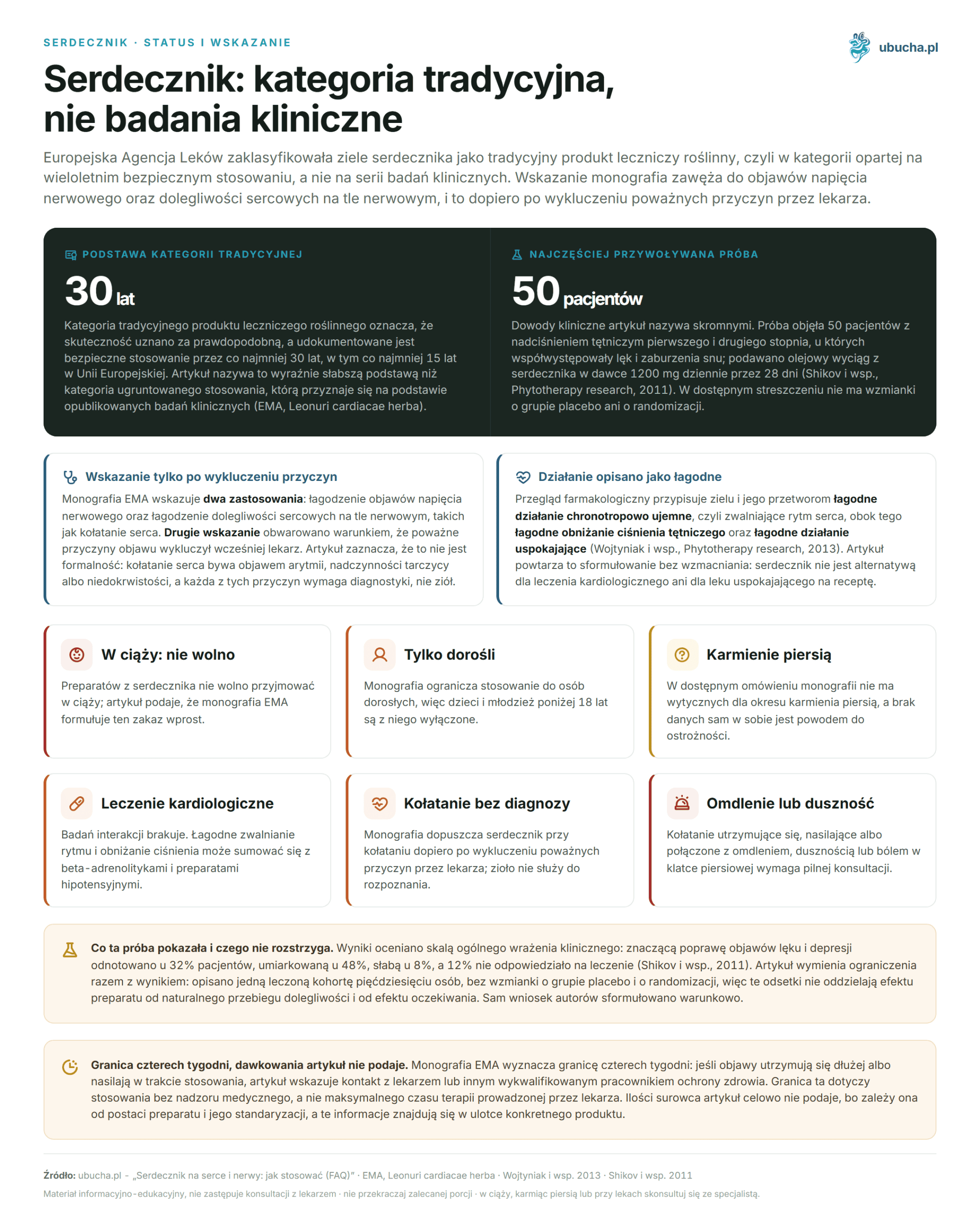
The monograph of the Committee on Herbal Medicinal Products classifies motherwort as a traditional herbal medicinal product. This category means that its effectiveness is considered probable, and safe use has been documented for at least 30 years, including at least 15 years in the European Union. This is clearly a weaker basis than the category of established use, which is granted based on published clinical studies.
The indication is narrowly defined: alleviating symptoms of nervous tension and alleviating heart complaints of a nervous origin, such as palpitations, provided that serious causes must be ruled out by a doctor beforehand. This reservation is not a formality. Palpitations can be a symptom of arrhythmia, hyperthyroidism, or anemia, and each of these causes requires diagnostics, not herbs.
The monograph also contains three limitations that guides usually remain silent about. The preparations are intended solely for adults. They should not be used during pregnancy. If symptoms persist longer than four weeks or worsen during use, one must contact a doctor or another qualified healthcare professional.
We do not provide dosing here intentionally. Motherwort is sometimes used for symptoms that may have serious cardiological underpinnings, and the amount of raw material depends on the form of the preparation and its standardization. This information can be found in the leaflet of the specific product, and any doubts should be resolved by a pharmacist or the attending physician.
What did the clinical study of motherwort show?
Clinical evidence for motherwort is modest and practically boils down to single trials. The most frequently cited comes from the Shikov team and involved 50 patients with stage one and two hypertension, who also had anxiety and sleep disorders. Participants took an oil extract of motherwort at a dose of 1200 mg daily for 28 days (Shikov et al., Phytotherapy research : PTR, 2011).
The results were evaluated using the clinical global impression scale. Significant improvement in anxiety and depression symptoms was noted in 32% of patients, moderate in 48%, weak in 8%, and 12% did not respond to treatment. The authors also observed a beneficial effect on the psycho-emotional state and blood pressure, with patients with stage one hypertension showing effects a week earlier than those with stage two. Adverse effects were minimal in all groups.
The limitations of this work must be mentioned along with the result, because without them, it sounds too strong. The available summary does not mention a placebo group or randomization: it describes one treated cohort of fifty people, and the result is given as percentages of patients with improvement on the clinical scale. Without a control arm, such numbers do not separate the effect of the preparation from the natural course of the complaint and from the placebo effect. The authors’ conclusion was also formulated conditionally: the extract may be a potentially effective agent in patients with hypertension and accompanying psychoneurological disorders.
It is also worth noting the scale of this entire evidence base. The most frequently cited trial involved fifty people and lasted four weeks, and apart from it, it is difficult to point to a large study with a control arm. The category of traditional use reflects this state of affairs precisely: long-term safe use is documented, not a series of high-quality clinical studies.
How does motherwort differ from valerian and hawthorn?
The comparison is easiest to conduct based on what each of these herbs says in its own European monograph, as this is the only criterion independent of marketing. The following comparison shows that the difference concerns both the strength of the evidence base and the scope of indication.
| Raw Material | Status in EMA Monograph | Indication according to the Monograph |
|---|---|---|
| Motherwort herb (Leonuri cardiacae herba) | traditional use | nervous tension and heart complaints of a nervous origin, e.g. palpitations, after serious causes have been ruled out; adults only |
| Valerian root (Valerianae radix) | established use for the ethanol extract, traditional for other forms | mild nervous tension and sleep disorders; for traditional forms, mild symptoms of psychological stress and help in falling asleep |
| Hawthorn leaf with flower (Crataegi folium cum flore) | traditional use | transient heart complaints of a nervous origin, e.g. palpitations, after serious causes have been ruled out; the monograph does not mention NYHA classification |
The last row corrects a claim that circulates in guides: hawthorn is sometimes described as a remedy for heart failure in NYHA classes I-II, but the EMA monograph does not mention any NYHA classification and limits the indication to transient complaints of a nervous origin. Valerian stands out here the most, as it is the only one with a category of established use for some forms. If you are looking for herbs for evening relaxation, we have described them separately in connection with hops for sleep and nervousness.
A common question is the comparison of motherwort with ashwagandha. These are two different tools: ashwagandha is an adaptogen studied for its response to chronic stress, while motherwort addresses cardiac symptoms of a nervous origin. Details on the former have been gathered in the post about ashwagandha for sleep and stress.
Who should not use motherwort?
The list starts with one absolute prohibition. Preparations containing motherwort should not be taken during pregnancy, as stated directly in the EMA monograph. The monograph also limits use to adults, so children and adolescents under 18 years of age are excluded. The available discussion of the monograph does not provide guidelines for breastfeeding, and the lack of data in itself is a reason for caution.
The second group arises from the pharmacology of the raw material itself, not from interaction studies, which simply do not exist for motherwort. Since the review attributes it with a mild heart rate-lowering and blood pressure-lowering effect, combining it with medications that have the same direction of action, such as beta-blockers or antihypertensive preparations, may accumulate these effects. Therefore, individuals treated cardiologically should discuss such an addition with their attending physician rather than introducing it independently.
The third situation is an undiagnosed symptom. The monograph allows motherwort for palpitations only after serious causes have been ruled out by a doctor, meaning that the herb is not a tool for self-diagnosis. Persistent, worsening palpitations or those accompanied by fainting, shortness of breath, or chest pain require urgent consultation, not an infusion.
The principles of combining herbs with each other and with medications have been gathered in a separate table, which is worth consulting before reaching for any complex preparation: which herbs should not be combined. When taking prescription medications simultaneously, talking to a pharmacist is cheaper than any complication.
Frequently Asked Questions
What does motherwort help with according to the EMA monograph?
The EMA monograph indicates two uses: alleviating symptoms of nervous tension and alleviating heart complaints of a nervous origin, such as palpitations. The second indication is conditional on serious causes of the symptom being ruled out by a doctor beforehand. The preparations are intended solely for adults.
Does motherwort lower blood pressure?
A pharmacological review attributes a mild blood pressure-lowering effect to the herb (Wojtyniak et al., Phytotherapy research : PTR, 2013). The word “mild” is significant here: motherwort does not replace antihypertensive therapy. With hypotensive medications, effects may accumulate, so discuss such combinations with your doctor.
Who should not use motherwort?
The EMA monograph prohibits use during pregnancy and limits the preparations to adults, excluding children and adolescents under 18 years of age. There is a lack of data for breastfeeding. Caution is also required for those treated cardiologically and anyone whose cause of palpitations has not been diagnosed.
How long can motherwort be used?
The EMA monograph sets a limit of four weeks. If symptoms persist longer or worsen during use, one must contact a doctor or another qualified healthcare professional. This limit applies to use without medical supervision, not the maximum duration of therapy conducted by a doctor.
Can motherwort be combined with heart medications?
There is a lack of studies on the interaction of motherwort with cardiological medications, so caution arises from its pharmacology. The herb is attributed with a mild heart rate-lowering and blood pressure-lowering effect, and heart medications often act in the same direction. Individuals taking them regularly should consult such an addition with their attending physician.
How does motherwort differ from valerian?
They differ in the strength of the evidence base and the scope of indication. Valerian has a category of established use for the ethanol extract and an indication covering sleep disorders. Motherwort remains in the category of traditional use, and its indication concerns nervous tension and palpitations of a nervous origin.
Dried herbs and plant extracts, including valerian extract, can be found in the herbs category in the u Bucha store.
This article is for informational and educational purposes only and does not constitute medical advice. Before starting supplementation, consult your doctor, especially if you are taking medications regularly, are pregnant or breastfeeding, or have a chronic illness.
Author: Michał Waluk · Published: 2026-08-09 · Updated: 2026-08-16