
Diabetes and THCV: what the only human study showed and what it did not measure
THCV blocks the CB1 receptor, but at higher doses it begins to stimulate it. What did the pilot study on 62 patients with type 2 diabetes measure and what did it not measure.
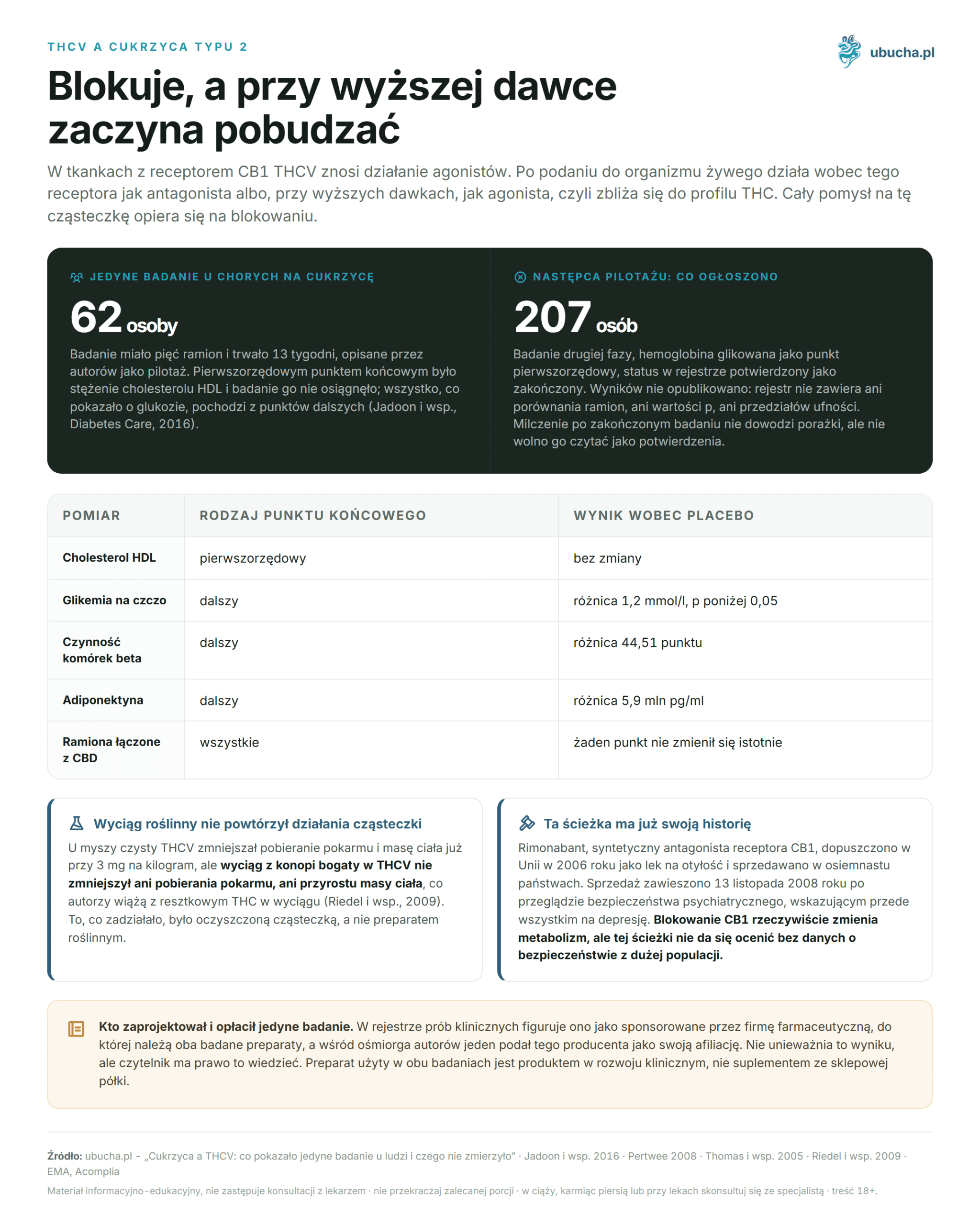
THCV differs from THC by two carbon atoms in the side chain and behaves oppositely in tissues with the CB1 receptor: instead of stimulating it, it blocks it. This was checked in patients with type 2 diabetes only once. The pilot study by Jadoon and colleagues involved 62 people, lasted 13 weeks, and had five arms, with its primary endpoint being HDL cholesterol concentration, not glucose. This endpoint was not achieved by the study. The results regarding glycemia come from secondary endpoints. Below, we describe what THCV does with cannabinoid receptors, what exactly was measured in this one human study, what was not measured, and why the research program on this molecule is at a standstill.
KEY INFORMATION
• THCV blocks the CB1 receptor in tissues that contain it, but in a living organism at higher doses, it begins to stimulate it, thus acting like THC (Pertwee, British Journal of Pharmacology, 2008).
• The only study on patients with type 2 diabetes involved 62 people and lasted 13 weeks. The primary endpoint was HDL concentration, and the study did not achieve it (Jadoon et al., Diabetes Care, 2016).
• The difference in fasting glycemia compared to placebo was 1.2 mmol/l in the THCV arm with p below 0.05, but this is a secondary endpoint, and the authors called the whole thing a pilot study.
• The study was funded by the manufacturer of the tested substance, as seen in the clinical trial registry under number NCT01217112.
• A subsequent phase two study involving 207 people, with hemoglobin A1c as the primary endpoint, was completed and no results have been published.
• THCV is present in trace amounts in oils and food products from hemp, and a THCV-rich extract did not replicate the effects of the pure molecule in mice.
How does THCV differ from THC in terms of structure?
THCV, or tetrahydrocannabivarin, has almost the same structure as THC. The difference lies in one place: the side chain. THC has a pentyl chain, a five-carbon chain. THCV has a propyl chain, a three-carbon chain. Two carbon atoms less.
This difference translates into how both molecules interact with the cannabinoid type 1 receptor. THC occupies the binding pocket and shifts the receptor to an active state, thus behaving like an agonist. THCV occupies the same place but weakens the response induced by agonists in vitro and in isolated tissues. In a binding study on mouse brain membranes and on cells with the human CB2 receptor, THCV displaced a marker from binding sites at constant affinities in the range of several tens of nanomoles, and at a concentration of 1 micromole, it abolished the stimulation induced by the synthetic agonist CP55940 (Thomas et al., British Journal of Pharmacology, 2005).
It should be remembered what these measurements indicate. These are laboratory systems: cell membranes, cell cultures with the introduced receptor, and isolated mouse vas deferens. They describe the affinity and direction of action of the molecule on the protein, not the fate of a patient with diabetes. Transitioning from such a measurement to a statement about humans requires human studies, and THCV has only one such study.
Does THCV block the CB1 receptor or stimulate it?
Both, depending on the dose and where you look. This distinction is more important than typical descriptions of this molecule suggest, as it determines whether THCV behaves like the opposite of THC or like THC.
Pertwee’s review from 2008 outlines three situations. In tissues with the CB1 receptor, THCV abolishes the action of agonists, and this with great strength, although depending on the tissue and which agonist was used. In vitro, towards the CB2 receptor, THCV behaves like a partial agonist. However, when administered to a living organism, THCV acts towards CB1 as an antagonist or, at higher doses, as an agonist of that receptor (Pertwee, British Journal of Pharmacology, 2008).
The last sentence has practical significance. The whole idea of THCV in metabolic disorders is based on blocking CB1. If at higher doses the molecule stops blocking and starts stimulating, its action may reverse and, in the process, approach the THC profile, including effects on the central nervous system. This fact alone is an argument for clinical studies to determine THCV doses, not readers of articles.
What exactly did the THCV study in patients with type 2 diabetes show?
Jadoon and colleagues conducted a randomized double-blind study with a placebo group, in a parallel design, described by the authors in the title as a pilot study. It involved 62 people with type 2 diabetes not treated with insulin, assigned to five arms: CBD 100 mg twice daily, THCV 5 mg twice daily, two different combinations of both substances, and placebo. The treatment lasted 13 weeks.
The primary endpoint was the change in HDL cholesterol concentration from baseline. This same endpoint appears in the clinical trial registry, in the study record NCT01217112. HDL concentration did not change. Everything this pilot study showed about glucose comes from secondary and further endpoints, meaning measurements that did not determine the sample size or the study outcome (Jadoon et al., Diabetes Care, 2016).
| Measurement | Type of endpoint | Result in the THCV arm compared to placebo |
|---|---|---|
| HDL cholesterol | primary | no change |
| Fasting glycemia | further | difference 1.2 mmol/l, p below 0.05 |
| Beta cell function (HOMA2) | further | difference 44.51 points, p below 0.01 |
| Adiponectin | further | difference 5.9 million pg/ml, p below 0.01 |
| Combined CBD with THCV arms | all | no point changed significantly |
The summary of the work provides only point estimates and p-values for these values, without confidence intervals, so it cannot be read how wide the range is consistent with the data. None of these measurements are clinical events: no one counted heart attacks, hospitalizations, or deaths. The authors themselves close the work with the statement that THCV could be a new agent in glycemia control, thus formulating a hypothesis to be tested, not a conclusion for application.
Who funded this study and why does it matter?
In the clinical trial registry, study NCT01217112 is listed as sponsored by a pharmaceutical company that owns both tested preparations. Among the eight authors of the work, one listed this very manufacturer as their affiliation. This does not invalidate the result, but the reader has the right to know that the only study on THCV in diabetes was designed and funded by an entity interested in its outcome.
This same context explains the caution regarding the second part of the argument that has been circling around THCV for years: the analogy with rimonabant. Rimonabant is a synthetic CB1 receptor antagonist, approved in the European Union in June 2006 and sold in eighteen member states as a drug for obesity. The European Medicines Agency conducted a review of it due to concerns about psychiatric safety and concluded that the benefits no longer outweighed the risks, pointing out adverse effects on mental health, primarily depression. Sales were suspended on November 13, 2008, and the license was ultimately withdrawn (European Medicines Agency, product documentation for Acomplia). The history of rimonabant thus shows that blocking CB1 indeed changes metabolism, but also that this pathway cannot be assessed without safety data from a large population. For THCV, such data do not exist.
Does THCV suppress appetite and what does this mean for cannabis products?
Data on appetite come from a study in mice. Riedel and colleagues compared a synthetic CB1 antagonist called AM251 with pure THCV, using a standard fasting protocol and an observation setup of animals fed without restriction. AM251 reduced food intake and weight gain, while pure THCV caused a decrease in appetite and weight loss at just 3 mg per kilogram (Riedel et al., British Journal of Pharmacology, 2009).
The most interesting part of this work usually falls out of descriptions. A THCV-rich cannabis extract did not reduce either food intake or weight gain, and the authors link this to residual THC present in the extract. The effect of THC was only able to be negated in this setup by simultaneous administration of CBD. In other words: what worked in this study was the purified molecule, not the plant preparation.
For a reader looking for THCV in the store, the conclusion is inconvenient. Cannabis strains approved for cultivation in the European Union are selected for THC content and fiber and seed utility, not for THCV content, so a plant extract is not a substitute for a standardized substance. The study in mice also says nothing about what pure THCV does to human appetite; in the pilot study in diabetes, appetite was only one of many measured parameters.
Why is the research program on THCV at a standstill?
After the 2016 pilot study, a phase two study was launched, which can be found in the registry under number NCT02053272. It involved 207 people, the tested substance was the same THCV preparation added to metformin, and the primary endpoint was the change in hemoglobin A1c, a measure of diabetes control from recent weeks. The study has a completed status in the registry, last confirmed in December 2022.
No results of this study have been published. The registry does not contain any comparison of arms, nor p-values, nor confidence intervals. For assessing THCV, this is information of comparable weight to the pilot study itself: there is a completed study with a sample size more than three times larger, designed around the proper primary endpoint, and its result has remained unknown to the public for several years. Silence after a completed study does not prove failure, but it should not be read as confirmation.
Hence the cautious answer to the question in the title of this article. THCV does indeed block the CB1 receptor, and in the only human study, it lowered fasting glycemia and improved beta cell function. However, no improvement in insulin sensitivity as a separate outcome was demonstrated, the study did not achieve its primary endpoint, and its successor has not announced any data. The mechanism is described. Efficacy in diabetes remains unconfirmed. How to manage diabetes is determined by a diabetologist, and the preparation used in both studies is a product being tested in clinical development, not a supplement from a store shelf. More about the distinction between both molecules can be found in the text about the differences between THC and THCV, and about another pathway through which cannabinoids affect glucose metabolism in the article about the PPAR gamma receptor and glucose metabolism.
Frequently Asked Questions
How does THCV differ from THC?
By the structure of the side chain: THC has a five-carbon chain, THCV a three-carbon chain. In tissues with the CB1 receptor, THCV weakens the action of agonists instead of stimulating the receptor. However, when administered to a living organism at higher doses, it behaves like an agonist towards CB1, similar to THC (Pertwee, 2008).
Does THCV lower blood sugar in humans?
In the only study on patients with type 2 diabetes, involving 62 people over 13 weeks, the difference in fasting glycemia compared to placebo was 1.2 mmol/l with p below 0.05. However, this was a secondary endpoint, and the primary endpoint of the study, which was HDL concentration, did not change (Jadoon et al., 2016).
Can THCV replace diabetes medications?
No. The basis is one pilot study funded by the manufacturer of the tested substance, which did not achieve its primary endpoint, and a phase two study that ended without announcing results. Metformin and insulin have decades of data on efficacy and safety. Changes in diabetes treatment are determined by a diabetologist.
Does THCV suppress appetite?
In mice, yes: pure THCV reduced food intake and body weight at just 3 mg per kilogram. In the same study, a plant extract rich in THCV did not work, probably due to residual THC. The effect in humans in such a setup has not been tested (Riedel et al., 2009).
Is there THCV in hemp oils and flowers?
In trace amounts. Certified cannabis strains grown in the European Union are not selected for THCV, and the clinical study used a standardized pharmaceutical preparation, not a plant extract. A food product or oil does not replicate the conditions of that study.
Does THCV interact with diabetes medications?
There are no studies that have tested this. A substance that lowers glycemia, added to glycemia-lowering medications, creates a predictable risk of hypoglycemia. This is why any supplementation decision in diabetes should be made with the attending physician, not independently.
This article is for informational and educational purposes only and does not constitute medical advice. Before starting to use cannabis or CBD for therapeutic purposes, consult with a physician, especially if you are taking other medications, are pregnant, or breastfeeding.
Author: Michał Waluk · Published: 2026-08-09 · Updated: 2026-08-16