
CBD Oil and Surgery and Anesthesia: What You Should Know Before the Procedure
What was actually measured in studies on cannabis and anesthesia, which enzymes CBD inhibits in humans, and why the cessation date is set by the anesthesiologist, not the article.
Before a planned procedure, the same question arises: what to do with CBD oil. The answer that circulates online usually says “stop for two weeks” and is supported by a study whose authors never wrote that. This article separates three things that are often conflated in guides: what was actually measured in patients before the procedure, which CBD interactions have been confirmed in humans, and which only in vitro, and who has the right to set the cessation date. These distinctions are not academic. They determine whether the anesthetic team receives useful information from you or a repeated number from the internet that lacks measurement behind it. The last of the three matters does not belong to the article or the store. It belongs to the anesthesiologist who knows your chart and your other medications.
KEY INFORMATION
• The most frequently cited perioperative study concerned cannabis users, not CBD oil, and sedation for endoscopy, not surgery under general anesthesia.
• In 18 healthy adults, after 640 mg of CBD, inhibition included CYP2C19, CYP2C9, CYP3A, and CYP1A2, but not CYP2D6, even though the signal for the latter enzyme was visible in in vitro studies.
• Exposure to midazolam, a sedation drug, increased by 56 percent.
• The half-life of CBD after long-term oral administration has been described as 2-5 days, not several weeks.
• EFSA states that the safety of CBD cannot be established in individuals taking medications. A patient before a procedure is just such a person.
• The cessation date is not set by the article. It is set by the anesthesiologist, to whom you will inform about CBD.
Did the studies on anesthesia concern CBD or THC-containing cannabis?
They concerned cannabis. Twardowski and colleagues reviewed 250 patient charts from one endoscopic center, conducted by one endoscopist, to limit differences in sedation technique. Regular cannabis users required significantly higher amounts of sedation medications than others (P=0.05), and the significance remained after adjusting for age and gender and the use of alcohol, benzodiazepines, and opioids (Twardowski et al., The Journal of the American Osteopathic Association, 2019).
Two things in this sentence are often quietly substituted in guides. First, cannabis was studied, which contains THC, not CBD oil. Second, sedation for endoscopy was studied, not general anesthesia in the operating room. The authors did not make inferences from one to the other. Their own conclusion is narrower: determining whether a patient uses cannabis is useful for planning care and assessing the need for medications.
The document that actually organizes perioperative procedures is the consensus of the American Society of Regional Anesthesia and Pain Medicine from 2023. It was created using the Delphi method, includes nine questions, and required the agreement of at least 75 percent of the panel. It included, among other things, a screening question about cannabis and postponing scheduled procedures. Separate questions concerned the simultaneous use of opioids and monitoring after the procedure. The authors’ conclusion is that surgical patients using cannabinoids are potentially at risk for worse perioperative outcomes (Shah et al., Regional Anesthesia and Pain Medicine, 2023).
Which enzymes does CBD inhibit in humans, and which only in vitro?
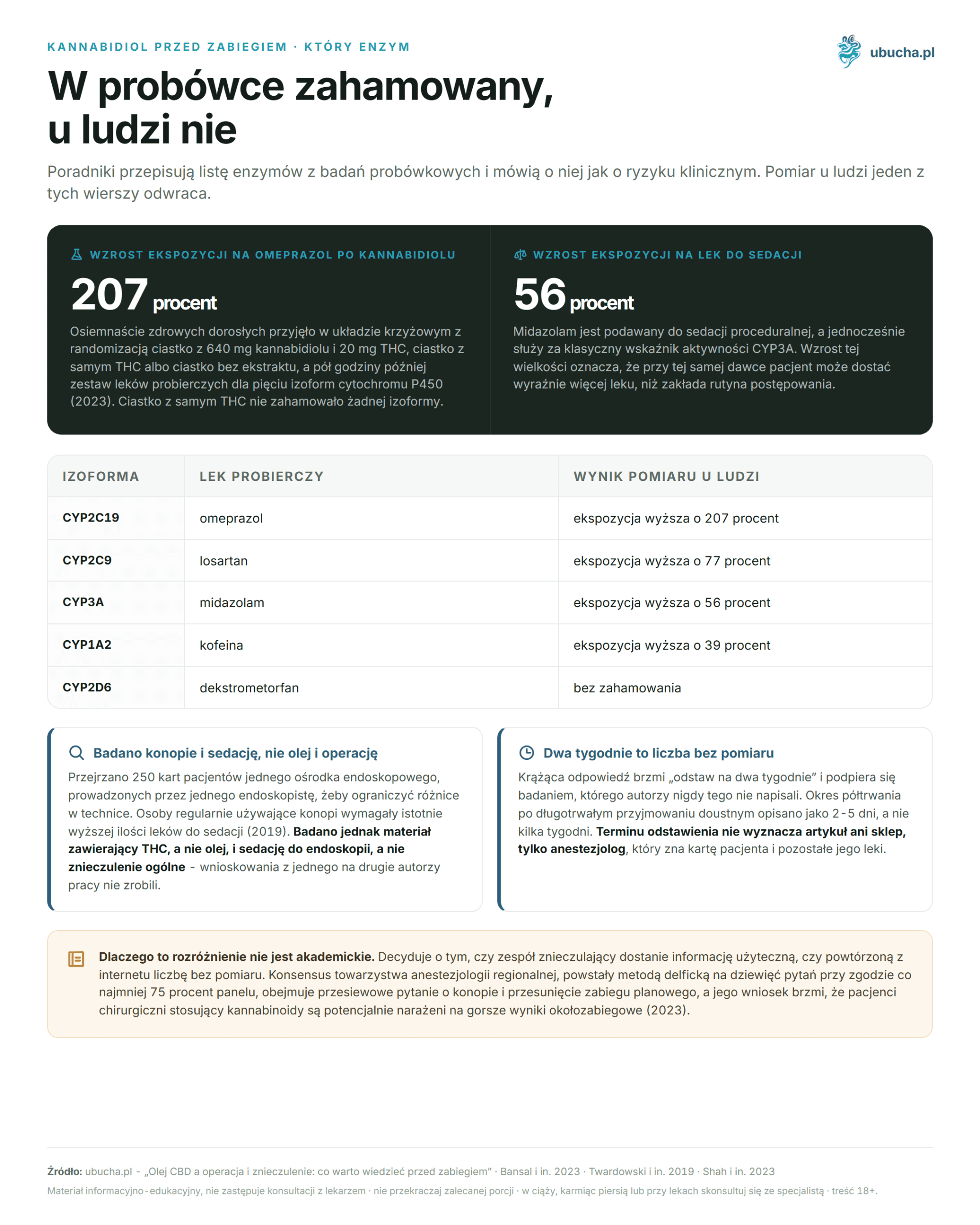
This distinction is more important than the list of enzymes itself, because guides transcribe the list from in vitro studies and talk about it as clinical risk. Measurement in humans looks different. Eighteen healthy adults received in a crossover design with randomization a cookie with 640 mg of CBD and 20 mg of THC, a cookie with only THC, or a cookie without extract, and half an hour later a set of probe medications for five isoforms of cytochrome P450.
| Isoform | Probe Drug | Result in Humans after 640 mg CBD |
|---|---|---|
| CYP2C19 | omeprazole | exposure increased by 207 percent |
| CYP2C9 | losartan | exposure increased by 77 percent |
| CYP3A | midazolam | exposure increased by 56 percent |
| CYP1A2 | caffeine | exposure increased by 39 percent |
| CYP2D6 | dextromethorphan | no inhibition |
The last row is presented in reverse by guides. CBD inhibits CYP2D6 in vitro, so this enzyme appears on warning lists, but at 640 mg in humans, there was no inhibition. The cookie with only THC did not inhibit any isoform (Bansal et al., Clinical Pharmacology and Therapeutics, 2023).
For anesthesia, the row with midazolam is the most telling. This is a drug given for procedural sedation, and at the same time a classic indicator of CYP3A activity. An increase in exposure of 56 percent means that at the same dose, the patient may receive significantly more medication than routine assumes. The direction here is opposite to the conclusion from the endoscopic study, where cannabis users needed more sedation. This is not a contradiction, but two different phenomena: the habituation of the central nervous system and the slowed breakdown of the drug. Only the person conducting the anesthesia can resolve them for a specific patient.
How long does CBD stay in the body?
Shorter than most guides state, and less precisely than the numbers suggested there. A systematic review of studies in humans gathered 24 works with pharmacokinetic data and reports a half-life of CBD in the range of 1.4-10.9 hours after aerosol administered to the oral mucosa, 2-5 days after long-term oral administration, about 24 hours after intravenous administration, and about 31 hours after smoking (Millar et al., Frontiers in Pharmacology, 2018).
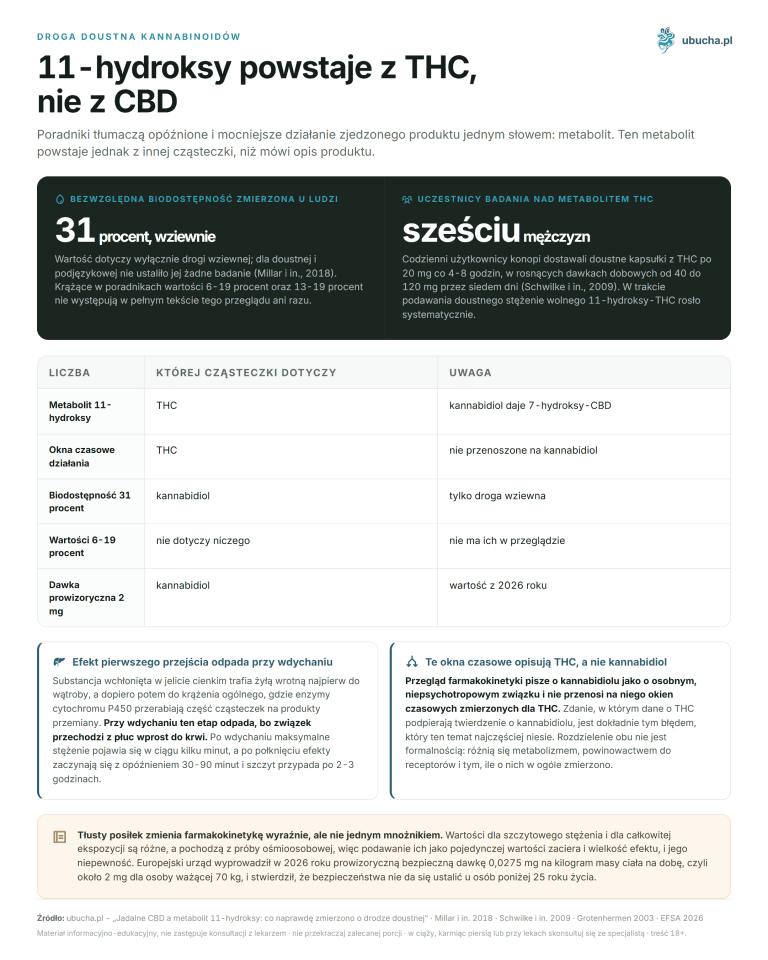
This same review points out something more significant than the numbers themselves. Absolute bioavailability was measured in humans only for the inhalation route and was about 31 percent. For the oral and sublingual routes, none of the analyzed works undertook such measurement. Therefore, the percentage values circulating in oral bioavailability tables have no measurement to refer to.
The practical effect: from this data, it is impossible to derive a single cessation date that is good for everyone. Absorption depends on the form of the preparation and the meal. The number of days from the guide is usually someone’s rounding, not a result of research. Therefore, we do not provide it here.
Who sets the cessation date before the procedure?
The anesthesiologist, after talking with you. This is not a polite formula, but a consequence of the state of knowledge. Postponing a scheduled procedure for a patient using cannabinoids is one of the nine questions in the 2023 perioperative consensus, meaning it is a matter resolved in the office, not in the article.
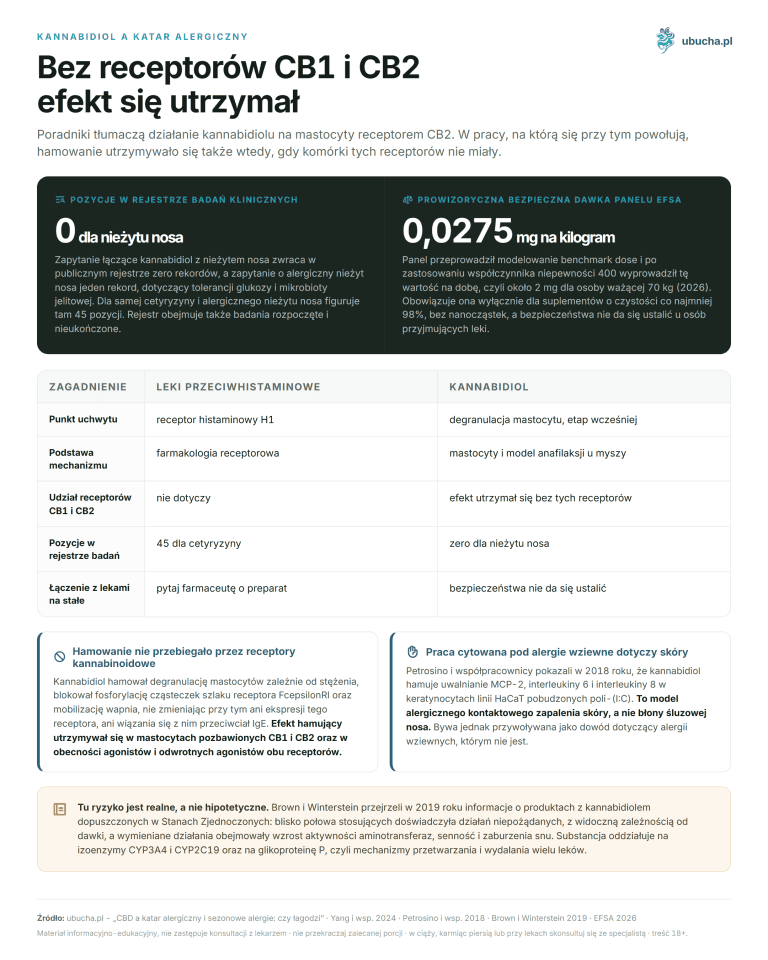
The second reason is regulatory. The EFSA panel assessed the safety of CBD in 2026 and derived a temporary safe dose of 0.0275 mg per kilogram of body weight per day, which is about 2 mg daily for a person weighing 70 kilograms, with an uncertainty factor of 400. This value applies only to supplements with at least 98 percent purity of CBD, without nanoparticles. The panel also states directly that the safety of CBD cannot be established in individuals under 25 years of age, in pregnant and breastfeeding women, and in individuals taking medications simultaneously (EFSA, update on the safety of CBD as a novel food, 2026).
A patient preparing for a procedure belongs to this third group almost by definition. The panel also notes the potential hepatotoxicity in humans, especially with other medications. The lack of established safety plus the inhibition of four cytochrome isoforms is enough to mention CBD, even if no one asks.
What to tell the anesthesiologist and what to bring?
Be specific about what you are taking, in what form, how often, and when you last took it. The anesthesiologist does not evaluate your choices, but plans doses and monitoring. Withholding information does not protect against anything and deprives the team of a clue. How to build such a conversation is described in our text about how to talk to a doctor about CBD and cannabis.
Bring the product packaging or its certificate of analysis. The reason is not formal: missing or inaccurate labeling of CBD and THC content, as well as contaminants such as pesticides or heavy metals, can lead to both harm and lack of expected effects (Corroon et al., Cannabis and Cannabinoid Research, 2020). The statement “I take CBD oil” carries less information than it seems until it is known what is in the bottle.
If someone else is handling the preparation, they must convey the information. The role of an observer is described in the text about caring for a loved one using CBD. Do not stop taking prescribed medications on your own to make room for an unregistered preparation. In a survey among cannabis users, in a self-selected sample, 46 percent reported that they replaced a prescription medication, most often an opioid, benzodiazepine, or antidepressant (Corroon et al., Journal of Pain Research, 2017). Before the procedure, such a silent switch is the information the team will miss the most.
When to call for help after the procedure?
Immediately if symptoms from the first group below appear. Guides on CBD and procedures usually end with “consult a doctor” and do not say what is a warning signal or what number to call. The emergency number in Poland is 112.
- Difficulty breathing, shallow or irregular breathing, bluish lips, inability to wake the person after the procedure. This is a situation for number 112, not for a morning visit.
- Loss of consciousness, seizures, confusion increasing hour by hour.
- Yellowing of the skin or the whites of the eyes, dark urine, persistent vomiting, pain in the right upper quadrant of the abdomen. EFSA notes potential hepatotoxicity in humans, especially with medications, so this is a signal for urgent contact with a doctor.
- Bleeding that cannot be stopped, extensive bruising, blood in urine or stool, especially with anticoagulant medications.
- Deeper sleep than indicated by the team, dizziness with falls, drop in blood pressure.
Milder symptoms reported in humans with CBD include diarrhea, vomiting, fatigue, and drowsiness, as well as deviations in liver tests (Huestis et al., Current Neuropharmacology, 2019). They do not require the emergency number, but do require reporting at the next contact with the attending physician, especially if they persist for several days.
Frequently Asked Questions
How long before surgery should I stop taking CBD?
This term is not set by the article. It is set by the anesthesiologist, as it depends on the type of anesthesia and other medications. For reference: the half-life of CBD after long-term oral administration has been described as 2-5 days, and postponing a scheduled procedure is one of the issues in the 2023 perioperative consensus.
Does CBD affect the action of general anesthesia?
There is a lack of direct measurement in humans under general anesthesia. However, it is known that in 18 healthy adults, 640 mg of CBD increased exposure to midazolam by 56 percent, and a review of 250 patient charts showed a higher demand for sedation in cannabis users.
Do I need to report CBD before a procedure with local anesthesia?
Yes, just like before any other procedure. Local anesthesia procedures often include sedation, and the medications used for it pass through isoforms that CBD inhibits in humans. The extent of anesthesia is determined by the team, so this information is always provided.
Which enzymes does CBD really inhibit, and which only in vitro?
In humans, after 640 mg, CYP2C19, CYP2C9, CYP3A, and CYP1A2 were inhibited. CYP2D6 was not inhibited, even though the signal for this enzyme is clear in in vitro studies. Lists of isoforms transcribed from in vitro studies to guides therefore overstate the clinical risk range.
When can I return to CBD after surgery?
After consulting with your attending physician, not on your own. After the procedure, medications that pass through the same isoforms that CBD inhibits are usually taken, and EFSA states that the safety of CBD in individuals taking medications cannot be established.
What to do if the procedure is urgent and there is no time to stop?
Inform about CBD upon admission, as early as possible, also in the emergency room. Information provided at the last minute is much more valuable to the team than not provided at all: it allows for monitoring planning despite the lack of time to stop.
This article is for informational and educational purposes and does not constitute medical advice. Before starting to use cannabis or CBD for therapeutic purposes, consult your doctor, especially if you are taking other medications, are pregnant, or breastfeeding.
Author: Michał Waluk · Published: 2026-08-09 · Updated: 2026-08-16