
What is PTSD? CBD as Support for Post-Traumatic Stress Treatment
PTSD is a disorder after trauma with established criteria and effective treatment. We check the symptoms, therapy standards, and what studies on CBD really show.
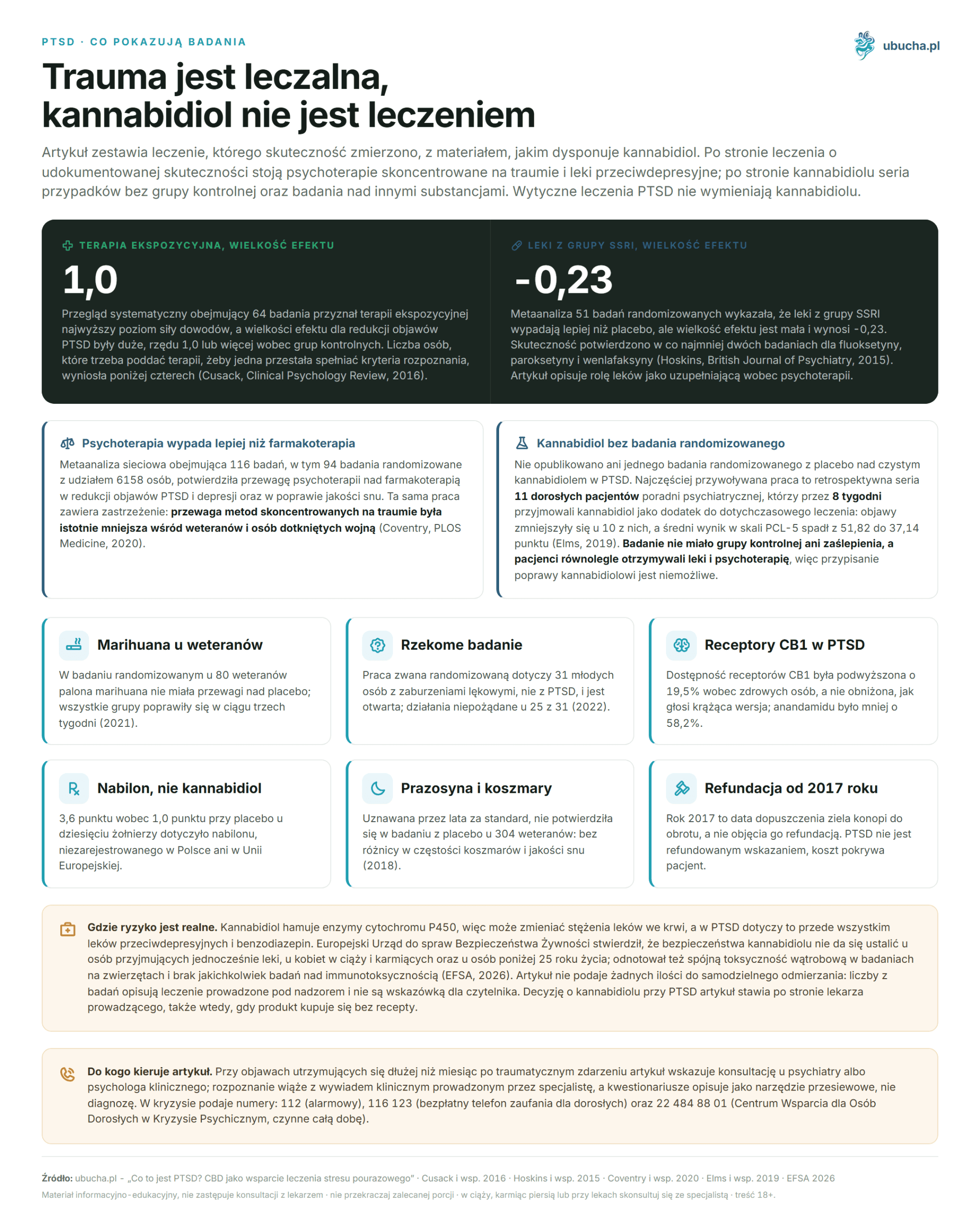
PTSD, or post-traumatic stress disorder, is a mental disorder that develops in some individuals after severe trauma. It has established diagnostic criteria, measurable symptoms, and, most importantly, effective treatment methods. Cannabidiol is increasingly mentioned in discussions about PTSD, and the state of research on it looks different than marketing texts suggest: we have a few small, open studies, one randomized study on smoked marijuana that showed no advantage over placebo, and no guidelines recommending cannabidiol. This article describes what is known about PTSD, what effective treatment looks like, and where current knowledge about cannabis in this indication ends. We have verified every number in the source work, and where popular compilations provide values that are not present in the cited studies, we state this directly.
KEY INFORMATION
• The lifetime prevalence of PTSD is 3.9% in a study involving 26 populations and over 71 thousand people, and among those who have experienced trauma, it is 5.6% (Koenen et al., PMC6034513).
• The treatment with the best-documented efficacy is trauma-focused psychotherapies. Exposure therapy has an effect size of around 1.0 compared to control groups (Cusack et al., PMID 26574151).
• The efficacy of SSRI medications is statistically significant but small (SMD -0.23) in a meta-analysis of 51 studies (Hoskins et al., PMID 25644881).
• The only randomized placebo-controlled study of smoked marijuana in 80 veterans showed no advantage over placebo (Bonn-Miller et al., PMC7968689).
• CBD is not a treatment for PTSD and is not included in any treatment guidelines for this disorder.
If you are experiencing suicidal thoughts or are in crisis, call 112 (emergency), 116 123 (free helpline for adults), or 22 484 88 01 (Support Center for Adults in Mental Health Crisis, available 24/7).
What is PTSD and how does post-traumatic stress develop?
PTSD is a disorder that develops after exposure to a real threat of death, serious injury, or sexual violence. It is characterized by recurring memories, avoidance, negative changes in thinking and mood, and hyperarousal, which persist for more than a month and disrupt daily functioning. Simply experiencing trauma does not yet mean a diagnosis.
The scale of the phenomenon is best described by a study involving 26 population surveys as part of the World Mental Health Surveys, which included 71,083 respondents. The lifetime prevalence of PTSD in this study was 3.9% in the entire sample and 5.6% among those who experienced trauma. Half of those diagnosed reported chronic symptoms (Koenen et al., Psychological Medicine, 2017).
This same work shows something that is discussed less frequently than the symptoms themselves. Access to treatment is very uneven: in high-income countries, 53.5% of individuals sought help, while in low-income and lower-middle-income countries, it was 22.8%. The problem is not only that PTSD occurs, but that a significant portion of patients do not receive the treatment that exists and works.
It is also worth clarifying a distinction that is often confused in popular texts. Immediately after the event, some individuals develop an acute stress reaction, which often resolves spontaneously within a few weeks. Only the persistence of symptoms for more than a month, with significant disruption of functioning, justifies a PTSD diagnosis. Historical terms like “shell shock” or “war neurosis” described the same symptom cluster long before it was formally classified.
What symptoms must PTSD have to be recognized?
The current American classification requires symptoms from four groups, persisting for more than a month after exposure to a trauma that meets the preliminary criterion. The ICD-11 classification uses a simplified model based on three groups: re-experiencing, avoidance, and a sense of current threat. The table below compares the groups of symptoms in the perspective used in clinical diagnostics.
| Group of Symptoms | How it manifests |
|---|---|
| Re-experiencing | Intrusive memories, nightmares, flashbacks, strong emotional and physiological reactions to reminders of the trauma |
| Avoidance | Persistent avoidance of thoughts and feelings related to the trauma and external reminders: people, places, conversations |
| Negative changes in thinking and mood | Memory gaps of the event, excessively negative beliefs about oneself and the world, self-blame, loss of interest, feelings of alienation |
| Hyperarousal | Irritability, risky behaviors, hypervigilance, exaggerated startle response, concentration and sleep problems |
Diagnosis is made based on a clinical interview, not on self-assessment from the internet. A structured interview conducted by a clinician is considered the standard, while self-report tools serve as screening and are used to track changes over time, not for diagnosis. This distinction has practical significance: a high score on a questionnaire is a reason to schedule an appointment with a specialist, not a diagnosis in itself.
A dissociative subtype is separately identified, in which depersonalization and derealization are added to the picture. Analyses show that individuals with this subtype differ from other patients in their neurobiological response pattern and response to standard cognitive-behavioral therapy (Lanius et al., Depression and Anxiety, 2012). For the patient, this means that therapy may be conducted in stages, with stabilization before exposure work.
What is known about the neurobiology of PTSD and the endocannabinoid system?
Imaging studies using positron emission tomography in individuals with PTSD have shown increased availability of CB1 cannabinoid receptors. The effect was global and was 19.5% above values in healthy individuals without a history of trauma and 14.5% above values in individuals after trauma who did not develop PTSD. It was also more pronounced in women.
This finding is worth remembering precisely because a reversed version of it circulates in Polish texts about cannabis, stating that there is decreased availability of CB1 receptors in PTSD. The work shows the opposite. At the same time, levels of anandamide, one of the endocannabinoids produced by the body, were lower in individuals with PTSD: by 53.1% compared to individuals after trauma without PTSD and by 58.2% compared to healthy volunteers. The authors interpret this arrangement as abnormal signaling, where an increased number of receptors accompanies a deficiency of the molecule that should stimulate them (Neumeister et al., Molecular Psychiatry, 2013).
The second well-described mechanism is the deficit in fear extinction. Extinction is the process of learning that a stimulus that previously predicted danger is no longer dangerous. In individuals with PTSD, the failure primarily lies in recalling extinguished memory, not in creating it (Milad et al., Biological Psychiatry, 2009). Exposure forms of psychotherapy are based on this mechanism.
Here appears the only well-documented point of contact between cannabidiol and this process in humans. In a double-blind placebo-controlled study, 48 participants underwent fear conditioning and then an extinction procedure. Cannabidiol administered after the extinction session enhanced the consolidation of learning, measured by the expectation of an aversive stimulus. Administered before the session, it did not produce this effect, and it had no effect on extinction itself (Das et al., Psychopharmacology, 2013). This study was conducted on healthy volunteers in a laboratory model, not on patients with PTSD, and should be read as such.
Why does PTSD disrupt sleep and cause nightmares?
Sleep disturbances are among the most common and burdensome symptoms of PTSD. Difficulty falling asleep or maintaining sleep is reported by 70% to 91% of patients, and nightmares by 19% to 71%, with the percentage depending on the severity of the disorder and whether the patient has experienced physical violence (Maher et al., CNS Drugs, 2006).
It is worth noting something that popular texts often overlook. Subjective reports from patients are unequivocal, but objective measurements conducted in sleep laboratories yield inconsistent results. Some studies clearly show worse sleep, while others find no differences compared to individuals without PTSD. Categorical descriptions of changes in sleep architecture, repeated in guides as established facts, therefore precede the data.
This same review also indicates that some sleep problems in individuals with PTSD have causes that no one is looking for. Sleep-related breathing disorders and sleep movement disorders occur in this group more frequently than in the general population and may account for awakenings, insomnia, and daytime fatigue. This is a real practical hint: persistent sleep problems after trauma should be diagnosed rather than immediately seeking a supplement for them.
Sleep has significance that goes beyond comfort. The rapid eye movement sleep phase is involved in organizing emotional memory, so its disruption may reinforce the memory traces of trauma. Therefore, improving sleep is often one of the first treatment goals, rather than an addition to it.
How is PTSD treated according to guidelines?
The first-line treatment is trauma-focused psychotherapies: exposure therapy, cognitive processing therapy, cognitive-behavioral therapy, and EMDR. A systematic review involving 64 studies assigned the highest level of evidence strength to exposure therapy, and effect sizes for reducing PTSD symptoms were large, around 1.0 or more compared to control groups. The number of individuals that need to be treated for one to no longer meet the diagnostic criteria was below four (Cusack et al., Clinical Psychology Review, 2016).
A meta-analysis of prolonged exposure therapy alone, involving 13 studies and 675 participants, provided a similar picture: a large effect compared to control groups and a result that well reflects the scale of change. The average patient after this therapy performed better than 86% of individuals in control groups. No significant difference was found between prolonged exposure and other active methods (Powers et al., Clinical Psychology Review, 2010).
Pharmacotherapy performs clearly worse than its prevalence suggests. A meta-analysis of 51 randomized studies showed that SSRI medications are statistically better than placebo, but the effect size is small and equals -0.23. Evidence of efficacy was obtained in at least two studies for fluoxetine, paroxetine, and venlafaxine (Hoskins et al., British Journal of Psychiatry, 2015). This does not mean that medications are useless, only that their role is complementary to psychotherapy.
It is also worth noting two things that have changed practice. Prazosin, long considered a standard for traumatic nightmares, did not confirm itself in a large placebo-controlled study involving 304 veterans: there was no difference in the frequency of nightmares, sleep quality, or overall assessment of change (Raskind et al., New England Journal of Medicine, 2018). Benzodiazepines, on the other hand, are discouraged in the long-term treatment of PTSD, as confirmed by a separate systematic review with meta-analysis (Guina et al., Journal of Psychiatric Practice, 2015).
A large network meta-analysis involving 116 studies, including 94 randomized studies with 6158 participants, confirmed the superiority of psychotherapy over pharmacotherapy in reducing PTSD and depression symptoms and improving sleep quality. However, it contains an important caveat: the superiority of trauma-focused methods was significantly smaller among veterans and war-affected individuals (Coventry et al., PLOS Medicine, 2020).
What do studies on CBD in PTSD really show?
Very little, and that is an honest answer. To date, not a single randomized placebo-controlled study has been published that tests pure cannabidiol in PTSD and demonstrates its efficacy. The material we have consists of one case series, a few descriptions of individual patients, and studies on marijuana, which is something different than cannabidiol.
The most frequently cited work is a retrospective series of 11 adult patients from a psychiatric clinic who took cannabidiol as an adjunct to their existing treatment for 8 weeks. Symptoms decreased in 10 of them, or 91%, and the average score on the PCL-5 scale dropped by 28%, from 51.82 to 37.14 points (Elms et al., Journal of Alternative and Complementary Medicine, 2019). The study had no control group or blinding, and patients were concurrently receiving medications and psychotherapy, so attributing the improvement to cannabidiol is impossible.
A description of a supposed randomized study with pure cannabidiol in 31 young people with PTSD circulates in Polish internet. We checked it at the source, and no work with such a description exists. The actual publication from 2022 concerns 31 young individuals aged 12 to 25 with treatment-resistant anxiety disorders, not PTSD, is an open-label study, not randomized, lasted 12 weeks, and measured anxiety severity, not PTSD symptoms. The result was favorable, but adverse effects occurred in 25 out of 31 participants, and the authors conclude by stating that randomized studies are needed (Berger et al., Journal of Clinical Psychiatry, 2022).
Do studies on marijuana say anything about CBD?
Only indirectly, and this is the source of most misunderstandings on this topic. Marijuana primarily contains THC, so results obtained from the herb do not transfer to oils. However, it is worth knowing them, as they are the strongest methodological material in this area.
The only randomized placebo-controlled study in this area concerned smoked marijuana with three different compositions, administered to 80 veterans with PTSD. No significant difference was found between active preparations and placebo in the severity of symptoms, although all groups, including placebo, improved over the three weeks (Bonn-Miller et al., PLOS ONE, 2021).
The largest collection of observations comes from an application in which 404 individuals using medical marijuana recorded 11,797 sessions over 31 months. All tracked symptoms decreased by more than 50% immediately after inhalation. However, the authors formulate a conclusion that usually disappears in citations: the baseline severity of symptoms did not change over time, and the dose used for anxiety increased, indicating the development of tolerance. Relief is therefore temporary, and marijuana does not prove to be a long-term solution (LaFrance et al., Journal of Affective Disorders, 2020).
The remaining material consists of case descriptions and observations from practice that are worth knowing but should not be confused with evidence. Among other things, a ten-year-old patient with PTSD after sexual abuse was described, in whom cannabidiol oil was associated with sustained anxiety reduction and improved sleep (Shannon and Opila-Lehman, The Permanente Journal, 2016). A broader observation comes from a retrospective review of documentation of 72 adults reporting anxiety or poor sleep quality: anxiety scores decreased in the first month for 79.2% of them, and sleep scores improved for 66.7%, although they fluctuated in subsequent months (Shannon et al., The Permanente Journal, 2019). None of these works had a control group, and the second did not concern patients with PTSD.
A randomized placebo-controlled study is ongoing that tests cannabidiol oil directly in PTSD (identifier NCT04197102), but its status is currently suspended. Until the results of such studies are published, cannabidiol remains an experimental intervention. Related issues have been described separately in texts about CBD and THC in the treatment of anxiety disorders and how cannabis can support the treatment of depression.
Do cannabinoids help with nightmares?
This is the only area where the data is somewhat stronger, but it concerns nabilone, a synthetic drug acting on cannabinoid receptors, not cannabidiol. Nabilone is not registered in Poland or the European Union, and these results cannot be transferred to oils available for sale.
In a double-blind crossover study, ten Canadian soldiers with PTSD, whose nightmares persisted despite standard treatment, participated. The reduction on the scale assessing recurrent, distressing dreams was 3.6 points with nabilone compared to 1.0 points with placebo, with a significance level of p equal to 0.03 (Jetly et al., Psychoneuroendocrinology, 2015). The trial was very small, and the authors themselves caution that the result needs to be repeated in a larger group.
An earlier open study involved the documentation of 47 patients with PTSD, whose nightmares persisted despite antidepressants and sleeping pills. In 72% of those treated with nabilone, nightmares ceased or their severity significantly decreased (Fraser, CNS Neuroscience and Therapeutics, 2009). A separate retrospective analysis involved 104 inmates with severe mental disorders and showed improvement in insomnia, nightmares, and overall severity of PTSD symptoms (Cameron et al., Journal of Clinical Psychopharmacology, 2014).
All three studies have the same limitations: small samples, lack of blinding in two of them, and lack of long-term data. They demonstrate that the direction of research makes sense, not that cannabinoids are an effective treatment for traumatic nightmares. For cannabidiol itself, equivalent data do not exist at all.
How does access to medical marijuana for PTSD look in Poland?
Non-fibrous cannabis is a pharmaceutical raw material in Poland for the preparation of prescription medications and is issued only by prescription. The basis is the amendment to the Act on Counteracting Drug Addiction announced as Dz.U. 2017 poz. 1458, effective from November 1, 2017. Therapy is not reimbursed, and the patient bears the full cost.
This last sentence is worth emphasizing because texts about PTSD often return to the claim that medical marijuana has been reimbursed in Poland since 2017. It is not. The year 2017 is the date of allowing the raw material to be marketed, not its inclusion in reimbursement, and these two things are often confused. PTSD is not on the list of reimbursed indications for any cannabinoid preparation.
Two procedural things have practical significance for the patient. A prescription for narcotics is valid for 30 days, not for a year like a regular electronic prescription. More importantly, regulations require that the cannabis plant be personally examined by a doctor. Exceptions to this requirement are narrow. A teleconsultation advertised as a quick path to a prescription for the herb directs the patient for a document that the doctor should not issue according to the regulations.
A separate category is products from hemp, available without a prescription. The threshold of 0.3% that defines them concerns the plant, not the finished product, and is calculated as the sum of delta-9-THC and tetrahydrocannabinolic acid, based on Article 4 point 5 of the Act on Counteracting Drug Addiction (Dz.U. 2023 poz. 1939) as amended by the Act of March 24, 2022 (Dz.U. 2022 poz. 763). These products are not medications and cannot be advertised for medical indications, including PTSD.
What are the risks and interactions of CBD with medications used in PTSD?
The risk does not lie in cannabidiol itself, but in the fact that a person with PTSD almost always takes something else. Cannabidiol inhibits cytochrome P450 enzymes, which are responsible for the metabolism of a large portion of medications, so it may alter their concentrations in the blood (Iffland and Grotenhermen, Cannabis and Cannabinoid Research, 2017). In the treatment of PTSD, this primarily concerns antidepressants and benzodiazepines.
A meta-analysis of adverse effects of cannabidiol included 12 double-blind placebo-controlled studies, totaling 803 participants. Cannabidiol was associated with more frequent discontinuation of participation in the study, more frequent occurrence of serious adverse events, and abnormal liver function test results. However, the authors note that associations with liver function tests and drowsiness occurred only in studies on childhood epilepsy, where cannabidiol may have interacted with clobazam or valproate. After excluding these studies, the only event associated with treatment remained diarrhea (Chesney et al., Neuropsychopharmacology, 2020).
The conclusion is inconvenient for marketing and important for the reader of this text. Cannabidiol itself performs mildly in studies, and warning signals appear exactly where it is accompanied by other medications, that is, in the situation of a person being treated for PTSD.
This is confirmed by the latest assessment from the European regulator. The European Food Safety Authority stated in 2026 that the safety of cannabidiol cannot be established in individuals taking medications simultaneously, in pregnant and breastfeeding women, and in individuals under 25 years of age. It also noted consistent liver toxicity in animal studies and a lack of any studies on immunotoxicity (EFSA, 2026).
For this reason, we do not provide any quantities for self-measurement in this article. The numbers appearing above describe specific clinical studies conducted under supervision and are not guidance for the reader. If you are considering cannabidiol for PTSD, make the decision with your attending physician, and tell them about it, even if you are buying the product over the counter. Hiding the use of cannabinoids disrupts clinical assessment because drowsiness may then be interpreted as a symptom of illness rather than a side effect of the product. Similar reservations apply to other mental disorders, which we described in the text about research on CBD in schizophrenia.
Who is most at risk for PTSD?
The risk is unevenly distributed and primarily depends on the type of trauma. The first large population study in the United States, involving 5877 individuals, established the lifetime prevalence of PTSD at 7.8%. The traumas most often associated with the disorder were combat participation and witnessing violence in men, and rape and sexual abuse in women. More than one-third of individuals with a PTSD episode did not recover even after many years (Kessler et al., Archives of General Psychiatry, 1995).
The authors of this work add a caveat that disappears in popular compilations but is significant. Precise estimation of the probability of developing PTSD after specific types of trauma would require differently designed studies. Therefore, tables circulating on the internet with exact percentages for rape, assault, or traffic accidents attributed to this study do not originate from it.
Two groups that have been highlighted in recent years are better documented. A systematic review involving 38 works and 19,428 individuals estimated the prevalence of PTSD symptoms during coronavirus epidemics at around 18%, with the COVID-19 pandemic itself at 9%. Symptoms affected about two out of ten healthcare workers (Salehi et al., Journal of Affective Disorders, 2021).
The second group is individuals displaced due to the war in Ukraine. A nationwide study of 2000 Ukrainians showed that displacement was associated with higher severity of PTSD symptoms, both in individuals displaced within the country and abroad, compared to those who remained in their place of residence (Ben-Ezra et al., Psychiatry Research, 2023). The work provides average symptom severity, not diagnosis rates, so circulating numbers in the range of several dozen percent have no basis in it.
Summary
PTSD is a disorder with established criteria and, importantly, effective treatment. Trauma-focused psychotherapies have documented large effect sizes, and the number of individuals that need to be treated for one to no longer meet the diagnostic criteria is less than four. SSRI medications work, but weaker than their popularity suggests.
Cannabidiol is not a treatment for PTSD and is not included in any guidelines. The data we have consists of one uncontrolled series of 11 patients, studies on another compound, namely nabilone, and one randomized study on smoked marijuana that showed no advantage over placebo. The work described in Polish internet as a randomized study of cannabidiol in PTSD actually concerns anxiety disorders and is an open-label study.
If you recognize symptoms persisting for more than a month after a traumatic event, schedule an appointment with a psychiatrist or clinical psychologist. Trauma is treatable, and methods with proven efficacy are available. In crisis, call 112, 116 123, or 22 484 88 01.
Frequently Asked Questions
Does CBD cure PTSD?
No. Cannabidiol is not a cure for PTSD and is not included in the treatment guidelines for this disorder. The standard remains trauma-focused psychotherapies and antidepressant medications. Available data on cannabidiol in PTSD comes from one uncontrolled series of 11 patients and does not allow for a conclusion about efficacy.
Is there a randomized study of CBD in PTSD?
There is no published randomized placebo-controlled study of pure cannabidiol in PTSD. The work sometimes described as such a study actually concerns 31 young people with treatment-resistant anxiety disorders, is an open-label study, and lasted 12 weeks. A study of cannabidiol directly in PTSD has been registered but currently has a suspended status.
What did the study on marijuana in veterans with PTSD show?
The randomized placebo-controlled study involved 80 veterans and compared three compositions of smoked marijuana with placebo. No significant difference in the severity of PTSD symptoms was found between the active preparations and placebo, although all groups improved over the three-week observation period.
Can CBD be combined with antidepressants?
Only after consulting with the attending physician. Cannabidiol inhibits cytochrome P450 enzymes and may alter the concentrations of drugs metabolized by these pathways. The European Food Safety Authority states that the safety of cannabidiol cannot be determined today for individuals taking medications.
Is medical marijuana reimbursed in Poland for PTSD?
No. Cannabis is issued only by prescription, and the patient bears the full cost of therapy. The year 2017 is the date of allowing the raw material to be marketed, not its inclusion in reimbursement. PTSD is not on the list of reimbursed indications for cannabinoid preparations.
When should you suspect PTSD in yourself and where to seek help?
If more than a month after a traumatic event you experience recurring memories, nightmares, avoidance, irritability, and disturbances in sleep and concentration, and the symptoms disrupt daily functioning, consult a psychiatrist or clinical psychologist. Free support is offered by the Helpline 116 123 and the Support Center 22 484 88 01. In an emergency crisis, call 112.
This article is for informational and educational purposes and does not constitute medical advice. Before starting to use cannabis or CBD for therapeutic purposes, consult with a doctor, especially if you are taking other medications, are pregnant, or breastfeeding.
Author: Michał Waluk · Published: 2026-05-04 · Updated: 2026-08-10