
CBD in Schizophrenia, Research on the Antipsychotic Effects of Cannabis
CBD in schizophrenia: what Leweke 2012 and McGuire 2018 studies showed, what doses were used, why THC acts oppositely, and what evidence does not confirm.
Schizophrenia affects about 24 million people worldwide, roughly one in 300. Despite sixty years of pharmacotherapy development, some patients respond poorly to treatment, and negative symptoms and cognitive dysfunction remain difficult to manage. Since 2012, cannabidiol has been one of the most studied molecules in psychiatry in this context because it acts outside the dopamine D2 receptor, i.e., outside the mechanism common to all registered antipsychotic drugs. This text organizes what actually results from clinical trials and what is their overextended interpretation. It also shows why the doses used in these studies are unattainable in dietary supplements and why THC acts in schizophrenia exactly opposite to cannabidiol.
KEY INFORMATION
• In a mental health crisis, with suicidal thoughts or acute psychosis, call 112 or 116 123 (free adult helpline, available 24/7). For children and youth, 116 111.
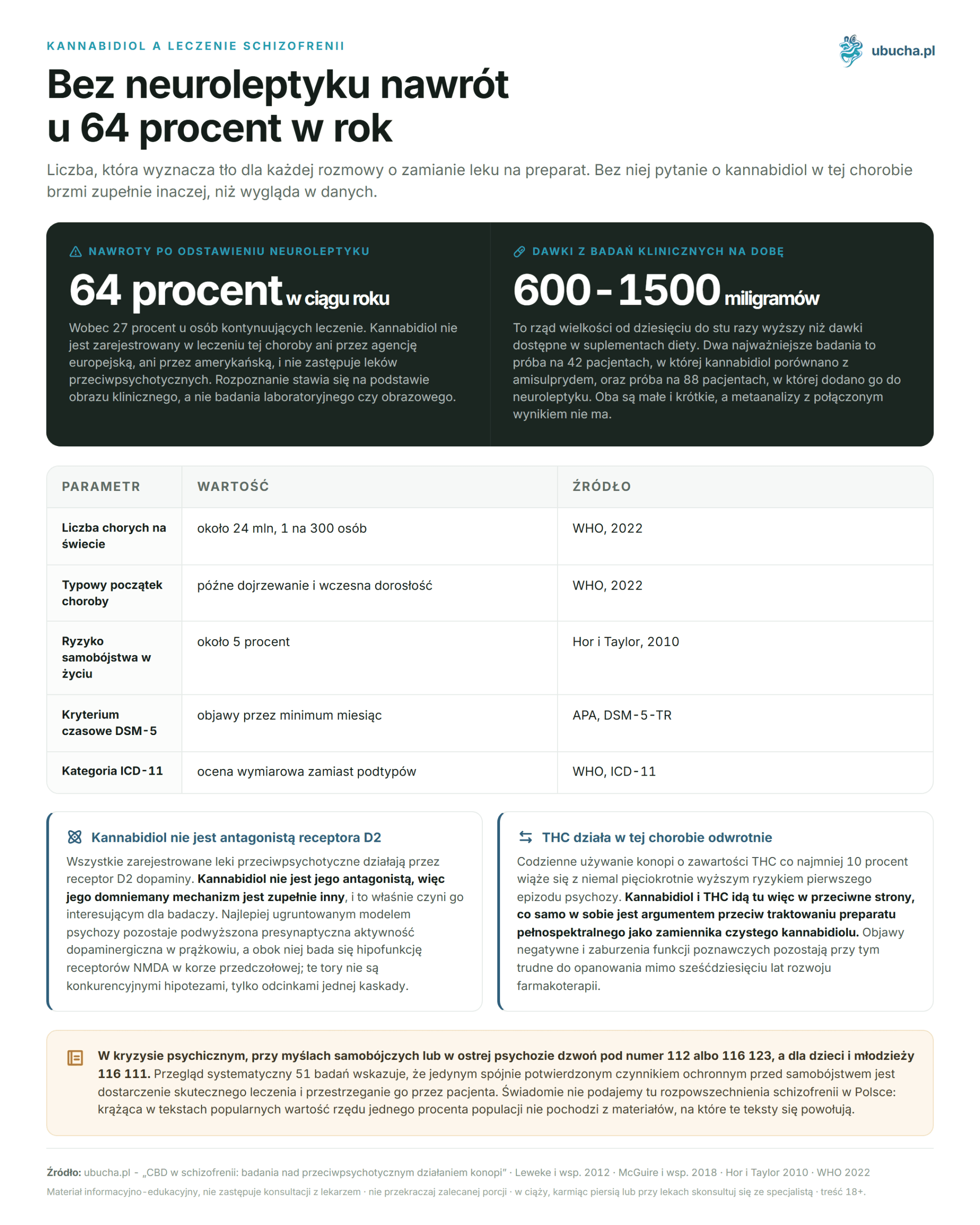
• CBD is not registered for the treatment of schizophrenia by either EMA or FDA and does not replace antipsychotic medications.
• All registered antipsychotic drugs act through the dopamine D2 receptor. CBD is not an antagonist of this receptor, so its presumed mechanism is completely different.
• The two most important clinical trials are Leweke 2012 (42 patients, CBD versus amisulpride) and McGuire 2018 (88 patients, CBD added to neuroleptic). Both are small and short, and there is no meta-analysis combining the results.
• Doses from studies, 600-1500 mg per day, are about 10-100 times higher than doses available in dietary supplements.
• Daily use of cannabis with at least 10 percent THC content is associated with nearly a fivefold increased risk of a first psychotic episode.
• Discontinuation of neuroleptics leads to relapse in 64 percent of patients within a year, compared to 27 percent in those continuing treatment.
What is schizophrenia and how common is it?
Schizophrenia is a chronic mental disorder with three groups of symptoms: positive (hallucinations, delusions), negative (withdrawal, anhedonia, impoverished speech), and cognitive. The World Health Organization estimates it affects about 24 million people worldwide, roughly one in 300. The lifetime risk of suicide is about 5 percent.
The illness usually begins in late adolescence or early adulthood, slightly earlier in men than women. Diagnosis is based on clinical presentation, not laboratory or imaging tests. DSM-5 requires the presence of at least two of five symptoms for a minimum of one month, with functional impairment lasting at least six months. ICD-11 describes the same disorder under category 6A20 and abandons classical subtypes in favor of dimensional assessment.
The suicide risk estimate comes from a systematic review of 51 studies published after 2004, whose authors accepted a consensus of about 5 percent lifetime risk (Hor and Taylor, Journal of Psychopharmacology, 2010). The same work indicates that the only consistently confirmed protective factor is providing effective treatment and patient adherence. This is the first reason why self-treatment experiments in this illness are dangerously incomparable to joint pain or insomnia.
| Parameter | Value | Source |
|---|---|---|
| Number of patients worldwide | about 24 million, roughly 1 in 300 people | WHO, 2022 |
| Typical onset | late adolescence and early adulthood | WHO, 2022 |
| Lifetime suicide risk | about 5 percent | Hor and Taylor, 2010 |
| DSM-5 time criterion | symptoms min. 1 month, functional impairment min. 6 months | APA, DSM-5-TR |
| ICD-11 category | 6A20, dimensional assessment instead of subtypes | WHO, ICD-11 |
We deliberately do not provide schizophrenia prevalence in Poland here. The commonly cited figure of about one percent of the population in popular texts does not come from WHO materials they reference, and publicly available reporting data do not allow an estimate that could be confidently presented here.
What neurobiological mechanisms underlie psychosis?
The best-established model is increased presynaptic dopaminergic activity in the striatum, driven by various risk factors. Alongside it, hypofunction of NMDA receptors in the prefrontal cortex is studied. These pathways are not competing hypotheses but segments of one cascade ending in dopamine excess.
The third version of the dopamine hypothesis, formulated by Howes and Kapur, calls this state a final common pathway: perinatal complications, stress, trauma, psychoactive substance use, and genetic susceptibility converge in increased presynaptic dopaminergic function in the striatum (Howes and Kapur, Schizophrenia Bulletin, 2009). The authors draw a conclusion directly relevant to the rest of this text: current drugs act below the site where the disorder originates, blocking the effect, not the cause.
The second pathway is the glutamatergic system. NMDA receptor antagonists ketamine and phencyclidine induce acute psychosis-like symptoms in healthy individuals, supporting the hypothesis of glutamatergic hypofunction in the prefrontal cortex since the 1990s. The relationship between glutamate and dopamine in schizophrenia is summarized in a separate review by the same research group (Howes et al., Journal of Psychopharmacology, 2015).
- Dopamine: excessive presynaptic synthesis and release in the striatum, a common convergence point of risk factors.
- Glutamate: weakened signaling via NMDA receptors in the prefrontal cortex, probably earlier in the cascade.
- Inflammatory processes: studied for over a decade but without established results to cite as confidently as the previous two points.
The last point deserves a separate sentence because it is often overused. Neuroinflammation is an active research area where microglial activation imaging results are inconsistent, not an established fact. If you read that CBD treats psychosis because it is anti-inflammatory, that argument rests on the weakest link in this chain.
What role does the endocannabinoid system play in psychosis?
The endocannabinoid system is clearly altered in psychosis but in the opposite direction to intuition. Patients with schizophrenia have elevated levels of endogenous cannabinoids in cerebrospinal fluid, and in prodromal individuals, higher anandamide was associated with later, not earlier, transition to overt psychosis.
The first observation was published by Leweke’s team in the late 1990s (Leweke et al., Neuroreport, 1999). A decade later, Koethe and colleagues measured anandamide in cerebrospinal fluid of 27 prodromal individuals and 81 healthy volunteers. Patients had significantly elevated levels, and those with lower values transitioned to psychosis earlier, interpreted as a protective role of this system in early schizophrenia (Koethe et al., British Journal of Psychiatry, 2009).
This relationship built the entire therapeutic hypothesis. Since anandamide appears compensatory, a substance that slows its breakdown should act beneficially. CBD inhibits anandamide degradation, and in the 2012 clinical trial, increased serum levels correlated significantly with clinical improvement. This is a rare case where clinical effect and mechanism biomarker were measured in the same study.
It is worth noting how different this pathway is from dopamine blockade. Neuroleptics cut the signal at the cascade’s end, whereas raising anandamide would enhance the brain’s own defensive response. We elaborated this contrast in a separate text on CBD as an antipsychotic compound. However, an honest caveat is necessary: a mechanistic hypothesis, even elegant, is not proof of efficacy.
How does CBD pharmacology differ from neuroleptics?
All licensed antipsychotic drugs act via the dopamine D2 receptor. CBD is not an antagonist of this receptor and has very weak affinity for cannabinoid receptors CB1 and CB2. Its described molecular targets include, among others, the 5-HT1A receptor, TRP family channels, GPR55, PPAR-gamma, and the FAAH enzyme.
The statement that every registered antipsychotic acts through D2 is not a journalistic simplification but a starting point of a review dedicated to early psychosis phases (Chesney et al., Psychopharmacology, 2022). The McGuire 2018 study authors put it even stronger: since CBD’s action does not seem to depend on dopamine receptor antagonism, it would represent a new class of treatment for this disorder. A summary of cannabidiol’s molecular targets is described in a separate review (Ibeas Bih et al., Neurotherapeutics, 2015).
| Molecular Target | Nature of CBD Action | Relevance in Psychosis |
|---|---|---|
| Dopamine D2 receptor | no significant antagonism | distinguishes CBD from every registered neuroleptic |
| FAAH | inhibition, increased anandamide | only mechanism linked to improvement in clinical trial |
| 5-HT1A | partial agonism | associated with anxiolytic effect |
| TRPV channels | modulation | anti-inflammatory hypothesis, preliminary evidence |
| GPR55 | antagonism | mainly preclinical data |
| CB1 and CB2 | very weak affinity | reason why CBD does not intoxicate like THC |
The difference is also visible in side effects. Drugs blocking D2 cause extrapyramidal symptoms and increase prolactin levels. They also promote weight gain, and their profiles differ enough that drug choice is practically a choice of tolerated side effects (Huhn et al., Lancet, 2019). The most commonly reported adverse effects of CBD in clinical trials are fatigue, diarrhea, and changes in appetite and weight (Iffland and Grotenhermen, Cannabis and Cannabinoid Research, 2017). The same review explicitly notes that CBD’s impact on hormonal balance remains unstudied.
What did the Leweke 2012 study comparing CBD with amisulpride show?
This was the first study comparing CBD with an active drug rather than placebo. Forty-two hospitalized patients in an acute schizophrenia episode received either CBD or amisulpride for 28 days, both arms with doses titrated up to 800 mg per day. Improvement was nearly identical in both groups, and CBD was clearly better tolerated.
Thirty-nine patients entered the intention-to-treat analysis, and 33 per protocol. PANSS scale improvement was 30.5 points in the CBD group and 30.1 points in the amisulpride group, with no significant difference (1.0 point, 95 percent confidence interval from minus 12.6 to 14.6, p=0.884). BPRS scale improvement was 20.5 and 19.4 points, respectively (Leweke et al., Translational Psychiatry, 2012).
| Outcome after 28 days | CBD | Amisulpride |
|---|---|---|
| PANSS improvement (points) | 30.5 | 30.1 |
| BPRS improvement (points) | 20.5 | 19.4 |
| Prolactin increase | significantly less (p below 0.001) | greater |
| Weight gain | significantly less (p=0.010) | greater |
| Extrapyramidal symptoms | significantly rarer (p=0.006) | more frequent |
However, limitations are serious and must be read alongside the result. The trial included several dozen people, observation lasted four weeks, there was no placebo arm, and no assessment of relapse or any endpoint longer than a month. The wide confidence interval for the difference means the study lacked power to detect even a large advantage of one treatment. The result is a premise that cannabidiol may have antipsychotic activity in humans, and nothing more.
What did the adjunctive McGuire 2018 study contribute?
McGuire 2018 is the largest randomized trial of CBD in schizophrenia to date. Eighty-eight patients with persistent symptoms despite neuroleptic treatment received additional CBD at 1000 mg per day or placebo for six weeks. The CBD group had fewer positive symptoms and was more often rated as improved by clinicians.
The breakdown was: 43 received CBD, 45 placebo, all continued their neuroleptic. The difference in PANSS positive symptom subscale was minus 1.4 points favoring CBD (95 percent confidence interval from minus 2.5 to minus 0.2). Clinician-rated improvement was better in the CBD group, and cognitive tests and global functioning scales improved in the same direction but did not reach statistical significance. Adverse event rates were similar (McGuire et al., American Journal of Psychiatry, 2018).
The effect size requires sober assessment. The PANSS positive subscale covers several dozen points, so a difference of about one and a half points is real but small. The authors described the study as exploratory, meaning its result justifies planning another trial, not changing clinical practice.
For patients, the practical takeaway is: even in the most favorable interpretation, CBD was an add-on, never a replacement. All participants continued neuroleptics throughout. The study does not answer what happens if someone replaces medication with oil, as that scenario was never tested.
Is there a meta-analysis confirming CBD efficacy in schizophrenia?
No. Beyond the two studies described and a few smaller trials, there is no work combining available results into a reliable effect estimate. Numbers circulating online as supposed meta-analyses of CBD in schizophrenia cannot be found in peer-reviewed literature, and identifiers given alongside lead to works in entirely different fields.
What does exist are narrative reviews. The most recent describes CBD as a promising option especially in early psychosis phases, where minimizing side effects is a clinical priority, and explicitly states unresolved questions will be closed only by ongoing clinical trials (Chesney et al., Psychopharmacology, 2022). A review summarizes the state of knowledge, not new evidence.
Larger phase 3 trials are underway by the manufacturer of a registered cannabidiol preparation, but their primary results have not yet been published. Numerical details repeated in popular texts, e.g., about a thousand patients in dozens of centers, lack confirmation in peer-reviewed literature and are therefore omitted here.
The regulatory consequence is clear. CBD is not registered for schizophrenia treatment in the European Union or the United States. The only approved cannabidiol-based drug is indicated for rare drug-resistant epilepsies and is not a psychiatric medication. Any statement starting with “studies have proven that CBD cures schizophrenia” is false as of August 2026.
What doses of CBD were used in studies and why are these not consumer doses?
Studies on psychosis used 600 to 1500 mg CBD per day. Dietary supplements legally available in the European Union usually provide 10-100 mg per day, one or two orders of magnitude less. Replicating the clinical trial dose from a consumer product is therefore not a matter of determination but arithmetic.
| Study or context | CBD dose | Administration method |
|---|---|---|
| Leweke 2012 | up to 800 mg per day | monotherapy, 28 days, hospital setting |
| McGuire 2018 | 1000 mg per day | add-on to neuroleptic, 6 weeks |
| Bhattacharyya 2018 | 600 mg single dose | single dose, imaging study |
| Typical dietary supplement | 10-100 mg per day | without medical supervision |
Pharmacokinetics add to the milligram difference. Oral cannabinoid absorption depends strongly on the preparation form and administration route, so pharmacological reviews recommend starting with low doses and slowly increasing under observation (Lucas et al., British Journal of Clinical Pharmacology, 2018). Clinical trials administer doses in controlled conditions, monitoring liver enzymes and concurrent drug levels.
It is also practical to state plainly: taking gram doses of cannabidiol from consumer oils would mean drinking quantities measured in bottles weekly, without any liver or neuroleptic interaction monitoring. This is not a cheaper therapy variant but an uncontrolled therapy variant.
Why do THC and high-potency cannabis increase psychosis risk?
In the multicenter EU-GEI study, daily cannabis use was associated with an odds ratio of 3.2 for psychotic disorder compared to never-users, and daily use of strains with at least 10 percent THC with an odds ratio of 4.8, nearly fivefold increased risk.
The study included 901 patients with first-episode psychosis and 1237 controls in eleven centers in Europe and Brazil from 2010-2015. Authors also calculated population attributable fraction: if high-potency cannabis disappeared from the market, 12.2 percent of first-episode psychosis cases in the sample could be prevented, 30.3 percent in London, and 50.3 percent in Amsterdam (Di Forti et al., Lancet Psychiatry, 2019). This is a case-control study, not a meta-analysis of prospective studies, and should be cited as such.
The second figure concerns outcomes of people who already had substance-induced psychosis. In a Danish registry of 6788 such patients, 32.2 percent later developed schizophrenia or bipolar disorder, with cannabis-induced psychosis having the highest conversion rate at 47.4 percent. Half of conversions occurred within 3.1 years of the episode (Starzer et al., American Journal of Psychiatry, 2018).
This explains the most common misunderstanding: since CBD looks promising, cannabis should also help. It should not. In flower with potency above 10 percent THC, cannabidiol is present only in trace amounts, so the net effect is determined by THC. More about what is known regarding marijuana’s impact on mental health is described separately. Isolated cannabidiol from clinical trials and illicit market flower are two different substances with opposite effects.
What is standard schizophrenia treatment?
Standard is continuous pharmacotherapy with an antipsychotic drug supplemented by psychosocial interventions. The basis for maintenance treatment is strong: a meta-analysis of 65 studies including 6493 patients found relapse within a year in 27 percent of those taking medication and 64 percent of those on placebo.
The same work provides other figures worth knowing before any independent decision. Rehospitalization occurred in 10 percent treated and 26 percent placebo. Aggressive behavior occurred in 2 percent versus 12 percent. Treatment costs side: weight gain in 10 percent versus 6 percent, movement disorders in 16 percent versus 9 percent, sedation in 13 percent versus 9 percent (Leucht et al., Lancet, 2012). The balance clearly favors continuing treatment but is not free and must be discussed with a doctor, not omitted.
Two observations rarely reach popular texts. Long-acting formulations protected better against relapse than oral tablets, indicating how much regular medication adherence matters. The second is a warning against excessive optimism: the difference between drug and placebo decreased with study length, so short trials overestimate benefits. The same mechanism applies to cannabidiol studies lasting four and six weeks.
- First-line treatment: single antipsychotic at the lowest effective dose, chosen based on tolerated side effects.
- Second-line treatment: switch to another antipsychotic after an adequately long trial at optimal dose.
- Third-line treatment: clozapine in treatment-resistant schizophrenia, with mandatory blood monitoring.
The non-pharmacological layer is not an add-on. UK NICE guidelines recommend cognitive-behavioral therapy tailored to psychosis and family interventions as standard care (NICE CG178). In practice, this layer is often hardest to access in Poland, pushing some patients toward self-purchased solutions.
Can CBD be used in high-risk individuals?
Outside clinical trials, no. In clinically high-risk individuals, a single 600 mg dose partially normalized activity in selected brain structures in functional MRI. This is a biological signal, not proof that cannabidiol reduces illness risk.
The study included 33 previously untreated high-risk participants, 16 receiving a single 600 mg CBD dose, 17 placebo, and 19 healthy controls. During a memory task, activation in the parahippocampal gyrus, midbrain, and striatum was higher in the CBD group than placebo but lower than healthy controls, i.e., intermediate. Task performance did not differ between groups. Authors state CBD may partially normalize these changes (Bhattacharyya et al., JAMA Psychiatry, 2018).
Epidemiological background helps understand why this is insufficient. An updated meta-analysis of 130 studies and 9222 high-risk individuals found 25 percent transition to psychosis within three years, with risk rising further and plateauing only after four years (Salazar de Pablo et al., JAMA Psychiatry, 2021). Three-quarters do not develop illness, so preventive intervention would need a very good safety profile with unknown effect.
Three practical problems add up: no study shows real reduction in illness numbers, unknown effects of months-long gram doses in young people, and risk that a sense of security delays effective psychological interventions. If depressive symptoms accompany risk symptoms, a more sensible starting point is discussing them with a doctor; we separately collected what is known about cannabis in depression context.
What are CBD interactions with antipsychotic drugs?
THC and CBD are metabolized in the liver and may have pharmacokinetic interactions with drugs processed by the same pathways. This occurs via enzyme and transporter inhibition or induction. The best-documented example is cannabidiol’s inhibition of clobazam metabolism.
Pharmacological reviews also point to pharmacodynamic interactions with CNS depressants and, relevant here, note cannabis use is contraindicated in significant mental illness (Lucas et al., British Journal of Clinical Pharmacology, 2018). A separate cannabidiol safety review concludes CBD’s effects on liver enzymes, transporters, and drug interactions require further clinical study (Iffland and Grotenhermen, Cannabis and Cannabinoid Research, 2017).
| Situation | Why it matters | What the doctor does |
|---|---|---|
| Neuroleptic metabolized in liver | possible change in blood drug level | monitors drug level and clinical picture |
| Clozapine | narrow therapeutic window, neutropenia risk | monitors blood counts and drug level |
| Sedatives and hypnotics | additive sedation | adjusts doses and timing |
| Liver disease | impaired cannabinoid metabolism | monitors transaminases before and during |
The practical rule is simple and requires no enzyme name knowledge. If you take an antipsychotic, adding cannabidiol is a medical decision, not a purchase decision. The treating psychiatrist must know, even if the product is bought as a dietary supplement, because interaction does not recognize legal packaging categories.
How to verify if a cited study says what the text claims?
It is worth knowing because false citations in texts about cannabidiol and psychosis are the rule, not the exception. Three reflexes suffice: check if the study exists, if it concerns the declared topic, and if it contains the cited number. Each takes a minute and catches a different error type.
The first reflex concerns study existence. Entering the PMID or PMC number in Europe PMC immediately shows title, authors, and year. If the title has nothing to do with the sentence topic the number was supposed to support, the citation is faulty even if the link opens correctly. Matching author name and year alone does not guarantee relevance, as authors publish many papers yearly.
The second reflex concerns topic. Sometimes the study exists and is related but addresses a different population, scale, or endpoint. A single-dose study in a few dozen people does not confirm efficacy in chronic treatment, even if both concern cannabidiol.
The third reflex is hardest and most often skipped. The identifier may be correct, the study appropriate, but the number in the text is wrong. Therefore, the number must be found in the study abstract, not taken at face value. If it is absent there but given in the text with decimal precision, it usually means it does not come from that study. This article passed such checks citation by citation, and some claims from its previous version did not survive.
Frequently Asked Questions
Can CBD replace antipsychotic medications?
No. In both clinical trials cited in this article, CBD was either compared with a drug for four weeks in a hospital or added to a drug the patient continued taking. Replacing the drug with cannabidiol has never been tested, and discontinuing neuroleptics results in relapse in 64 percent of people within a year.
Will medical marijuana help in schizophrenia?
No, it works in the opposite direction. Daily use of cannabis with at least 10 percent THC content is associated with nearly a fivefold increased risk of a first psychotic episode. Isolated cannabidiol administered in clinical trials and high-potency cannabis flower are two different substances with opposite effects.
What doses of CBD were used in schizophrenia studies?
From 600 to 1500 mg per day, most commonly 1000 mg in McGuire 2018 and up to 800 mg in Leweke 2012. Dietary supplements usually provide 10-100 mg per day, one or two orders of magnitude less, so the research dose cannot be replicated from them.
Does CBD interact with clozapine or olanzapine?
It may interact. Cannabidiol is metabolized in the liver and can inhibit enzymes and transporters responsible for processing other drugs, which is practically significant for clozapine with its narrow therapeutic window. Adding CBD to psychosis treatment requires the consent and supervision of the treating psychiatrist.
Does CBD prevent psychosis development in at-risk individuals?
It is unknown because such a study has not been conducted. A single 600 mg dose partially normalized activity in selected brain structures in an imaging study of 33 people, but no study has shown that cannabidiol reduces actual illness incidence in this group.
Where to seek help in a mental health crisis in Poland?
In an acute crisis, with suicidal thoughts or psychosis, call 112 or 116 123, the free adult helpline available 24/7. For children and youth, 116 111 is available. Psychiatric hospital emergency rooms admit without referral.
What does this mean in practice?
Evidence for cannabidiol’s antipsychotic effect exists but is thinner than most texts suggest. It consists of two small randomized trials, several smaller attempts, and a consistent mechanistic hypothesis based on anandamide. There is no meta-analysis, no registration for this indication, and no study on relapse prevention.
At the same time, what is known about standard treatment is much better documented. Continuing antipsychotic medication reduces annual relapse rate from 64 to 27 percent, and the only consistently confirmed protective factor against suicide in schizophrenia is providing effective treatment and adherence. None of these numbers have a cannabidiol counterpart.
The practical conclusion can be summarized in four sentences. Cannabidiol can be at most an add-on, never monotherapy. Study doses are unattainable in dietary supplements. THC and high-potency cannabis are contraindicated in this illness without exceptions. Any treatment change occurs under psychiatric care, not after reading an article, including this one.
If a loved one is ill, the most effective things you can do are boring and proven: help maintain treatment continuity, contact a psychiatrist or mental health center, support daily functioning, and respond quickly to relapse signs. Leave the cannabidiol conversation for when these basics work and conduct it with the treatment team.
This article is for informational and educational purposes and does not constitute medical advice. Before starting cannabis or CBD for therapeutic purposes, consult a doctor, especially if you take other medications, are pregnant, or breastfeeding.
Author: Michał Waluk · Published: 2026-05-04 · Updated: 2026-08-10