
Researchers Explained the Mechanism of CBD Action in Inflammatory States
How CBD extinguishes inflammation: the switch of 15-lipoxygenase, PPAR gamma, adenosine, and TRP channels. What studies have shown in humans and what only in mice.
In 2023, a team from Friedrich Schiller University in Jena described what exactly happens in human macrophages after the administration of cannabidiol. The work of Peltner and colleagues showed that CBD shifts the immune cell from producing pro-inflammatory mediators to lipids that extinguish inflammation. This is a rare case where the popular claim about anti-inflammatory properties receives a specific molecular description. In this text, I go through the pathways that appear in this description: the switch of lipid mediator classes, the nuclear receptor PPAR gamma, adenosine signaling, and TRP channels. For each, I separate what has been measured in cell cultures and in animals from what has been verified in humans. This boundary determines how much of the described mechanism can be transferred to one’s own medicine cabinet.
KEY INFORMATION
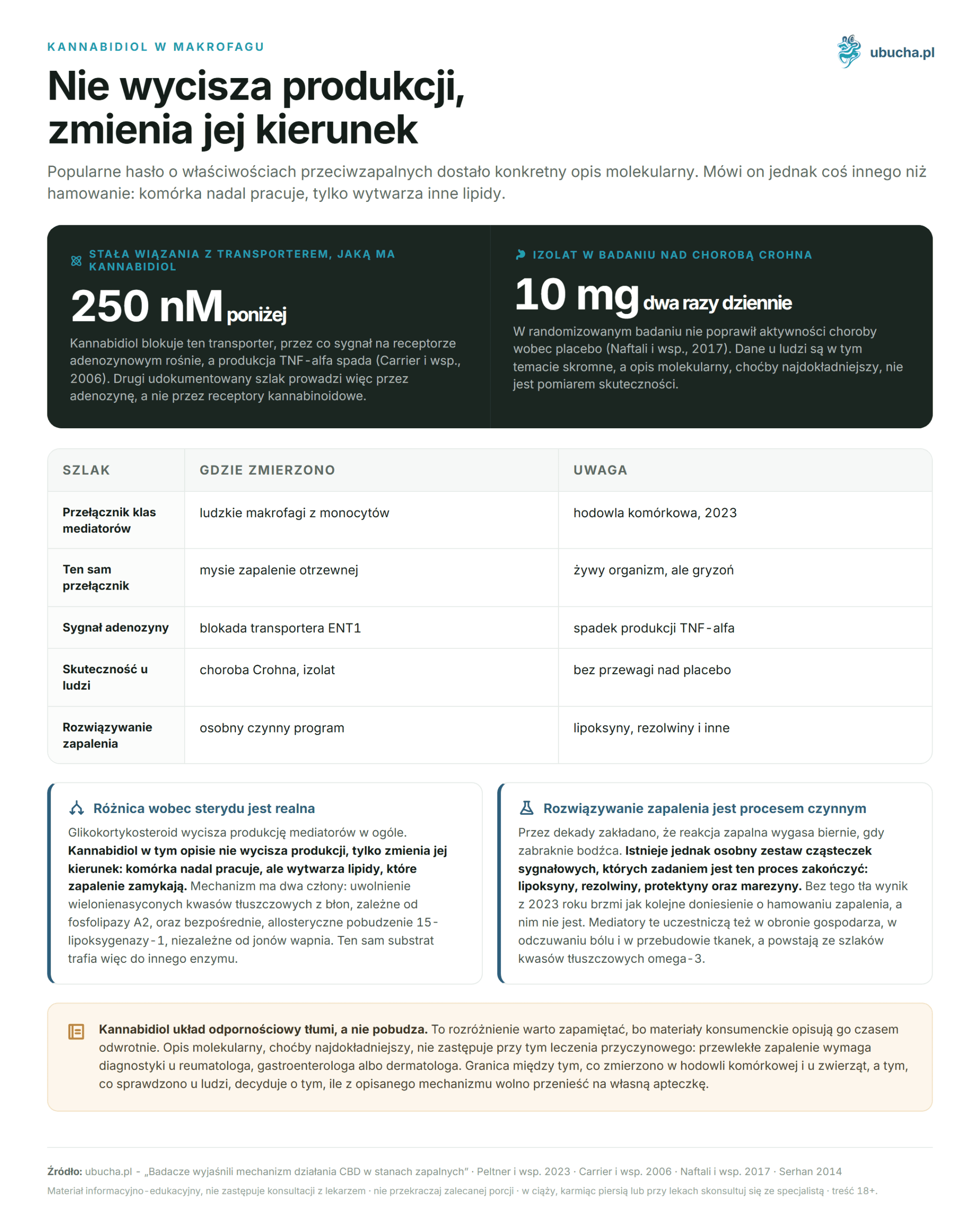
• CBD acts in macrophages as a switch of lipid mediator classes. It inhibits leukotriene production by 5-lipoxygenase and stimulates the formation of mediators that extinguish inflammation through allosteric activation of 15-lipoxygenase-1 (Peltner et al., 2023).
• The second documented pathway goes through adenosine. CBD blocks the ENT1 transporter with a binding constant below 250 nM, which increases the signal at the A2A receptor and decreases TNF-alpha production (Carrier et al., PNAS, 2006).
• Data in humans are scarce. In a randomized study, CBD isolate at a dose of 10 mg twice daily did not improve Crohn’s disease activity compared to placebo (Naftali et al., 2017).
• CBD does not replace causal treatment. Chronic inflammation requires diagnostics by a rheumatologist, gastroenterologist, or dermatologist.
What exactly is the discovery from 2023 about?
The Peltner team described CBD as a factor switching lipid mediator classes in innate immune cells. In human macrophages derived from monocytes, cannabidiol enhanced the production of specialized pro-resolving mediators while simultaneously suppressing leukotriene production dependent on 5-lipoxygenase (Cell Chemical Biology, 2023).
The mechanism has two components. The first is the release of polyunsaturated fatty acids from membranes, dependent on phospholipase A2. The second is the direct, allosteric stimulation of 15-lipoxygenase-1, independent of calcium ions. The same substrate, arachidonic acid, thus goes to another enzyme and produces a different set of signaling lipids.
The authors did not stop at cell culture. In a mouse model of peritonitis induced by zymosan, the administration of CBD raised the levels of pro-resolving mediators and lowered the concentration of pro-inflammatory eicosanoids. This means that the switch also works in a living organism, at least in rodents.
The difference compared to steroids is real. Glucocorticoids suppress the production of mediators altogether. CBD in this description does not suppress production but changes its direction: the cell continues to work but produces lipids that close inflammation. Resolving inflammation is an active process, not just the simple cessation of the stimulus, and I describe it more broadly in the text about lipoxins and resolvins.
What are pro-resolving mediators mentioned in this study?
They are a family of lipids that the body produces to close inflammation. For decades, it was assumed that the inflammatory response ceases passively when the stimulus is removed. Research on resolving acute inflammation has shown something different: there is a separate set of signaling molecules whose task is to conclude this process.
The group includes four families: lipoxins, resolvins, protectins, and maresins, collectively described as specialized pro-resolving mediators. Their synthetic counterparts administered to animals show strong biological activity. They not only induce an anti-inflammatory effect but also a distinct pro-resolving mechanism and enhance the removal of microorganisms (Serhan, 2014).
This same work points out that these mediators are not limited to extinguishing inflammation. They participate in host defense, pain perception, organ protection, and tissue remodeling. They arise from the pathways of essential omega-3 fatty acids, which directly links them to dietary composition.
Why is this background necessary when discussing CBD? Because without it, the result from 2023 sounds like another report on inhibiting inflammation, which it is not. Peltner’s work does not describe the suppression of production but rather its shift towards this very family of lipids. The claim makes sense only when it is known that resolving inflammation is a separate, active biological program that may not be activated.
Does CBD stimulate or suppress the immune system?
It suppresses. This distinction is worth remembering because consumer materials often describe cannabidiol as an immune-boosting agent, while the review of immunological literature says otherwise. The authors of the summary of studies on the immune response regulated by CBD state that the data predominantly indicate immunosuppressive action (Nichols and Kaplan, 2020).
The indicated mechanisms are three. The first is direct inhibition of the activation of various types of immune cells. The second is inducing apoptosis, or programmed cell death of those cells. The third is increasing the pool of regulatory cells, which then control the remaining populations.
This same review contains a caveat important for the entire text. The authors write that the receptor responsible for CBD’s action in the immune system, if there is indeed one such receptor, has not yet been unequivocally identified. All the pathways described above are therefore partial pathways, not a complete explanation.
The practical conclusion is twofold. In diseases with excessive immune system activity, such as autoimmune diseases, the suppressive action is desirable. In a person with reduced immunity or during an infection, the same property ceases to be an advantage. This is one of the reasons why supplementation during immunosuppressive treatment requires a conversation with a doctor, not a self-made decision.
Why is it difficult to describe the mechanism of CBD action in one sentence?
Because cannabidiol does not have a single target. Classic anti-inflammatory drugs target a single enzyme or protein: ibuprofen inhibits cyclooxygenases, adalimumab neutralizes TNF-alpha, tofacitinib blocks JAK kinases. CBD, on the other hand, shifts the balance in several systems at once, and the strength of each of these interactions is moderate.
A review of the pharmacology of smaller cannabinoids organizes this list. Compounds from cannabis act as agonists and antagonists at CB1 and CB2 receptors, on TRP family channels, on peroxisome proliferator-activated receptors, and on the serotonin receptor 5-HT1A (Walsh et al., 2021). The simultaneous activation of many pathways explains the wide spectrum of observed effects.
This same feature complicates research. If a substance acts weakly in ten places, the result depends on which system dominates in a given model. Two laboratories may obtain divergent results, even though both worked correctly.
The consequence for the reader is practical. Expecting CBD to block interleukin 6 like tocilizumab ends in disappointment. Treating it as a modulator that restores the cell’s ability to self-regulate fits the data better. Reviews of the antioxidant and anti-inflammatory properties of cannabidiol describe it precisely in this second role (Atalay et al., 2019).
What is the difference between acute and chronic inflammation?
Acute inflammation is a response to an injury or infection that lasts a few days and resolves on its own. Macrophages first produce pro-inflammatory cytokines, then change phenotype and repair tissue. Chronic inflammation occurs when this cycle gets stuck in the first phase and does not transition to the second.
A perspective published in Nature Medicine describes this state as systemic chronic inflammation. The authors link it to diseases that account for the largest share of disability and mortality worldwide: cardiovascular disease, cancer, diabetes, chronic kidney disease, fatty liver disease, and autoimmune and neurodegenerative disorders (Furman et al., 2019).
The factors that sustain this state are largely behavioral. The work lists chronic infections, lack of exercise, poor diet, exposure to environmental and industrial pollutants, and psychological stress. None of these act dramatically on a weekly scale; all act on a decadal scale.
For assessing a supplement, this has specific significance. Since the problem is an unresolved process, not a single excess signal, a substance supporting resolution makes theoretical sense. However, this does not mean it will replace the removal of the cause. More about how this looks in specific disease entities can be found in the review of studies on CBD in autoimmune diseases.
How does CBD act on the nuclear receptor PPAR gamma?
PPAR gamma is a transcription factor in the cell nucleus that regulates lipid metabolism and the course of the inflammatory response. It is already a therapeutic target: thiazolidinediones used in type 2 diabetes act through this same receptor. The question was whether the anti-inflammatory action of CBD depends on it.
The answer was provided by an experiment with receptor blockade. In rat models of neurotoxicity induced by beta-amyloid, the administration of a PPAR gamma antagonist clearly weakened the effect of cannabidiol on reactive gliosis and subsequent neuronal damage. With the receptor preserved, CBD additionally stimulated neurogenesis in the hippocampus (Esposito et al., 2011).
The design of this experiment is stronger than a simple correlation measurement. The authors did not limit themselves to stating that CBD binds to the receptor. They disabled the receptor and showed that the effect disappears. This distinguishes a real mechanism from a coincidence observed by chance.
It is worth noting the limitation of this result. The model concerned beta-amyloid-induced neuroinflammation in rats, not rheumatic or intestinal diseases in humans. The role of PPAR gamma in other types of inflammation remains a separate issue. A broader description of this receptor has been gathered in a separate text about how CBD acts on PPAR gamma and glucose metabolism.
How does CBD enhance adenosine signaling and the A2A receptor?
Adenosine acts as a safety brake for the immune system. When it binds to the A2A receptor, the immune cell loses its aggressive phenotype. The signal ends when the transporter pulls adenosine back into the cell. CBD does not directly stimulate the A2A receptor; it blocks this transporter.
The measurements are precise. Cannabidiol binds to the ENT1 nucleoside transporter with an inhibition constant below 250 nM and reduces adenosine uptake in mouse microglia and in RAW264.7 macrophages. In mice treated with lipopolysaccharide, a low dose of CBD reduced TNF-alpha production, and this effect was abolished by the A2A receptor antagonist and completely disappeared in animals lacking this receptor (Carrier et al., PNAS, 2006).
Evidence with double validation, pharmacological and genetic, is a rare value here. Most reports on cannabinoid mechanisms rely solely on concentration correlations.
This pathway also appears in neuroinflammation. In a viral model of multiple sclerosis in mice, CBD limited the passage of leukocytes across the blood-brain barrier, reduced the expression of the adhesion molecule VCAM-1 and interleukin 1 beta, and suppressed microglial activation. The A2A receptor antagonist blocked these effects only partially, indicating that adenosine is one of the pathways, not the only one (Mecha et al., 2013). I describe this thread separately in the text about inhibiting adenosine uptake.
What does CBD do to the intestinal barrier and inflammatory bowel disease?
The intestine is the largest immune organ in the body, and its permeability determines how many inflammatory stimuli enter the bloodstream. Tight junction proteins, such as zonula occludens and occludin, bind epithelial cells. In inflammatory bowel disease, their function weakens.
Studies on the human intestinal epithelial cell line Caco-2 have shown that cannabinoids affect inflammation-induced permeability, with individual compounds acting in opposite directions (Alhamoruni et al., 2012). This is an important caveat: not all cannabinoids seal the barrier, so the composition of the preparation matters.
Data in humans vary depending on what was administered. In a prospective placebo-controlled study of 21 patients with active Crohn’s disease, cigarettes with THC-rich flower gave a clinical response, defined as a decrease in the CDAI score by over 100 points, in 10 out of 11 patients compared to 4 out of 10 in the placebo group. The primary endpoint, full remission, was not achieved (Naftali et al., 2013).
This same team then checked the CBD isolate itself. Twenty patients received 10 mg of CBD twice daily for 8 weeks. The preparation was found to be safe, but the disease activity index decreased similarly in both the treatment and placebo groups (Naftali et al., 2017). The authors themselves pointed out two possible reasons: too low a dose or lack of interaction with other cannabinoids.
What is the difference between the anti-inflammatory action of CBD and THC?
The starting point is the affinity for receptors. Tetrahydrocannabinol binds directly to CB1 and CB2 receptors, with the former being responsible for the psychoactive effect. Cannabidiol binds both weakly and exerts most of its effects outside of them, through TRP channels, nuclear receptors, and the adenosine system.
The CB2 receptor is the one that interests immunologists because it is mainly found on immune cells, and its stimulation does not produce a psychoactive effect. Evidence that access to it does not require THC at all is beta-caryophyllene: a common terpene from black pepper that has proven to be a selective agonist of this receptor (Gertsch et al., PNAS, 2008).
A comparison of two studies from the same team shows that the difference has clinical consequences. THC-rich flower gave a clinical response in patients with Crohn’s disease, while the CBD isolate at a low dose did not yield any. The authors of the second study pointed to the lack of interaction with other cannabinoids as one possible explanation.
This does not mean that THC is better. It means that CBD isolate and full-spectrum extract are two different pharmacological products that should not be treated interchangeably when reading studies. The result obtained for one does not transfer to the other, and most press reports blur this boundary.
What data exist for rheumatoid arthritis?
The animal model performs significantly better here than clinical studies. In collagen-induced arthritis in mice, the administration of CBD after the onset of symptoms effectively halted disease progression, both with intraperitoneal and oral administration.
The dose-dependence had a bell shape, which is important for anyone considering increasing the dose. The best effect occurred at 5 mg/kg per day intraperitoneally and 25 mg/kg per day orally, and above these values, the effect weakened. Clinical improvement was accompanied by protection of joints from severe damage and a decrease in TNF secretion by synovial membrane cells (Malfait et al., PNAS, 2000).
In humans, the material is much more limited. A preliminary assessment of a preparation containing CBD and THC for pain associated with rheumatoid arthritis involved a small group and lasted five weeks. The authors described it directly as a preliminary study and called for larger trials (Blake et al., Rheumatology, 2006).
The practical conclusion is cautious. Animal models show an effect on the disease process itself, while studies in humans so far focus more on symptoms. The gap between these two levels of evidence is large in rheumatology, and no available data close it.
Which receptors outside the endocannabinoid system respond to CBD?
A systematic comparison of eleven pure cannabinoids and plant extracts on TRP channels and enzymes of the endocannabinoid system provided a picture that cannot be summarized in one sentence but can be tabulated. The following results come from one study, so they are measured using the same method.
| Molecular Target | CBD Action | Significance |
|---|---|---|
| TRPV1 | stimulates, then desensitizes | pain and heat perception |
| TRPA1 | strong agonist and desensitizing factor | oxidative stress sensor |
| TRPV2 | stimulates and desensitizes | macrophage functions |
| FAAH | the only studied compound that inhibits it | breakdown of anandamide |
| GPR55 | antagonist | osteoclast activity |
| 5-HT1A | agonistic properties | anxiety, mood, neuroimmunology |
Data on TRP channels and FAAH inhibition come from the work of De Petrocellis and colleagues (British Journal of Pharmacology, 2011). The role of GPR55 comes from a study in which CBD acted as an antagonist of this receptor, and its administration to mice significantly reduced bone resorption (Whyte et al., PNAS, 2009). Agonistic properties towards the 5-HT1A receptor were previously described by Russo (Neurochemical Research, 2005).
Desensitization of the channel deserves a separate sentence because it is often misunderstood. Stimulation of TRPV1 first generates a signal and only then silences it, just like capsaicin in warming ointments. The analgesic effect is therefore a consequence of stimulation, not blockade.
Do CBG and terpenes enhance the anti-inflammatory action?
The concept of the entourage effect suggests that the full set of compounds from the plant acts differently than a single isolate. Russo has gathered arguments for this approach, pointing to the interaction of cannabinoids and terpenoids as a basis for cultivating strains with a planned composition (Frontiers in Plant Science, 2019).
The strongest single evidence concerns beta-caryophyllene. This terpene is found in black pepper and oregano and has proven to be a selective agonist of the CB2 receptor, which is responsible for the immune response without psychoactive effects. The authors called it the first documented dietary cannabinoid (Gertsch et al., PNAS, 2008).
Cannabigerol has its own data from the intestinal model. In a mouse model of colitis induced by dinitrobenzenesulfonic acid, CBG reduced inflammation indices, decreased myeloperoxidase activity and expression of inducible nitric oxide synthase, and normalized disturbed levels of interleukin 1 beta and interleukin 10 (Borrelli et al., 2013). The authors concluded that the compound deserves clinical trials.
However, two things need to be separated. It has been shown that individual accompanying compounds have their own pharmacological activity. However, it has not been demonstrated in human studies how much the mixture exceeds the isolate. The numbers circulating in marketing materials have no basis in published clinical measurements.
What are the real limitations of this data?
The first limitation concerns absorption. In a pharmacokinetic study in adults with drug-resistant epilepsy, the same capsule administered after a high-fat meal of 840 to 860 kilocalories resulted in an average fourteen-fold higher maximum concentration and a four-fold greater total exposure than when taken on an empty stomach (Birnbaum et al., Epilepsia, 2019). The study involved eight patients, so the precision of the estimate is limited, but the direction is beyond doubt.
The second concerns doses. In a registration study in Dravet syndrome, 20 mg per kilogram of body weight per day was used, which is about 1400 mg per day for an adult (Devinsky et al., NEJM, 2017). Over-the-counter supplements provide doses two orders of magnitude lower. Transferring conclusions from one level to another is not justified.
The third limitation is interactions. Cannabidiol affects liver enzymes that metabolize drugs, which is significant for preparations with a narrow therapeutic window. The product information for medicinal products registered in the European Union also lists increased aminotransferase activity as a dose-dependent effect (EMA, Epidyolex documentation).
The fourth is methodological. Most of the mechanisms described above were measured in cell cultures or in rodents. There are practically no randomized studies that would measure the same biochemical indicators in humans after supplementation. This does not mean that the mechanism is false. It means that its translation into health outcomes remains unestablished.
How to read the label of hemp oil?
Start with the type of extract. An isolate is pure cannabidiol. Broad spectrum additionally contains other cannabinoids and terpenes but no THC. Full spectrum retains trace amounts of THC, within the norm for industrial hemp.
The Polish threshold requires precision because it is sometimes reported incorrectly. The sum of the content of delta-9-THC and tetrahydrocannabinolic acid in the flowering or fruiting tops of plants from which resin has not been removed must not exceed 0.3 percent when calculated on a dry mass basis, and the result is rounded to one decimal place. The basis is Article 4 point 5 of the Act of July 29, 2005 on counteracting drug addiction as amended by the Act of March 24, 2022 (Journal of Laws 2022 item 763). The national threshold corresponds to the EU threshold, but it does not follow from it: these are two separate regulations of the same value.
The value calculated as a sum, not just as delta-9-THC alone, changes the result of the laboratory test. A preparation that is within the norm when measuring THC alone may exceed it when the acidic form is added.
Next, check the analysis report from an independent laboratory for a specific batch. You are interested in the compliance of the declared cannabidiol content with the measurement and the absence of pesticide and heavy metal residues. If you are looking for products with such a report, check the category of hemp oils.
Who should not use CBD?
Pregnant and breastfeeding women are the first group. The American Food and Drug Administration recommends that they avoid cannabis and cannabidiol, citing insufficient safety data for the fetus and the transfer of cannabinoids into milk (FDA).
The second group is patients taking drugs with a narrow therapeutic index. With anticoagulants, immunosuppressants, or antiepileptics, changes in liver metabolism directly affect the concentration of the drug in the blood. The decision to add cannabidiol is made by the attending physician, not the supplement seller.
The third group includes individuals with liver disease. The increase in aminotransferase activity described in the registration documentation concerned therapeutic doses, but with existing organ damage, the safety margin is narrower.
The fourth group is minors. Outside of registered neurological indications, the use of cannabidiol in children without medical supervision is not justified, as the developing nervous system reacts to psychoactive substances differently than a mature one.
Finally, a note about legal status, as it can be confused. Cannabidiol does not appear in Polish lists of controlled substances. Hexahydrocannabinol, or HHC, is sometimes sold as a related product and is a controlled substance in Poland. These are two different molecules with different statuses, so the name on the label has legal significance, not just marketing significance.
Frequently Asked Questions
Is CBD more effective than ibuprofen in inflammatory states?
They cannot be directly compared because they work differently. Ibuprofen inhibits cyclooxygenases and provides a quick, strong effect in acute pain. Cannabidiol has a weak effect on many targets at once, including TRP channels and the PPAR gamma receptor. Clinical evidence for chronic inflammation remains preliminary.
How long after starting CBD can one expect an effect?
Clinical studies in inflammatory bowel diseases were conducted over an eight-week scheme, and only after that time was disease activity assessed. Effects related to sleep may be reported earlier, but they are subjective. Shorter observation does not allow for a conclusion about whether the preparation affects the inflammatory process itself.
Can CBD replace biological drugs in RA or psoriasis?
No. Biological drugs have documented efficacy in large registration studies, and there is no such data for cannabidiol. Available human trials involved small groups and mainly assessed pain and sleep quality, not disease activity. Any change in treatment is always determined by the attending physician.
Does a meal affect the absorption of CBD?
Yes, and very significantly. In a study of adults with drug-resistant epilepsy, the same capsule after a high-fat meal resulted in a fourteen-fold higher maximum concentration and a four-fold greater total exposure than when taken on an empty stomach. Taking the preparation once with food and once without gives incomparable results.
Does full spectrum work stronger than isolate?
Preclinical data indicate that accompanying compounds have their own activity: beta-caryophyllene stimulates the CB2 receptor, and cannabigerol alleviated colitis in mice. However, studies in humans have not measured how much the mixture exceeds the isolate. Percentage promises from marketing materials have no basis in such measurements.
Can CBD be combined with anti-inflammatory drugs?
There are no absolute contraindications at standard doses, but cannabidiol affects the hepatic metabolism of many drugs. With chronic use of both groups, it is reasonable to periodically check liver function tests. For drugs with a narrow therapeutic window, the decision is made by the physician.
This article is for informational and educational purposes and does not constitute medical advice. Before starting to use cannabis or CBD for therapeutic purposes, consult a doctor, especially if you are taking other medications, are pregnant, or breastfeeding.
Author: Michał Waluk · Published: 2026-05-04 · Updated: 2026-08-10