
Vitamin E Acetate and the EVALI Crisis: What Should Never Be in a Vaporizer Cartridge
How many cases and deaths there were, what the bronchoalveolar lavage fluid study showed, and why the CDC speaks of a strong correlation rather than a proven cause.
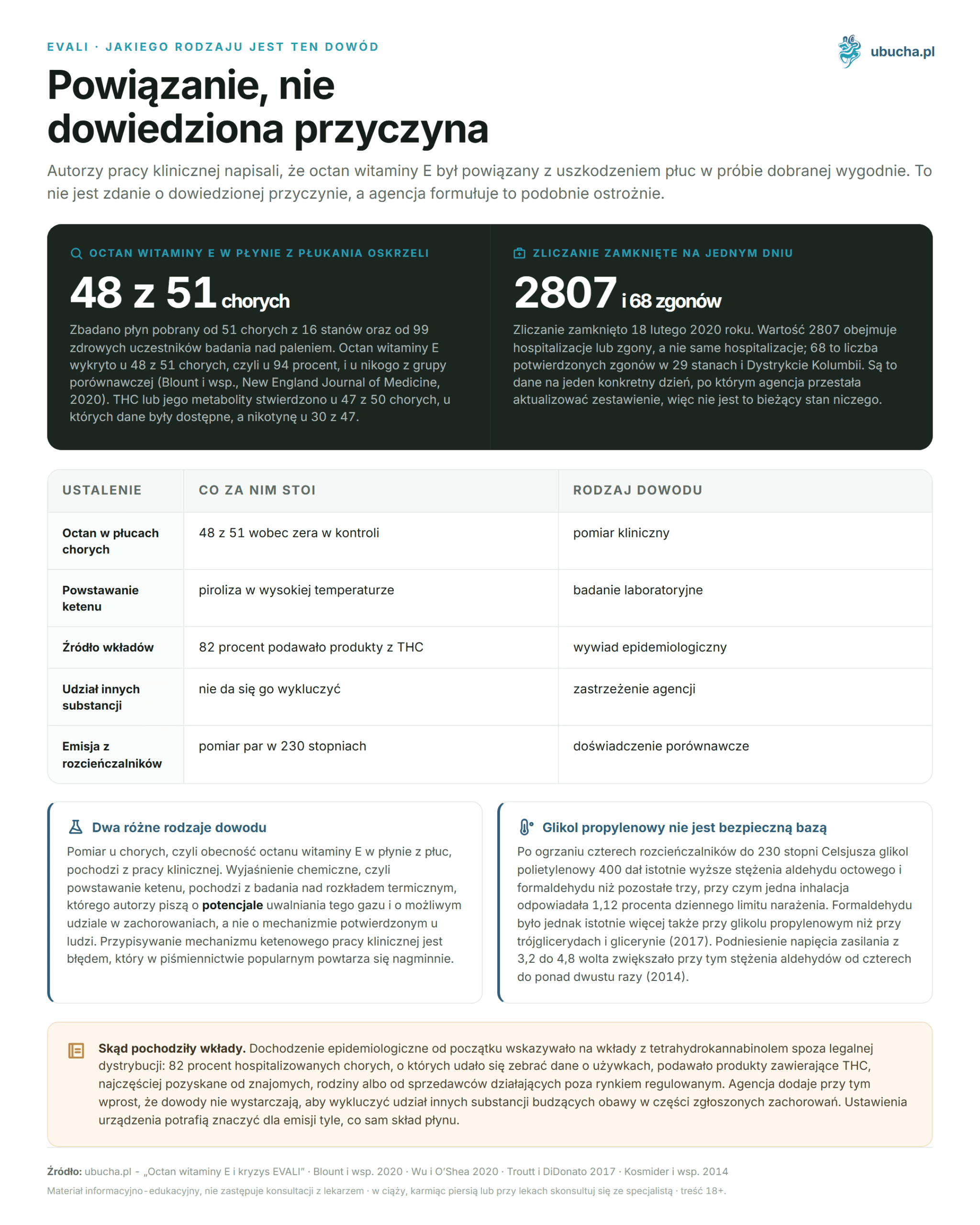
In the summer of 2019, people began to be hospitalized in the United States with severe lung damage after using vaporizers. The American Centers for Disease Control and Prevention named this disease EVALI, and as of February 18, 2020, reported 2807 hospitalizations or deaths and 68 deaths in 29 states and the District of Columbia (CDC, data closed February 18, 2020). Suspicion fell on vitamin E acetate, a cheap and colorless thickening additive used to dilute illegal THC cartridges. This story has been surrounded by repeated shortcuts: that the cause has been proven, that vaporization itself is to blame, and that other diluents are safe. This text shows what exactly has been demonstrated, on what sample, and with what caveat, and what conclusions cannot be drawn from these findings.
KEY INFORMATION
• The CDC closed the count on February 18, 2020, at 2807 hospitalizations or deaths and 68 deaths.
• Vitamin E acetate was detected in the bronchoalveolar lavage fluid of 48 out of 51 patients, or 94 percent, and in none of the comparison group.
• The authors of this work speak of a correlation in a conveniently selected sample, not of a proven cause; the CDC uses words about a strong correlation.
• 82 percent of hospitalized patients for whom substance use data was collected reported using products containing THC, most often from informal sources.
• The CDC notes that it is not possible to rule out the involvement of other substances in some cases of illness.
What was the EVALI crisis and how many people were affected?
EVALI is an acronym for the English name of lung damage associated with the use of e-cigarettes or vaping products. Cases began to be systematically counted in August 2019, when there was a sudden increase in hospital admissions for severe pneumonia among people using such devices in several states at once. The counting was closed on February 18, 2020.
It is important to read these two numbers exactly as reported by the CDC, as they circulate in a distorted form. The value of 2807 includes hospitalizations or deaths, not just hospitalizations, while 68 is the number of confirmed deaths in 29 states and the District of Columbia. These are data for one specific day, after which the agency stopped updating the count, so it is not a current state of anything.
The clinical picture corresponded to lung tissue damage from inhaling fatty substances. The epidemiological investigation from the beginning pointed to tetrahydrocannabinol cartridges from outside legal distribution: 82 percent of hospitalized patients for whom substance use data was collected reported using products containing THC, most often obtained from friends, family, or from sellers operating outside the regulated market.
What exactly did the bronchoalveolar lavage fluid study show?
The work on which this entire story is based examined bronchoalveolar lavage fluid taken from 51 EVALI patients from 16 states and from 99 healthy participants in a smoking study conducted since 2015, among whom were non-smokers, exclusive e-cigarette users, and exclusive cigarette smokers. Vitamin E acetate was detected in 48 out of 51 patients, or 94 percent, and in none of the comparison group (Blount et al., New England Journal of Medicine, 2020).
Equally important is what was not found. Among the other priority substances tested, namely plant oils, medium-chain triglyceride oil, coconut oil, petroleum distillates, and thinning terpenes, nothing was detected in patients except for coconut oil and limonene, in one case each. THC or its metabolites were found or reported from interviews in 47 out of 50 patients for whom data were available, and nicotine in 30 out of 47.
The wording of the conclusion matters here and differs from what is repeated on the internet. The authors wrote that vitamin E acetate was associated with EVALI in a conveniently selected sample, involving 51 patients. This is not a statement about a proven cause. The CDC formulates it similarly cautiously, speaking of a strong correlation and adding directly that the evidence is insufficient to rule out the involvement of other concerning substances in some reported cases of illness. The study was funded by the National Cancer Institute and other public institutions.
Why would vitamin E acetate be harmful when inhaled?
Vitamin E acetate taken orally or applied to the skin is a well-known substance considered safe. The hypothesis explaining its harmfulness when inhaled concerns what happens to it at high temperatures inside the device, not the molecule itself.
A study combining analysis, theoretical calculations, and experimentation showed that the pyrolysis of vitamin E acetate during vaporization has the potential to release ketene, a gas with high pulmonary toxicity, along with carcinogenic alkenes and benzene (Wu and O’Shea, PNAS, 2020). The authors speak of potential and possible involvement in illnesses, not of a mechanism confirmed in humans, and this sentence should be read as such.
It is necessary to separate two things that blend together in popular descriptions. The measurement in patients, i.e., the presence of vitamin E acetate in lung fluid, comes from clinical work. The chemical explanation, i.e., the formation of ketene, comes from a laboratory study on thermal decomposition. These are two different types of evidence, and attributing the ketene mechanism to clinical work is a mistake that is frequently repeated in popular literature. The temperature at which devices operate can be comparable to the conditions of pyrolytic apparatus, which the authors cite as a reason why such reactions are even possible.
What other diluents have been studied for toxicity?
Vitamin E acetate is not the only substance added to oils intended for vaporization and is not the only one that has been studied. In a comparative experiment, four diluents used in the cannabis industry were heated to 230 degrees Celsius: propylene glycol, vegetable glycerin, polyethylene glycol 400, and medium-chain triglycerides, and the resulting vapors were analyzed for acetic aldehyde, acrolein, and formaldehyde (Troutt and DiDonato, Journal of Alternative and Complementary Medicine, 2017).
The result is less convenient than popular summaries suggest. Polyethylene glycol 400 produced significantly higher concentrations of acetic aldehyde and formaldehyde than the other three substances at 230 degrees, and one inhalation corresponded to 1.12 percent of the daily exposure limit, roughly equivalent to the exposure from one cigarette. However, formaldehyde was also significantly higher with propylene glycol than with triglycerides and glycerin, and propylene glycol is, along with glycerin, the most commonly used solvent in e-cigarettes. Therefore, it cannot be fairly stated that propylene glycol is a safe base and that the problem lies solely with polyethylene glycol.
Separately, the impact of the device itself was measured. In a study of vapors from ten commercial nicotine solutions and three control solutions, increasing the power supply voltage from 3.2 to 4.8 volts increased the concentrations of formaldehyde, acetic aldehyde, and acetone from four to over two hundred times, with the highest values coming from propylene glycol-based solutions (Kosmider et al., Nicotine and Tobacco Research, 2014). Device settings can therefore be as significant for emissions as the composition of the liquid itself.
| Substance | What was measured | Source of measurement |
|---|---|---|
| Vitamin E Acetate | Present in lung fluid of 48 out of 51 EVALI patients and in none of 99 people from the comparison group | Blount et al., 2020 |
| Vitamin E Acetate (pyrolysis) | Potential for releasing ketene and alkenes and benzene during thermal decomposition | Wu and O’Shea, 2020 |
| Polyethylene Glycol 400 | Highest concentrations of formaldehyde and acetic aldehyde among the four tested diluents at 230 degrees | Troutt and DiDonato, 2017 |
| Propylene Glycol | Significantly more formaldehyde than with glycerin and triglycerides; highest carbonyls in vapor study | Troutt and DiDonato, 2017; Kosmider et al., 2014 |
| Medium-Chain Triglycerides and Glycerin | Lowest concentrations of formaldehyde and acetic aldehyde among the four diluents; no differences found with acrolein | Troutt and DiDonato, 2017 |
Does EVALI imply that vaporization as such is dangerous?
Such a conclusion cannot be drawn from these studies, and it is worth stating this clearly, as extending the finding about one additive to the entire category of devices is the most common abuse in this topic. The finding concerned a specific substance added to a specific type of product, namely oil cartridges with THC purchased outside legal distribution, in a specific country and during a specific period.
This does not mean that the matter is closed in the other direction. The CDC noted that the evidence does not allow for ruling out the involvement of other substances, both in THC products and those without, in some cases of illness. There is also the question of long-term effects, which none of the described studies address, as all concerned acute episodes or measurements of emissions in the laboratory.
For readers in Poland, there is one more difference that is important. This entire story concerns oil cartridges, in which a diluent is needed at all. Dry herb devices heat plant material and contain no oil base, so the question of diluents simply does not arise; how vaporization compares to other methods of administration is described in the comparison of bongs, vaporizers, and joints, and practical temperature issues have been gathered in the text about herb vaporization.
What to look for in the documentation of an inhalation product?
The document that resolves anything is the certificate of analysis relating to a specific batch. The cannabinoid profile alone does not answer the question of this article, as vitamin E acetate, polyethylene glycol, and oils are not cannabinoids and will not appear in such testing. Therefore, the scope of the panel matters, not just the presence of the document.
Three things can be checked without specialist knowledge, and each of them directly results from the studies described above. First, whether the certificate includes solvents and diluents, i.e., the group in which the substances from this text sit. Second, whether the manufacturer provides the full composition of the base, not just the cannabinoid content, because without this, it is unknown what is being heated. Third, whether the batch number on the document matches the number on the packaging, as a certificate issued for an entire product line says nothing about a specific item. The same principle applies to other groups of contaminants, which we discuss in more detail in the article on heavy metals in CBD products.
Frequently Asked Questions
What is EVALI and how many cases were there?
It is lung damage associated with the use of e-cigarettes or vaping products, counted in the United States since August 2019. As of February 18, 2020, the CDC reported 2807 hospitalizations or deaths and 68 confirmed deaths in 29 states and the District of Columbia. After this date, the agency stopped updating the count.
Has it been proven that vitamin E acetate causes EVALI?
Not in that wording. It was detected in the lung fluid of 48 out of 51 patients and in none of the comparison group, but the authors speak of a correlation in a conveniently selected sample, while the CDC speaks of a strong correlation. The agency adds that the evidence is insufficient to rule out the involvement of other substances in some cases of illness.
Where did the idea come from that vitamin E acetate breaks down to ketene?
From a separate laboratory study on the thermal decomposition of this substance, which showed the potential for releasing ketene and alkenes and benzene during vaporization. This is a chemical explanation, not a mechanism confirmed in patients, and comes from a different work than the measurement of lung fluid.
Is propylene glycol a safe base?
Research does not allow for that statement. When heated to 230 degrees, polyethylene glycol 400 produced the highest concentrations of formaldehyde, but propylene glycol produced significantly more than glycerin and triglycerides. In another study, the highest concentrations of carbonyls came from propylene glycol-based solutions, and increasing the power supply voltage increased them many times over.
Do dry herb devices bypass this problem?
In terms of diluents, yes, because they heat plant material and do not contain an oil base, so the question of adding oil does not arise at all. This does not mean that emissions from such a device are zero, as temperature affects the composition of vapors regardless of what is being heated.
What should a certificate of analysis for a vaporizer cartridge include?
A panel of solvents and diluents, not just the cannabinoid profile, because the substances described in this article are not cannabinoids and will not be revealed in cannabinoid testing. Additionally, the full composition of the base and a batch number matching the number on the packaging.
If you are interested in dry herb equipment, where the question of diluents does not arise, check out the vaporizers category.
This article is for informational and educational purposes only and does not constitute medical advice. Before starting to use cannabis or CBD for therapeutic purposes, consult your doctor, especially if you are taking other medications, are pregnant, or are breastfeeding.
Author: Michał Waluk · Published: 2026-08-09 · Updated: 2026-08-16